
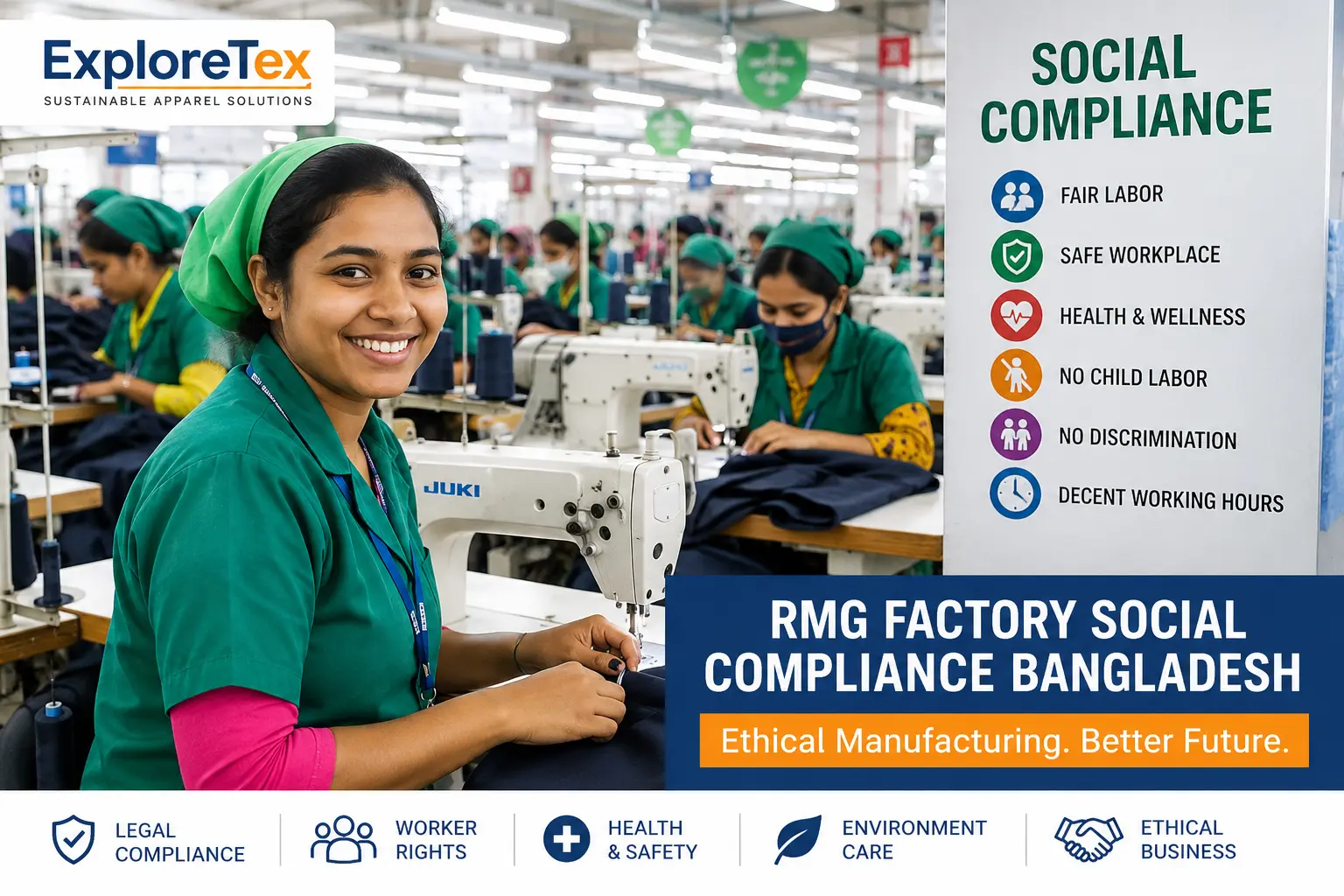
RMG Factory Social Compliance Bangladesh: The Complete 2026 Strategy for Global Brands
The Modern Sourcing Paradigm
The global fashion landscape is undergoing a structural transformation. International fashion brands, retail networks, and corporate purchasers no longer evaluate textile production partners solely on the basis of per-unit margins or lead times. The contemporary consumer, backed by stringent national and international regulatory frameworks, demands absolute supply chain accountability. At the heart of this operational shift is the necessity for an optimized rmg factory social compliance bangladesh framework.
For years, procurement teams treated ethical manufacturing as a peripheral corporate social responsibility (CSR) metric. Today, it represents a foundational risk management objective. Non-compliance leads directly to catastrophic brand dilution, severe customs penalties, and legal liability under emerging European due diligence laws.
As a premium, European-managed manufacturing partner, ExploreTex bridges the gap between commercial viability and ethical rigor. By operating our own vertical manufacturing infrastructure in South Asia alongside partner facilities in Europe, we provide global brands with a secure, ethically auditable production hub. This comprehensive guide details the structural parameters of an authentic rmg factory social compliance bangladesh strategy, outlining the practical, technical, and regulatory protocols required to execute transparent garment production at scale.
Introduction: The New Era of Ethical Apparel Manufacturing
In the highly competitive world of global fashion, scaling a private label or retail brand requires more than just innovative design—it requires a radically transparent and robust supply chain. For European and North American brands seeking cost-effective, high-volume production, mastering rmg factory social compliance bangladesh is no longer merely a corporate social responsibility (CSR) bullet point; it is a rigid legal and commercial mandate.
As we navigate 2026, consumer demands, European Union directives on supply chain due diligence, and global customs regulations have fundamentally shifted the landscape. Brands can no longer afford to partner with unverified facilities. This is where the intersection of European oversight and Asian manufacturing power becomes critical.
ExploreTex, a leading premier clothing manufacturer bridging European standards with global scale, operates a sophisticated Dual-Hub Production Model. By maintaining our headquarters and design offices in Lisbon, Portugal, while directly operating high-capacity manufacturing facilities in Dhaka, Bangladesh, we eliminate the traditional risks of offshoring. We ensure that our definition of rmg factory social compliance bangladesh exceeds international minimums, providing our partners with the utmost confidence in their product’s ethical origins.
This comprehensive guide serves as the ultimate pillar resource for understanding the mechanics, audit structures, and operational realities of rmg factory social compliance bangladesh. It is designed to equip fashion brands, sourcing directors, and wholesale buyers with the exact knowledge required to build a compliant, scalable, and profitable apparel brand.
The Core Dimensions of an Authentic RMG Factory Social Compliance Bangladesh Framework
To understand how an effective rmg factory social compliance bangladesh framework functions on the factory floor, one must dissect it into clear operational components. True social compliance cannot be achieved via a superficial paper trail or a single pre-scheduled annual check. It requires continuous oversight of several interdependent operational areas.
+-----------------------------------------------------------------------+
|              RMG FACTORY SOCIAL COMPLIANCE BANGLADESH                 |
+-----------------------------------------------------------------------+
        |                        |                       |
        v                        v                       v
 [Structural Safety]     [Labor & Human Rights]  [Environmental Integration]
  - Structural Integrity  - Living Wage Equity    - Chemical Management (ZDHC)
  - Fire Protection       - Working Hours Cap     - Effluent Treatment (ETP)
  - Electrical Audits     - Collective Bargaining - Renewable Integration
1. Structural, Fire, and Electrical Safety
The foundational tier of any verified rmg factory social compliance bangladesh protocol is the physical safety of the manufacturing plant. Following historic industry overhauls, factory buildings must undergo strict engineering assessments.
Structural Integrity: Verifying structural load calculations against the weight of heavy industrial knitting, cutting, and laundry machinery.
Fire Protection Systems: Installation of certified fire doors, integrated smoke detection arrays, automatic sprinkler networks, and unobstructed, clearly marked escape routes.
Electrical Infrastructure: Regular thermal scanning of electrical panels, proper grounding systems, and the elimination of makeshift wiring loops to eliminate fire hazards.
2. Fair Labor Standards and Human Rights Protection
Human capital remains the most critical component of the apparel manufacturing ecosystem. A compliant facility ensures that personnel are protected by international labor standards, specifically those endorsed by the International Labour Organization (ILO).
Abolition of Forced and Child Labor: Implementing rigorous, biometric-backed age verification protocols during recruitment.
Fair Compensation: Adherence to or exceeding national minimum wage standards, combined with transparent overtime calculation models and timely electronic wage transfers.
Regulated Working Hours: Strict enforcement of statutory maximum shifts (typically capped at 48 hours per week plus a maximum of 12 hours of overtime), ensuring mandatory weekly rest days.
Freedom of Association: Providing secure, non-retaliatory mechanisms for worker representation, such as safety committees and independent participation in trade unions.
3. Occupational Health and Safety (OHS) Systems
Beyond catastrophic incident prevention, a high-performing rmg factory social compliance bangladesh initiative focuses on daily physiological well-being on the production floor.
Ergonomic Workstations: Providing properly configured seating and anti-fatigue matting for sewing machine operators and quality control inspectors.
Personal Protective Equipment (PPE): Enforcing the consistent use of steel-mesh gloves in cutting rooms, particulate masks in fabric-shaving zones, and chemical-resistant gear in laundry and dyeing areas.
Ambient Control: Continuous monitoring of indoor air quality, humidity levels, ambient temperature, and noise decibels to ensure an optimal work environment.
4. Environmental Responsibility and Chemical Integrity
Modern social compliance is deeply linked with environmental impact. A facility cannot claim social responsibility if it pollutes local communities’ natural resources.
Effluent Treatment Plants (ETP): Operating continuous, automated biological or chemical ETPs to neutralize wastewater before discharge.
Zero Discharge of Hazardous Chemicals (ZDHC): Ensuring that all dyes, fixatives, and processing chemicals comply with global safety standards, excluding carcinogens and heavy metals from production.
Section 1: The Evolution of RMG Factory Social Compliance Bangladesh
To fully grasp the current state of rmg factory social compliance bangladesh, one must understand its historical evolution. The Ready-Made Garment (RMG) sector in Bangladesh is an economic powerhouse, being one of the largest apparel exporters globally. However, the industry underwent a massive paradigm shift over the last decade, transitioning from fragmented, poorly regulated operations to one of the most rigorously inspected textile sectors in the world.
1.1 The Transition to the RMG Sustainability Council (RSC)
Following historical industrial tragedies, global brands formed coalitions to enforce structural, electrical, and fire safety. Today, the RMG Sustainability Council (RSC) oversees these critical safety components. When evaluating rmg factory social compliance bangladesh, RSC certification and active remediation tracking are non-negotiable baselines. Compliance today means continuous monitoring, not just a one-time structural assessment.
1.2 European Supply Chain Directives
The EU Corporate Sustainability Due Diligence Directive (CSDDD) requires companies to identify, prevent, and mitigate adverse human rights and environmental impacts in their value chains. Because ExploreTex is a Portuguese-based company, our application of rmg factory social compliance bangladesh is entirely synchronized with these strict European legal frameworks. When a brand partners with us, they inherit a supply chain that is already pre-calibrated to satisfy rigorous EU import inspections.
1.3 The Direct Operation Advantage
Many brands fail in their compliance efforts because they rely on third-party sourcing agents who secretly sub-contract orders to unapproved, non-compliant factories—a practice known as unauthorized subcontracting. ExploreTex prevents this entirely. Through our ethical and sustainable manufacturing infrastructure, we maintain direct equity and operational control over our Bangladesh facility. We do not farm out your tech packs to the lowest bidder; we produce them in our own strictly controlled, impeccably clean environment.
The Evolving Regulatory Architecture of Global Sourcing
The metrics governing an rmg factory social compliance bangladesh strategy are shaped by complex global trade regulations. Understanding these structural frameworks is vital for international apparel buyers.
The Impact of European Due Diligence Directives
The European Union’s Corporate Sustainability Due Diligence Directive (CSDDD) and similar national legislations (such as Germany’s LkSG) have shifted compliance from a voluntary marketing choice to a strict legal obligation. Under these laws, European brands are legally liable for human rights violations and environmental breaches occurring at every tier of their supply chain. This means purchasing from a non-compliant production center can lead to substantial financial penalties and import bans at European ports.
The Role of Independent Auditing Infrastructure
To verify compliance on the ground, the industry relies on standardized third-party certification frameworks. A facility meeting elite sourcing requirements must be regularly appraised by independent bodies under recognized protocols:
| Framework / Certification | Principal Focus Area | Verification Method |
| BSCI (Business Social Compliance Initiative) | Comprehensive labor rights, fair compensation, and working hour restrictions. | Periodic semi-announced audits with worker interviews. |
| Sedex / SMETA | Four-pillar assessment: Labor, Health & Safety, Environment, and Business Ethics. | Detailed desktop records review combined with on-site inspections. |
| RSC (RMG Sustainability Council) | Structural engineering, advanced fire safety installations, and electrical compliance. | Independent engineering teams executing on-site technical testing. |
| OEKO-TEX Standard 100 | Chemical safety and raw material toxicity thresholds in finished garments. | Analytical laboratory testing of components (fabric, thread, zippers). |
When managing apparel production in Bangladesh, navigating these certifications can be challenging for overseas buyers. This highlights the benefit of a hybrid manufacturing model. By using a partner backed by a registered European entity, brands ensure all certifications are legally verifiable under Western commercial laws, eliminating compliance blind spots.
Section 2: Core Pillars of RMG Factory Social Compliance Bangladesh
A truly compliant factory operates on multiple axes. Below is a detailed breakdown of the fundamental pillars that define modern rmg factory social compliance bangladesh.
2.1 Labor Rights and Wage Systems
The cornerstone of rmg factory social compliance bangladesh is fair compensation and the strict prohibition of forced and child labor.
Transparent Payroll: Compliant facilities utilize biometric time-tracking and digital payroll systems to ensure workers are paid accurately for every minute worked, eliminating off-the-books deductions.
Living Wage Transitions: While meeting the legally mandated minimum wage is the baseline, advanced facilities work toward providing living wages. ExploreTex operates under strict European management standards to ensure fair compensation that supports the local workforce.
Voluntary Overtime: Overtime must be entirely voluntary, compensated at premium rates (typically 200% of the standard hourly rate), and capped to prevent worker exhaustion.
2.2 Workplace Health and Safety (WHS)
Physical safety is aggressively audited under rmg factory social compliance bangladesh frameworks.
Fire Safety: Facilities must feature sophisticated, automated fire suppression systems, multiple unobstructed outward-opening fire exits, illuminated emergency routing, and conduct regular, documented evacuation drills.
Structural Integrity: Factories must possess up-to-date load-bearing certifications. At ExploreTex, our directly operated hub ranks among the cleanest and safest facilities in Dhaka.
Chemical Management: Proper handling of dyes and treatments is vital. Workers must be provided with, and trained to use, Personal Protective Equipment (PPE) such as masks, gloves, and eye protection.
2.3 Freedom of Association and Grievance Mechanisms
A key indicator of authentic rmg factory social compliance bangladesh is how a factory handles worker voices.
Worker Participation Committees (WPC): Workers must have the right to elect representatives who can negotiate with management without fear of retaliation or dismissal.
Anonymous Grievance Channels: Best-in-class factories implement secure, third-party hotlines and physical suggestion boxes allowing workers to report harassment or safety concerns safely.
2.4 Environmental Responsibility
Social compliance is deeply intertwined with environmental stewardship. As part of our eco-friendly fabrics and sustainable production initiatives, ExploreTex ensures that our rmg factory social compliance bangladesh protocols include strict wastewater management (ETP – Effluent Treatment Plants), energy-efficient lighting, and adherence to GOTS (Global Organic Textile Standard) and OEKO-TEX® Standard 100 criteria.
The Strategic Value of the ExploreTex Hybrid Manufacturing Paradigm
Navigating an offshore rmg factory social compliance bangladesh environment independently presents significant operational risks for standalone fashion labels and mid-sized retail networks. Common challenges include language barriers, shifting local subcontractor networks, and a lack of direct oversight, which can lead to compliance vulnerabilities. ExploreTex solves these issues through an integrated, dual-hub operational framework.
   [ INTERNATIONAL CLIENT ]
              |
              v (Governed by European Contract Law)
    [ EXPLORETEX PORTUGAL ] ---> Managed Local Network (High-End / Low MOQ / Sampling)
              |
              v (Direct Operational Control & Equity)
   [ VERTICAL FACILITY BD ] ---> High-Volume Automated Production (Strict Social Compliance)
1. Direct Ownership and Vertical Infrastructure Strategy
Unlike conventional sourcing brokers or trading agents who simply pass orders to independent third-party factories, ExploreTex maintains direct equity and operational control within its industrial footprint. This direct involvement fundamentally changes how rmg factory social compliance bangladesh standards are maintained. Because we control the facility’s operations, we manage labor practices, structural investments, and shift patterns directly, providing true supply chain transparency.
2. The European Legal Protection Layer
One of the most valuable aspects of the ExploreTex model is our corporate structure. Our headquarters are based in Portugal, operating as a registered Portuguese brand. This allows global clients to sign manufacturing contracts governed entirely by European commercial law.
This framework offers key structural benefits:
Enforceable Compliance Guarantees: Social compliance standards are written directly into contracts under European jurisdiction.
Intellectual Property Protection: Digital tech packs, custom pattern files, and proprietary fabric developments are protected by EU legal standards.
Financial Security: Sourcing operations are free from the financial risks associated with transferring capital to unverified offshore accounts.
3. Scalable Dual-Hub Flexibility
By combining a managed local production network inside Portugal with a high-capacity vertical plant in Bangladesh, ExploreTex provides a scalable manufacturing system. Brands can design, sample, and launch low-Minimum Order Quantity (MOQ) premium lines or luxury capsule collections within Europe, utilizing our luxury textile suppliers in Portugal. Once those styles prove successful in the market, production can smoothly transition to our South Asian facility for large-scale runs, maintaining consistent quality and social compliance throughout the entire cycle.
To better understand how these compliance workflows and production metrics align with your brand’s unique sourcing requirements, explore our comprehensive framework below.
Section 3: The Certification Matrix: Proof of Compliance
Claiming compliance is easy; proving it requires rigorous third-party auditing. When brands search for a manufacturing partner, the presence of these certifications validates the rmg factory social compliance bangladesh claims. ExploreTex ensures our production network maintains the world’s highest certifications:
| Certification | Focus Area | What It Validates in the Factory |
| BSCI (Business Social Compliance Initiative) | Labor Rights | Ensures adherence to ILO conventions, preventing child labor, and guaranteeing fair remuneration. |
| WRAP (Worldwide Responsible Accredited Production) | Comprehensive Social | Certifies that production is safe, lawful, humane, and ethical based on 12 core principles. |
| SEDEX / SMETA | Ethical Audit Methodology | Provides a globally recognized format for auditing labor standards, health, safety, and business ethics. |
| GOTS | Environmental / Organic | Verifies the organic status of textiles from harvesting of the raw materials through environmentally and socially responsible manufacturing. |
| OEKO-TEX® Standard 100 | Chemical Safety | Tests every component of a garment (threads, buttons, zippers) for harmful substances. |
| ISO 9001 | Quality Management | Ensures consistent, high-quality production systems and continuous improvement mechanisms. |
By aligning with International Labour Organization (ILO) standards and undergoing regular SMETA audits by Sedex, the ExploreTex manufacturing ecosystem operates with radical transparency.
Factory-Floor “Expert” Insights: Real-World Compliance Execution
To understand true social compliance, one must look beyond corporate handbooks and look at daily factory operations. Authentic rmg factory social compliance bangladesh execution requires precise engineering, systematic workflows, and structured quality protocols.
1. Fabric Relaxation and Shrinkage Control Workflows
In discount, non-compliant factories, raw fabric rolls are taken straight from delivery trucks and sent to cutting tables to maximize speed. This approach ignores necessary material preparation and creates quality issues later on.
When you invest in quality full package clothing production, the material preparation process follows strict quality control gates:
[Raw Fabric Arrival]
        |
        v
[De-batching & Unrolling]
        |
        v
[24–48 Hour Tension-Free Relaxation State] ---> Normalizes internal yarn stresses
        |
        v
[Automated Spreading & Precision Laser Cutting] ---> Prevents post-wash garment twisting
This relaxation step is critical for compliance and quality. Forcing operators to work with unrelaxed, unstable fabric leads to high defect rates. This causes line bottlenecks, forcing unexpected overtime shifts that compromise working hour compliance limits.
As detailed in the technical audit checklist above, maintaining ambient factory environment metrics like lighting, temperature, and structured waste disposal control directly supports stable process workflows and product standards.
2. Machine Calibration and Worker Health Protection
Industrial sewing machine calibration is typically viewed as a product quality metric, but it also directly impacts occupational health and safety.
Needle Guard Systems: Every active mechanical needle must be fitted with an intact physical finger-guard. Removing these guards to marginally increase line speed is a common compliance breach in unmanaged facilities.
Ergonomic Foot-Pedal Tensioning: Calibrating the resistance of machine clutches and foot pedals reduces physical strain on operators, minimizing repetitive strain injuries over long production runs.
Low-Emission Servomotors: Modern sewing stations utilize direct-drive brushless servomotors. These units emit 35% less heat and reduce ambient noise levels below 70 decibels, protecting workers’ hearing and improving the workplace environment.
3. Real-Time Tracking and Anti-Subcontracting Protection
A major compliance vulnerability in global apparel sourcing is unapproved subcontracting. This happens when an independent factory accepts an order that exceeds its actual capacity, then secretly outsources work to unverified, un-audited facilities to meet deadlines.
ExploreTex prevents this risk through our structured clothing manufacturer in Bangladesh operational ecosystem. We utilize an integrated Enterprise Resource Planning (ERP) tracking system to monitor production in real time:
Raw Material Digitization: Incoming yarn batches and fabric rolls are assigned unique barcodes upon arrival at our facility.
In-Line Smart Scanning: As bundled garment parts move through cutting, sewing, finishing, and final packaging, they are scanned at individual production stations.
Real-Time Output Verification: The production data is continuously cross-referenced with our internal capacity metrics, ensuring all work remains within our approved facility.
Client Dashboard Access: International clients receive clear visibility into production progress, providing objective verification that their order is being manufactured ethically in a compliant environment.
Section 4: Answer Targets
What exactly is RMG factory social compliance in Bangladesh?
Answer: RMG factory social compliance in Bangladesh refers to the strict adherence to legal, ethical, and safety standards by Ready-Made Garment manufacturers. In 2026, this framework mandates the payment of fair living wages, the absolute prohibition of child and forced labor, the enforcement of rigorous structural and fire safety protocols (often overseen by the RSC), and the guarantee of workers’ rights to collective bargaining. Factories must validate these practices through recognized third-party audits such as BSCI, WRAP, and SEDEX.
How does a Dual-Hub Production Model improve RMG compliance?
Answer: A Dual-Hub Production Model, such as the one pioneered by Portuguese manufacturer ExploreTex, improves rmg factory social compliance bangladesh by maintaining European corporate governance over Asian manufacturing floors. By operating a headquarters in Lisbon and holding direct equity in a Dhaka-based factory, the company eliminates unauthorized subcontracting. This ensures that the strict EU supply chain due diligence regulations are enforced directly at the source, resulting in zero compromise on labor ethics and quality control.
What are the AQL standards in compliant RMG factories?
Answer: AQL (Acceptable Quality Limit) is an international statistical sampling standard used to measure production quality. Highly compliant factories integrating rmg factory social compliance bangladesh typically utilize AQL 1.5 for critical defects and AQL 2.5 to 4.0 for major and minor defects. At ExploreTex, our dedicated Quality Assurance teams implement AQL 2.5/4.0 inspections at pre-production, mid-line, and final stages to guarantee flawless output.
Section 5: ExploreTex’s Comprehensive Solution
For brands, the headache of navigating rmg factory social compliance bangladesh is entirely mitigated when partnering with a vertically integrated company. ExploreTex provides full-package apparel production solutions, handling everything from the initial design phase to global delivery.
5.1 Digital Twin Engineering and Tech Packs
Before a single piece of fabric is cut in our compliant Bangladesh facility, our Lisbon-based design team utilizes Digital Twin Engineering. We create high-fidelity 3D digital avatars to simulate realistic fabric drape and tension. If you lack technical blueprints, we provide professional tech pack design services. This reduces textile waste on the factory floor, a key component of modern environmental compliance.
5.2 Size Grading and Maximum Fabric Yield
Our expert team handles complex mathematical size grading, scaling garments from XS to 5XL while maintaining perfect proportions. This optimization ensures maximum fabric yield, reducing off-cut waste and supporting the environmental targets required by rmg factory social compliance bangladesh. All patterns are digitally archived in Lisbon, making future re-orders seamless and highly cost-effective for your private label clothing manufacturing brand.
5.3 AQL Quality Control and Radical Transparency
Because we understand that quality and compliance are inseparable, our AQL quality control inspections are embedded into the daily workflow of our Dhaka factory. We practice radical transparency: if a design detail presents a production risk, we provide upfront solutions rather than overpromising. This ensures your collection is produced ethically and on schedule.
5.4 Global Logistics and Customs Management
Navigating international trade laws can be as complex as maintaining factory floor compliance. As a registered Portuguese entity, ExploreTex handles all export documentation, certificates of origin, and customs clearances. Whether you need FOB (Free on Board) or DDP (Delivered Duty Paid) terms, our global logistics team ensures your fully compliant garments arrive ready for immediate retail distribution.
Technical Production Lifecycle & Quality Gates
An authentic rmg factory social compliance bangladesh framework is built directly into every phase of the manufacturing process. The lifecycle of a garment production run must balance technical precision with ethical labor practices.
The Production Pipeline
To illustrate how these processes work together on the factory floor, the roadmap below outlines the lifecycle of an order from initial pattern design to final shipping compliance.
Section 6: Factory-Floor “Expert” Insights: The ExploreTex Approach
To understand how rmg factory social compliance bangladesh functions in reality, we must look at the day-to-day operations on the factory floor. Here are exclusive insights from our production management team operating between our Lisbon HQ and our Dhaka facility.
Insight 1: The Eradication of Subcontracting
“The biggest threat to rmg factory social compliance bangladesh is the blind spot created by unauthorized subcontracting,” notes our lead compliance officer. “Many brands believe they are manufacturing in a tier-1 facility, only to find out their sourcing agent moved the order to a tier-3 sweatshop to increase margins. At ExploreTex, because we are the trusted custom clothing manufacturer in Portugal with a directly operated hub in Dhaka, the factory you audit is the exact factory where your garments are cut, sewn, and finished. We have absolute control over the needle.”
Insight 2: Supply Chain Traceability
“Compliance isn’t just about the sewing floor; it’s about the entire supply chain. When performing global fabric sourcing, we trace the origin of the cotton. If a brand requests organic cotton, we don’t just take a supplier’s word for it; we require the transaction certificates that trace the fiber back to the farm, fulfilling GOTS criteria. This is how we protect our clients from greenwashing.”
Insight 3: Continuous Training Over Punitive Action
“True rmg factory social compliance bangladesh is an ongoing culture, not a yearly audit checklist. We invest heavily in our Line Quality Units and Finishing Quality Units. We conduct continuous safety and operational training. A well-trained worker is not only safer but more efficient. By treating our workforce with dignity and providing excellent working conditions, we achieve lower turnover rates, which directly translates to higher, more consistent quality for our buyers.”
The Economics of Social Compliance: High Efficiency vs. Low Cost
A common misconception among apparel brand executives is that a strict rmg factory social compliance bangladesh framework increases production costs, reducing a brand’s market competitiveness. This view relies on outdated manufacturing models. In a modern apparel ecosystem, ethical operations and high production efficiency support each other.
+--------------------------------------------------------------------------+
|                      THE COMPLIANCE EFFICIENCY LOOP                      |
+--------------------------------------------------------------------------+
|                                                                          |
|   Strict Social Compliance -> Lower Worker Turnover -> High Skill Levels |
|                                                                          |
|   High Fabric Utilization (85%+) <- Calibrated Machinery & Lean Workflows |
|                                                                          |
|   Result: Lower Defect Rates (AQL 2.5) + Stable, Competitive Per-Unit Costs |
+--------------------------------------------------------------------------+
1. The Cost of Worker Turnover vs. Stable Workforce Performance
Factories with poor working conditions, erratic shift schedules, and unpredictable compensation models experience high annual worker turnover, often exceeding 40%. This constant change creates clear operational costs:
Recruitment and Onboarding Overheads: Constantly hiring and training new operators uses valuable factory resources.
Lower Production Speeds: New, un-adapted operators run lines at lower efficiency, dragging down overall output.
Higher Defect Rates: Inexperienced workers produce more mistakes, resulting in high fabric waste and costly re-work loops.
In contrast, investing in an ethical, stable work environment reduces turnover below 5%. Maintaining a consistent, skilled production team improves overall line efficiency, allowing compliant factories to offer competitive per-unit costs through stable production speeds.
2. High Fabric Utilization through Advanced Machinery
Fabric accounts for roughly 60% to 70% of a garment’s total manufacturing cost. Non-compliant facilities often run poorly maintained, outdated machinery that misaligns cuts and creates material waste.
An optimized, socially compliant factory leverages advanced production technology to maximize material efficiency:
By using automated digital spreading machines and laser cutting systems, our facilities achieve a fabric utilization rate of over 85%. This reduction in textile waste directly lowers the per-unit cost of the garment, proving that modern tech investments support both environmental responsibility and financial performance.
3. Risk Mitigation as Financial Protection
For modern fashion brands, the financial risk of a disrupted supply chain far outweighs minor differences in raw production costs. If an unmanaged, non-compliant factory faces a sudden regulatory closure, a brand loses its initial capital investment and faces major retail disruptions:
Missed Retail Windows: Delays in product launches lead to missed seasonal sales and lost revenue.
Contractual Penalties: Delays can trigger chargebacks and financial penalties from major retail partners.
Brand Valuation Damage: The long-term cost of public PR crises from supply chain exposure is difficult to recover from.
Partnering with an established, European-managed provider like ExploreTex clothing manufacturer addresses these risks from the start. We handle the complexities of international compliance so your team can focus confidently on design, marketing, and scaling your brand.
Section 7: Specialized FAQ Section
When brands begin the vendor selection process, they have critical questions regarding risk, timelines, and ethical guarantees. Below is a specialized FAQ section addressing the most pressing concerns surrounding rmg factory social compliance bangladesh.
Q1: How do I verify that my production meets rmg factory social compliance bangladesh standards?
A: The most reliable method is to partner with a vertically integrated manufacturer like ExploreTex. You should request up-to-date, third-party audit reports such as BSCI, WRAP, or SEDEX (SMETA). Additionally, ExploreTex operates with an open-door policy; clients are welcome to inspect our clean, highly regulated facilities in Dhaka by appointment.
Q2: Does ExploreTex offer sustainable and eco-friendly fabrics?
A: Yes. As part of our comprehensive rmg factory social compliance bangladesh and environmental commitment, we source premium sustainable materials. We offer GOTS-certified organic cotton, OEKO-TEX® Standard 100 fabrics, and materials meeting the Global Recycled Standard (GRS) and Recycled Claim Standard (RCS).
Q3: Can my collection carry the “Made in Portugal” label?
A: It depends on the production hub utilized. ExploreTex operates a Dual-Hub Production Model. Low-MOQ, luxury items produced entirely in our Portuguese network can carry the “Made in Portugal” label. High-volume orders produced in our directly operated Dhaka facility will carry “Made in Bangladesh” labels, backed by world-class rmg factory social compliance bangladesh guarantees and European quality control oversight.
Q4: Do I need a fully finished Tech Pack to get started with ExploreTex?
A: No. If you only have a sketch or a conceptual vision, our Lisbon-based design team will create a comprehensive, professional Tech Pack. This ensures that when the design moves to our compliant factory floor in Bangladesh, every specification—from stitch tension to fabric composition—is executed flawlessly.
Q5: What makes rmg factory social compliance bangladesh different in 2026 compared to a decade ago?
A: A decade ago, compliance was often self-reported and poorly regulated. Today, rmg factory social compliance bangladesh is driven by strict international bodies like the RSC, automated biometric payrolls, mandatory structural engineering assessments, and sophisticated, third-party ethical audits. It is a highly regulated, data-driven environment.
Q6: What is the Minimum Order Quantity (MOQ) for custom private label manufacturing?
A: Our MOQ is highly competitive and designed to help premium brands scale safely. We typically require 500 pieces per style and 1,000 pieces per order. This volume allows us to maintain professional-grade factory efficiency and rigorous rmg factory social compliance bangladesh standards while providing flexibility for fashion launches.
Q7: How does ExploreTex handle international trade laws and shipping?
A: Navigating global trade is complex, but we make it seamless. Our logistics team handles all export documentation, customs clearance, and ensures compliance with EU, US, UK, and GCC textile regulations. Please contact our Lisbon headquarters to discuss whether FOB or DDP shipping terms best suit your business model.
Q8: What happens if a design detail presents a production risk during the manufacturing process?
A: We prioritize radical transparency. If a specific design element threatens garment integrity or violates our rmg factory social compliance bangladesh safety protocols during the mid-line AQL inspection, our experts will halt the process and provide proactive solutions to you upfront. We never overpromise and underdeliver.
Q9: How do you ensure that workers are paid fairly in your Bangladesh facility?
A: Ethical remuneration is the bedrock of our operations. We strictly adhere to, and strive to exceed, the legal wage mandates set by the government. We utilize transparent, digital payroll systems ensuring on-time payments, zero illegal deductions, and fully compensated voluntary overtime in accordance with European ethical oversight and rmg factory social compliance bangladesh mandates.
Q10: Is it possible to use third-party Quality Assurance (QA) agencies in your factory?
A: Absolutely. While we have an incredibly strict internal AQL 2.5/4.0 inspection standard managed by our own highly qualified QC team, we welcome external validation. Brands are free to involve independent third-party QA agencies for final inspections, further cementing our commitment to total rmg factory social compliance bangladesh transparency.
What are the core criteria for evaluating an authentic RMG factory social compliance Bangladesh framework?
An authentic framework requires verification across four operational pillars:
Structural Integrity and Safety: Building safety certified by the RMG Sustainability Council (RSC), including active fire protection and thermal-scanned electrical systems.
Verified Labor Metrics: Clear compliance with ILO standards, including verified age-screening, transparent working hour tracking capped at 60 hours per week (including overtime), and digital wage payments.
Occupational Health Systems: Consistent use of task-specific PPE, ergonomic workstations, and active ambient ventilation.
Environmental Controls: Automated biological Effluent Treatment Plants (ETP) and full alignment with Zero Discharge of Hazardous Chemicals (ZDHC) frameworks.
How does ExploreTex mitigate compliance risks for European apparel brands sourcing from Bangladesh?
ExploreTex addresses offshore sourcing risks through an integrated dual-hub corporate structure:
European Contract Law Protection: Brand contracts are signed directly with our registered entity in Portugal, providing reliable legal recourse under EU standards.
Direct Factory Management: We maintain direct equity and operational oversight in our high-capacity Bangladesh facilities, eliminating unapproved third-party subcontracting.
End-to-End Supply Chain Management: We handle the entire logistics pipeline under Delivered Duty Paid (DDP) terms, managing export documentation, customs clearances, and final warehouse delivery.
Why is an integrated hybrid production model between Portugal and Bangladesh more reliable than standard broker sourcing?
Traditional apparel brokers operate as middle-men with limited visibility into daily factory operations, creating compliance and quality risks. The ExploreTex hybrid model combines the strengths of two distinct regions:
Portugal Hub: Handles initial trend research, design support, low-MOQ development, and premium collection launches.
Bangladesh Hub: Manages high-volume production with advanced vertical integration, factory-direct pricing, and strict social compliance.
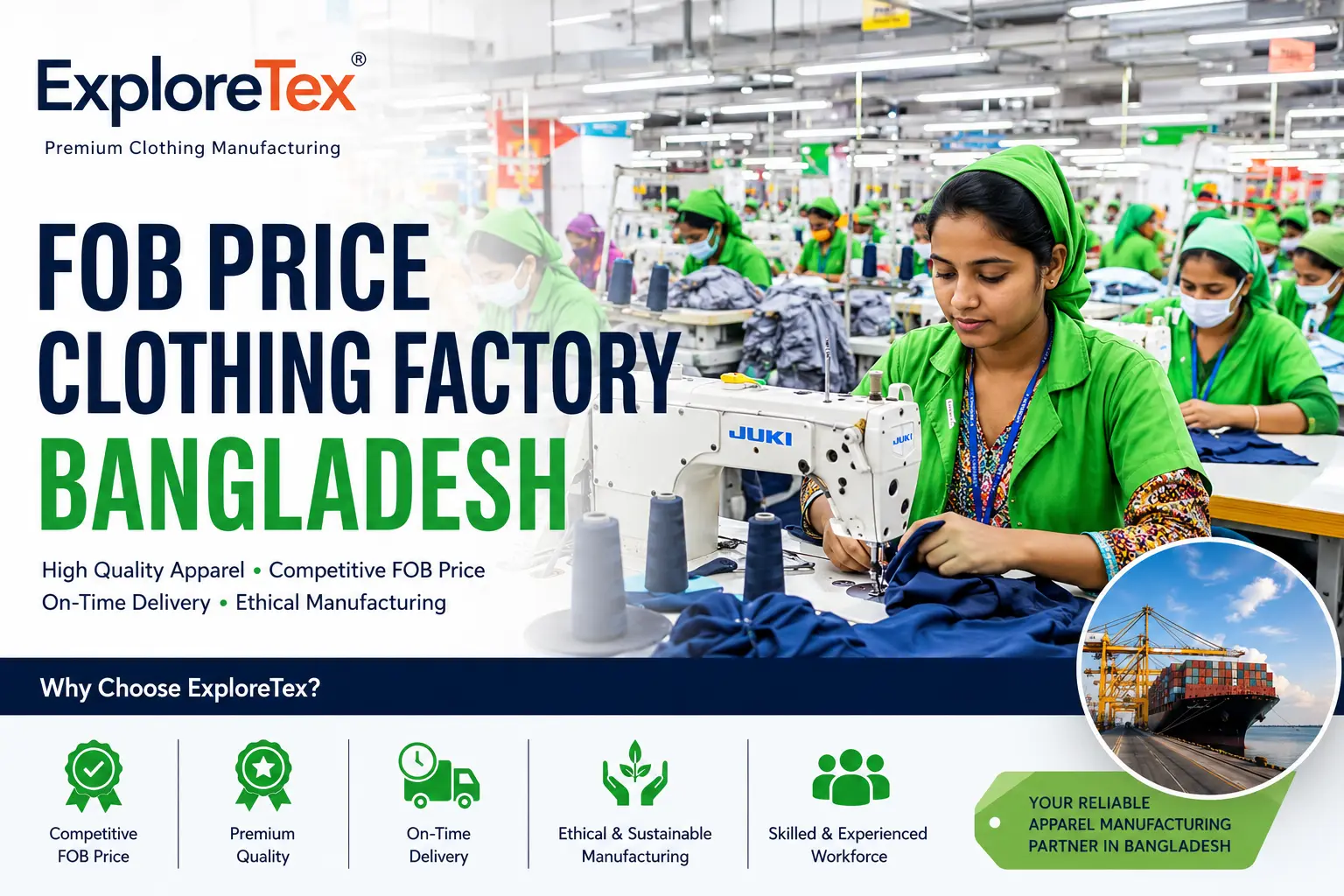
Comprehensive FAQ Section
1. How does a brand verify that an RMG factory social compliance Bangladesh framework is actually being enforced?
Brands should look past static certificates and request continuous operational data, including active BSCI or SMETA audit numbers linkable to the main databases, current RSC structural evaluation reports, anonymized digital time-card logs, and real-time chemical tracking sheets. ExploreTex provides clients with clear visibility into our operational data, ensuring compliance standards are actively maintained on the production floor.
2. Can a factory meet strict social compliance standards while remaining cost-competitive?
Yes. Modern social compliance helps optimize production costs. Maintaining an ethical workspace keeps worker turnover below 5%, which stabilizes line efficiency and reduces defect rates compared to high-turnover plants. Furthermore, automated manufacturing systems improve fabric utilization rates past 85%, reducing raw material waste and lowering overall per-unit production costs.
3. What specific fire safety measures are mandatory under RSC compliance guidelines?
RSC guidelines require structural, fire, and electrical safety upgrades:
Fire Barriers: Installing certified, fire-rated steel doors to isolate emergency stairwells.
Detection Systems: Integrated smoke and heat detection arrays connected to a centralized alarm system.
Suppression Networks: Automatic sprinkler systems installed across high-load material storage zones.
Infrastructure Maintenance: Routine thermal scanning of electrical lines to prevent overheating hazards.
4. How does the EU Corporate Sustainability Due Diligence Directive (CSDDD) impact apparel sourcing?
The CSDDD shifts ethical sourcing from a marketing preference to a legal requirement for European businesses. It holds brands legally liable for human rights or environmental issues throughout their supply chains. Sourcing from unverified, non-compliant factories can result in major financial penalties and cargo seizures at EU border ports.
5. What are the Minimum Order Quantities (MOQs) when partnering with ExploreTex?
Our MOQs are structured to support brand growth. For custom private label garments using standard fabrics, production generally starts around 500 pieces per design. For brands scaling high-volume retail lines, our vertical facility in Bangladesh easily manages larger volume runs while maintaining strict compliance standards throughout production. For lower MOQ capsule runs or premium sampling, clients can utilize our managed partner network through our clothing manufacturer in Bangladesh framework.
6. What is the difference between FOB and DDP shipping terms for international apparel sourcing?
FOB (Free On Board): The manufacturer delivers finished goods to the port of origin (e.g., Chittagong). The buyer assumes all responsibility, costs, and risks for ocean freight, import duties, customs clearance, and inland transport.
DDP (Delivered Duty Paid): This is an ExploreTex specialty. We manage the entire logistics pipeline. We handle export documentation, international sea/air freight, import clearances, customs duties, and local delivery, bringing compliant products straight to your warehouse doors.
7. How does ExploreTex eliminate the risk of unapproved factory subcontracting?
We address subcontracting risks through direct factory equity ownership and an integrated ERP tracking system. Every production batch is barcoded at arrival and scanned at each stage of cutting, sewing, and finishing. This data is monitored in real-time against our known facility capacity, ensuring all garments are manufactured entirely within our approved, audited facility.
8. Are the dyes and chemicals used in ExploreTex facilities safe for consumers and the environment?
Yes. Our sourcing networks strictly follow REACH regulations and OEKO-TEX Standard 100 protocols. All processing inputs are verified against the Zero Discharge of Hazardous Chemicals (ZDHC) Manufacturing Restricted Substances List (MRSL), ensuring our garments are safe for consumers and free from harmful environmental toxins.
9. How can an international apparel brand initiate a compliant sourcing project?
Getting started is straightforward. Brands can connect with our team to share their design visions, tech packs, and production requirements. Our specialists in Lisbon analyze your specifications, map out sourcing strategies, and provide clear, transparent cost breakdowns covering all development steps. To explore our production models, feel free to contact ExploreTex today.
10. Can ExploreTex help develop custom fabric blends and technical trims?
Yes. Through our integrated supply network, we offer comprehensive product development and sourcing services. Whether you require GOTS-certified organic cotton, recycled polyester blends, or custom branded hardware, our teams manage development from fiber to finished garment. Explore our capabilities further by reviewing our full package clothing production guide.
Conclusion: Partnering for Sustainable Growth
Navigating the complexities of international apparel production requires a partner who intimately understands both the high-end demands of the European fashion market and the immense scaling capabilities of Asian manufacturing. In 2026, rmg factory social compliance bangladesh is the critical bridge between these two worlds.
By choosing ExploreTex, you are not merely hiring a contractor; you are securing a strategic manufacturing partner. From high-fidelity 3D digital avatars to rigorous factory-floor ethical standards, we protect your brand’s reputation, budget, and timeline. By unifying European management standards with direct operational control in Dhaka, we guarantee that your apparel is crafted ethically, sustainably, and flawlessly. Ensure your brand is built on a foundation of integrity by integrating world-class rmg factory social compliance bangladesh protocols into your next collection.