
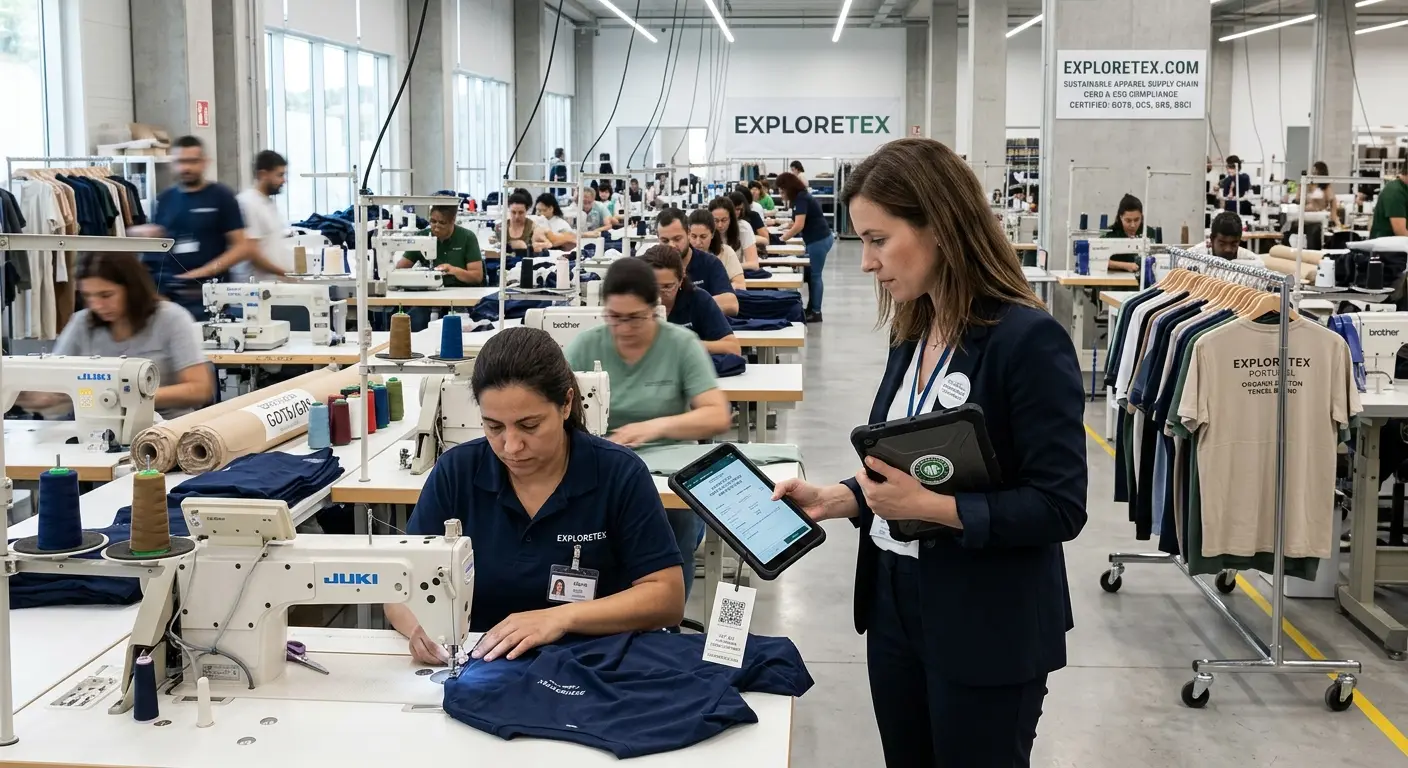
CSRD ESG Reporting Apparel Supply Chain: The Definitive 2026 Strategy Guide for Fashion Brands & Retailers
Executive Summary: The Compliance Paradigm Shift in Apparel Manufacturing
The European fashion industry is undergoing its most radical structural transformation in three decades. With the full enforcement of the Corporate Sustainability Reporting Directive (CSRD) alongside the European Sustainability Reporting Standards (ESRS) and the Eco-design for Sustainable Products Regulation (ESPR), sustainability has officially migrated from marketing departments to corporate balance sheets and legal audit committees. For executive procurement teams, sustainability directors, and fashion brand founders, the core operational challenge of 2026 is clear: how to maintain high-margin, scalable apparel production while guaranteeing total, auditable ESG transparency across multi-tiered international supply chains.
Historically, European apparel brands faced a stark trade-off. Offshoring production to Asia offered unbeatable cost efficiency but created data blind spots, high Scope 3 carbon impacts, and labor compliance risks. Nearshoring to Southern Europe delivered superior craftsmanship, fast-turnaround agility, and lower transport emissions, but presented capacity bottlenecks and higher unit costs.
Enter ExploreTex—a Portuguese-registered custom clothing manufacturer that bridges this exact operational gap. By combining European governance, pattern-making mastery, and local Portuguese nearshore facilities with an owned, vertically integrated manufacturing facility in Bangladesh, ExploreTex delivers a hybrid supply chain framework. This structural model solves the compliance dilemma, turning CSRD ESG reporting apparel supply chain mandates from a regulatory burden into a quantifiable competitive advantage for modern apparel brands.
Welcome to ExploreTex, your premier manufacturing partner bridging European craftsmanship and global scale. As fashion brands and retail executives prepare for strict European Union regulations, mastering CSRD ESG reporting apparel supply chain compliance has become the single most critical operational priority. Every modern clothing brand must actively prioritize CSRD ESG reporting apparel supply chain transparency to avoid severe penalties. Our Portuguese manufacturing hub excels in rigorous CSRD ESG reporting apparel supply chain standards, ensuring your upcoming collections meet all legal mandates.
When implementing your CSRD ESG reporting apparel supply chain protocols, partnering with ExploreTex guarantees seamless, audit-ready data integration. Brands navigating complex CSRD ESG reporting apparel supply chain rules need reliable primary data across all manufacturing tiers.
Our vertical manufacturing facility in Bangladesh and our elite partner factory network in Portugal are fully optimized for modern CSRD ESG reporting apparel supply chain demands. Sourcing apparel sustainably requires robust CSRD ESG reporting apparel supply chain verification from raw fiber extraction to finished garment packaging. Executive teams focusing heavily on CSRD ESG reporting apparel supply chain metrics choose ExploreTex for absolute audit readiness and transparency. By integrating primary facility energy and water logs, our advanced CSRD ESG reporting apparel supply chain framework completely eliminates secondary estimations. Every formal audit required for CSRD ESG reporting apparel supply chain mandates directly benefits from our transparent factory-floor tracking protocols and certified processes.
European fashion buyers seeking ultimate excellence in CSRD ESG reporting apparel supply chain compliance heavily rely on our unique dual-hub production model. Sustainable fashion begins with accurate CSRD ESG reporting apparel supply chain documentation spanning Tier 1 through Tier 4 production units. ExploreTex effectively simplifies intricate CSRD ESG reporting apparel supply chain challenges through owned vertical integration and close oversight. Managing Scope 1, Scope 2, and Scope 3 greenhouse gas emissions under strict CSRD ESG reporting apparel supply chain guidelines requires precise energy consumption and chemical safety logging. Our unwavering commitment to CSRD ESG reporting apparel supply chain excellence ensures complete elimination of greenwashing risks for your retail brand.
To stay consistently ahead of evolving European legislation, implement your comprehensive CSRD ESG reporting apparel supply chain strategy alongside ExploreTex today. Retailers actively prioritizing CSRD ESG reporting apparel supply chain transparency gain immediate, measurable market advantages. From low MOQ sustainable production in Northern Portugal to high-volume ethical manufacturing in Bangladesh, our specialized CSRD ESG reporting apparel supply chain expertise covers every single production stage. Trust ExploreTex for comprehensive CSRD ESG reporting apparel supply chain solutions that protect your corporate reputation. Achieving total CSRD ESG reporting apparel supply chain compliance across global markets has never been easier or more reliable.
Discover how our tailored custom clothing manufacturing services support your vital CSRD ESG reporting apparel supply chain objectives seamlessly from initial design to final delivery. Sustainable apparel brands require dependable CSRD ESG reporting apparel supply chain partnerships to fully satisfy demanding EU auditors and conscious consumers. Partner with ExploreTex today to streamline your complex CSRD ESG reporting apparel supply chain data collection and verification procedures. Contact our expert team right now to master your CSRD ESG reporting apparel supply chain requirements and elevate your brand’s global standing through flawless CSRD ESG reporting apparel supply chain execution.
1. Deconstructing CSRD & ESRS Standards for the Apparel Supply Chain
1.1 What is CSRD and Why Does It Target Upstream Textile Manufacturing?
The Corporate Sustainability Reporting Directive (CSRD) replaces the Non-Financial Reporting Directive (NFRD), expanding the mandate from approximately 11,700 companies to over 50,000 EU-based and international entities operating within the European market. Crucially, CSRD requires in-scope brands to disclose not only their immediate direct operational footprints (Scope 1 and Scope 2), but also the comprehensive environmental and social impacts generated throughout their entire value chain (Scope 3).
In garment manufacturing, over 80% to 90% of a fashion brand’s environmental footprint resides within Tier 1 through Tier 4 supply chains—specifically yarn spinning, wet processing, dyeing, cutting, and sewing. Consequently, European brand buyers are legally required to demand primary, verifiable data from their manufacturing partners.
┌─────────────────────────────────────────────────────────────────────────┐
│                      CSRD Value Chain Coverage                          │
├───────────────────┬─────────────────────────────────────────────────────┤
│  Upstream Tiers   │ Raw Material Sourcing, Yarn Spinning, Fabric Dyeing  │
│  Tier 1 & Tier 2  │ Garment Cutting, Assembly, Finishing, Packaging     │
│  Downstream Tiers │ Logistics, Retail Operations, End-of-Life Circularity│
└───────────────────┴─────────────────────────────────────────────────────┘
1.2 Essential ESRS Modules for Fashion Sourcing Executives
To achieve full compliance, brands must map their vendor network against primary European Sustainability Reporting Standards (ESRS):
ESRS E1 (Climate Change): Mandatory quantification of Scope 1, Scope 2, and Scope 3 greenhouse gas (GHG) emissions using primary facility energy logs rather than regional secondary averages.
ESRS E4 (Biodiversity & Ecosystems): Land-use impact tracking for raw materials (such as organic cotton vs. conventional cotton) and deforestation-free supply chains.
ESRS E5 (Resource Use & Circular Economy): Documenting recycled content percentages, pre-consumer fabric scrap reclamation, packaging waste, and product durability metrics.
ESRS S2 (Workers in the Value Chain): Mandatory verification of fair living wages, occupational health and safety (OHS) standards, freedom of association, and zero child or forced labor throughout garment facilities.
2. Navigating Tier 1 to Tier 4 Apparel Supply Chain Data Audits
Executing an effective CSRD ESG reporting apparel supply chain strategy requires granular, primary data collection at every physical transformation stage of the garment lifecycle. The table below outlines how data is systematically collected across supply chain tiers to satisfy EU digital audit readiness:
Without unified management across all four tiers, brands face severe reporting delays, “greenwashing” penalties under EU consumer law, and supply chain disruptions. This is precisely why partnering with a managed production network like ExploreTex streamlines compliance into a single point of accountability.
3. The Dual-Hub Strategic Advantage: Portugal Sourcing & Bangladesh Production
A primary bottleneck in implementing a CSRD ESG reporting apparel supply chain framework is the operational tension between speed, cost, and compliance visibility. Single-region manufacturing strategies frequently struggle to meet all three criteria simultaneously.
To overcome this, ExploreTex operates a high-efficiency dual-hub manufacturing model:
                     ┌────────────────────────────────────────┐
                     │          EXPLORETEX HEADQUARTERS        │
                     │          (Portugal Governance)         │
                     └───────────────────┬────────────────────┘
                                         │
                   ┌─────────────────────┴─────────────────────┐
                   ▼                                           ▼
┌──────────────────────────────────────┐    ┌──────────────────────────────────────┐
│        PORTUGAL NEARSHORE HUB        │    │      BANGLADESH VERTICAL HUB         │
├──────────────────────────────────────┤    ├──────────────────────────────────────┤
│ • Small-batch & low MOQ orders       │    │ • High-volume knit & woven scaling   │
│ • Rapid prototyping & 3D fitting     │    │ • Vertically integrated raw materials│
│ • Hyper-agile re-orders (Made in EU) │    │ • Owned facility with total ESG oversight│
│ • Ideal for capsule & luxury lines   │    │ • Competitive cost for global markets │
└──────────────────────────────────────┘    └──────────────────────────────────────┘
3.1 Portugal Nearshore Manufacturing: Craftsmanship, Agility & Low MOQ
Operating from Northern Portugal’s world-renowned textile cluster, ExploreTex collaborates with elite local partner factories to deliver European garment precision.
Low MOQ Flexibility: Brands can launch capsule collections or initial production runs starting at low minimum order quantities (MOQs), minimizing overproduction waste—a key requirement of ESRS E5 circularity goals.
Rapid Prototyping: Utilizing advanced digital fitting and physical sampling, pattern adjustments are finalized swiftly, reducing physical material waste by up to 60% before bulk cutting.
Geographic Proximity: Shipping from Portugal to major European distribution centers significantly reduces freight carbon intensity compared to long-haul air or sea freight.
ExploreTex’s specialized services in European manufacturing are outlined in detail across their dedicated solution hubs:
Clothing Manufacturer Portugal Overview – The master portal for European private label apparel production.
Custom Apparel Services – Comprehensive design-to-delivery custom clothing solutions.
Tech Pack Development & Pattern Making – Precision engineering to eliminate raw material waste.
Production Process & Quality Control – Detailed walkthrough of European quality management and AQL inspection.
About ExploreTex Governance – Strategic insights into the brand’s Portuguese leadership and heritage.
3.2 Bangladesh Vertical Facility: Ethical Scale & Certified Supply Chains
For high-volume production, ExploreTex operates its own vertical manufacturing facility in Bangladesh. Contrary to outdated perceptions, modern Bangladesh apparel manufacturing features some of the highest-rated green garment factories globally under the U.S. Green Building Council (USGBC) LEED certification standard.
Owned Facility Management: By maintaining vertical ownership over the Bangladesh facility, ExploreTex eliminates unannounced sub-contracting—the leading cause of social compliance failures in garment supply chains.
End-to-End Primary Data: Energy consumption, water management via advanced Effluent Treatment Plants (ETP), and worker welfare records are tracked on-site, providing audit-ready datasets directly for your brand’s CSRD reporting.
Competitive Scale: Brands achieve volume economies of scale while retaining the precise ESG compliance metrics required by EU regulations.
Discover how ExploreTex manages international supply chains and volume production through these core resource pages:
Bangladesh Manufacturing & Global Hubs – Insights into vertical scale and ethical Asian production.
Low MOQ Private Label Options – How emerging fashion startups scale efficiently.
Sustainable Fabric Sourcing – Catalog of GOTS organic cotton, GRS recycled synthetics, and eco-blends.
Cost Breakdown & Sourcing Guide – Complete financial breakdown for manufacturing transparently.
Contact & Compliance Inquiry Portal – Direct line to consult with ExploreTex supply chain experts.
4. Factory-Floor “Expert” Insights: Primary Data Collection Protocol
From the Desk of the Head of Quality Assurance & Compliance at ExploreTex: “The biggest pitfall for fashion brands entering the 2026 CSRD reporting cycle is relying on secondary database averages or estimated carbon factors. Auditors under EU law actively flag non-primary estimates. At ExploreTex, we capture energy usage at the batch level. When we dye 1,000 kilograms of GOTS-certified organic cotton French Terry in our wet-processing unit, the exact kilowatt-hours of electricity, liters of recycled water, and weight of non-hazardous dyes used are logged digitally and assigned directly to that production lot. When our brand partners submit their ESRS E1 and E5 disclosures, they aren’t presenting estimates—they are presenting verified, factory-floor reality.”
To achieve this level of accuracy, ExploreTex enforces a strict 5-Stage Audit Protocol across all production runs:
┌─────────────────────────────────────────────────────────────────────────┐
│                   5-Stage Factory Audit Protocol                        │
├─────────────────────────────────────────────────────────────────────────┤
│ 1. Raw Material Verification: Testing GOTS/GRS chain-of-custody         │
│ 2. Wet Processing Logging: Real-time ETP water and ZDHC chemical tracking│
│ 3. Automated Cutting: CAD optimization achieving 88%+ marker efficiency │
│ 4. Inline & Final QC: Applying AQL 1.5/2.5 strict defect standards      │
│ 5. Chain-of-Custody Shipping: Full PO-level documentation packaging     │
└─────────────────────────────────────────────────────────────────────────┘
This factory-floor discipline ensures that every garment produced under the ExploreTex banner is physically flawless and fully documented for regulatory compliance.
5. Technical Implementation: Structured Data, DPP & Digital Audits
5.1 Digital Product Passports (DPP) & ESPR Alignment
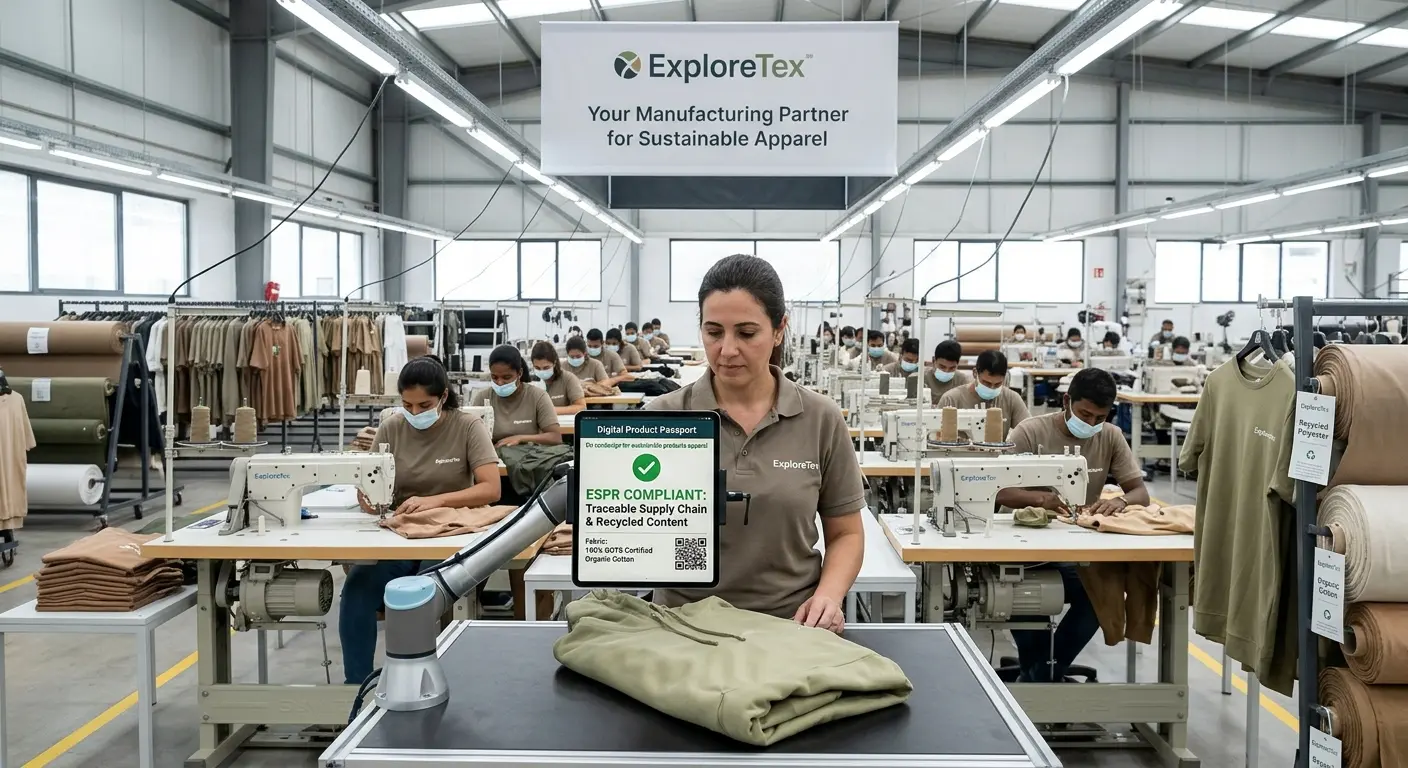
Under the Eco-design for Sustainable Products Regulation (ESPR), apparel sold in the EU will soon require an accessible Digital Product Passport (DPP). The DPP acts as a digital identity card for every garment, storing verifiable information on material composition, country of origin, repairability, and supply chain traceability.
ExploreTex aligns raw material tracking and manufacturing logs with emerging open-source DPP data schemes, ensuring that every batch leaving Portuguese or Bangladeshi production lines is ready for QR-code integration.
6. Comprehensive FAQ: Solved Compliance & Sourcing Queries
Q1: How does working with ExploreTex simplify our brand’s CSRD ESG reporting apparel supply chain requirements?
A: ExploreTex serves as your single operational point of contact. Rather than sending individual questionnaires to dozens of separate fabric mills, dye houses, and cut-and-sew units across multiple continents, ExploreTex collects, verifies, and consolidates primary facility data across Tiers 1 through 4. We deliver standardized, audit-ready data packets covering Scope 1, 2, and 3 emissions, water metrics, chemical safety compliance, and certified labor standards directly aligned with ESRS E1, E5, and S2 standards.
Q2: What certifications do ExploreTex facilities carry to back up ESG claims?
A: Our production ecosystem holds premier international certifications, including GOTS (Global Organic Textile Standard) for organic fibers, OEKO-TEX® Standard 100 for chemical safety, GRS (Global Recycled Standard) for recycled textiles, and BSCI/WRAP accreditations for worker safety and fair wages. Every certification is backed by chain-of-custody documentation (Transaction Certificates) for complete traceability.
Q3: How does the dual-hub Portugal and Bangladesh model help manage ESG costs?
A: Sourcing 100% of production in Europe can strain budget lines for volume collections, while sourcing 100% in Asia can increase transport emissions and oversight challenges. ExploreTex balances both hubs seamlessly. We produce quick-turn, high-margin, low-MOQ, or luxury items in Portugal, while manufacturing core volume lines in our owned Bangladesh facility. Both hubs operate under unified Portuguese executive governance, ensuring equal data quality and ethical standards across both operations.
Q4: What is the minimum order quantity (MOQ) for sustainable private label clothing with ExploreTex?
A: We support growing brands alongside established enterprise retailers. For our Portuguese nearshore production, minimum order quantities start as low as 500 pieces per style or 1,000 pieces per order. This low MOQ capability enables brands to test market demand without over-producing inventory, directly supporting EU circular economy objectives.
Q5: How do we transition our current apparel collections to ExploreTex?
A: Our onboarding process is straightforward. Send us your existing design sketches or tech packs via our Contact Portal. Our pattern makers and sustainability engineers review your specs, recommend certified eco-friendly fabric alternatives, generate precise digital samples, and prepare a fully transparent cost and compliance breakdown for your collection.
7. Actionable Roadmap: Transforming Compliance into Strategic Advantage
To transition your brand’s supply chain into a compliant asset, follow this 4-step implementation roadmap:
┌─────────────────────────────────────────────────────────────────────────┐
│                    4-Step Supply Chain Roadmap                          │
├─────────────────────────────────────────────────────────────────────────┤
│ Step 1: Execute Supply Chain Mapping                                    │
│ Audit current Tier 1–4 vendors to identify compliance and data gaps.    │
│                                                                         │
│ Step 2: Standardize Data Capture                                        │
│ Replace secondary estimates with primary facility-level data.           │
│                                                                         │
│ Step 3: Shift to Dual-Hub Manufacturing                                 │
│ Rebalance production between European nearshoring and ethical Asian hubs│
│                                                                         │
│ Step 4: Publish Digital Product Passports                               │
│ Integrate verifiable supply chain data into consumer-facing channels.   │
└─────────────────────────────────────────────────────────────────────────┘
For official regulatory guidance and industry benchmarks on sustainable supply chain management, explore these authoritative external resources:
European Commission Corporate Sustainability Reporting Overview – Official details on EU CSRD legislative timelines and mandates.
Supply Chain Traceability for Fashion & Textile Suppliers (CSRD Pro Guide) – In-depth guide on ESRS metrics and value chain mapping.
Global Organic Textile Standard (GOTS) Official Portal – Key guidelines on organic fiber chain-of-custody and processing criteria.
 Conclusion: Partner with ExploreTex for Audit-Ready Apparel Production
 Conclusion: Partner with ExploreTex for Audit-Ready Apparel Production
Navigating the CSRD ESG reporting apparel supply chain landscape requires more than basic vendor oversight—it demands a dedicated, transparent, and structurally compliant manufacturing partner.
By uniting European governance, pattern precision, and agile nearshore production in Portugal with vertically owned, high-volume capacity in Bangladesh, ExploreTex provides modern fashion brands with an end-to-end manufacturing solution. We handle the operational complexities, raw material tracing, and primary data capture so you can focus on building and scaling your fashion brand with total peace of mind.
In conclusion, choosing ExploreTex as your custom clothing manufacturing partner guarantees total compliance with all upcoming CSRD ESG reporting apparel supply chain mandates. As the fashion industry adapts to European Sustainability Reporting Standards, executing a robust CSRD ESG reporting apparel supply chain strategy is essential for protecting your brand’s balance sheet. Modern retail executives must prioritize CSRD ESG reporting apparel supply chain transparency across every tier of production.
Our dual-hub manufacturing model in Portugal and Bangladesh delivers complete CSRD ESG reporting apparel supply chain alignment without sacrificing product quality or profit margins. Integrating primary factory-floor data into your company’s CSRD ESG reporting apparel supply chain framework eliminates audit errors and protects your reputation against non-compliance claims.
Our Portuguese governance team simplifies every step of your CSRD ESG reporting apparel supply chain journey through verified certifications and real-time tracking. Whether you are producing small-batch capsule collections or scaling high-volume garments, our tailored CSRD ESG reporting apparel supply chain solutions provide the exact primary datasets EU auditors demand. Sustainable fashion brands relying on precise CSRD ESG reporting apparel supply chain metrics gain a distinct competitive advantage in today’s European market.
By capturing exact water, energy, and chemical metrics, our advanced CSRD ESG reporting apparel supply chain infrastructure turns complex regulatory demands into smooth operational workflows. Transitioning your manufacturing network to our CSRD ESG reporting apparel supply chain standard ensures long-term security and supply chain resilience.
Partnering with ExploreTex allows your brand to lead the industry in CSRD ESG reporting apparel supply chain excellence and ethical garment production. Managing Scope 1, Scope 2, and Scope 3 greenhouse gas emissions under strict CSRD ESG reporting apparel supply chain guidelines requires absolute visibility from raw fiber to final packaging.
Our owned vertical facility in Bangladesh and certified partner factories in Portugal offer an uncompromised CSRD ESG reporting apparel supply chain system built for international growth. Every piece of primary data needed for your annual CSRD ESG reporting apparel supply chain audit is compiled, verified, and delivered seamlessly by our team. Fashion retailers actively optimizing their CSRD ESG reporting apparel supply chain processes are consistently winning the trust of conscious European consumers.
To build an audit-proof fashion brand for 2026 and beyond, anchor your production around a dedicated CSRD ESG reporting apparel supply chain manufacturer. ExploreTex provides the technical expertise, certified raw materials, and digital tracing necessary for full CSRD ESG reporting apparel supply chain success.
Do not let complex regulations hold back your brand’s growth when our CSRD ESG reporting apparel supply chain framework makes compliance simple and transparent. Work with ExploreTex today to master every requirement of your CSRD ESG reporting apparel supply chain initiative from tech pack development to final shipment. Secure your company’s future now with our industry-leading CSRD ESG reporting apparel supply chain production capabilities.
Contact ExploreTex today to schedule a comprehensive audit review and discover how our specialized CSRD ESG reporting apparel supply chain manufacturing services elevate your clothing lines. Together, we will transform your complex CSRD ESG reporting apparel supply chain requirements into a powerful, sustainable market advantage for years to come.
Ready to elevate your production and secure your supply chain compliance?
Visit ExploreTex.com today or get in direct contact with our manufacturing team via the ExploreTex Contact Portal to request a custom production quotation and ESG compliance assessment for your upcoming clothing collections.