
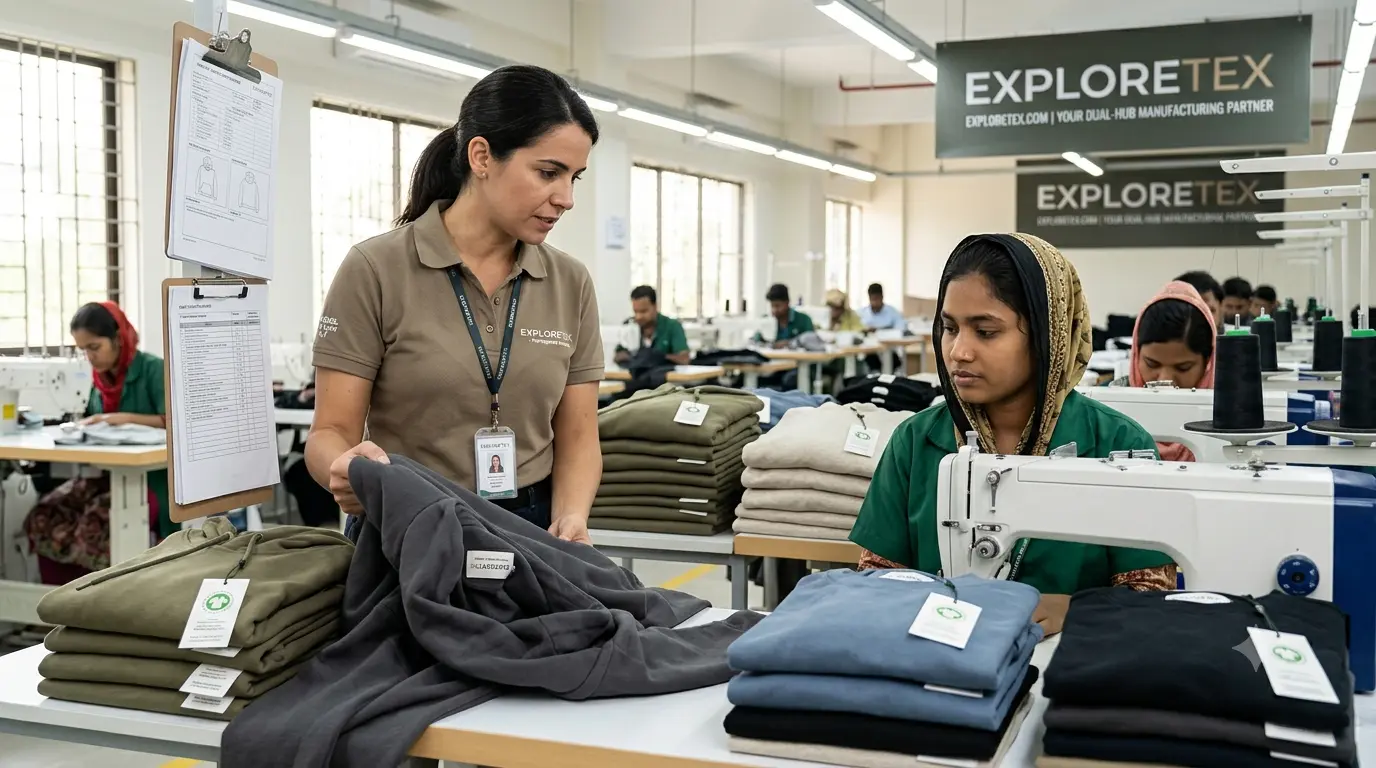
The Ultimate Guide to Partnering with a Scandinavian Clothing Factory: Sourcing Sustainable, High-GSM Apparel with ExploreTex
How European Textile Governance and Dual-Hub Vertical Manufacturing Deliver Nordic Precision, Eco-Compliance, and Scalable Cost Efficiency for Modern Apparel Brands
What is a Scandinavian clothing factory manufacturing partner?
A Scandinavian clothing factory manufacturing partner is an apparel producer engineered to meet the stringent design, sustainability, material, and ethical standards of Nordic fashion brands. These standards require high-GSM fabrics (300–500 GSM), organic and recycled certifications (GOTS, OEKO-TEX Standard 100, GRS), zero-defect stitch craftsmanship, and strict EU labor compliance. Companies like ExploreTex operate a European-managed dual-hub production system—combining Portuguese tech-pack engineering with vertical Bangladesh manufacturing—to give global brands direct access to authentic Scandinavian-grade manufacturing at optimized production costs.
The global fashion landscape has experienced a monumental shift toward minimalism, functionalism, and uncompromising sustainability—a trifecta pioneered by Nordic fashion houses. For emerging and established brands looking to capture this aesthetic, finding a manufacturing partner that operates at the exact level of a true scandinavian clothing factory is no longer just an option; it is an absolute necessity.
Historically, securing a scandinavian clothing factory meant sourcing production exclusively within the borders of Sweden, Denmark, or Norway. However, as global economics have evolved, the definition of a scandinavian clothing factory has expanded. Today, it refers less to a geographical location and more to an uncompromising standard of production ethics, extreme technical precision, environmental stewardship, and supply chain transparency. Brands worldwide are seeking the scandinavian clothing factory ethos, demanding that every garment is engineered with intention and manufactured without exploitation.
This comprehensive guide serves as an educational masterclass on what it takes to manufacture apparel to these exacting standards. We will explore the structural DNA of Nordic fashion, the technical realities of sustainable textile engineering, and how forward-thinking partners like ExploreTex have engineered a dual-hub production model that perfectly replicates the scandinavian clothing factory experience for modern brands.
Introduction: The Nordic Apparel Challenge and the Search for the Ideal Scandinavian Clothing Factory
The Scandinavian fashion ecosystem—spanning Sweden, Denmark, Norway, Finland, and Iceland—has redefined global apparel design. Famous for minimal aesthetics, clean lines, heavy fabric weights, understated functional luxury, and unyielding environmental standards, Nordic clothing brands set the benchmark for modern apparel quality. However, for growing apparel brands and established labels seeking to produce for this discerning market, finding a reliable scandinavian clothing factory presents a complex operational dilemma.
Domestic manufacturing in Northern Europe carries exorbitant production costs, high Minimum Order Quantities (MOQs), and limited capacity for high-volume scaling. Conversely, sourcing blindly from distant overseas facilities often leads to compromised fabric hand-feel, inconsistent size grading, weak seam construction, and non-compliance with strict European Union eco-regulations.
To bridge this gap, modern fashion brands require a specialized scandinavian clothing factory framework. ExploreTex, a Portuguese-registered company with its own registered Portuguese brand, offers the ultimate manufacturing solution. By uniting European design management in Portugal with a directly operated vertical production hub in Bangladesh, ExploreTex functions as an elite scandinavian clothing factory partner that guarantees Nordic quality control, zero-defect craftsmanship, and total supply chain transparency.
What defines a Scandinavian clothing factory standard? A true scandinavian clothing factory standard is defined by four core pillars: extreme minimalist technical execution, stringent environmental sustainability (such as GOTS and GRS certifications), uncompromising ethical labor practices, and deep supply chain transparency. A manufacturing partner operating under the scandinavian clothing factory ethos prioritizes closed-loop water systems, living wages, precision pattern-making to minimize textile waste, and the use of eco-friendly or recycled fibers over fast-fashion synthetics.
How do you find a Scandinavian clothing factory for low MOQ production? Finding a scandinavian clothing factory that accommodates low Minimum Order Quantities (MOQ) requires looking for hybrid or “dual-hub” manufacturers. Because strict local Nordic production is often cost-prohibitive for small runs, brands look to European hubs like Portugal. By partnering with a premier Clothing Manufacturer Portugal, brands gain access to the scandinavian clothing factory standard of European management, ethical compliance, and high-quality construction, often with flexible MOQs starting as low as 500 pieces per design.
Why is Portugal considered the modern alternative to a local Scandinavian clothing factory? Portugal has emerged as the premier alternative to a local scandinavian clothing factory due to its deep historical roots in luxury textile engineering, strict adherence to European Union labor and environmental laws, and geographical proximity to the Nordic region. A Portuguese manufacturer operates identically to a traditional scandinavian clothing factory in terms of quality and ethics, but benefits from a highly specialized, localized supply chain that makes scalable, sustainable production more economically viable for global brands.
Section 1: The Blueprint of a True Scandinavian Clothing Factory
To understand what sets a scandinavian clothing factory apart, one must analyze the technical specs that define Nordic apparel. Scandinavian design is not merely an aesthetic; it is an engineering philosophy built on longevity, material integrity, and environmental stewardship.
       [ MODERN SCANDINAVIAN CLOTHING FACTORY STANDARDS ]
                                |
     +--------------------------+--------------------------+
     |                                                     |
 [ MATERIAL SCIENCE ]                              [ CRAFTSMANSHIP ]
 - Organic & Recycled Fibers                       - Double-Needle Stitching
 - Heavyweight Fabrics (300-500 GSM)               - Reinforced Stress Points
 - OEKO-TEX Standard 100 Dyes                      - Pre-Shrunk & Anti-Pilling
     |                                                     |
     +--------------------------+--------------------------+
                                |
                   [ ETHICAL GOVERNANCE ]
                   - GOTS & Fair Labor Compliance
                   - Closed-Loop Eco Systems
                   - 100% Traceable Supply Chain
1. Material Science & Heavyweight Fabric Engineering
A certified scandinavian clothing factory prioritizes premium, high-density textiles. Nordic fashion relies heavily on luxury French Terry, heavyweight fleece, combed ring-spun jersey, and high-tensile woven twills.
Heavyweight GSM Requirements: Standard retail garments often utilize thin 140–180 GSM fabrics. In contrast, a scandinavian clothing factory operates with 240–320 GSM for premium T-shirts and 380–500 GSM for luxury hoodies and sweatshirts.
Fiber Purity: Fabrics must utilize long-staple organic cotton, mulesing-free merino wool, linen, or Global Recycled Standard (GRS) certified synthetic blends.
2. Precision Tailoring and Construction Aesthetics
When contracting a scandinavian clothing factory, brands demand exact structural symmetry. This includes drop-shoulder cuts, clean boxy silhouettes, hidden seam reinforcement, and precise ribbing ratios (such as 2×2 heavy elastane ribbing on cuffs and hems).
3. Stringent Eco-Certifications and EU Compliance
Nordic consumers demand verifiable sustainability credentials. A compliant scandinavian clothing factory must adhere to the EU Strategy for Sustainable and Circular Textiles and maintain international certifications, including:
Business Social Compliance Initiative (BSCI)
SEDEX SMETA Ethical Audits
The Structural DNA of Nordic Fashion Production
Understanding why the scandinavian clothing factory standard is so highly sought after requires a deep dive into the architecture of Nordic fashion itself. It is a philosophy where form strictly follows function, and where the longevity of a garment is valued over its immediate trendiness. When you operate a scandinavian clothing factory or partner with a facility that mirrors its principles, you are engaging in a highly specialized form of textile engineering.
1. The Principle of Utilitarian Minimalism
A core hallmark of a scandinavian clothing factory output is utilitarian minimalism. This is not simply the absence of decoration; it is the mathematical optimization of a garment. In a traditional scandinavian clothing factory, pattern makers focus intensely on seam placement, not just for aesthetics, but for structural integrity and mobility. Every stitch has a purpose. If a seam does not contribute to the garment’s function or fit, a true scandinavian clothing factory protocol dictates its removal. This minimalist approach actually makes manufacturing more difficult, as there are no superfluous details to hide poor stitching or uneven fabric tension.
2. Climate-Responsive Textile Selection
Apparel originating from a scandinavian clothing factory environment is heavily influenced by the harsh Nordic climate. This demands a mastery over technical fabrics. A facility adhering to the scandinavian clothing factory methodology must be proficient in handling heavyweight organic cottons, mulesing-free merino wools, weather-resistant bonded textiles, and multi-layered performance wear. Sourcing these materials requires a deeply integrated global network, which is why modern brands rely on an innovative, high-quality, and sustainable apparel solutions partner to navigate the complexities of international fabric procurement.
3. The Durability Mandate
Fast fashion relies on planned obsolescence. Conversely, the scandinavian clothing factory model relies on planned permanence. A high-tier scandinavian clothing factory will utilize reinforced stitching techniques—such as flat-felled seams, French seams, and bar-tacking at stress points—to ensure the garment survives years of rigorous wear. The ultimate goal of a scandinavian clothing factory is to create apparel that can be passed down through generations, thereby inherently reducing the environmental impact of consumption.
Section 2: ExploreTex — The Portuguese Dual-Hub Advantage for Scandinavian Apparel
Finding a scandinavian clothing factory inside Scandinavia that offers fair prices and low MOQs is nearly impossible. This is why ExploreTex engineered its industry-leading Dual-Hub Manufacturing Model.
 +-----------------------------------------------------------------------+
 |                     EXPLORETEX DUAL-HUB ENGINE                        |
 +-----------------------------------------------------------------------+
 | PORTUGAL HUB (Porto / Lisbon)     | BANGLADESH HUB (Vertical Facility)|
 | - Tech Pack & Pattern Design     | - High-Volume Vertical Execution   |
 | - Luxury / Low-MOQ Sampling       | - Cost Reduction up to 40%         |
 | - EU Legal & Ethical Oversight   | - In-House Knitting, Dyeing, Sewing|
 +-----------------------------------------------------------------------+
                                    |
                                    v
            [ RESULT: SCANDINAVIAN QUALITY AT SCALABLE MARGINS ]
As detailed in our overview of clothing manufacture in Portugal, ExploreTex operates with European management from Portugal while utilizing a fully owned vertical factory in Bangladesh. This hybrid infrastructure allows ExploreTex to execute every order with the precision of a top-tier scandinavian clothing factory.
The Dual-Hub Workflow Defined:
European Governance & Technical Direction (Portugal): Our Portuguese HQ oversees pattern drafting, 3D digital sampling, fabric testing, and compliance verification. Clients receive European legal protection, clear communication, and single-point-of-contact convenience.
Vertical Manufacturing Power (Bangladesh): High-volume cutting, knitting, dyeing, and assembly take place in our fully controlled Bangladesh facility. This vertical integration eliminates middleman markups, reducing production costs by up to 40% compared to traditional European manufacturing.
Managed Portuguese Partner Facilities: For ultra-luxury, rapid-turnaround, or ultra-low MOQ capsule runs, ExploreTex coordinates with our curated network of partner facilities in Northern Portugal, establishing us as one of the best clothing manufacturers in Portugal.
By combining these two regions, ExploreTex operates as an accessible scandinavian clothing factory alternative, providing Nordic design compliance alongside factory-direct pricing.
Why Brands Look Beyond Local: The Modern “Scandinavian Clothing Factory” Model
For decades, the gold standard was to have a physical scandinavian clothing factory located in Stockholm, Copenhagen, or Oslo. However, as raw material costs rose and skilled labor shortages impacted local industries, maintaining a domestic scandinavian clothing factory became unsustainable for all but the most expensive luxury heritage brands.
Enter the modern interpretation of the scandinavian clothing factory.
Today’s most successful Nordic brands have realized that the location of the factory is less important than the operational standards of the factory. They sought locations that could provide the exact same ethical framework, technological infrastructure, and craftsmanship as a domestic scandinavian clothing factory, but with greater scale and supply chain efficiency.
The Portuguese Advantage
Portugal rapidly became the spiritual successor to the local scandinavian clothing factory. Governed by stringent European Union regulations, a Portuguese facility operates with the same environmental and labor guarantees as a scandinavian clothing factory. Portugal offers a robust ecosystem of specialized dyers, spinners, and weavers located within a concentrated geographic radius, reducing the carbon footprint of domestic transport. When brands seek a scandinavian clothing factory experience for premium, complex garments, they inevitably turn to a managed production network in Portugal to fulfill their private label needs.
The Dual-Hub Engineering Solution
To truly scale, a modern scandinavian clothing factory strategy must balance luxury craftsmanship with volume capability. ExploreTex pioneered a unique “Dual-Hub” model that perfectly captures the scandinavian clothing factory philosophy. They maintain a full-package garment manufacturing partner network in Portugal for high-complexity, low-volume luxury items, while simultaneously operating a directly-owned facility in Bangladesh.
Operating a facility in Bangladesh under European management ensures that the ethical and quality benchmarks of a scandinavian clothing factory are rigorously maintained at a global scale. This direct operational control means brands do not have to sacrifice the scandinavian clothing factory ethos of living wages, safe working conditions, and strict quality control, even when producing high-volume retail orders.
Sustainability: The Non-Negotiable Pillar of a Scandinavian Clothing Factory
If there is one non-negotiable trait that defines a scandinavian clothing factory, it is a radical, almost obsessive commitment to environmental sustainability. A true scandinavian clothing factory does not view sustainability as a marketing buzzword; it is an integrated engineering requirement.
Certifications That Define the Standard
A facility claiming to operate at a scandinavian clothing factory level must prove its commitment through rigorous third-party auditing. Educational understanding of these certifications is vital for any brand looking to source apparel:
GOTS (Global Organic Textile Standard): A scandinavian clothing factory must frequently source GOTS-certified organic cotton, which ensures the textile is not only grown without toxic pesticides but that the manufacturing process meets strict environmental and social criteria.
GRS (Global Recycled Standard): For synthetic materials, a scandinavian clothing factory relies on the Global Recycled Standard to verify the recycled content of products (like recycled polyester or regenerated nylon) and to ensure responsible social, environmental, and chemical practices.
OEKO-TEX® Standard 100: Every single component—from the fabric to the thread, buttons, and zippers—used in a scandinavian clothing factory must be tested for harmful substances to ensure consumer safety.
Closed-Loop Systems and Chemical Management
Water scarcity and toxic runoff are the fashion industry’s greatest sins. A scandinavian clothing factory standard manufacturer combats this by implementing advanced Effluent Treatment Plants (ETP). In a true scandinavian clothing factory setup, water used in the dyeing process is chemically neutralized, filtered, and returned to the ecosystem cleaner than when it was extracted. Furthermore, a scandinavian clothing factory utilizes low-impact, AZO-free dyes, ensuring that local waterways are protected from industrial pollution.
Waste Reduction via Precision Grading
Textile waste on the cutting room floor is a massive issue. A technologically advanced scandinavian clothing factory employs sophisticated CAD (Computer-Aided Design) software for pattern making and size grading. By algorithmically calculating the optimal marker efficiency, a scandinavian clothing factory can utilize up to 95% of the fabric yardage, dramatically minimizing off-cut waste. This is where the principles of a scandinavian clothing factory directly align economic savings with ecological preservation.
Section 3: Factory-Floor “Expert” Insights — Technical Precision in Scandinavian Garment Manufacturing
To achieve true Nordic quality, a scandinavian clothing factory must maintain rigid technical controls during raw material selection, pattern drafting, and assembly line production. Below are expert insights directly from the ExploreTex engineering team:
+-----------------------------------------------------------------------+
|                 FACTORY-FLOOR TECHNICAL SPECIFICATIONS                 |
+-----------------------------------------------------------------------+
| PARAMETER             | STANDARD PRODUCTION   | EXPLORETEX NORDIC SPEC|
+-----------------------+-----------------------+-----------------------+
| Heavyweight Hoodie GSM| 280 - 320 GSM         | 420 - 500 GSM         |
| Fabric Shrinkage Rate | 5% - 8%               | Under 2% (Pre-Shrunk) |
| Seam Stitching        | Standard Overlock     | 4-Needle 6-Thread Flatlock|
| Inspection Standard   | General AQL 2.5       | Strict AQL 1.5 Level II|
| Color Fastness        | Grade 3               | Grade 4-5 (ISO 105-B02)|
+-----------------------+-----------------------+-----------------------+
Expert Insight 1: Pre-Shrunk Fabric Engineering & Dimensional Stability
A common complaint with low-cost manufacturers is garment shrinkage after the first retail wash. A genuine scandinavian clothing factory prevents this through controlled heat-setting and compaction processes.
Compacting & Stenter Processing: At ExploreTex, all circular-knit cotton fabrics undergo stenter drying and mechanical compacting. This locks the loop structure of the jersey or fleece, guaranteeing a dimensional shrinkage rate under 2% (compared to industry averages of 5–8%).
GSM Stability Control: We test fabric weight pre-wash and post-wash using digital GSM cutters and precision electronic scales to ensure the finished product retains its thick, structural hand-feel.
Expert Insight 2: Seam Tensioning and Reinforced Construction
Scandinavian apparel is designed for longevity and active daily wear. A reliable scandinavian clothing factory implements heavy-duty seam engineering:
Twin-Needle & Flatlock Stitching: On crewnecks and hoodies, we use twin-needle coverstitching on necklines, cuffs, and bottom hems. For activewear and base layers, 4-needle 6-thread flatlock machines create flat, chafe-free seams capable of withstanding intense stress.
Bar-Tack Reinforcement: All pocket openings, side slits, and stress points receive automated electronic bar-tack stitching to prevent tearing over time.
Expert Insight 3: Eco-Dyeing and Color Fastness Science
Nordic brands favor muted earth tones, washed pastels, and deep monochromes. Achieving these hues requires non-toxic, eco-certified dye formulations.
AZO-Free & Low-Impact Dyes: Working with a certified sustainable organic cotton clothing manufacturer ensures that all dyeing processes use zero harmful AZO compounds, heavy metals, or formaldehyde.
Color Fastness Ratings: Fabrics undergo ISO 105-B02 lightfastness and ISO 105-C06 washing fastness testing, consistently achieving Grade 4–5 ratings to prevent fading.
Expert Insight 4: Digital Twin Engineering and Tech Pack Calibration
Before cutting fabric, an advanced scandinavian clothing factory digitizes the entire design process. As explained in our guide to turnkey clothing manufacturing services, ExploreTex utilizes 3D CAD modeling software (CLO 3D / Browzwear) to create digital twin prototypes. This allows clients to evaluate drape, silhouette, stress distribution, and size grading online—saving thousands of dollars in physical sample revisions and cutting development timelines by 50%.
Section 4: Full-Package Production Services Tailored for Nordic Brands
When partnering with a scandinavian clothing factory, brand owners should not have to manage multiple vendors for fabrics, labels, tags, and freight. ExploreTex provides a complete, end-to-end full package production service that covers every stage of the garment lifecycle.
 [ STEP 1: Tech Pack & 3D Prototyping ]
                  │
                  ▼
 [ STEP 2: Fabric Sourcing & Custom Knitting ]
                  │
                  ▼
 [ STEP 3: Eco-Dyeing & OEKO-TEX Certification ]
                  │
                  ▼
 [ STEP 4: Precision Cutting & Assembly Line Stitching ]
                  │
                  ▼
 [ STEP 5: Inline AQL 1.5 Quality Control ]
                  │
                  ▼
 [ STEP 6: Custom Packaging & Global DDP Logistics ]
1. Fabric Sourcing and Custom Material Development
Through our network, ExploreTex provides direct access to the world’s finest mills, including top luxury textile suppliers in Portugal. Whether your brand requires 450 GSM diagonal-back French Terry, 100% organic cotton single jersey, water-repellent nylon, or custom bamboo-blended fabrics, ExploreTex engineers custom knits precisely to your tech pack specifications.
2. Comprehensive Private Label Branding
A top-tier scandinavian clothing factory delivers fully finished, retail-ready garments. As an experienced private label clothing manufacturer in Europe, ExploreTex manages:
High-definition woven neck tags and organic cotton care labels.
Screen printing, high-density puff printing, soft-touch discharge printing, and silicone badging.
Computerized flat and 3D embroidery.
Custom FSC-certified hangtags, branded polybags, and custom mailer boxes.
3. Strict Quality Control (AQL 1.5 Inspection Standards)
Quality assurance at ExploreTex follows international Acceptable Quality Limit (AQL) standards. While standard factories inspect under AQL 2.5 or 4.0, our scandinavian clothing factory quality protocol operates under strict AQL 1.5 Level II standards:
Fabric Inspection: 100% of raw fabric rolls are inspected using 4-Point System machines prior to cutting.
In-Line Quality Audits: QC inspectors check seam tension, stitch density (SPI – Stitches Per Inch), and measurement tolerances during assembly.
Final Pre-Shipment Inspection: Garments undergo final needle detection, thread trimming, steam pressing, and dimensional measurement verification before packaging.
Factory-Floor “Expert” Insights: The Technical Reality
To truly understand the scandinavian clothing factory methodology, we must step onto the factory floor and examine the highly technical processes that govern everyday production.
Expert Insight: The Mathematics of Size Grading
“In a traditional scandinavian clothing factory setting, size grading is not a simple linear scale. Human bodies do not grow symmetrically. When we grade a pattern from a base size Medium up to a 3XL or down to an XS, we use complex mathematical algorithms to adjust the X and Y axes independently. This ensures that the minimalist drape—so crucial to the scandinavian clothing factory aesthetic—is maintained across every single body type. Poor grading destroys the silhouette, and in a scandinavian clothing factory, the silhouette is everything.”
Expert Insight: Needle Size and Fabric Tension
“Many brands overlook the physics of sewing. A scandinavian clothing factory protocol requires the exact matching of needle size, thread composition, and machine tension to the specific density of the fabric. If you use a standard needle on a fine, high-gauge organic cotton, you will cause micro-tears in the yarn, leading to premature degradation. A scandinavian clothing factory technician spends hours calibrating machinery for each specific fabric lot before a single bulk production stitch is made.”
Expert Insight: Virtual Prototyping
“To minimize the carbon footprint of shipping physical samples back and forth, a modern scandinavian clothing factory utilizes 3D virtual prototyping. We engineer a digital twin of the garment based on the Tech Pack. This allows the brand to see how the fabric drapes, behaves, and reflects light in a simulated physics environment. It is the ultimate evolution of the scandinavian clothing factory ethos: maximizing efficiency while minimizing physical waste.”
The Production Process: Engineering the Scandinavian Aesthetic
Partnering with a manufacturer that operates to scandinavian clothing factory standards means engaging in a highly structured, sequential production process. This “Fibre to Fashion” journey requires intense collaboration between the brand and the manufacturer. When you utilize a Full Package Clothing Production service, you are adopting the scandinavian clothing factory workflow.
Step 1: Strategic Discovery and Tech Pack Development
No scandinavian clothing factory will begin cutting fabric based on a rough sketch. The foundation of scandinavian clothing factory production is the Tech Pack (Technical Package). This is the architectural blueprint of the garment. It includes:
POM (Points of Measure): Exact dimensional tolerances down to the millimeter.
BOM (Bill of Materials): A granular list of every physical component required, from the primary textile down to the exact pantone code of the sewing thread.
Construction Details: Instructions on seam types, SPI (Stitches Per Inch), and finishing techniques.
If a brand lacks a Tech Pack, a true scandinavian clothing factory partner provides a PhD-led technical team to build one, ensuring no detail is left to interpretation.
Step 2: Sourcing and Raw Material Procurement
A scandinavian clothing factory is only as good as the raw materials it procures. Working with a global garment manufacturer, importer, exporter ensures access to a curated directory of premium global mills. Whether the design requires deadstock luxury fabrics from Italy or highly certified organic cottons from India, the scandinavian clothing factory standard dictates that all materials undergo rigorous testing for colorfastness, shrinkage, and pilling before bulk ordering.
Step 3: Prototyping and Fit Sampling
The first physical iteration in a scandinavian clothing factory is the “Proto Sample.” This is evaluated for general design intent. Once approved, the scandinavian clothing factory produces a “Fit Sample” in the exact base size. Technical fittings are often conducted via live video conferences—a hallmark of modern scandinavian clothing factory communication—where master pattern makers analyze drape, ease, and mobility.
Step 4: Bulk Production under AQL Standards
Once the Pre-Production (PP) sample is approved, the scandinavian clothing factory moves to bulk cutting and sewing. In a facility mirroring the scandinavian clothing factory standard, this is not a chaotic assembly line, but a highly synchronized modular production system. Quality is not checked at the end; it is embedded into every station.
Step 5: Final Finishing and Logistics
The final stage of the scandinavian clothing factory process is pressing, tagging, and packing. Modern scandinavian clothing factory partners utilize eco-friendly packaging, such as biodegradable polybags or recycled kraft paper. Furthermore, managing global trade is complex, which is why a top-tier partner will handle all customs clearances, certificates of origin, and freight forwarding to deliver the goods seamlessly.
Section 5: Comparative Analysis — Sourcing Models for Scandinavian Apparel
To select the right scandinavian clothing factory strategy, fashion founders and sourcing managers must compare their options across costs, MOQs, lead times, and quality control.
| Strategic Metric | Local Domestic Scandinavian Factory | Traditional Overseas Agency (Asia) | ExploreTex Dual-Hub Model |
| Average Unit Cost | High (€25 – €45+ per unit) | Low (€6 – €12 per unit) | Optimized (€10 – €18 per unit) |
| Minimum Order Quantity (MOQ) | 100 – 300 Pcs / High Cost | 2,000 – 5,000 Pcs | Flexible (500 Pcs per style) |
| Fabric Quality & Hand-Feel | Premium High-GSM | Variable / Standard GSM | Premium High-GSM (Nordic Spec) |
| Legal Protection & Management | European Jurisdiction | High International Risk | Portuguese EU Registered Business |
| Sustainability & Ethics | High / Certified | Low Transparency | GOTS, OEKO-TEX, BSCI Certified |
| Production Lead Times | 4 – 6 Weeks | 12 – 16 Weeks | 6 – 8 Weeks (Full Delivery) |
| Customization & Tech Packs | Limited Fabrics | High Communication Barriers | 3D Digital Prototyping & Full Package |
As shown above, the ExploreTex dual-hub model delivers the luxury quality and legal security of a European scandinavian clothing factory alongside the cost savings and scalability of vertical overseas production.
Quality Control & Compliance: The Legal and Ethical Realities
To legally and ethically sell apparel in Europe, North America, or globally, strict adherence to international law is required. A scandinavian clothing factory is built on a foundation of unyielding compliance.
Understanding ISO 9001 and Quality Management
A true scandinavian clothing factory operates under strict ISO 9001 quality management systems. This internationally recognized standard ensures that the scandinavian clothing factory has documented, repeatable processes that guarantee consistent quality output. It means that whether you order 500 units or 50,000 units, the operational parameters of the scandinavian clothing factory remain identical.
The AQL (Acceptable Quality Limit) Framework
In a scandinavian clothing factory, quality control is driven by mathematics. The industry standard utilized by any reputable scandinavian clothing factory is the AQL 2.5/4.0 inspection standard.
AQL 2.5: Dictates the maximum acceptable limit for major defects (e.g., a highly visible skipped stitch, a structural tear).
AQL 4.0: Dictates the maximum acceptable limit for minor defects (e.g., an uncut thread end inside a pocket).
During the bulk run, independent auditors randomly select a statistically significant batch of garments. If the defect rate exceeds these strict mathematical limits, the entire batch is rejected. A scandinavian clothing factory prides itself on maintaining defect rates far below these acceptable limits.
Social and Ethical Auditing
A scandinavian clothing factory is deeply committed to human rights. Certifications like BSCI (Business Social Compliance Initiative), WRAP (Worldwide Responsible Accredited Production), SEDEX, and SMETA are mandatory. These audits ensure that the scandinavian clothing factory enforces zero forced labor, zero child labor, mandatory living wages, safe structural building codes, and regulated working hours. When a brand demands a scandinavian clothing factory standard, they are demanding the absolute protection of the workers who make their clothes.
The Economic Advantage: The Dual-Hub Strategy Explained
Operating a fashion brand is highly capital intensive. While the aesthetic and ethical ideals of a scandinavian clothing factory are desirable, the harsh reality of retail margins can make domestic Nordic production impossible for emerging designers. This is the precise reason the industry has evolved.
By utilizing a partner that operates a Dual-Hub network, brands achieve the ultimate synergy.
The Incubation Hub (Portugal): For high-fashion, ultra-complex designs, or brands needing low minimum order quantities, the Portuguese network acts as the elite scandinavian clothing factory incubator. It allows brands to test the market, develop intricate tech packs, and establish their visual identity without committing to massive capital outlays.
The Scaling Hub (Bangladesh): Once a style is proven and retail demand spikes, the brand must scale. The partner shifts bulk production to their directly operated, European-managed facility in Bangladesh. Because this facility operates on the exact same scandinavian clothing factory principles—utilizing the same tech packs, the same AQL 2.5 standards, and the same ethical labor laws—the brand scales its profit margins exponentially without ever sacrificing the original scandinavian clothing factory quality.
This system offers transparent cost breakdowns from day one. A brand receives a clear estimate of labor, raw materials, dyeing, and shipping, ensuring that the financial modeling required to run a successful apparel business is predictable and secure.
Section 6: Step-by-Step Onboarding — Launching Your Collection with ExploreTex
Partnering with ExploreTex as your primary scandinavian clothing factory is designed to be streamlined, transparent, and stress-free. Below is the step-by-step process for onboarding your brand:
[ PHASE 1: DISCOVERY & TECH PACK REVIEW ]
 └── Submit tech packs, design sketches, or reference physical garments.
 └── Receive a detailed cost breakdown and fabric recommendations within 24–48 hours.

[ PHASE 2: 3D VIRTUAL SAMPLING & FIT SAMPLES ]
 └── ExploreTex drafts digital 3D virtual samples for visual approval.
 └── Physical lab dips, fabric swatches, and physical fit samples are produced and shipped.

[ PHASE 3: GOLDEN SAMPLE APPROVAL ]
 └── Review the pre-production "Golden Sample" for fit, stitching, labels, and trim accuracy.
 └── Sign off on bulk production specifications.

[ PHASE 4: BULK VERTICAL MANUFACTURING ]
 └── Raw materials are custom knit, dyed, cut, sewn, and embellished under AQL 1.5 QC.
 └── Receive photo and video updates at key production milestones.

[ PHASE 5: FINAL QC, PACKAGING, & DOOR-TO-DOOR LOGISTICS ]
 └── Garments undergo 100% metal detection, pressing, and custom packaging.
 └── ExploreTex manages customs clearance and DDP shipping directly to your warehouse.
ExploreTex handles all international customs documentation, duty processing, and freight management, allowing your team to focus entirely on marketing and expanding your brand. Browse through the ExploreTex blog directory to learn more about our strategic sourcing methods.
Specialized FAQ Section: Mastering Factory Partnerships
To further educate brands on integrating with a scandinavian clothing factory standard manufacturer, we have compiled a highly technical Frequently Asked Questions section.
Q1: What exactly makes a Portuguese facility comparable to a traditional Scandinavian clothing factory?
A1: A Portuguese facility is governed by the same strict EU environmental and labor regulations as a traditional scandinavian clothing factory. Portugal has a centuries-old heritage in textile manufacturing, meaning their workforce possesses the same generational technical knowledge required to execute minimalist, high-precision Nordic designs.
Q2: How does a Scandinavian clothing factory approach Minimum Order Quantities (MOQ)?
A2: While traditional offshore factories demand massive MOQs, a modern scandinavian clothing factory standard partner is designed for flexibility. By utilizing specialized modular production lines, they can offer low MOQs—often starting around 500 pieces per style—allowing brands to test markets sustainably before scaling.
Q3: Can a Scandinavian clothing factory help if I only have a design sketch and no Tech Pack?
A3: Absolutely. A hallmark of a premium scandinavian clothing factory is their in-house technical capability. If you utilize the design submission and pricing portal of a reputable partner, their expert pattern makers and technical designers will convert your mood boards or rough sketches into comprehensive, production-ready Tech Packs, complete with size grading and fabric specifications.
Q4: What is the difference between FOB and DDP in a Scandinavian clothing factory contract?
A4: FOB (Free on Board) means the scandinavian clothing factory is responsible for delivering the goods to the nearest port, after which the brand assumes responsibility for sea/air freight and customs. DDP (Delivered Duty Paid) means the scandinavian clothing factory partner handles every aspect of logistics, including paying all import duties, and delivers the final product directly to the brand’s warehouse door.
Q5: How does a Scandinavian clothing factory ensure color consistency across large fabric dye lots?
A5: A scandinavian clothing factory utilizes advanced spectrophotometers to measure color mathematically via light wavelengths, rather than relying on the human eye. They approve “Lab Dips” (small swatches of dyed fabric) before bulk dyeing begins, ensuring the final bulk fabric perfectly matches the brand’s specified Pantone shade.
Q6: Why is AQL 2.5 critical when sourcing from a Scandinavian clothing factory?
A6: AQL 2.5 is the mathematical threshold for major defects. A true scandinavian clothing factory adheres to this to guarantee that 97.5% or more of your bulk order is flawlessly constructed. It is a non-negotiable metric for brands selling premium, high-ticket apparel to discerning consumers.
Q7: Can a Scandinavian clothing factory source custom proprietary fabrics?
A7: Yes. A globally integrated scandinavian clothing factory standard partner has established relationships with spinning mills and weavers worldwide. If a brand requires a custom-blended fabric (e.g., a specific weight of organic cotton mixed with recycled elastane), the factory’s R&D department will engineer and knit that fabric specifically for the client.
Q8: How does the onboarding process work when I contact a Scandinavian clothing factory?
A8: When you contact our team, the process begins with a Strategic Discovery phase. The scandinavian clothing factory project managers will review your designs, timeline, budget, and sustainability goals. They then provide a transparent roadmap, detailing costs, sampling timelines, and production schedules, ensuring zero ambiguity before any financial commitment is made.
Section 7: Frequently Asked Questions
FAQ 1: Why should Nordic brands choose a Portuguese-managed dual-hub manufacturer instead of a local Scandinavian factory?
Local Scandinavian factories carry extreme labor costs and limited raw material supply chains, making retail margins unsustainable. A Portuguese-managed dual-hub company like ExploreTex provides European design oversight, strict quality control, and EU legal security while manufacturing in its vertical Bangladesh facility. This cuts production costs by up to 40% while maintaining the heavy fabric weights and ethical standards required by Nordic consumers.
FAQ 2: What fabric weights (GSM) does ExploreTex offer for Scandinavian streetwear and luxury lines?
ExploreTex specializes in heavy-gsm fabrics tailored to Nordic climate and fashion preferences. We produce T-shirts ranging from 220 GSM to 320 GSM single jersey, and hoodies, crewnecks, and sweatpants ranging from 380 GSM to 500 GSM luxury French Terry and brushed fleece.
FAQ 3: How does ExploreTex enforce sustainable and ethical manufacturing standards?
ExploreTex enforces sustainability across the entire supply chain. Our facilities hold global certifications including GOTS (Organic Cotton), OEKO-TEX Standard 100 (harmful substance testing), BSCI, and SEDEX SMETA (ethical labor and fair wages). All wastewater from our dyeing facilities passes through modern Effluent Treatment Plants (ETP).
FAQ 4: What is the Minimum Order Quantity (MOQ) for working with ExploreTex?
Our standard Minimum Order Quantity is 500 pieces per style (which can be split across multiple colorways and sizes). This low MOQ allows startup and mid-sized Scandinavian apparel brands to launch high-quality custom collections without over-committing capital.
FAQ 5: Can ExploreTex help develop tech packs and digital 3D garment samples?
Yes. If you do not have finished CAD files or tech packs, the ExploreTex design team in Portugal can develop comprehensive tech packs based on your physical reference samples, sketches, or mood boards. We also create 3D virtual digital twin renders to visualize garment fit and drape before cutting fabric.
FAQ 6: How can I contact ExploreTex to request a quote or order sample swatches?
You can get in touch with our team directly by visiting the official ExploreTex contact page. Submit your design details or tech pack to receive a custom quote within 24 to 48 hours.
The Future of the Scandinavian Clothing Factory is Global Integration
The concept of the scandinavian clothing factory has transcended its geographical origins. It is no longer confined by borders; it is defined by an uncompromising ethos. Today, a scandinavian clothing factory represents the absolute pinnacle of ethical labor, environmental stewardship, and minimalist technical excellence.
For modern fashion brands aiming to capture this prestigious market segment, forcing production into a local Nordic facility is often an economic misstep. The future belongs to brands that intelligently leverage global networks. By partnering with a manufacturer that applies the scandinavian clothing factory standards across a sophisticated dual-hub model—utilizing the high-end development capabilities of Portugal and the ethical, high-volume scaling power of Bangladesh—brands achieve the impossible: premium quality, rigorous sustainability, and robust profit margins.
The transition from a raw idea to a market-ready, sustainably produced garment requires deep technical expertise and a transparent partnership. If your brand is ready to elevate its production to the strict requirements of the scandinavian clothing factory standard, the next step is strategic consultation. With dedicated project management, PhD-led technical design, and certified global facilities, bringing your vision to life with precision has never been more attainable. End-to-end excellence is not an accident; it is engineered.
Conclusion: Elevate Your Brand with an Industry-Leading Manufacturing Partner
Finding a true scandinavian clothing factory partner means securing a manufacturer that respects material purity, technical precision, eco-compliance, and transparent business ethics.
With headquarters in Portugal and vertical production facilities in Bangladesh, ExploreTex provides the ideal manufacturing engine for Nordic fashion brands, European startups, and global labels. Eliminate middleman fees, secure high-GSM fabrics, and scale your brand with complete confidence.
Ready to bring your apparel designs to life? Contact the ExploreTex engineering team today to request a custom quote and order physical fabric samples for your next collection.