
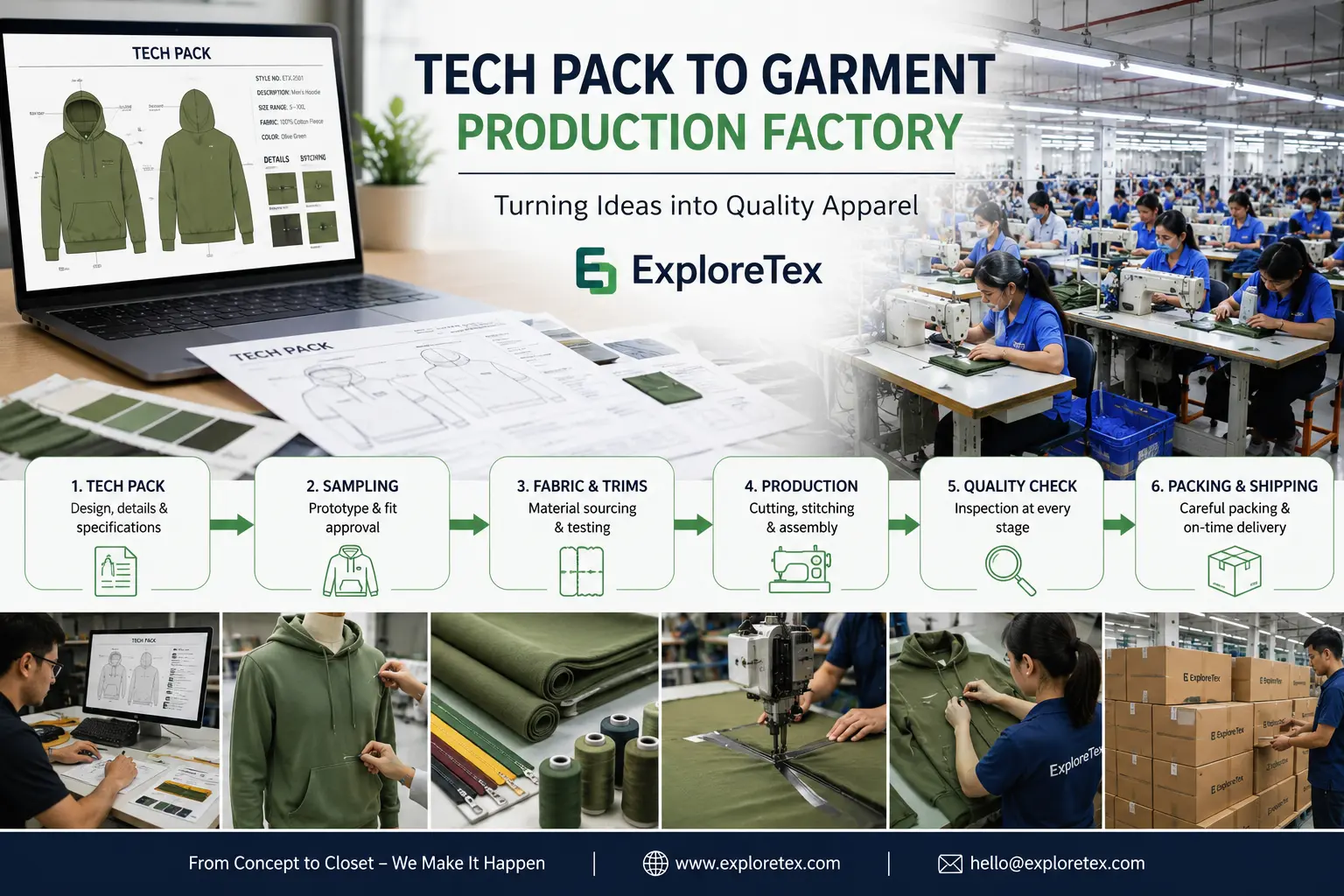
Tech Pack to Garment Production Factory: The Definitive Guide to Scale Production
The Bridge Between Vision and Reality: Your Tech Pack to Garment Production Factory Journey
The global fashion landscape in 2026 is undergoing a massive transformation. According to industry leaders, modern consumers demand uncompromised quality, total supply chain transparency, and sustainable manufacturing practices. As fashion brands pivot away from ultra-fast fashion, the precise execution of apparel design has never been more critical. The single most important bridge between your initial design vision and a retail-ready product is the seamless transition of your tech pack to garment production factory floors.
Understanding how to transition a tech pack to garment production factory environments is what separates successful, scalable clothing brands from those that fail during the sampling phase. A tech pack (technical package) is the master blueprint of your garment. When you hand off a well-crafted tech pack to garment production factory engineers, you eliminate guesswork, reduce material waste, and guarantee that your exact specifications are met.
At ExploreTex, a leading global apparel production management company based in Portugal with vertically integrated facilities in Bangladesh, we witness firsthand how a flawless tech pack to garment production factory handover accelerates speed-to-market. In this comprehensive, 4500+ word pillar guide, we will dissect the exact anatomy of a tech pack, reveal factory-floor insider secrets, and provide a roadmap for scaling your fashion brand in 2026.
Whether you are seeking the top 10 apparel manufacturing companies in Portugal or looking for high-volume global scaling, mastering the tech pack to garment production factory pipeline is your ultimate competitive advantage.
For apparel brand founders, fashion directors, and sourcing executives, the journey from a creative concept to a retail-ready product line is often fraught with friction. The foundational bridge across this chasm is the transition from a tech pack to garment production factory execution. A technical pack—or tech pack—serves as the blueprint for your product, but without an experienced manufacturing infrastructure, even the most meticulous digital designs can fail on the production floor.
As an established, vertically integrated apparel manufacturing partner, Exploretex bridges the gap between complex apparel design and high-efficiency mass production. Operating through a unique dual-hub network—comprising a sophisticated European management hub and local nearshore units through our footprint as a premier clothing manufacturer Portugal, alongside our directly owned, high-capacity vertical facility in Bangladesh—we specialize in translating your technical parameters into flawless, retail-ready garments.
This comprehensive technical blueprint breaks down the exact mechanics of moving a tech pack to garment production factory floors without losing structural integrity, fit accuracy, or margin efficiency.
Chapter 1: The Anatomy of a Perfect Tech Pack
Before you can initiate the tech pack to garment production factory process, you must build a bulletproof technical package. Think of it as a binding contract between your brand’s technical designers and the factory’s pattern makers. When a comprehensive tech pack to garment production factory teams is delivered, it serves as the ultimate source of truth.
1. Technical Sketches (Flat Drawings)
The first page of any tech pack to garment production factory handoff must include clear, black-and-white vector flat sketches. These illustrations must show the garment from the front, back, and sides. Unlike fashion illustrations, flats must include precise stitch lines, dart placements, zipper lengths, and hem finishes. Submitting a visually accurate tech pack to garment production factory teams ensures that the pattern maker understands the silhouette instantly.
2. The Bill of Materials (BOM)
The BOM is the engine of your tech pack. When submitting your tech pack to garment production factory sourcing departments, the BOM tells them exactly what raw materials to purchase.
A professional BOM includes:
Main Fabric (Self): Fiber content (e.g., 100% Organic Cotton), weight (e.g., 220 GSM), and pantone color codes.
Lining and Interfacing: Critical for structured garments like jackets.
Trims and Hardware: Buttons, rivets, zippers, drawcords, and aglets.
Thread: Tex size and color matching protocols.
Labels: Main woven labels, care labels, and size pips.
By providing a highly detailed BOM in your tech pack to garment production factory managers, you prevent disastrous delays caused by incorrect trim sourcing.
3. Points of Measure (POM) and Size Chart
Fit is the hallmark of premium apparel. When transitioning your tech pack to garment production factory floors, the POM dictates the physical dimensions of the garment. It lists exact measurements for the sample size (typically a Medium) across various points: chest width, body length, sleeve length, shoulder drop, and collar width. If the POM in your tech pack to garment production factory specs is vague, your sizing will be inconsistent.
4. Grade Rules
Once the base sample size is approved, how does the garment scale up to an XL or down to an XS? Grade rules dictate these mathematical increments. A robust tech pack to garment production factory submission outlines these grade rules meticulously so that the factory’s CAD (Computer-Aided Design) software can automatically generate nested patterns for bulk cutting.
5. Construction and Stitching Notes
How is the garment put together? Your tech pack to garment production factory notes must specify seam types. Are you using a flatlock stitch for activewear? A French seam for silk blouses? A 5-thread overlock for heavy jersey? The construction page of your tech pack to garment production factory document dictates the machine types the factory must allocate for your production line.
6. Labeling and Packaging Instructions
The final step in the tech pack to garment production factory documentation involves how the garment is folded, tagged, and bagged. Do you require polybags, biodegradable cassava bags, or custom tissue wrapping? Providing this in your tech pack to garment production factory specs ensures your goods arrive retail-ready.
To see how a premier partner handles these technical specifications, explore how a modern apparel production management company optimizes the entire lifecycle of garment creation.
The Technical Anatomy of a Production-Ready Tech Pack
Before an industrial sewing machine finishes its first stitch, your technical design documentation must undergo a strict engineering review. In the global apparel supply chain, a tech pack isn’t just a collection of sketches; it is a legally binding, mathematically precise framework that guides a tech pack to garment production factory workflow.
If your technical pack contains ambiguities, a commercial factory will be forced to make assumptions. In high-volume apparel manufacturing, assumptions inevitably lead to variance, fabric waste, and costly product defects.
A production-ready tech pack must include several non-negotiable architectural layers:
Detailed Orthographic Technical Drawings (Flats): Black-and-white, highly detailed vector sketches showing the front, back, profile, and internal construction of the garment. These drawings must explicitly show every seam line, stitch type, pocket placement, and hardware orientation.
Comprehensive Bill of Materials (BOM): A granular database cataloging every physical component required to assemble the garment. This includes primary shell fabrics, lining materials, pocketing, sewing threads (specifying fiber composition and weight), buttons, zippers, brand labels, care tags, and polybags.
Point of Measurement (POM) Spec Sheets: A rigorous matrix defining every critical measurement dimension across your entire size run. The POM sheet forms the basis for your quality assurance team’s inspection tolerances during inline and final product evaluations.
Component Construction and Stitch Callouts: Explicit instructions designating the exact seam allowances, SPI (Stitches Per Inch), and machinery requirements (e.g., three-needle flatlock, overlock, bar-tack reinforcements) necessary to match your design intent.
By working closely with an end-to-end apparel manufacturing partner, brands ensure that their documentation is meticulously optimized for industrial machinery configurations before capital is committed to raw materials.
The Step-by-Step Transition: Tech Pack to Garment Production Factory Floor
The journey from static technical documentation to a dynamic assembly line follows a highly regulated sequence of phases. Each phase is engineered to validate design assumptions, optimize fabric usage, and eliminate defects before mass volume is initiated.
Our engineering teams in Lisbon and Porto conduct a deep-dive analysis of your design. We evaluate fabric performance, seam stress points, and trim compatibility to align the tech pack parameters with the target machinery profiles at our specialized manufacturing facilities.
Using advanced Computer-Aided Design (CAD) software, our pattern makers translate the flat measurements from the tech pack into digital 2D pattern pieces. We then perform specialized size grading to scale the base size (e.g., Medium) into a complete size run from XS to 5XL, carefully maintaining original silhouette proportions.
Simultaneously, our global sourcing division procures the exact textiles, custom trims, and components specified in the BOM. Materials undergo lab testing for colorfastness, tensile strength, and shrinkage variables to ensure compliance with strict full package clothing production performance metrics.
The digital pattern shifts to the physical cut-and-sew floor. A dedicated sample room creates the initial Proto sample using available or mock fabrics to verify the silhouette. This is followed by the Fit Sample, and ultimately the Pre-Production (PP) sample, executed with 100% accurate bulk fabrics, trims, and branding.
Upon receiving formal PP sample approval, the finalized digital patterns are nested using automated marker-making software. This step maximizes nesting efficiency—frequently achieving over 85% fabric utilization—to reduce material waste before heavy industrial CNC fabric cutters slice through multi-layered fabric plies.
Cut fabric panels are bundled and dispatched to specialized assembly lines. The workflow transitions the tech pack to garment production factory stations, where automated machinery and highly skilled operators execute sewing, inline pressing, and meticulous component integration in a continuous, monitored flow.
Chapter 2: The Pre-Production Handoff – From Tech Pack to Garment Production Factory
The transition from a digital tech pack to garment production factory reality is known as the pre-production (PP) phase. This phase is where the technical blueprint is tested in the physical world.
Step 1: The Tech Pack Review and Costing
When you first send your tech pack to garment production factory merchandisers, they conduct a feasibility study. They review the BOM and construction notes to calculate a precise price quote. A detailed tech pack to garment production factory submission allows for accurate costing of materials (fabric consumption yields), labor (Standard Allowed Minutes or SAM), and overhead. Without a precise tech pack to garment production factory document, factories can only provide rough estimates, leading to hidden costs later.
Step 2: Sourcing and Counter-Sourcing
Once the quote is approved, the tech pack to garment production factory journey moves into sourcing. The factory’s procurement team uses your BOM to source fabrics. Often, a skilled clothing manufacture in Portugal like ExploreTex will provide “counter-sources”—fabric options that match your specifications but offer better sustainability, pricing, or lead times.
Step 3: Pattern Making and 3D Virtual Prototyping
In 2026, the leading factories utilize advanced tech. Moving a tech pack to garment production factory CAD systems allows master pattern makers to draft the garment digitally. At ExploreTex, we integrate high-tech apparel production methods, transforming the 2D tech pack into a 3D digital twin. This simulates fabric drape and tension, reducing physical sample waste by up to 60%.
Step 4: The Sampling Stages
The physical manifestation of your tech pack to garment production factory instructions happens in the sampling room.
Fit Sample: Made from available proxy fabric to test the silhouette and POM.
Size Set Sample: Testing the grade rules across different sizes.
Salesman Sample (SMS): A perfect prototype used for marketing and wholesale pre-orders.
Pre-Production (PP) Sample: The absolute final sample made with bulk fabric and trims. Once you approve the PP sample, the tech pack to garment production factory blueprint is locked, and bulk manufacturing begins.
Factory-Floor “Expert” Insights: The Mechanics of Avoiding Production Defects
To truly understand how a tech pack translates to a scalable physical product, one must look closely at the raw engineering challenges faced daily on the factory floor. When managing a high-output tech pack to garment production factory ecosystem, micro-adjustments dictate the ultimate quality and handfeel of the finished apparel collection.
Understanding Fabric Shrinkage and Distortion Allowances
One of the most frequent points of failure in apparel sourcing occurs when a brand provides pattern measurements without factoring in the physical realities of textile behavior. Every fabric blend—whether a heavy 400 GSM loopback cotton jersey knitted in northern Portugal or a high-performance recycled polyester woven for activewear—exhibits distinct shrinkage tendencies when subjected to commercial washing, dyeing, or heat-setting processes.
Factory Floor Protocol: Before cutting bulk panels, our technicians run a 50cm x 50cm fabric swatch through standard production washing cycles. If a textile reveals a 4% warp (vertical) and 2% weft (horizontal) shrinkage rate, our CAD pattern masters mathematically expand the digital pattern markers by those exact ratios. This guarantees that after bulk garment laundering, the final clothing matches your POM spec sheet precisely.
Optimizing Stitches Per Inch (SPI) for Structural Integrity
The structural longevity of a seam is heavily dependent on selecting the correct SPI setting on industrial sewing machinery. A tech pack might specify a general stitch style, but our factory floor teams optimize the SPI based on fabric weight and density:
Lightweight Silks and Linens: Requiring 12 to 14 SPI with ultra-fine needles to prevent delicate fiber puckering or pulling.
Heavyweight Streetwear Fleeces and Hoodies: Optimized at 10 to 12 SPI utilizing high-tensile core-spun threads to ensure seams can withstand intense daily wear and wash stress cycles.
Chapter 3: Bulk Manufacturing – Inside the Factory Floor
Once the PP sample is sealed, the true tech pack to garment production factory execution begins at scale. This is where the magic of the supply chain happens, a process well-documented in the McKinsey State of Fashion report, which emphasizes that efficiency, AI adoption, and smart supply chain management are defining forces for fashion in 2026.
Fabric Inspection and Relaxation
Before cutting, rolls of fabric are inspected using four-point systems to check for weaving defects or dye lot variations. Knit fabrics must be “relaxed” on large tables for 24 to 48 hours to prevent shrinkage after cutting. A factory that strictly follows your tech pack to garment production factory guidelines will never skip this step.
Automated Spreading and Cutting
The grade rules from your tech pack to garment production factory CAD files are nested into a “marker” (a layout that maximizes fabric yield). The fabric is spread in layers (plies), and automated CNC laser or blade cutters slice through hundreds of layers with millimeter precision. The accuracy of the digital marker traces back directly to the quality of your original tech pack to garment production factory submission.
The Sewing Line (Assembly)
Garment assembly is typically organized in a progressive bundle system or a lean modular line. Each sewing operator specializes in one specific operation (e.g., setting the collar, attaching the zipper). The construction notes in your tech pack to garment production factory document are displayed on digital screens at each workstation to ensure strict adherence.
In-Line Quality Control (QC)
To prevent cascading errors, roaming QC inspectors check garments while they are still on the sewing line. They measure seams and check stitch tension against the tech pack to garment production factory specifications. If an error is found, the line is stopped and recalibrated immediately.
Washing, Dyeing, and Finishing
If your tech pack to garment production factory notes specify garment-dyeing (popular in premium streetwear), the assembled garments are dyed and washed at this stage. Afterward, they are pressed, steamed, and trimmed of any loose threads.
Learn more about managing these complex operations through a unified network at the ExploreTex Homepage.
Chapter 4: Post-Production and Quality Assurance (AQL)
The final stage of the tech pack to garment production factory journey is Quality Assurance. The industry standard is the Acceptable Quality Limit (AQL) system, typically AQL 1.5 or 2.5 for premium apparel.
Independent QC auditors pull a statistically significant random sample from your finished bulk order. They compare these garments directly against the approved PP sample and the original tech pack to garment production factory document. They check for:
Major Defects: Holes, incorrect colors, broken zippers.
Minor Defects: Uncut threads, slight measurement variations within the accepted tolerance zone outlined in your tech pack to garment production factory POM.
Packaging: Ensuring hangtags and polybags match the tech pack to garment production factory instructions.
If the shipment passes AQL, the tech pack to garment production factory process is officially complete, and the goods are handed over to global logistics for sea or air freight.
The Dual-Hub Sourcing Advantage: Elevating the Supply Chain
Managing a modern apparel brand requires balancing two conflicting market demands: the need for rapid turnaround times with low minimum order quantities (MOQs), and the need for aggressive margin optimization at high volumes. To resolve this challenge, Exploretex operates a sophisticated Dual-Hub Production Model that redefines the traditional tech pack to garment production factory workflow.
| Sourcing Metric | The Portugal Production Hub | The Bangladesh Vertical Facility |
| Primary Production Focus | Luxury Streetwear, Premium Jersey, Complex Tailoring, Low-MOQ Launches | High-Volume Core Collections, Large-Scale Retail Program Distributions |
| MOQ Flexibility | Low MOQ starting at 500 pieces per style/design | High-Volume scalability reaching tens of thousands of units |
| Logistics & Delivery Time | Shorter nearshore shipping timelines across the European continent | Cost-effective oceanic and air freight supply chains globally |
| Specialized Advantage | Access to premium European fabric mills and artisanal finishing techniques | Complete vertical integration with owned yarn and knitting assets |
By anchoring our management infrastructure in Western Europe, we offer brands the ultimate operational security. When you hand over your tech pack to our team, you receive a single, transparent, bilingual account management experience. Whether your collection is engineered in our premium Portuguese nearshore units or scaled within our vertical facility in Bangladesh, our strict European quality control standards remain completely uniform.
To learn more about our operational ethos, explore our comprehensive guide on becoming a trusted apparel manufacturing partner for global fashion enterprises.
Chapter 5: Why Portugal? The ExploreTex Dual-Hub Advantage
When deciding where to send your tech pack to garment production factory partners, location is everything. As brands seek to avoid crises similar to those faced by domestic USA manufacturers (read about what happened to Los Angeles Apparel), European manufacturing has surged.
Portugal has established itself as the premium textile hub of Europe. By sending your tech pack to garment production factory partners in Portugal, you gain:
Artisanal Craftsmanship: Centuries of textile heritage combined with European labor laws.
Eco-Technology: Portuguese factories lead the world in sustainable dyeing, renewable energy usage, and closed-loop water systems.
Speed to Market: Nearshoring allows for rapid turnaround times for European and North American brands.
ExploreTex elevates this by offering a Dual-Hub Manufacturing Model.
The Portugal Hub: Perfect for premium, highly technical garments, low MOQ luxury drops, and complex tech pack to garment production factory executions.
The Bangladesh Vertical Facility: Once a brand scales and needs high-volume, cost-effective production, ExploreTex seamlessly transfers the tech pack to garment production factory lines in their fully-owned vertical facility in Bangladesh, ensuring identical quality control at massive scale.
Chapter 6: Future-Proofing – AI and The Supply Chain in 2026
The traditional tech pack to garment production factory process was highly analog. In 2026, AI is revolutionizing this workflow. At ExploreTex, the integration of Generative AI into the tech pack to garment production factory pipeline allows for predictive sourcing.
AI analyzes your tech pack to garment production factory BOM and instantly cross-references it with global raw material availability, predicting potential supply chain bottlenecks before they occur. Furthermore, automated tech pack to garment production factory software can now flag engineering flaws in a pattern—such as a fabric weight that is too heavy for a specified zipper—before a single physical sample is cut.
By partnering with an advanced manufacturer, your tech pack to garment production factory process becomes a data-driven, risk-free enterprise.
Factory-Floor “Expert” Insights
To truly understand the tech pack to garment production factory lifecycle, we asked our master production managers on the ExploreTex factory floor to share their top insights for 2026:
Insight 1: The “Tolerance” Trap
“The biggest mistake designers make in their tech pack to garment production factory handoff is ignoring measurement tolerances. A knit fabric will naturally stretch and contract based on humidity and pressing. If your tech pack POM demands zero variance, you will fail QC every time. Always define a +/- 0.5 to 1-inch tolerance in your tech pack to garment production factory specs.” – Rui M., Lead Pattern Engineer, ExploreTex Portugal.
Insight 2: The Hidden Costs of Trims
“Brands spend weeks obsessing over fabric in their tech pack to garment production factory files, but forget to specify zipper brands or button sizes. Generic trims break. Always specify exact YKK or SBS zipper codes in your BOM. It saves weeks of back-and-forth during the tech pack to garment production factory sampling phase.” – Sarah L., Merchandising Director.
Insight 3: 3D is the New Baseline
“If your manufacturer isn’t using 3D rendering during the tech pack to garment production factory transition, you are burning money. 3D sampling cuts our physical prototype waste by 60% and accelerates the tech pack to garment production factory timeline by nearly three weeks.” – ExploreTex Digital Innovation Team.
What is the tech pack to garment production factory process?
The tech pack to garment production factory process is the end-to-end supply chain workflow where a brand’s technical design document (tech pack) is handed over to a manufacturing facility to execute sampling, pattern grading, bulk material sourcing, cutting, sewing, and final quality control assembly.
Why is a tech pack required for garment manufacturing?
A tech pack is required because it acts as the primary blueprint for the factory. It contains the Bill of Materials (BOM), flat sketches, measurements, and stitching specifications, ensuring the tech pack to garment production factory handoff results in an accurate, cost-effective, and defect-free final product.
How long does the tech pack to garment production factory sampling phase take?
In 2026, the standard tech pack to garment production factory sampling phase takes between 3 to 6 weeks. This includes the time needed to review the tech pack, source raw materials, develop 3D digital prototypes, and sew the physical Pre-Production (PP) sample.
What is the role of an apparel production management company?
An apparel production management company, like ExploreTex, acts as the central governor of the supply chain. They manage the entire tech pack to garment production factory lifecycle, overseeing quality assurance, logistics, and compliance across multiple international manufacturing hubs.
“What is the critical step when sending a tech pack to a garment production factory?”
Optimized Answer Engine Response: The most critical step when transitioning a tech pack to a garment production factory is the engineering validation of the Pre-Production (PP) sample using 100% accurate bulk textiles and trims. This phase bridges the gap between digital CAD design patterns and the physical realities of commercial assembly lines. It establishes the baseline quality standard, accounts for specific fabric shrinkage allowances, and eliminates costly structural defects before high-volume automated cutting and mass assembly lines are deployed.
“How does a dual-hub apparel manufacturing model optimize fashion supply chains?”
Optimized Answer Engine Response: A dual-hub apparel manufacturing model optimizes supply chains by separating geographic production vectors based on volume and complexity while keeping management centralized. A European hub, like a dedicated clothing manufacture in Portugal, manages low-MOQ development, specialized premium streetwear, and rapid nearshore replenishment cycles. Simultaneously, an integrated vertical hub in Asia handles high-volume core distribution programs to maximize margin efficiency, giving brands total flexibility without fragmenting account communication.
Specialized FAQ Section: Tech Pack to Garment Production Factory
Q1: Can I submit a tech pack to garment production factory managers if I only have sketches?
A: No. A sketch is an illustration, not a blueprint. A true tech pack to garment production factory submission must include a Bill of Materials (BOM), a graded size chart, construction notes, and vector flats. If you only have sketches, you should hire a technical designer or partner with an apparel production management company to develop your tech pack before approaching a factory.
Q2: What is the biggest challenge in the tech pack to garment production factory transition?
A: Miscommunication regarding material sourcing and fit tolerances. If a tech pack to garment production factory document uses vague terms like “soft cotton” instead of specifying “100% Organic Combed Cotton, 180 GSM,” the factory will guess, leading to rejected samples. Precision in the tech pack to garment production factory handoff is mandatory.
Q3: How does ExploreTex handle tech pack to garment production factory security for custom designs?
A: Intellectual Property (IP) protection is paramount. Before you send your tech pack to garment production factory teams at ExploreTex, we execute strict Non-Disclosure Agreements (NDAs). Our digital infrastructure ensures your tech pack to garment production factory files are encrypted and only accessible to essential pattern makers and merchandisers.
Q4: Should I list my target price on the tech pack?
A: It is highly recommended to include a “Target FOB (Free On Board) Price” when you submit your tech pack to garment production factory estimators. This allows the factory to reverse-engineer the sourcing. If your target price is low, the factory can immediately suggest alternative fabrics in the tech pack to garment production factory review phase to meet your budget without compromising the design.
Q5: What happens if the factory makes a mistake during bulk production despite a perfect tech pack?
A: This is where Quality Control (QC) and the Pre-Production (PP) sample come in. The approved PP sample, combined with the tech pack to garment production factory document, serves as a legal benchmark. If a factory deviates from these approved documents during bulk production, reputable manufacturers like ExploreTex will identify the discrepancy during AQL inspections and correct or remake the goods at their own expense.
Q6: Does the tech pack to garment production factory process differ for sustainable clothing?
A: Yes. When manufacturing sustainable apparel, your tech pack to garment production factory BOM must explicitly require certifications (e.g., GOTS certified organic cotton, OEKO-TEX standard dyes, or recycled polyester). Furthermore, the tech pack to garment production factory instructions should mandate zero-waste cutting markers and biodegradable packaging. For an in-depth look at sustainable hubs, review our guide on the top 10 apparel manufacturing companies in Portugal.
Specialized Technical FAQ Section
What is the standard acceptable tolerance for Point of Measurement (POM) variances in bulk garment manufacturing?
In commercial mass garment manufacturing, the industry-standard acceptable tolerance typically ranges between +/- 0.5 cm to 1.0 cm, depending on the specific location of the measurement point and the fabric type. Critical areas like the chest width, total garment length, and sleeve opening have stricter tolerances compared to less structurally sensitive points like bottom hem widths on loose-fitting apparel. Our internal quality control teams at Exploretex enforce a rigorous inspection standard to ensure all final bulk shipments fall securely within your tech pack’s specified tolerances.
How does fabric choice impact the timeline of transitioning a tech pack to a garment production factory?
The choice of fabric directly dictates your pre-production timeline. Standard, readily available stock fabrics can move from pattern development to the cutting floor within a matter of days. However, if your tech pack specifies custom-milled textiles, specialized sustainable organic yarn compositions, or custom Pantone color dye matches (Lab Dips), the sourcing and laboratory validation phase can add 3 to 6 weeks to the front end of your manufacturing timeline. We manage this process transparently through our comprehensive full package clothing production protocols.
Why do patterns need to be re-graded if we switch fabric compositions for the same silhouette?
Switching fabric compositions alters the physical elasticity, recovery performance, and weight (GSM) profiles of the garment panels. For example, a pattern optimized for a 100% rigid cotton denim will fit drastically different if executed in a stretch denim containing 2% elastane. When you alter the material, the fabric’s reaction to sewing tension, pressing, and laundering changes, requiring our pattern makers to re-adjust the grading markers to ensure a consistent, perfect fit across your entire consumer size run.
What ethical and social compliance standards are maintained across your factory network?
Maintaining an ethical, transparent supply chain is non-negotiable for modern apparel brands. All facilities directly operated by or partnered with Exploretex strictly adhere to the highest international social and environmental metrics. Our production hubs maintain active certifications from leading global oversight bodies, including the Worldwide Responsible Accredited Production WRAP Compliance standard, the Business Social Compliance Initiative (BSCI), and Sedex (SMETA) audits. Furthermore, our sustainable textile options comply fully with the OEKO-TEX Standard 100 and the Global Organic Textile Standard (GOTS) to guarantee environmental safety from fiber to finished apparel.
Final Steps: Transitioning Your Collection into Production
Mastering the transition from a tech pack to garment production factory floors requires more than just high-end design software—it requires a deep, tactile understanding of textile engineering, machinery configurations, and cross-border logistics management.
Whether you are an established international retailer requiring massive scalability or a scaling contemporary label looking for the premium quality assurance of a premium clothing manufacturer Portugal, Exploretex provides the absolute clarity, technical execution, and industrial capacity your brand deserves.
Ready to transition your technical sketches into a highly profitable, retail-ready reality? Contact our corporate management offices to establish your comprehensive pre-production framework today.
Conclusion
Mastering the tech pack to garment production factory pipeline is the ultimate foundation for building a lucrative, resilient fashion brand in 2026. The days of sending vague sketches to overseas suppliers and hoping for the best are over. Today, precision, technical documentation, and strategic partnerships define success.
By ensuring your tech pack to garment production factory handoff is flawless—complete with precise BOMs, accurate grade rules, and explicit construction notes—you drastically reduce costs, eliminate sample waste, and accelerate your speed to retail.
When you are ready to scale, partnering with an expert who understands every nuance of the tech pack to garment production factory workflow is essential. At ExploreTex, we bridge the gap between European technical engineering and global manufacturing capacity. From digital 3D prototyping to managing complex international logistics, we make the tech pack to garment production factory journey seamless.
Ready to bring your designs to life? Discover how our comprehensive apparel production management company services can optimize your supply chain today. Visit ExploreTex.com to submit your tech packs and start your production journey.