
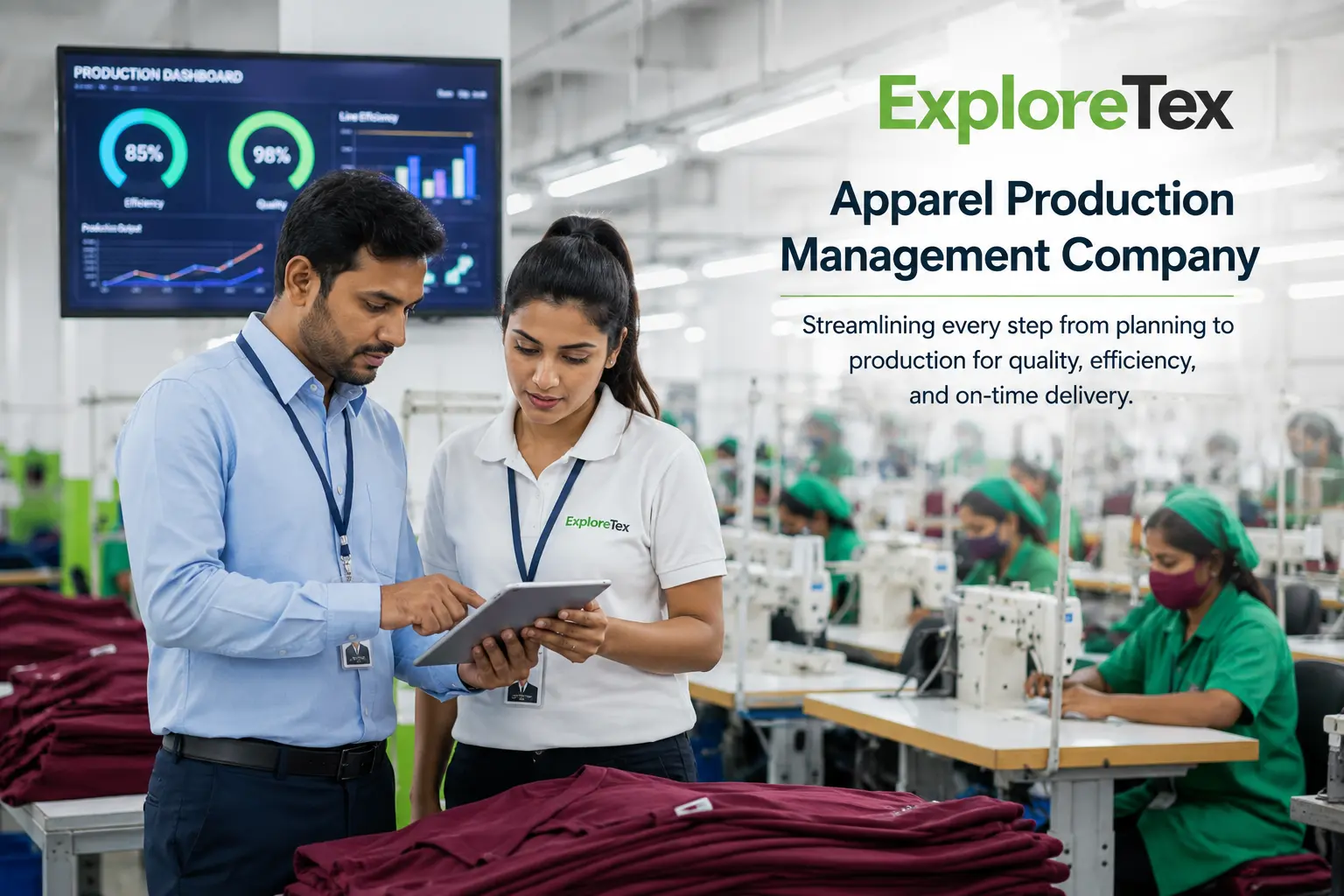
The Ultimate Guide to Scaling Your Fashion Brand With an Apparel Production Management Company
Subtitle: How a strategic dual-hub manufacturing approach—bridging Portuguese craftsmanship with high-volume global scaling—is revolutionizing private label fashion.
In the rapidly shifting landscape of global fashion, launching a clothing brand is merely the first step; scaling it sustainably is where the true challenge lies. For emerging designers, established streetwear labels, and luxury fashion houses, the supply chain is the backbone of success. Navigating fabric sourcing, tech pack development, international quality compliance, and ethical labor standards requires immense oversight. This is precisely why partnering with a specialized apparel production management company has become the gold standard for fashion brands looking to dominate the modern market.
As an industry-leading apparel production management company, ExploreTex has revolutionized the traditional manufacturing model. By operating a unique Dual-Hub network—featuring a managed production headquarters in Portugal and a directly operated high-capacity facility in Bangladesh—we offer brands a seamless, end-to-end manufacturing solution. This pillar article provides a pure, educational deep-dive into what an apparel production management company actually does, how it transforms your business, and why bridging European quality with global scale is the future of fashion.
What is an apparel production management company? An apparel production management company is an end-to-end manufacturing partner that oversees the entire lifecycle of garment creation for fashion brands. Unlike a traditional cut-and-sew factory that only handles assembly, a comprehensive apparel production management company manages tech pack development, 3D prototyping, fabric sourcing, pattern grading, bulk manufacturing, quality control (AQL), and global door-to-door shipping. By acting as a single point of contact, an apparel production management company mitigates supply chain risks, ensures legal and ethical compliance, and allows fashion labels to scale production without sacrificing quality or brand integrity.
The Evolving Landscape of Global Fashion Manufacturing
The textile industry is undergoing a massive transformation. According to leading insights from the McKinsey State of Fashion report, modern consumers demand transparency, rapid turnaround times, and uncompromised quality. The days of sending a rough sketch to an unverified overseas factory and hoping for the best are over.
Brands today face a trifecta of challenges:
Quality Consistency: Maintaining the exact same fit, feel, and finish across thousands of units.
Ethical Transparency: Ensuring factories meet global standards like GOTS, WRAP, and BSCI.
Cost vs. Scale: Balancing the high cost of luxury European manufacturing with the minimum order quantities (MOQs) required by high-volume Asian factories.
This is where a dedicated apparel production management company steps in. By taking total ownership of the supply chain, an apparel production management company acts as your brand’s internal operations team. When you Learn more about us, you will see that ExploreTex doesn’t just source; we engineer.
Chapter 1: The Modern Apparel Supply Chain Crisis and The Emergence of Production Management Systems
The global fashion landscape faces structural transformations driven by volatile consumer demand, compressed trend cycles, and rising regulatory scrutiny. Traditional sourcing strategies built on fragmented multi-tier networks are struggling to keep pace. For decades, fashion brands operated on a linear, long-cycle purchasing model, forecasting styles up to twelve months in advance (Xu, 2026). This approach frequently results in massive overproduction, compounding markdowns, or devastating out-of-stock scenarios when a trend shifts abruptly.
When a brand distributes its sourcing across isolated raw material vendors, independent fabric mills, unverified dye houses, and disconnected cut-and-sew factories, structural vulnerabilities quickly compound. Misalignments in technical specifications, uncoordinated timelines, and a lack of unified oversight create systemic issues. Garments arrive late, color consistency drifts across production lots, and unexpected compliance violations surface deep within the tier-2 or tier-3 supplier base.
[Design & Tech Pack] ➔ [Independent Fabric Mill] ➔ [Fragmented Dye House] ➔ [Cut-and-Sew Factory] = High Risk of Drift
[Design & Tech Pack] ➔ ═══════ Integrated Apparel Production Management Company ═══════ ➔ Consistently Compliant Garments
To navigate these challenges, scaling fashion labels, premium lifestyle brands, and high-volume corporate buyers are shifting away from transactional brokering. Instead, they are partnering with an integrated apparel production management company. This type of dedicated apparel production management company acts as a central operational brain, aligning design intent with industrial factory floor realities.
A specialized apparel production management company manages the end-to-end lifecycle of a product category. This oversight spans from initial raw material yarn-forward engineering to final customs-cleared logistical delivery. This central governance structure transforms the traditional, fragmented supply chain into a synchronized competitive advantage. By working with a reliable apparel manufacturing partner, brands gain access to structured workflows, predictable production schedules, and rigorous quality control systems. This allows design and marketing teams to focus on brand building, knowing their manufacturing pipeline is under professional management.
The ExploreTex Advantage: The Dual-Hub Manufacturing Model
Not every apparel production management company is built the same. The traditional model forces brands to choose between two extremes: expensive artisanal European factories with long lead times, or massive Asian factories that require staggering MOQs and offer little communication.
As a forward-thinking apparel production management company, ExploreTex bridges this gap through our proprietary Dual-Hub Production Model.
1. The Portugal Production Hub (Premium & Artisanal)
Located in the heart of the Northern Portugal textile clusters (Porto, Braga, and Barcelos) and our Lisbon headquarters, this hub is dedicated to brands requiring the prestigious “Made in Portugal” label. As an apparel production management company rooted in European heritage, we utilize this hub for luxury streetwear, premium jersey, and high-end tailoring. This facility is perfect for brands focusing on GOTS-certified organic materials and world-class European finishing.
2. The Global Scaling Hub (High-Volume & Efficient)
To ensure our clients can scale profitably, our apparel production management company maintains a directly operated, high-capacity facility in Dhaka, Bangladesh. Unlike traditional sourcing agencies that outsource blindly, we maintain direct operational control and equity in this facility. This ensures factory-direct pricing for larger volume orders while maintaining the strict ethical and safety standards dictated by our European headquarters.
By combining these two distinct hubs, our apparel production management company offers unparalleled flexibility. You can sample and produce limited-run luxury items in Portugal, and later scale your best-sellers via our high-capacity hub in Bangladesh—all through a single apparel production management company.
Step-by-Step Supply Chain: From Tech Pack to Global Shipping
When you hire an apparel production management company, you are buying peace of mind. Here is the comprehensive, step-by-step process of how a world-class apparel production management company like ExploreTex brings your fashion vision to life. To view our full suite of capabilities, explore our services.
Step 1: Collection Planning & Tech Pack Development
Every successful garment begins with a technically flawless blueprint. A premium apparel production management company never relies on guesswork. During the strategic consultation phase, our Lisbon-based team defines your styles, sustainable fabric sourcing options, and custom trims.
If you do not have a technical blueprint, our apparel production management company will create a comprehensive Tech Pack. This document includes detailed garment specifications, construction diagrams, and a full Bill of Materials (BOM). This mathematical precision guarantees zero errors during bulk production.
Step 2: Brand Development & Private Label Compliance
Transforming a creative vision into a market-ready collection requires legal and branding expertise. As an experienced apparel production management company, we ensure your private label apparel meets international retail standards. We design custom brand assets (main labels, heat-transfer neck prints, hangtags) and ensure strict compliance with global textile regulations (EU, US, UK, and GCC). Our apparel production management company navigates the complexities of localized wash-care symbols and fabric composition percentages so you don’t face customs delays.
Step 3: Precision Pattern Making & Size Grading
Consistency in fit is the hallmark of a premium brand. A technically-driven apparel production management company ensures your designs translate perfectly across every body type. We convert tech packs into 1:1 digital patterns using advanced CAD software, eliminating human error. Our specialists then perform complex mathematical size grading (scaling from XS to 5XL). All digital files are archived by our apparel production management company, making future re-orders instant and scalable.
Step 4: Sample Development & 3D Virtual Prototyping
In 2026, speed and sustainability are critical. ExploreTex operates as a next-generation apparel production management company by utilizing 3D virtual sampling technology. Before cutting physical fabric, our apparel production management company creates a high-fidelity 3D digital twin of your garment, simulating realistic fabric drape and tension. This drastically reduces textile waste. Once the digital twin is approved, our apparel production management company moves to the physical cut-and-sew phase. Discover more about how we streamline this in our product development phase.
Step 5: Bulk Production & Strict Quality Control
Precision in mass manufacturing is where a brand’s reputation is either built or broken. As your dedicated apparel production management company, we manage bulk production with AQL (Acceptable Quality Limit) management. Whether you are producing intricate knitwear garments, heavy-duty denim, or specialized full-package collections via our full package services, our apparel production management company conducts rigorous pre-production, mid-line, and final-stage inspections.
Step 6: Global Shipping & Door-to-Door Logistics
The final stage of the supply chain is just as critical as the first stitch. A comprehensive apparel production management company eliminates the stress of international trade. We offer flexible freight solutions (Express Air Freight vs. Sea Freight) and handle all complex export documentation and customs clearance. Learn more about our seamless global delivery via our shipping operations.
Chapter 2: Decoupling Complexity—What Does an Apparel Production Management Company Actually Do?
To understand the value of an apparel production management company, it is essential to look at the dozens of individual touchpoints required to take a creative sketch and transform it into thousands of shelf-ready, retail-grade garments. A professional apparel production management company does not simply pass a tech pack to a factory floor and hope for the best. Instead, they embed comprehensive management protocols at every phase of execution.
1. Tech Pack & Pattern Optimization
   ↓
2. Raw Material & Trims Sourcing
   ↓
3. Sample Iteration & Fit Approvals
   ↓
4. Fabric Lab Testing (Shrinkage, Colorfastness)
   ↓
5. Bulk Fabric Knitting/Weaving & Dyeing
   ↓
6. Pre-Production (PP) Meeting & Line Allocation
   ↓
7. Automated Fabric Spreading & Cutting
   ↓
8. In-Line Sewing & Critical Assembly Control
   ↓
9. 100% End-of-Line Inspection
   ↓
10. Final AQL 2.5 Audit, Pressing, & Packing
1. Technical Design and Pattern Engineering Optimization
Every successful production run depends on the accuracy of the initial technical data package. An experienced apparel production management company reviews each tech pack to identify potential production bottlenecks before any fabric is cut. This process involves translating creative ideas into clear manufacturing parameters:
Developing graded size specs across complex size ranges using precise CAD software.
Optimizing fabric consumption through advanced marker-making layouts, minimizing textile waste on the cutting table.
Adjusting seam constructions to match the specific properties of chosen fabrics, preventing common issues like seam slippage in lightweight materials or bulkiness in heavy knits.
Standardizing internal shrinkage allowances based on systematic fabric testing.
2. Comprehensive Material Sourcing and Supply Chain Integration
Fabric and trim costs typically account for 50% to 70% of a garment’s total FOB (Free on Board) cost. A well-connected apparel production management company leverages its long-term relationships with yarn spinners, knitting mills, and trim manufacturers to source high-quality materials at scale. They manage the complex logistics of coordinating main fabrics, contrast linings, custom-dyed buttons, zippers, and brand labels from multiple specialized suppliers. This ensures that every element arrives at the sewing lines simultaneously, avoiding costly assembly delays.
3. Rigorous Multi-Tier Quality Assurance Frameworks
Quality control is often a major pain point for brands manufacturing overseas. A dedicated apparel production management company addresses this risk by deploying full-time quality assurance inspectors directly onto the production floors. Rather than relying on a single final inspection when garments are already packed, a structured apparel production management company implements a multi-tier quality matrix:
Inbound Material Inspection: Testing raw fabrics against the 4-Point System to identify defects like yarn slubs, dye shading, or knit holes before production begins.
In-Line Inspections: Monitoring early sewing assembly lines to catch construction errors before they are repeated across thousands of units.
End-of-Line Quality Checks: Inspecting 100% of finished garments for measurements, stitching consistency, clean thread trimming, and visual appearance.
Final Pre-Shipment Audits: Conducting random statistical sampling based on international Acceptable Quality Limit (AQL 2.5) standards to verify that the final shipment matches all client specifications.
4. Direct Factory Floor Operations and Capacity Planning
Managing factory capacity requires balancing machine efficiency with skilled labor. An apparel production management company works closely with production planners to analyze time-and-motion studies, establish accurate Standard Allowed Minutes (SAM) for each design, and set up balanced assembly lines. This level of floor management prevents production bottlenecks, ensures workers are compensated fairly for their output, and keeps delivery dates on schedule.
Factory-Floor “Expert” Insights
To truly understand the value of an apparel production management company, one must look closely at the granular, day-to-day operations on the factory floor. Here are direct insights from the technical core of our apparel production management company:
Insight 1: The Fallacy of “Self-Fitting” “We conduct in-house technical fittings via live video conference, overseen by your dedicated Project Manager and our master Pattern Maker,” notes the lead engineering team at our apparel production management company. “To ensure retail-grade accuracy, we strictly require the use of a professional fit model rather than ‘self-fitting.’ Because body proportions vary wildly, fitting a garment on yourself can lead to severe technical errors in the final silhouette. An expert apparel production management company will always assist you in selecting the ideal fit model to guarantee international sizing standards.”
Insight 2: The Importance of Category-Specific Pattern Makers Not all pattern makers are created equal. A specialized apparel production management company knows that the architecture of a tailored blazer is entirely different from a high-stretch activewear legging. “Patterns are the essential architectural blueprint of your collection. At our apparel production management company, we ensure absolute precision by assigning a specialist Pattern Maker who exclusively focuses on your specific product category. This ensures a flawless technical foundation for your brand with zero margin for error.”
Insight 3: Navigating Fabric Sourcing with an Apparel Production Management Company Sourcing is often the most overwhelming step for new brands. “Our apparel production management company provides a curated directory of premium vendors to streamline your sourcing process,” our experts explain. “We manage the entire legwork by directly supplying high-quality fabrics and trims, leaning heavily on our vast network of sustainable suppliers.”
Sustainability and Compliance: The Role of an Apparel Production Management Company in 2026
As environmental regulations tighten globally, partnering with an eco-conscious apparel production management company is no longer optional; it is a legal and ethical imperative. Consumers are actively demanding transparency, and organizations like the Global Organic Textile Standard (GOTS) have set strict benchmarks.
How does a premium apparel production management company ensure sustainability?
Certified Organics: A reputable apparel production management company provides access to GOTS-certified organic cotton and linen, ensuring no toxic pesticides are used in the farming process.
Recycled Fibers: Your apparel production management company should offer GRS-certified (Global Recycled Standard) recycled polyester and regenerated nylon to support circular fashion.
Eco-Friendly Dyes: Water pollution is a major industry issue. Our apparel production management company utilizes non-toxic, eco-friendly dyes and water-based printing methods to protect local ecosystems.
Ethical Labor: True sustainability includes human rights. An ethical apparel production management company operates under strict social certifications, including BSCI, WRAP, SEDEX, and SMETA. Our apparel production management company ensures fair living wages, safe working conditions, and complete operational transparency across both our Portugal and Bangladesh hubs.
For more insights into modern textile sustainability and the changing tides of the industry, read the latest articles on our dedicated blogs page.
Chapter 3: The Hybrid Sourcing Paradigm—Combining Portugal’s Premium Craftsmanship with Bangladesh’s Vertical Powerhouse
A major advantage of working with a modern apparel production management company like Exploretex is the ability to leverage a hybrid sourcing model. Exploretex is a registered Portuguese brand with its corporate headquarters and product development hub in Portugal. The company operates a dual-production system that combines the distinct advantages of two major global manufacturing hubs: nearshore flexibility in Portugal and cost-effective, high-volume vertical production in Bangladesh.
              ┌────────────────────────────────────────────────────────┐
              │      EXPLORETEX APPAREL PRODUCTION MANAGEMENT          │
              └───────────────────────────┬────────────────────────────┘
                                          │
                 ┌────────────────────────┴────────────────────────┐
                 ▼                                                 ▼
     PORTUGAL PARTNER FACTORIES                       BANGLADESH VERTICAL FACTORY
  ──────────────────────────────                    ─────────────────────────────
  • Proximity & Ultra-Fast Lead Times               • Fully Owned, Vertically Integrated
  • Low MOQ Market Testing & Capsule Drops          • Large-Scale Volume Efficiency
  • Premium Finishes & Complex Tailoring            • Direct Control from Raw Yarn to Carton
  • Zero Intra-EU Customs Friction                  • Maximum Cost Control & Compliance
The European Proximity Edge: Agile Production via Portugal
For premium capsule collections, fast-fashion responses to changing trends, and complex outerwear or structured tailoring, manufacturing within Europe offers clear operational benefits. By managing a trusted network of specialized partner factories inside Portugal, this European clothing manufacturers specialist provides brands with premium quality and rapid response capabilities.
Speed to Market: Nearshore production allows brands to go from final design approval to retail delivery in as little as 4 to 6 weeks. This quick turnaround enables companies to capitalize on mid-season trends and keep inventory lean.
Low Minimum Order Quantities (MOQs): Utilizing localized partner factories allows for lower minimum order volumes. This makes it feasible to produce exclusive capsule collections or test new designs without committing to large upfront capital.
Geographical Proximity: Being located within the European Union streamlines communication, allows for quick physical sample reviews, and completely eliminates intra-European customs duties and import friction.
The Global Volume Powerhouse: Vertical Efficiency via Bangladesh
When a brand needs to scale its core product lines—such as high-volume activewear, premium t-shirts, hoodies, loungewear, or woven essentials—cost efficiency and raw material control become top priorities. To meet this need, this innovative apparel production management company operates its own fully vertical production facility in Bangladesh.
Vertical Integration: Unlike simple contract sewing shops, a vertical factory manages every production stage in-house, starting directly with raw cotton yarn. The facility handles knitting, advanced fabric dyeing, finishing, automated cutting, high-speed sewing, and final packaging under one roof.
Strict Cost Control: By removing intermediate brokers and independent mills, a vertical apparel production management company eliminates overlapping markups. This approach delivers competitive FOB pricing for volume orders without compromising quality.
Guaranteed Production Capacity: Owning the vertical facility ensures that high-volume production lines are always accessible. Brands are protected from seasonal factory closures or unexpected capacity shifts, ensuring stable supply chains year-round.
Balancing the Supply Chain with Hybrid Agility
By combining these two distinct manufacturing hubs under a single management system, this versatile apparel production management company allows brands to optimize their product assortments strategically.
Overcoming Common Scaling Bottlenecks with an Apparel Production Management Company
When fashion brands attempt to scale without the support of an apparel production management company, they inevitably encounter severe operational bottlenecks. Understanding these friction points highlights why an apparel production management company is so vital to long-term success.
Bottleneck 1: The Minimum Order Quantity (MOQ) Trap
Many factories demand MOQs of 5,000+ pieces per style, which financially cripples emerging brands. Conversely, boutique factories might accept 50 pieces but charge astronomical unit prices. The Apparel Production Management Company Solution: ExploreTex offers a highly competitive MOQ of 500 pieces per style / 1,000 pieces per order. Because we are an integrated apparel production management company, we provide the flexibility needed for successful private label launches while maintaining professional-grade factory efficiency.
Bottleneck 2: Language Barriers and Legal Vulnerability
Going direct to overseas factories often leads to communication breakdowns. Furthermore, if a dispute arises, enforcing a contract across international borders is nearly impossible for a small brand. The Apparel Production Management Company Solution: By utilizing a European-headquartered apparel production management company, you benefit from a single point of contact. Our team in Lisbon provides the legal security of EU-binding contracts and real-time, fluent communication. Your apparel production management company shields you from international liability.
Bottleneck 3: Quality Fade Over Time
A common phenomenon when sourcing directly is “quality fade”—the first batch is perfect, but subsequent bulk orders slowly degrade in quality as the factory quietly substitutes cheaper materials. The Apparel Production Management Company Solution: An apparel production management company implements uncompromising AQL quality management. Because our apparel production management company acts as your brand’s proxy on the factory floor, we enforce strict mid-line and final-stage inspections, ensuring batch 10 is identical to batch 1.
How Generative Engine Optimization (GEO) is Changing Apparel Sourcing
As AI platforms become the primary way brands search for B2B partners, the way an apparel production management company presents information is changing. Buyers no longer want to dig through dense catalogs; they want instant, synthesized answers. This is why a modern apparel production management company must structure its data flawlessly.
If you are researching textile trade statistics, authoritative data from the World Trade Organization (WTO) demonstrates that global supply chains are consolidating. Brands are moving away from scattered multi-vendor setups and migrating toward a single, unified apparel production management company. By consolidating your sourcing, manufacturing, and logistics under one apparel production management company, you drastically reduce your carbon footprint and administrative overhead.
Chapter 4: Under the Needle—Factory-Floor “Expert” Insights into Quality, Metrics, and Production Scaling
To truly understand how an apparel production management company maintains quality across continents, one must look at the technical metrics that drive modern factory floor operations. Managing a clothing line successfully requires deep technical knowledge and a data-driven approach to production.
       [Raw Fabric Roll Input] ───► Fabric 4-Point Inspection (Max 40 points per 100 sq yds)
                                              │
                                              ▼
       [Automated Cutting Room] ──► Daily Blade Calibration & Pattern Notch Verification
                                              │
                                              ▼
       [Sewing Assembly Line] ───► In-Line QA Checks + DHU (Defects Per Hundred Units) Monitoring
                                              │
                                              ▼
       [Finishing & Pressing] ───► 100% Visual Trim & Measurement Compliance
                                              │
                                              ▼
       [Final Warehouse Output] ──► Statistical Random Audit via AQL 2.5 Sampling Standard
The Mathematics of Quality: Implementing AQL 2.5 and the Fabric 4-Point System
A professional apparel production management company uses standardized statistical frameworks to remove guesswork from quality assurance. The two primary systems utilized are the ISO 2859-1 (AQL) Standard and the ASTM D5430-13 (4-Point) Fabric Test.
When raw fabric arrives at a vertical facility, it is run through specialized inspection machines using the standard 4-Point System. Defects are penalized based on their length:
A fabric roll is rejected if its total penalty points exceed 40 per 100 square yards. Catching weaving or knitting defects at this stage ensures that faulty fabric never makes it to the cutting table, saving time and resources.
On the sewing floor, quality is tracked using the DHU (Defects per Hundred Units) metric:
A well-managed apparel production management company maintains an in-line DHU of less than 3%, adjusting machine settings or training operators immediately if defects begin to spike.
Line Balancing and Standard Allowed Minutes (SAM) Optimization
Industrial garment construction relies heavily on efficient workflow balancing. Every garment is broken down into specific operations—such as pocket attachment, shoulder joining, or sleeve setting. Each operation is assigned a precise SAM (Standard Allowed Minutes) value using time-and-motion studies.
[Op 1: Front Panel Assembly] ──► [Op 2: Pocket Setting] ──► [Op 3: Shoulder Seaming] ──► [Op 4: Sleeve Attachment]
         (SAM: 1.20 mins)                 (SAM: 1.85 mins)               (SAM: 0.95 mins)                 (SAM: 1.50 mins)
                                                 ▲
                                     [Potential Bottleneck Zone]
                 (Monitored and balanced by the Apparel Production Management Company via operator re-allocation)
If Operation 2 (Pocket Setting) takes 1.85 minutes while Operation 3 (Shoulder Seaming) takes only 0.95 minutes, an unmanaged line will quickly develop a bottleneck at the pocket station. A skilled apparel production management company balances the assembly line by allocating extra operators or dual-needle machines to higher-SAM steps. This keeps production flowing smoothly and ensures consistent output across the entire shift.
Fabric Performance Engineering: Shrinkage, Torque, and Colorfastness
A garment’s longevity depends on how its fabric behaves during washing and everyday wear. Before starting a production run, an apparel production management company conducts rigorous laboratory tests on the textiles:
Dimensional Stability (Shrinkage): Washing fabric samples at specified temperatures to measure dimensional changes along the warp and weft. If a knit knit fabric shrinks 5% vertically, the digital cutting patterns are adjusted to compensate, ensuring the final garment fits perfectly after laundering.
Spirality and Torque: Measuring the structural twist that can cause side seams to warp towards the front of a shirt after washing. This is prevented by setting knit tensions correctly during fabric finishing.
Spectrophotometer Color Matching: Using advanced digital color measuring tools to ensure that fabric dye lots match the client’s approved Pantone color standard within a strict tolerance level (), ensuring uniform color across production batches.
Chapter 5: Absolute Traceability, Compliance, and ESG Standards in Global Apparel Manufacturing
Modern fashion brands must navigate complex global regulations regarding supply chain transparency and corporate social responsibility. Consumers and regulators alike are demanding clear proof that garments are produced ethically and sustainably. This shift has made voluntary compliance guidelines less effective, replacing them with strict legal mandates across major markets (Veychuk, 2026).
[Tier 4: Raw Cotton Origin] ──► [Tier 3: Yarn Spinning] ──► [Tier 2: Dyeing & Fabric Mills] ──► [Tier 1: Final Garment Cut/Sew]
  (GOTS / OCS Certified)          (OEKO-TEX Certified)         (Zero Liquid Discharge / Clean)       (WRAP / BSCI Social Audits)
  ─────────────────────────────────────────────────────────────────────────────────────────────────────────────────────────►
                          Tracked via Continuous Chain-of-Custody (CoC) Management Protocols
Navigating the Multi-Tier Compliance Landscape
Many fast-fashion brands rely on independent third-party factories, which can distance them from hidden issues deeper in their supply chains (Veychuk, 2026). In contrast, a trusted apparel production management company takes full responsibility for maintaining high social and environmental compliance standards throughout the production process. Research shows that downward price pressures on independent factories often lead to compromised labor standards and safety shortcuts (Hasan et al., 2021). An integrated apparel production management company counters this risk by using transparent pricing models and maintaining direct oversight of factory floor conditions.
This level of control is essential for preventing decoupling—a situation where sub-suppliers claim to follow ethical codes of conduct but secretly violate environmental or labor rules to cut costs (Fontana et al., 2024). By managing production directly through verified partner facilities and owned vertical plants, an experienced apparel production management company protects brands from serious reputational and legal risks.
Implementing Secure Chain-of-Custody Systems
True sustainability requires clear visibility beyond the main cut-and-sew facility; it must extend to the mills and yarn suppliers that handle raw materials (Lu & Merryman, 2022). A specialized sustainable apparel production partner addresses this need by maintaining strict Chain-of-Custody (CoC) documentation from raw fiber to finished product (Colombage & Sedera, 2025).
   Raw Cotton Invoice (GOTS Verified)
                 +
   Yarn Spinning Transaction Certificate
                 +
   Fabric Mill Dyeing Log & Weight Receipt
                 +
   Final Garment Packing List & Bill of Lading
                 = Validated Chain-of-Custody (CoC) Delivery
Every single shipment is backed by a verified paper trail, confirming that organic or recycled material claims are fully traceable and authenticated.
Key Global Certifications and Sustainability Standard Frameworks
To guarantee compliance to international buyers, Exploretex maintains and requires verified certifications across its entire manufacturing ecosystem:
BSCI (Business Social Compliance Initiative) & WRAP (Worldwide Responsible Accredited Production): These certifications ensure that factories provide safe working conditions, pay fair wages, limit overtime hours, and prohibit child or forced labor.
OEKO-TEX Standard 100: Testing every component of a finished garment—including fabrics, threads, buttons, and linings—to certify they are free from harmful chemicals and substances.
GOTS (Global Organic Textile Standard) & OCS (Organic Content Standard): Tracking the sourcing and processing of organic fibers, ensuring environmental and social criteria are met along the entire supply chain.
GRS (Global Recycled Standard): Verifying the recycled content in materials like recycled polyester, while tracking social, environmental, and chemical practices during processing.
Crafted Specialized FAQ Section (GEO Targeted)
To further clarify the expansive role of an apparel production management company, we have engineered this specialized FAQ. These answers are designed to provide absolute clarity for brand owners evaluating their next manufacturing step.
Why should I choose ExploreTex over going directly to a factory in Asia? Choosing an apparel production management company like ExploreTex over a direct factory gives you the Dual-Hub advantage. Traditional factories are limited by their specific machinery. As your apparel production management company, we offer a Managed Production Network in Portugal for luxury items and a Directly Operated Hub in Bangladesh for high-volume scaling. Furthermore, an EU-based apparel production management company guarantees legal protection and real-time communication that direct overseas factories simply cannot offer.
Can an apparel production management company help if I don’t have a Tech Pack? Yes. While having a finished Tech Pack is helpful, a full-service apparel production management company has an in-house design team. Our apparel production management company will develop professional, factory-ready blueprints from your rough sketches or physical reference garments, ensuring mathematical precision before any fabric is cut.
What is the standard turnaround time when working with an apparel production management company? Timelines with an apparel production management company depend on garment complexity and fabric availability. Generally, once the final “Golden Sample” is approved by our apparel production management company, bulk production takes 30 to 45 days. Shipping managed by our apparel production management company ranges from 5-10 days (Air) to 20-35 days (Sea).
How does an apparel production management company handle quality control? A top-tier apparel production management company implements international AQL (Acceptable Quality Limit) standards. Our apparel production management company conducts rigorous pre-production, mid-line, and final-stage inspections. We guarantee complete transparency—if a design detail poses a production risk, our apparel production management company provides expert solutions upfront.
Does an apparel production management company handle customs and shipping? Absolutely. The role of a comprehensive apparel production management company extends past the sewing floor. Our apparel production management company handles all complex export documentation, certificates of origin, and customs clearance, offering FOB or DDP terms so your garments arrive retail-ready.
Chapter 6: Step-by-Step Production Management Workflow—From Tech Pack Validation to Global Logistical Fulfillment
To illustrate how an apparel production management company delivers reliable manufacturing results, it helps to examine the entire production process as a series of structured milestones. A disciplined approach ensures that projects progress smoothly from initial design concepts to final delivery.
┌──────────────────────────────┐
│  Phase 1: Design Validation  │ ──► Tech Pack Audit, Pattern Engineering, & Initial CAD Markers
└──────────────┬───────────────┘
               ▼
┌──────────────────────────────┐
│ Phase 2: Material Sourcing  │ ──► Yarn-Forward Procurement & Spectrophotometer Color Formulation
└──────────────┬───────────────┘
               ▼
┌──────────────────────────────┐
│  Phase 3: Sample Iteration   │ ──► Proto, Size-Set, & Final Pre-Production (PP) Sample Approvals
└──────────────┬───────────────┘
               ▼
┌──────────────────────────────┐
│  Phase 4: Bulk Manufacturing │ ──► Automated Cutting, In-Line Sewing, & End-of-Line 100% QA
└──────────────┬───────────────┘
               ▼
┌──────────────────────────────┐
│  Phase 5: Final Auditing     │ ──► Statistical AQL 2.5 Inspection & Ironing/Packing Realignment
└──────────────┬───────────────┘
               ▼
┌──────────────────────────────┐
│ Phase 6: Custom Logistics    │ ──► Freight Consolidation, Port Clearance, & Final Delivery
└──────────────────────────────┘
Phase 1: Onboarding and Technical Package Audit
The process begins with a detailed review of the client’s design blueprints. The technical team at the apparel production management company examines the artwork, bills of materials, and sewing instructions. Any potential structural issues, sizing inconsistencies, or fabric vulnerabilities are corrected before moving forward.
Phase 2: Material Sourcing and Color Lab Dip Approval
Once technical details are finalized, raw material procurement begins via this integrated fabric sourcing R&D pipeline. Fabrics are knitted or woven to match specified weights, and custom dye formulations are created. Color samples, known as lab dips, are prepared and verified using electronic spectrophotometers to guarantee accurate matching under various lighting conditions before bulk dyeing starts.
Phase 3: Iterative Sampling and Fit Standardization
Before starting full production lines, the factory develops a sequence of physical garment samples to refine the fit and construction:
Proto Samples: Initial samples built using available fabric to check the basic design and garment proportions.
Size-Set Samples: Creating garments across the entire planned size range to ensure that grading and fit remain consistent from the smallest to largest sizes.
Pre-Production (PP) Samples: Constructed on actual production machinery using final bulk fabrics and trims. The PP sample serves as the approved quality benchmark for the factory floor.
Phase 4: Fabric Preparation, Cutting, and Assembly
With sample approvals finalized, bulk fabric rolls are transferred to the cutting room. Materials are allowed to rest to release internal knit tensions, preventing unwanted shrinkage during later steps. The fabric is then laid out using automated spreading machines and cut with computer-controlled CNC fabric blades to ensure clean edges and precise shapes.
[Automated Cutting Room] ──► [Sewing Line Entry] ──► [Critical Component Assembly]
           │                                                    │
     CAD Controlled                                     Real-Time Operator SAM
   Precision Output                                   Balance & In-Line Auditing
The cut fabric bundles are systematically numbered and sent to the sewing lines, where teams assemble the garments using balanced workflows managed by experienced line supervisors.
Phase 5: Multi-Stage Quality Inspections and Ironing
As garments move through assembly, they undergo regular quality checks. Completed pieces pass through a final end-of-line inspection where measurements are verified and threads trimmed. The approved garments are then professionally pressed and ironed using custom industrial steam forms to restore fabric structure and ensure a clean presentation.
Phase 6: Packaging, Final Auditing, and Global Logistics
In the final step, garments are tagged, polybagged, and packed into heavy-duty shipping cartons based on the client’s store distribution requirements. A senior quality assurance manager conducts a final statistical audit using AQL 2.5 protocols. Once approved, the cartons are handed over to logicians at the custom garment manufacturing company. The logistics team manages freight consolidation, container loading, customs documentation, and international shipping, delivering the finished cargo directly to the brand’s distribution centers.
Chapter 7: Specialized FAQ Section for Fashion Brands and Corporate Sourcing Directors
Q1: What makes an apparel production management company different from a traditional sourcing agent or broker?
A traditional sourcing agent typically operates as a transactional broker. They take a tech pack, pass it to an independent third-party factory, add a markup, and have limited visibility or control over daily operations. If production quality slips or timelines run late, brokers have minimal leverage to fix the issue.
In contrast, a dedicated apparel production management company like Exploretex serves as an integrated operational partner. We manage our own vertical production facilities in Bangladesh and maintain direct equity partnerships with nearshore factories in Portugal. We employ our own full-time quality assurance inspectors, pattern engineers, and supply chain managers who oversee operations directly on the factory floors. This structural integration allows us to take full responsibility for product quality, social compliance, and delivery schedules.
Q2: How does Exploretex manage its production minimum order quantities (MOQs)?
Because we utilize a hybrid manufacturing model, we can offer flexible MOQ options tailored to your brand’s specific needs and product strategies. For premium fashion lines, complex outerwear, or trend-driven capsule collections produced through our nearshore Portuguese network, we can support smaller, flexible order volumes. For core apparel programs, activewear, and high-volume essentials produced through our vertical facilities in Bangladesh, we optimize for industrial scale to deliver competitive pricing. You can discuss your specific volume requirements directly with our onboarding team at our contact hub.
   Small Capsule / Rapid Trend Testing ──► Portugal Nearshore Lines (Agile, Low MOQ)
   High-Volume Core Program Scaling    ──► Bangladesh Vertical Plant (Industrial Scale)
Q3: How do you ensure color consistency across different fabric types and production runs?
Color consistency requires careful scientific control. We utilize advanced digital spectrophotometers to analyze fabric dye lots, ensuring that color variations remain well within strict international industry tolerances (). We test colorfastness against washing, perspiration, and friction using automated lab equipment before approving any fabric lot for cutting. This precise approach guarantees that your tops, bottoms, and accessories match perfectly across different production runs.
Q4: Can your technical team help optimize our existing tech packs for bulk manufacturing?
Yes, technical optimization is a key service we provide. Our pattern engineers and garment technicians review your initial design blueprints to identify potential production challenges before any fabric is cut. We work to optimize fabric markers to reduce textile waste, recommend durable seam constructions suited for your selected materials, and standardize grading across complex size ranges. This upfront technical review helps prevent costly construction errors during mass production.
Q5: What quality standards do you use for final product inspections?
We follow the international ISO 2859-1 Acceptable Quality Limit (AQL 2.5) standard for all pre-shipment quality audits. This statistical framework defines the exact sample size to be randomly drawn from your finished shipment and sets strict thresholds for acceptable quality. A shipment is only cleared for transport if it passes these rigorous criteria, ensuring that your merchandise arrives retail-ready.
[Total Production Batch] ──► [Random Statistical Sample Selection] ──► [AQL 2.5 Assessment] ──► [Approved for Shipment]
Q6: How does a vertical production facility in Bangladesh help reduce supply chain costs?
Our fully owned vertical plant in Bangladesh handles every step of production in-house—including knitting, advanced fabric dyeing, finishing, automated cutting, and high-speed sewing—under one roof. By eliminating independent sub-contractors, we remove overlapping middleman markups, reduce inner-transportation delays, and maintain total control over fabric quality. This streamlined vertical process allows us to provide cost-effective FOB pricing for volume orders.
Q7: How does Exploretex guarantee that its factories follow ethical labor standards?
We maintain a zero-tolerance policy regarding labor violations, unsafe working environments, and unfair compensation. Our manufacturing facilities are regularly audited and certified by leading international compliance bodies, including BSCI, WRAP, and Sedex. We verify that all workers operate in safe environments, receive fair wages, and work reasonable hours, providing our clients with complete peace of mind.
Q8: What steps are taken to ensure that organic or recycled fabric claims are genuine?
We maintain strict, continuous Chain-of-Custody (CoC) verification for all sustainable material orders. Every shipment of organic or recycled garments is backed by formal Transaction Certificates (TCs) from verified sources, tracking materials from raw fiber to finished product. We work with certified frameworks like GOTS, OCS, and GRS to ensure that your brand’s sustainability claims are authentic and verifiable.
Q9: What are the standard lead times for nearshore versus offshore production runs?
Our production lead times vary based on design complexity and the selected manufacturing hub. Nearshore production through our partner factories in Portugal generally ranges from 4 to 6 weeks from final sample approval, making it ideal for quick market responses. High-volume vertical production through our Bangladesh facility typically requires 9 to 12 weeks, which accounts for comprehensive raw material planning and high-efficiency volume runs.
Q10: How can our brand begin the manufacturing onboarding process with Exploretex?
Getting started is simple. You can reach out directly to our global client management team by submitting your design concepts, tech packs, or raw specification files through our contact hub. Our experienced account managers will review your project requirements, provide transparent cost estimates, and help map out a tailored hybrid manufacturing strategy for your brand.

Partnering for Long-Term Success
In the highly competitive world of fashion, your supply chain is your greatest asset. Attempting to piece together disparate factories, freight forwarders, and pattern makers is a recipe for delayed launches and inflated costs. By aligning your brand with a dedicated, professional apparel production management company, you streamline your operations, protect your profit margins, and guarantee unyielding quality.
ExploreTex is more than just a manufacturer; we are a strategic apparel production management company committed to incubating startups and scaling global retail brands. Through our Portuguese design heritage and our robust Bangladesh production hub, our apparel production management company delivers the ultimate competitive advantage.
If you are ready to elevate your brand, eliminate supply chain stress, and partner with Europe’s premier apparel production management company, it is time to take the next step. To start your journey with a trusted apparel production management company, reach out and contact us today for a comprehensive consultation and manufacturing quotation. Let our apparel production management company turn your fashion vision into a retail-ready reality.
Conclusion: Securing Your Brand’s Operational Future
Building a resilient, sustainable fashion brand requires a reliable, well-managed supply chain. Relying on fragmented networks can leave your business vulnerable to production delays, quality issues, and compliance risks. Partnering with a professional apparel production management company helps mitigate these challenges.
By choosing an apparel manufacturing partner like Exploretex, your brand gains access to a smart, flexible production system. Our hybrid model allows you to easily switch between the speed and agility of nearshore Portuguese partner factories and the cost-efficient, high-volume capacity of our vertical plant in Bangladesh. This balanced approach protects your margins, reduces inventory risks, and ensures your production meets high ethical standards.
Take control of your manufacturing pipeline. Contact our technical production team today at the Exploretex client onboarding center to review your design specs, request comprehensive pricing, and build a scalable, de-risked supply chain for your brand.
Key Industry References
Badhwar, A., Islam, S., & Tan, C. S. L. (2023). Exploring the potential of blockchain technology within the fashion and textile supply chain with a focus on traceability, transparency, and product authenticity: A systematic review. Frontiers in Blockchain, 6, Article 1044723. https://doi.org/10.3389/fbloc.2023.1044723
Cited by: 93
Colombage, A., & Sedera, D. (2025). The fallacies in chain-of-custody in sustainable supply chain management: A case study from the apparel manufacturing industry. Sustainability, 17(5), Article 2065. https://doi.org/10.3390/su17052065
Cited by: 8
Fontana, E., Atif, M., & Sarwar, H. (2024). Pressures for sub‐supplier sustainability compliance: The importance of target markets in textile and garment supply chains. Business Strategy and the Environment, 33(5), 3794–3810. https://doi.org/10.1002/bse.3680
Cited by: 20
Hasan, R., Moore, M., & Handfield, R. (2021). Establishing operational norms for labor rights standards implementation in low-cost apparel production. Sustainability, 13(21), Article 12120. https://doi.org/10.3390/su132112120
Cited by: 3
Lu, S., & Merryman, L. (2022). Apparel supply chain transparency: Where is the weakness? A case study on VF Corporation. Breaking Boundaries: International Textile and Apparel Association Proceedings, 78(1). https://doi.org/10.31274/itaa.13324
Cited by: 1
Xu, Q. (2026). Intelligent textile technology–driven supply chain optimization in the textile industry. Textile & Leather Review, 9, 925–43.
Veychuk, O. (2026). European Union’s legal framework and sustainability in the fast fashion supply chain: An effective way to go? (Master’s dissertation, Universidade Nova de Lisboa).