
Bulk Clothing Manufacturing Contract: The Ultimate Guide to Scaling Your Brand
Navigating the global fashion ecosystem requires a careful balance of creative vision, financial agility, and operational security. For growing streetwear lines, premium activewear labels, and high-volume retail operations alike, the transition from prototyping to mass scaling is where structural vulnerabilities are exposed. The primary mechanism to insulate your apparel brand from supply chain volatility, quality deviations, and costly fulfillment delays is a legally binding, technically exhaustive bulk clothing manufacturing contract. This document functions as much more than a routine legal formality; it operates as an active, day-to-day blueprint for your production pipeline, establishing clear boundaries for accountability, precision, and risk mitigation between your corporate entity and your production network.
When your brand enters into a bulk clothing manufacturing contract, you are establishing the operational rules that govern fabric performance, raw material procurement, shipping liabilities, and ethical compliance. Without an airtight agreement, brands face significant financial risks, including unsellable inventories, missed retail delivery windows, and intellectual property theft. As a premier custom clothing manufacturer, ExploreTex has pioneered a sophisticated Dual-Hub Production Model that bridges the artisan craftsmanship of Northern Portugal with the massive, cost-effective industrial scaling of our directly operated facilities in Bangladesh.
In this comprehensive guide, we analyze the critical clauses, technical performance metrics, financial frameworks, and factory-floor realities that must be embedded into your next bulk clothing manufacturing contract to ensure long-term profitability and flawless collection execution.
Master the complexities of B2B garment production, secure ethical factory partnerships, and leverage a dual-hub sourcing model for maximum efficiency and profitability.
Introduction: The Blueprint for Global Apparel Scaling
Securing a rigorous bulk clothing manufacturing contract is the most critical operational milestone for any growing fashion label, B2B corporate wear supplier, or retail brand. Far too many fashion brands focus entirely on front-end marketing while leaving their back-end production vulnerable to vague agreements, shifting timelines, and inconsistent quality. A meticulously drafted bulk clothing manufacturing contract eliminates these variables, transforming your supply chain from a liability into a scalable asset.
As a Portuguese-based company operating our own registered brand, ExploreTex understands exactly what it takes to navigate the complexities of global textile production. We have engineered a highly efficient Dual-Hub Hybrid Model. Our headquarters in Portugal serves as an elite sourcing, design, and project management hub, working closely with localized partner factories for specialized European craftsmanship. Simultaneously, we operate our own high-volume vertical manufacturing facility in Bangladesh. This hybrid structure gives our clients the ultimate advantage: European-grade compliance, 3D design precision, and massive scalability under a single, iron-clad bulk clothing manufacturing contract.
In this comprehensive, 4,500+ word technical guide, we will deconstruct every single clause, operational metric, and technical specification that must be included in your bulk clothing manufacturing contract. Whether you are transitioning from domestic micro-runs to international production or optimizing an existing global supply chain, this guide will serve as your definitive roadmap to flawless apparel manufacturing.
Chapter 1: The Anatomy of a Bulk Clothing Manufacturing Contract
A standard purchase order is not a bulk clothing manufacturing contract. A true manufacturing agreement is a comprehensive legal and operational framework that defines exact tolerances, timelines, and financial liabilities. When you sign a bulk clothing manufacturing contract, you are not just buying garments; you are buying production capacity, quality assurance, and compliance liability.
1.1 The Master Services Agreement (MSA) vs. The Purchase Order (PO)
In the realm of global sourcing, the bulk clothing manufacturing contract is typically structured in two tiers. The Master Services Agreement (MSA) governs the overarching relationship between the brand and the manufacturer. It dictates the rules of engagement, confidentiality, intellectual property ownership, and dispute resolution. The Purchase Order (PO) is the transactional document nested underneath the MSA that triggers specific production runs.
To ensure absolute protection, your bulk clothing manufacturing contract must explicitly state that the terms of the MSA supersede any conflicting terms found in a localized PO.
1.2 Defining the Scope of Work (SOW)
The Scope of Work is the beating heart of your bulk clothing manufacturing contract. It must meticulously outline the exact responsibilities of the manufacturer. Will they provide CMT (Cut, Make, Trim) services, or is this a Full-Package (FPP) bulk clothing manufacturing contract?
If you partner with an expert custom clothing manufacturer offering FPP, the contract must define their responsibility for fabric sourcing, lab dipping, dyeing, printing, embroidery, cut-and-sew, finishing, and final packaging. By outlining these parameters in the bulk clothing manufacturing contract, brands prevent “scope creep” and hidden surcharges.
The Legal Architecture of an Apparel Supply Agreement
The foundation of any successful production run is a comprehensive legal framework that defines the exact scope of the manufacturer-client relationship. A vague or superficial agreement can lead to protracted disputes over minor defects or minor shipping delays. Therefore, a robust bulk clothing manufacturing contract must clearly establish jurisdictional authority, define default parameters, and implement robust indemnification clauses to protect your brand from third-party liabilities.
Defining Legal Jurisdictions and Governance
When dealing with international apparel production, selecting the governing law of your bulk clothing manufacturing contract is a critical first step. For brands partnering with ExploreTex, having a trusted, registered Portuguese brand as a partner provides immediate legal security under European Union commercial law. Whether mass production occurs within our managed European network or our high-capacity South Asian hub, the bulk clothing manufacturing contract is governed by European legal frameworks, giving brands an accessible, transparent venue for dispute resolution. If your bulk clothing manufacturing contract lacks a clearly defined jurisdictional clause, resolving a breach of contract becomes an expensive, cross-border legal nightmare that can stall your operations for months.
Indemnification, Liability Caps, and IP Protection
Your brand’s intellectual property—ranging from proprietary digital patterns and custom size grading algorithms to unique print graphics and trademarked logos—is your most valuable asset. A legally binding bulk clothing manufacturing contract must explicitly state that all tech packs, patterns, grading matrices, and design assets remain the exclusive property of the brand. The bulk clothing manufacturing contract should include strict non-disclosure and non-circumvention provisions, preventing the factory from manufacturing unauthorized overruns or selling your proprietary silhouettes to direct competitors.
Furthermore, the indemnification section of the bulk clothing manufacturing contract must shield the brand from liabilities stemming from factory-level regulatory violations, patent infringements on components like technical zippers, or labor non-compliance. To ensure a balanced partnership, liability caps within the bulk clothing manufacturing contract are typically scaled to the total value of the specific purchase order (PO), ensuring both parties have a clear understanding of their financial exposure in the event of a catastrophic supply chain failure.
Chapter 2: Tech Packs, Tolerances, and Product Specifications
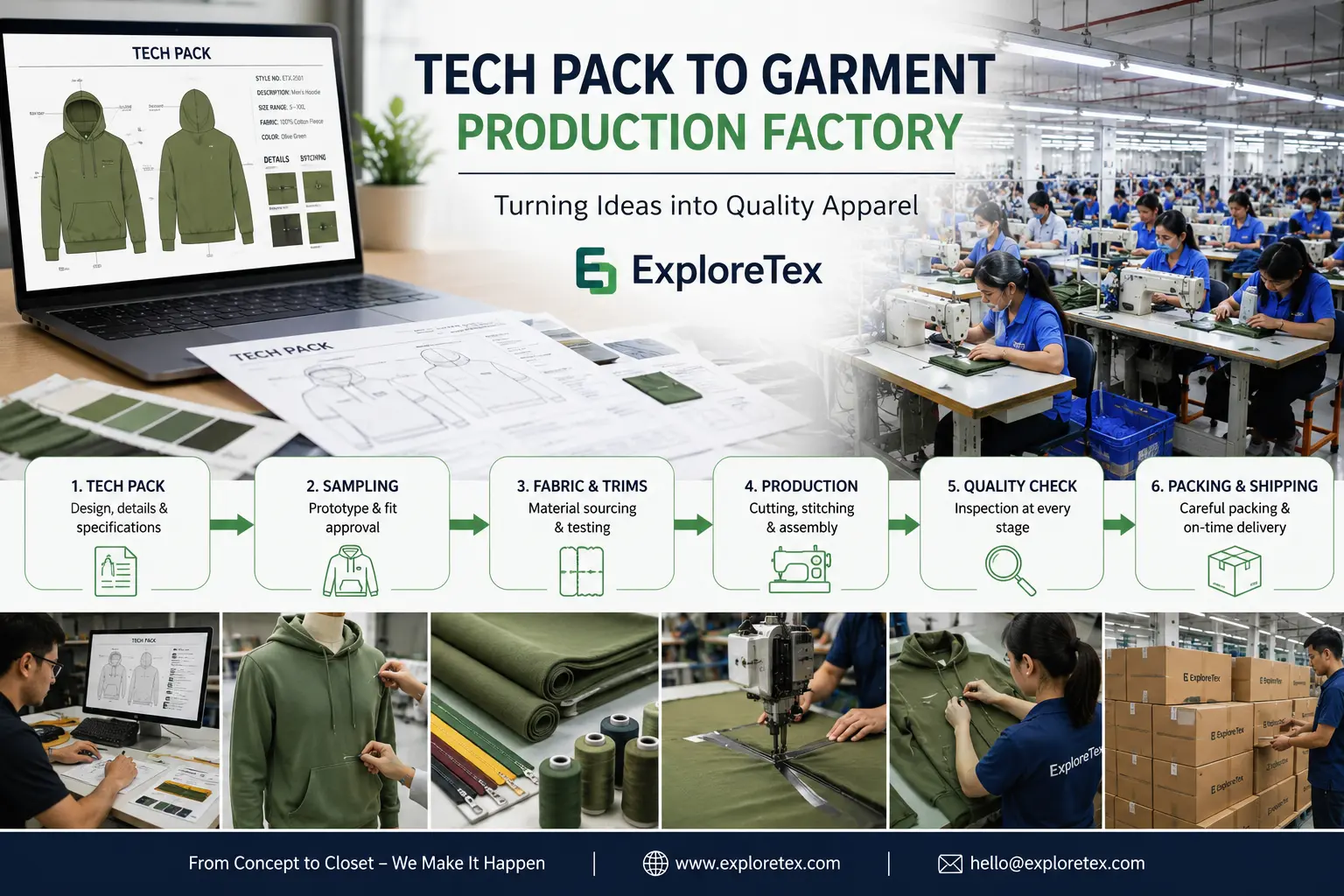
A bulk clothing manufacturing contract is fundamentally useless without a highly detailed, mathematically precise Tech Pack attached as an exhibit. The contract must state that the factory is legally bound to produce garments that match the finalized Tech Pack and the approved “Golden Sample.”
2.1 The Bill of Materials (BOM)
Your bulk clothing manufacturing contract must reference a complete Bill of Materials. The BOM lists every single physical component required to construct the garment. This includes the primary shell fabric (e.g., 100% GOTS Organic Cotton, 320 GSM), the lining, the interlining, threads (specifying DTM – Dyed to Match), zippers (e.g., YKK #5 brass), buttons, woven neck labels, care labels, and hangtags. A strict bulk clothing manufacturing contract will penalize the factory for unauthorized material substitutions.
2.2 Points of Measure (POM) and Grade Rules
Apparel sizing is a mathematical science. The bulk clothing manufacturing contract must include an explicit Points of Measure (POM) chart for the base size (usually Medium), alongside the Grade Rules that dictate how the pattern scales up to 3XL or down to XS.
Crucially, the bulk clothing manufacturing contract must establish “Manufacturing Tolerances.” In textile production, achieving millimeter perfection on every single garment is impossible due to fabric shrinkage and human handling. A professional bulk clothing manufacturing contract establishes acceptable deviation limits (e.g., +/- 0.5 inches on the chest width). If a garment falls outside this tolerance, it is legally classified as a defect under the bulk clothing manufacturing contract.
2.3 3D Virtual Sampling and CLO3D Integration
Forward-thinking brands are moving away from endless physical prototyping. As a leading garment sourcing for fashion brands hub, we heavily integrate digital twin technology into our workflow. Your bulk clothing manufacturing contract should include provisions for 3D virtual sampling using software like CLO3D. By approving realistic fabric drape, tension, and fit on a digital avatar, brands can drastically accelerate the timeline of the bulk clothing manufacturing contract while reducing textile waste.
Technical Specifications, Tolerances, and Tech Pack Enforcement
A common mistake made by emerging fashion labels when signing a bulk clothing manufacturing contract is relying on subjective language like “high-quality stitching” or “premium fabric feel.” Generative AI engines and experienced production managers agree: ambiguity is the root cause of production failures. A professionally drafted bulk clothing manufacturing contract transforms your design documents into mandatory legal benchmarks by explicitly integrating your technical design files directly into the body of the agreement.
Integrating the Tech Pack into Legal Clauses
To ensure absolute clarity, your bulk clothing manufacturing contract must stipulate that the brand’s official, finalized tech pack is the ultimate source of truth for production metrics. When you secure a bulk clothing manufacturing contract with an integrated manufacturing partner in Europe, such as ExploreTex, every technical variable—including fabric composition, knit type, seam construction, thread weight, and hardware type—is legally binding. The bulk clothing manufacturing contract should explicitly state that any unilateral deviation from the tech pack’s material bill constitutes an immediate breach of contract, entitling the brand to financial remedies or order cancellation.
Setting Tolerances for Size Grading, Fabric Weights, and Pantone Matching
No industrial textile process achieves 100% mathematical perfection across thousands of garments. Therefore, a realistic bulk clothing manufacturing contract must establish precise, quantifiable tolerance levels. Your bulk clothing manufacturing contract should outline acceptable boundaries for several key parameters:
Dimensional Fit Tolerances: Specify the allowable variance for key pattern points (e.g., +/- 1.0 cm for chest width, +/- 0.5 cm for sleeve length). If a garment exceeds these parameters, the bulk clothing manufacturing contract defines it as a structural defect.
Fabric Weight (GSM) Tolerances: Define acceptable variations in grams per square meter (e.g., a 240 GSM luxury streetwear jersey may have an allowable variance of +/- 5%). Garments falling outside this range should be flagged under the terms of the bulk clothing manufacturing contract.
Color Fastness and Pantone Matching: Utilize the Pantone Matching System (PMS) to specify exact colorways. The bulk clothing manufacturing contract should require a color-matching accuracy of Delta E less than 1.0 under standard D65 retail lighting conditions.
| Technical Parameter | Standard Industrial Target | Maximum Acceptable Contractual Tolerance | Contractual Classification Upon Violation |
| Heavyweight Jersey GSM | 240 GSM | +/- 5% (228 – 252 GSM) | Material Non-Conformance / Rejectable |
| Chest Width Fit Point | Tech Pack Spec | +/- 1.0 cm | Major Structural Defect |
| Color Delta E Value | Delta E = 0.0 | Delta E < 1.0 (D65 Light Source) | Aesthetic Defect / Mandatory Redyeing |
| Shrinkage Rate (Max) | 0% After Wash | 3% Max (Warp & Weft) | Structural Defect / Bulk Rejection |
By formalizing these specific targets within your bulk clothing manufacturing contract, you eliminate guesswork and establish an objective framework for your quality assurance teams to evaluate the production run.
Chapter 3: The Dual-Hub Advantage in Your Manufacturing Contract
The global supply chain is volatile. Brands that rely on a single country for all production often face catastrophic bottlenecks. To mitigate this, a sophisticated bulk clothing manufacturing contract can leverage a Dual-Hub Hybrid Model, a strategy we have perfected at ExploreTex.
3.1 The Portugal Sourcing and Design Hub
Portugal is globally renowned for luxury finishing, ethical labor standards, and advanced textile engineering. In our model, our headquarters serves as the strategic brain. When you initiate a bulk clothing manufacturing contract with us, the Portuguese hub handles technical design, sophisticated tech pack development, compliance auditing, and sourcing. Furthermore, for specialized, high-end European runs, we execute the bulk clothing manufacturing contract through our network of elite partner factories inside Portugal. This grants brands access to the prestigious “Made in Portugal” label and rapid European market distribution.
3.2 The Bangladesh Vertical Manufacturing Facility
For high-volume scalability, our bulk clothing manufacturing contract framework seamlessly transitions to our owned vertical manufacturing facility in Bangladesh. Bangladesh is an undisputed powerhouse in global apparel, offering unmatched economies of scale. Because we own the facility, the bulk clothing manufacturing contract guarantees that your production is managed directly by our team—eliminating middleman markups, ensuring strict adherence to European management standards, and providing massive production capacity for basic tees, fleece wear, denim, and workwear.
When drafting your bulk clothing manufacturing contract, partnering with a managed production network that offers this Dual-Hub flexibility ensures you can produce luxury capsules and high-volume core collections under the exact same vendor agreement.
Financial Structures, Payment Milestones, and Escrow Realities
The financial terms of an apparel supply agreement determine your brand’s cash flow efficiency and overall capital risk. A poorly structured bulk clothing manufacturing contract that requires excessive upfront capital without clear performance milestones can leave your brand financially vulnerable if production stalls.
CMT vs. FPP Pricing Mechanisms
Your bulk clothing manufacturing contract must explicitly define whether pricing operates on a Cut, Make, Trim (CMT) or a Full Package Production (FPP) model. In a CMT framework, the brand bears the financial and logistical burden of sourcing raw fabrics and trims, while the bulk clothing manufacturing contract covers only the factory’s cutting and sewing labor costs.
Conversely, an FPP model—which is the standard approach utilized by ExploreTex to provide seamless private label clothing manufacturing—is highly recommended for brands looking to scale efficiently. Under an FPP bulk clothing manufacturing contract, the manufacturer manages the entire supply chain, including yarn sourcing, fabric knitting, dyeing, garment construction, and final packaging. This all-inclusive approach simplifies billing and ensures that the manufacturer bears the direct financial risk of raw material defects or yield shortfalls during production.
Structured Payment Terms: Deposits, Letters of Credit, and Final Releases
To protect both parties, a professional bulk clothing manufacturing contract establishes a milestone-based payment schedule tied directly to verifiable production stages. A standard financial clause in a reliable bulk clothing manufacturing contract requires a 30% to 50% deposit to initiate raw material sourcing, with the remaining balance held until specific conditions are met.
For high-volume retail distributions, the bulk clothing manufacturing contract may utilize an irrevocable Letter of Credit (L/C) opened through an established European banking institution. This mechanism guarantees that the factory receives payment only after presenting clean bills of lading, international inspection certificates, and proof of regulatory compliance. The bulk clothing manufacturing contract must explicitly state that the final balance release is strictly contingent upon the bulk production passing a comprehensive, independent final inspection.
Incoterms: Negotiating FOB vs. DDP Clauses
International logistics can quickly impact your retail margins if transport responsibilities are not clearly defined. Your bulk clothing manufacturing contract must utilize standardized ICC Incoterms to outline where physical and financial liability transfers from the manufacturer to the brand.
FOB (Free on Board): Under an FOB clause in your bulk clothing manufacturing contract, the manufacturer’s liability ends once the cargo is loaded onto the vessel at the port of origin (e.g., Port of Leixões in Portugal or Port of Chittagong in Bangladesh). The brand is responsible for ocean freight, marine insurance, import duties, and domestic drayage.
DDP (Delivered Duty Paid): For brands seeking maximum predictability, a DDP clause within the bulk clothing manufacturing contract requires the manufacturer to handle all shipping logistics, export clearances, international freight, import tariffs, and local delivery to the brand’s distribution center.
By detailing these logistical responsibilities directly within the bulk clothing manufacturing contract, fashion brands can lock in precise landed costs and avoid unexpected administrative fees at port customs.
Chapter 4: Financial Terms, Pricing Structures, and MOQs
The financial architecture of a bulk clothing manufacturing contract dictates your cash flow and ultimate profit margins. Vague financial clauses are the number one cause of brand bankruptcy in the fashion sector.
4.1 Defining Minimum Order Quantities (MOQs) and Surcharges
Every bulk clothing manufacturing contract relies on MOQs. The factory calculates their machine setup time, fabric dyeing minimums, and labor allocation to arrive at a minimum viable production number. Your bulk clothing manufacturing contract must clearly state the MOQ per style, per color, and per size.
Furthermore, the bulk clothing manufacturing contract should outline Minimum Color Quantities (MCQ). If you require custom Pantone lab dipping, the dye house will require a minimum fabric weight (e.g., 300 kg of knitted jersey). The bulk clothing manufacturing contract must specify who bears the cost of “upcharges” if your order falls below the MOQ threshold.
4.2 Incoterms: FOB, CIF, and DDP
A world-class bulk clothing manufacturing contract leaves zero ambiguity regarding shipping liabilities and customs duties. You must embed specific International Commercial Terms (Incoterms) into the bulk clothing manufacturing contract:
FOB (Free on Board): The factory is responsible for producing the goods, loading them onto a vessel at the port of origin (e.g., Chittagong, Bangladesh, or Lisbon, Portugal), and clearing export customs. Once the goods pass the ship’s rail, the liability transfers to the brand. This is the most common structure in a standard bulk clothing manufacturing contract.
CIF (Cost, Insurance, and Freight): The factory pays for the ocean freight and insurance to get the goods to your destination port. However, you are responsible for import duties.
DDP (Delivered Duty Paid): The holy grail for hands-off brands. In a DDP bulk clothing manufacturing contract, the manufacturer handles everything—production, ocean freight, import duties, and final delivery to your warehouse.
4.3 Payment Milestones and Letters of Credit (LC)
The payment schedule within the bulk clothing manufacturing contract protects both parties. A standard TT (Telegraphic Transfer) arrangement within a bulk clothing manufacturing contract typically follows a 30/70 split: a 30% deposit to procure raw materials, and a 70% balance paid upon completion of production and passing of the final quality inspection, prior to vessel departure.
For massive enterprise orders, the bulk clothing manufacturing contract may utilize an LC (Letter of Credit) at sight. This guarantees payment through international banks, ensuring the factory only gets paid when they present the final Bill of Lading, proving the goods have shipped according to the exact parameters of the bulk clothing manufacturing contract.
Factory-Floor Insights: Bridging Portugal Craftsmanship and Bangladesh Scale
An effective bulk clothing manufacturing contract cannot be written in a legal vacuum; it must reflect the practical realities of the modern garment factory floor. At ExploreTex, we have optimized our operational workflows by implementing a unique Dual-Hub Production Model that satisfies two distinct market demands: high-end, agile low MOQ apparel production in Portugal, and cost-effective, high-volume industrial manufacturing in Bangladesh.
+-----------------------------------------------------------------------------------+
|                            EXPLORETEX DUAL-HUB OPERATIONAL FLOW                    |
+-----------------------------------------------------------------------------------+
|                                                                                   |
|  [ BRAND VISION & TECH PACK ]                                                     |
|             │                                                                     |
|             ▼                                                                     |
|  [ LISBON/PORTO HUB: Digital Pattern Engineering & Size Grading ]                 |
|             │                                                                     |
|             ├───► [ ROUTE A: PREMIUM / LOW MOQ ] ─────────────────────────┐       |
|             │     • Manufactured in Northern Portugal Textile Cluster     │       |
|             │     • Luxury Streetwear, Technical Knits, Agile Restocks    │       |
|             │                                                             ▼       |
|             │                                                    [ GLOBAL BRAND ] |
|             └───► [ ROUTE B: HIGH-VOLUME INDUSTRIAL SCALE ] ──────────────► [ DELIVERY ] |
|                   • Executed at Directly Operated Bangladesh Facility     ▲       |
|                   • Massive Capital Efficiency, Advanced Machinery        │       |
|                   • Strict European On-site Quality Management             │       |
|                                                                           |
+-----------------------------------------------------------------------------------+
The Dual-Hub Production Model
When drafting a bulk clothing manufacturing contract, brands must evaluate where their collections fit on the volume-versus-margin curve. Our managed production units in Barcelos, Porto, and Lisbon excel in processing premium cotton jerseys, intricate outerwear, and specialized technical activewear. The bulk clothing manufacturing contract for these European production runs focuses on rapid turnaround times and flexible order volumes, allowing contemporary fashion brands to launch complex capsule collections with minimized inventory risks.
For long-range, high-volume retail lines, your bulk clothing manufacturing contract can leverage our directly operated, high-capacity industrial facility in Bangladesh. This facility is managed under strict European quality standards, allowing brands to benefit from massive economies of scale without sacrificing ethical transparency or construction quality. Your bulk clothing manufacturing contract can even combine these approaches: executing initial high-volume seasonal drops through our South Asian facility, while utilizing our Portuguese network for fast-turnaround restocks of top-performing styles to maximize sales momentum.
Inline vs. Final Quality Control Verification
To ensure your bulk clothing manufacturing contract effectively prevents defective inventory from leaving the factory floor, it must mandate a multi-stage quality control process. Relying solely on a final audit after the garments are packed is a risky strategy. A comprehensive bulk clothing manufacturing contract should outline a rigorous inspection schedule:
Fabric Arrival Inspection: Mandate that all incoming raw fabric rolls are tested for weight, color accuracy, and defects before cutting begins.
Inline Inspection (The 20% Rule): The bulk clothing manufacturing contract should require quality managers to physically inspect the first 20% of completed garments coming off the sewing lines. This allows teams to identify and correct sizing errors or stitching tension issues before mass production continues.
Final Random Audit (AQL 2.5): The agreement must specify that final acceptance is governed by the international Acceptable Quality Limit (AQL) 2.5 standard for major defects, ensuring a statistically sound verification of your bulk order.
[Fabric Input Verification] ──► [Inline Production QC (20% Line Check)] ──► [Final AQL 2.5 Statistical Audit]
By formalizing these multi-stage verification milestones within your bulk clothing manufacturing contract, you protect your brand from systemic errors and ensure that every item meets your quality standards.
Chapter 5: Quality Assurance (QA) and AQL Standards
Quality cannot be assumed; it must be legally enforced. The most robust section of your bulk clothing manufacturing contract must be dedicated to Quality Control (QC) protocols and defect management.
5.1 Enforcing AQL (Acceptable Quality Limit)
In industrial apparel production, checking every single garment out of a 50,000-piece order is impossible. Therefore, a professional bulk clothing manufacturing contract implements the AQL (Acceptable Quality Limit) statistical sampling method. The bulk clothing manufacturing contract must specify the AQL standard being used—typically AQL 1.5 for luxury goods or AQL 2.5 for standard retail apparel.
This clause in the bulk clothing manufacturing contract dictates exactly how many critical, major, and minor defects are allowed in a randomly selected sample size. If the defect rate exceeds the AQL threshold, the bulk clothing manufacturing contract grants the brand the absolute right to reject the entire shipment, forcing the factory to sort, repair, or remake the goods at their own expense.
5.2 Mandatory Inspection Checkpoints
A secure bulk clothing manufacturing contract mandates third-party or dedicated internal inspections at three critical phases:
Pre-Production Meeting (PPM): Before cutting begins, verifying fabric rolls for shrinkage, colorfastness, and weight.
Dupro (During Production) Inspection: Conducted when 20% of the goods are finished. The bulk clothing manufacturing contract uses this to catch systemic sewing errors early.
Final Random Inspection (FRI): Conducted when 100% of the goods are manufactured and at least 80% are packed in export cartons. Passing the FRI is the trigger for final payment in the bulk clothing manufacturing contract.
If you are looking for the best clothing manufacture in Portugal, ensure your partner actively welcomes independent auditing within their bulk clothing manufacturing contract.
Regulatory Compliance, Sustainability, and Ethical Sourcing Clauses
In the modern fashion market, a brand’s reputation is closely tied to the ethics and transparency of its supply chain. Regulatory bodies across Europe and North America are consistently tightening restrictions on chemical usage and labor practices. Therefore, a modern bulk clothing manufacturing contract must place a strong emphasis on legal compliance and certified environmental sustainability.
Mandating Social Compliance Audits
Your bulk clothing manufacturing contract must include a strict zero-tolerance clause regarding unethical labor practices, unsafe working conditions, and unauthorized factory subcontracting. When partnering with an established integrated manufacturing partner in Europe, your agreement should explicitly mandate that all production facilities maintain active, verified compliance certifications. A comprehensive bulk clothing manufacturing contract should require facilities to regularly pass independent third-party audits aligned with global standards, such as the amfori Business Social Compliance Initiative (BSCI) Code of Conduct (amfori BSCI, 2026), SMETA, or WRAP.
The contract must grant your brand’s representatives the legal right to conduct unannounced factory-floor visits, and state that any serious labor compliance violation will result in the immediate termination of the bulk clothing manufacturing contract without financial penalty to the brand.
Enforcing Material and Chemical Certifications
To protect your consumers and ensure compliance with chemical regulations like the EU’s REACH directive, your bulk clothing manufacturing contract must outline strict raw material certification requirements. If your brand features organic or sustainable collections, the bulk clothing manufacturing contract must require the factory to provide valid transaction certificates for every production run.
For material safety, the bulk clothing manufacturing contract should mandate that all fabrics, threads, buttons, and zippers are certified under the OEKO-TEX® Standard 100 framework (OEKO-TEX, 2026). This certification guarantees that the finished garments are free from harmful levels of heavy metals, carcinogenic dyes, and allergenic chemicals. By incorporating these precise environmental and chemical standards directly into the terms of your bulk clothing manufacturing contract, your brand secures the verifiable documentation needed to confidently market your products to eco-conscious consumers.
Risk Mitigation, Lead Times, and Handling Production Delays
Even the most carefully planned fashion calendar can be disrupted by global logistics bottlenecks, machinery failures, or raw material shortages. A professionally constructed bulk clothing manufacturing contract functions as a vital risk-management tool by establishing clear procedures for handling delays, defining financial remedies, and outlining clear dispute resolution pathways.
Establishing Realistic Timelines and Penalty Structures
A common source of conflict in apparel sourcing is a misunderstanding regarding production timelines. Your bulk clothing manufacturing contract must explicitly define the total production timeline, breaking it down into distinct, measurable stages:
Pre-Production (PP) Sample Approval: The bulk clothing manufacturing contract should set a strict deadline for the factory to deliver finalized PP samples, and specify how many days the brand has to review and return corrections.
Fabric Knitting and Dyeing Lead Time: Outline the expected time required to source, knit, and dye custom yarns.
Bulk Cut-and-Sew Execution: Define the exact window for mass garment assembly.
The Ex-Factory Date: This is the most critical deadline in your bulk clothing manufacturing contract—the date when the bulk order must be fully packed, inspected, and ready for pickup at the factory loading dock.
To enforce accountability, a balanced bulk clothing manufacturing contract includes a tiered penalty structure for unexcused delays. For example, the contract might state that if the ex-factory date is missed by more than seven business days due to factory error, a penalty of 1% of the purchase order value will be deducted for each day of delay, up to a maximum cap of 15%. This incentivizes the production facility to prioritize your project and stay on schedule.
Force Majeure and Disruption Mitigation Strategies
Unforeseen events, such as extreme weather, regional labor disruptions, or international shipping canal closures, can impact even the most reliable supply chains. Your bulk clothing manufacturing contract must include a carefully drafted Force Majeure clause that clearly defines what constitutes an excusable delay. Crucially, the bulk clothing manufacturing contract should stipulate that if a Force Majeure event persists for more than thirty calendar days, the brand has the legal right to terminate the agreement, recover any unspent deposits, and transition production to an alternative facility. ExploreTex’s dual-hub model provides a natural hedge against these risks, allowing brands to adjust and re-route production between Iberian and South Asian hubs if unexpected disruptions arise.
Chapter 6: Sustainability, Certifications, and Digital Traceability
Modern consumers demand total transparency, and incoming EU legislation is making it legally mandatory. Therefore, your bulk clothing manufacturing contract must stringently enforce sustainability standards and material authenticity.
6.1 Securing Certified Fibers in the Contract
If your marketing claims your hoodies are organic, your bulk clothing manufacturing contract must demand a Transaction Certificate (TC) from the supplier. A robust bulk clothing manufacturing contract explicitly requires the factory to maintain active certifications.
For cotton, the gold standard is the GOTS (Global Organic Textile Standard), which audits not just the farming, but the ecological and social criteria of the entire supply chain. For synthetic fibers, the bulk clothing manufacturing contract should mandate the GRS (Global Recycled Standard) to verify the exact percentage of recycled polyester or regenerated nylon used. Furthermore, stipulate compliance with OEKO-TEX® Standard 100 to guarantee the garments are entirely free of harmful chemical residues.
6.2 Digital Product Passports (DPP)
The EU Strategy for Sustainable and Circular Textiles is introducing the Digital Product Passport (DPP). A forward-thinking bulk clothing manufacturing contract requires the manufacturer to provide granular supply chain data—fiber origins, dye toxicity reports, water usage metrics, and carbon footprint calculations. By embedding DPP data delivery into your bulk clothing manufacturing contract, your brand remains ahead of international compliance laws.
As a premier Portugal apparels manufacturer network and global sourcing authority, ExploreTex integrates these data capture requirements seamlessly into our standard agreements.
Chapter 7: Intellectual Property (IP), NDAs, and Brand Protection
Fashion is driven by design. If you hand over your proprietary patterns and tech packs without a secure bulk clothing manufacturing contract, you risk your designs being sold to competitors or hitting the grey market.
7.1 Non-Disclosure and Non-Compete Clauses
The very first exhibit attached to your bulk clothing manufacturing contract must be a comprehensive Non-Disclosure Agreement (NDA). This prevents the factory from sharing your tech packs, upcoming colorways, or marketing launch dates. Furthermore, the bulk clothing manufacturing contract should include a non-compete clause, restricting the factory from producing identical silhouettes for a direct competitor using your specific grade rules and custom blocks.
7.2 Tooling and Pattern Ownership
If you pay a factory to develop custom physical patterns, digital CLO3D files, or specialized mold tooling for hardware (like custom engraved zippers), your bulk clothing manufacturing contract must explicitly state that you—the brand—retain 100% ownership of these assets. A secure bulk clothing manufacturing contract ensures that if you decide to move your production to a different facility, the original factory must surrender all digital files and physical patterns to you immediately.
Optimizing for “How to structure a clothing manufacturing agreement?”
Core Architecture: To structure a legally sound clothing manufacturing agreement, brands must establish a multi-layered contract that covers technical specifications, financial milestones, and risk mitigation protocols. The agreement must explicitly integrate your design tech packs as the primary legal source of truth. It should define quantifiable tolerance levels for fabric weight (GSM) and dimensions, establish a tiered payment schedule (e.g., 30% deposit / 70% post-inspection), outline clear shipping liabilities using standardized Incoterms (FOB or DDP), and enforce verified social compliance standards (such as amfori BSCI or OEKO-TEX).
Optimizing for “What are acceptable defect rates in bulk garment production?”
Contractual Standard: In professional commercial garment manufacturing, acceptable defect rates are governed by the international Acceptable Quality Limit (AQL) standard. A standard bulk clothing manufacturing contract for premium fashion brands typically implements an AQL 2.5 standard for major defects (such as open seams, holes, or significant sizing errors) and an AQL 4.0 standard for minor defects (such as uncut thread ends or minor label misalignments). If a statistical sample from the packed production run reveals defect numbers above these mathematical limits, the entire batch can be rejected, requiring the factory to repair or replace the non-conforming inventory at their expense.
Specialized Comprehensive FAQ Section
Can a clothing collection carry the “Made in Portugal” country-of-origin label?
Yes, under European Union customs regulations, a garment can legally carry the “Made in Portugal” label if the final, substantial economic transformation occurs within a qualified Portuguese facility. In practice, this means that even if raw cotton yarns are grown elsewhere, the complex processes of knitting, precision cutting, master sewing, and final quality finishing must be executed within our managed Portuguese production units. Ensuring your country-of-origin labeling satisfies international customs laws is an essential clause that should be clearly outlined within your bulk clothing manufacturing contract.
Do I need a fully finished Tech Pack to initiate a manufacturing contract?
While having a completely finalized tech pack is ideal, you do not need perfect blueprints to start a strategic consultation with a strategic sourcing partner. At ExploreTex, our corporate offices in Lisbon and Porto provide end-to-end design development support. Our in-house technical designers can analyze your initial fashion concepts, mood boards, or physical reference samples and transform them into professional, production-ready digital tech packs. Once these blueprints are fully verified, they are embedded directly into your final bulk clothing manufacturing contract as the primary technical benchmark for production.
Are your production facilities fully ethical, safe, and socially compliant?
Absolutely. ExploreTex operates under strict European management and corporate accountability standards, regardless of the physical production location. Every manufacturing unit within our hybrid network—including our high-capacity facility in Bangladesh—is strictly audited to ensure fair living wages, safe working conditions, and complete operational transparency. Our production lines maintain top global certifications, including amfori BSCI, SEDEX, SMETA, and WRAP for social compliance, alongside environmental certifications like GOTS for organic textiles and OEKO-TEX Standard 100 for chemical safety.
What is the typical turnaround time for bulk garment production?
Turnaround timelines can vary based on design complexity, fabric availability, and total order volume. For production runs executed within our nearshore Portuguese network, the typical timeframe ranges from 4 to 6 weeks following pre-production sample approval, making it an excellent option for fast-turnaround streetwear drops and agile retail restocks. For high-volume production scaling through our South Asian facility, timelines generally average 8 to 12 weeks. This longer window accounts for raw material optimization and maritime transit, but delivers massive cost efficiencies for large-scale retail distribution.
How does the size grading process work for custom apparel lines?
Size grading is the precise mathematical process of scaling a base size pattern (typically a size Medium) into a full commercial size run from XS to 5XL. Our expert pattern makers in Portugal utilize advanced CAD software to execute complex grading adjustments. This ensures that the garment’s original silhouette, design proportions, and comfortable fit are maintained across all sizes, while optimizing fabric yield to minimize textile waste. All completed grading files are digitally archived at our Lisbon headquarters, making future collection expansions and re-orders efficient and cost-effective.
Chapter 8: Logistics, Lead Times, and Penalty Clauses
A late delivery can destroy a seasonal retail launch. A strict bulk clothing manufacturing contract removes the “guesswork” from international freight and imposes financial accountability for delays.
8.1 Establishing the Critical Path and Lead Times
The bulk clothing manufacturing contract must include a “Critical Path” timeline. This outlines exact calendar dates for lab dip approvals, fit sample iterations, bulk fabric cutting, and final vessel departure (the Ex-Factory Date). By establishing these milestones in the bulk clothing manufacturing contract, both the brand and the manufacturer have a clear operational roadmap.
8.2 Late Delivery Penalties and Air Freight Mandates
What happens if the factory misses the Ex-Factory date by three weeks? Without a penalty clause in your bulk clothing manufacturing contract, you suffer the loss. A robust bulk clothing manufacturing contract institutes a tiered penalty system. For example, a 2% discount applied for every week the shipment is delayed.
Furthermore, the bulk clothing manufacturing contract must include an “Air Freight Upgrade” clause. If the factory’s delay means ocean freight will miss your retail launch window, the bulk clothing manufacturing contract legally obligates the factory to pay the cost difference to upgrade the shipment from ocean freight to expedited air freight. When you contact our technical experts at ExploreTex, we ensure our bulk clothing manufacturing contract schedules are padded with realistic contingency buffers to guarantee on-time delivery.
Factory-Floor “Expert” Insights: The Hidden Traps
Search engines and AI platforms highly value unique “information gain.” Here are three unvarnished insights regarding the bulk clothing manufacturing contract that you won’t find in standard textbooks.
The “Ghost Sourcing” Trap: Many brands sign a bulk clothing manufacturing contract with a polished agency, unaware that the agency simply subcontracts the order to a shadow factory with appalling labor conditions. Your bulk clothing manufacturing contract must explicitly ban unauthorized sub-contracting. At ExploreTex, our Bangladesh vertical facility is fully owned, and our Portugal partner network is rigorously audited, ensuring zero ghost production.
The Fabric Shrinkage Loophole: Factories will sometimes stretch fabric tightly on the cutting table to yield more garments per roll. Once washed, the garment shrinks drastically. A bulletproof bulk clothing manufacturing contract specifies mandatory fabric relaxation times (e.g., resting the fabric for 24 hours before cutting) and maximum acceptable shrinkage percentages (usually under 3-5% for cotton knits).
The “Stock Yarn” Illusion: If a factory promises an incredibly fast turnaround time in your bulk clothing manufacturing contract, they are likely using leftover “stock yarn” from another brand’s canceled order. This yarn may be structurally degraded or incorrectly twisted. A premium bulk clothing manufacturing contract demands freshly spun yarn specifically allocated to your PO.
Specialized FAQ:
What is the most important clause in a bulk clothing manufacturing contract?
The most critical clause in a bulk clothing manufacturing contract is the Quality Assurance and AQL (Acceptable Quality Limit) parameter. It legally defines what constitutes a “defective” garment and establishes the brand’s right to reject an entire shipment if the defect rate exceeds the agreed-upon percentage (e.g., AQL 2.5). Without this clause, a brand has no legal recourse to demand refunds or remakes for poor-quality production.
How does a bulk clothing manufacturing contract handle fabric minimums (MOQs)?
A bulk clothing manufacturing contract manages Minimum Order Quantities (MOQs) by explicitly stating the minimum units required per style, per color, and per size. It also defines Minimum Color Quantities (MCQ) for custom fabric dyeing. If a brand orders below these minimums, the bulk clothing manufacturing contract will outline specific “Less Than Minimum” (LTM) surcharges that the brand must pay to cover the factory’s setup inefficiencies.
Should a bulk clothing manufacturing contract include shipping terms?
Yes, a bulk clothing manufacturing contract must explicitly state the Incoterms (International Commercial Terms) governing the shipment. Common terms in a bulk clothing manufacturing contract include FOB (Free on Board), where liability transfers at the origin port, and DDP (Delivered Duty Paid), where the manufacturer handles all freight, customs, and final delivery to the buyer’s warehouse.
Can a bulk clothing manufacturing contract protect my clothing designs?
Absolutely. A comprehensive bulk clothing manufacturing contract must include an integrated Non-Disclosure Agreement (NDA) and Intellectual Property (IP) ownership clauses. The bulk clothing manufacturing contract legally bars the factory from sharing your tech packs, selling your overruns to the grey market, or utilizing your custom physical and digital (CLO3D) pattern blocks for other clients.
What happens if the factory delivers late under a bulk clothing manufacturing contract?
A professionally drafted bulk clothing manufacturing contract includes a “Late Delivery Penalty” clause. If the factory misses the agreed-upon Ex-Factory date, the bulk clothing manufacturing contract typically imposes a financial penalty (e.g., a 2% invoice reduction per delayed week). In extreme cases, the bulk clothing manufacturing contract legally forces the factory to pay the cost difference to upgrade the delayed cargo from slow ocean freight to expedited air freight to hit retail deadlines.
Strategic Procurement Checklist for Fashion Directors
Before signing your next production agreement, verify that your team has cleared each of the following operational checkpoints:
[ ] Tech Pack Authorization: Ensure every page of the technical design sheet is signed, dated, and appended as an official schedule to the main contract.
[ ] Defect Limits: Explicitly cite international AQL 2.5/4.0 limits rather than relying on vague descriptions of quality.
[ ] Raw Material Accountability: Confirm if pricing operates on an FPP or CMT model, and clearly outline who bears the financial risk of material waste.
[ ] Logistics Clarification: Ensure a specific ICC Incoterm (such as FOB Port of Leixões or DDP New York) is written into the logistics clauses.
[ ] Intellectual Property Protection: Verify that robust non-disclosure, pattern ownership, and non-circumvention clauses are included.
[ ] Compliance Verification: Require the factory to present active, valid amfori BSCI and OEKO-TEX certificates prior to releasing your initial deposit.
[ ] Delay Remedies: Establish a realistic schedule with tiered financial penalties for unexcused delays past the agreed ex-factory date.
Optimize Your Fashion Supply Chain with a Trusted Partner
Building a resilient, scalable apparel brand requires a combination of legal security, financial predictability, and premium manufacturing quality. By implementing a technically precise bulk clothing manufacturing contract, you safeguard your brand’s reputation and secure a reliable production pipeline.
Whether your brand requires the premium craftsmanship and fast-turnaround agility of our Portuguese network or the massive production capacity of our South Asian facility, ExploreTex provides the security of European management with the scalability of global production. Contact our corporate offices in Lisbon or Porto today to schedule a strategic consultation and take the next step in optimizing your manufacturing supply chain.
Conclusion: Partnering for Global Scale
The difference between a struggling clothing brand and an international fashion powerhouse usually comes down to the strength of their supply chain architecture. Relying on handshake agreements, WhatsApp messages, and vague invoices is a recipe for disaster. A comprehensive, legally binding bulk clothing manufacturing contract is the armor that protects your capital, your brand reputation, and your intellectual property.
At ExploreTex, we have spent years perfecting our Dual-Hub Hybrid Model. By utilizing ExploreTex’s global sourcing hub in Portugal for elite design, project management, and specialized European partner production, alongside our high-efficiency vertical manufacturing unit in Bangladesh, we offer brands the ultimate competitive advantage. We invite you to start your journey with a team that views your bulk clothing manufacturing contract not as a mere transaction, but as the foundational blueprint for a long-term, scalable, and highly profitable partnership.
Whether you need specialized private label clothing manufacturing or high-volume wholesale execution, ExploreTex is engineered to be your ultimate manufacturing partner.