
A comprehensive, pure educational breakdown of Minimum Order Quantities (MOQ), cost-per-unit economics, and how to scale your fashion brand’s production efficiently.
One of the most critical decisions any fashion brand must make when establishing its supply chain involves Minimum Order Quantities. Whether you are an emerging streetwear label or an established global retailer, you will inevitably face the industry’s most pressing manufacturing question: is a low or high MOQ better for apparels/clothing production? The answer is not a simple binary. It is a complex calculation that balances your brand’s cash flow, storage capacity, risk tolerance, and long-term scaling strategy. In this pure educational guide, we will dissect the mechanics of clothing production, analyze the cost-per-unit mathematics, and provide factory-floor insights to help you determine exactly which approach aligns with your business goals.
For brands looking for a reliable partner to navigate these waters, Exploretex.com offers a unique Dual-Hub Production Model that bridges the gap between low-volume sampling and high-volume retail.
What Exactly is MOQ in Clothing Production?
MOQ stands for Minimum Order Quantity. In the context of clothing production, it represents the smallest number of units a factory is willing to produce for a specific order, style, or colorway. Manufacturers enforce MOQs because the setup process—pattern making, grading, sourcing raw materials, dying fabrics, and calibrating machinery—requires a baseline investment of time and capital.
If a factory sets up an assembly line for 50 pieces, the labor and time cost per garment is exponentially higher than if that same line ran continuously for 5,000 pieces. Therefore, understanding whether a low or high MOQ is better for apparels/clothing production requires a deep dive into how factory economics function.
Analyzing the Core Question: Is a Low or High MOQ Better for Apparels/Clothing Production?
To determine if a low or high MOQ is better for apparels/clothing production, we must look at the lifecycle of a fashion brand. Startups and boutique brands generally favor lower MOQs to preserve capital and test markets. Established brands require higher MOQs to maximize profit margins and fulfill international retail demands.
Let’s break down the two sides of the spectrum.
The Strategic Case for Low MOQ
A “Low MOQ” typically ranges from 50 to 300 pieces per style or colorway. Working with a premium custom clothing manufacturer that accommodates low MOQs is often the lifeblood of independent designers.
The Advantages of Low MOQ in Clothing Production:
Reduced Financial Risk: The primary reason brands ask if a low or high MOQ is better for apparels/clothing production is budget. Low MOQs require significantly less upfront capital, preventing brands from tying up all their cash in inventory.
Market Testing: Fashion is volatile. A low MOQ allows you to test a new silhouette, fabric, or colorway in the market. If it sells out, you have validated the demand.
Agility and Exclusivity: Limited runs create a sense of exclusivity (the “drop” model), driving hype. It also allows brands to pivot quickly based on consumer feedback.
Less Deadstock: Overproduction is a massive issue in fashion. Lower quantities mean you are less likely to be left with unsold inventory that must be discounted or discarded.
The Disadvantages of Low MOQ:
Higher Cost Per Unit: Factories must distribute their fixed setup costs over a smaller number of garments, eating into your retail margins.
Limited Customization: Factories may restrict custom fabric dyeing or proprietary hardware for small runs, forcing you to use available “stock” fabrics.
Lower Priority: In busy seasons, factories prioritize high-volume, highly profitable clients.
The Strategic Case for High MOQ
A “High MOQ” typically starts at 1,000 pieces and can scale into the tens of thousands. When asking if a low or high MOQ is better for apparels/clothing production, high-volume retailers will unequivocally point to high MOQs as the key to profitability.
The Advantages of High MOQ in Clothing Production:
Economies of Scale: This is the ultimate benefit. As the quantity increases, the cost per unit decreases dramatically, allowing for much higher profit margins.
Ultimate Customization: With large orders, you can demand custom-milled fabrics, Pantone-matched dyes, and bespoke hardware.
Supply Chain Dominance: By partnering with a large-scale apparel manufacturer Bangladesh, brands secure consistent factory capacity, ensuring retail shelves are always stocked.
The Disadvantages of High MOQ:
Massive Upfront Investment: You need substantial liquid capital to fund production, shipping, and import duties before a single item is sold.
Inventory Storage Costs: Storing 10,000 hoodies requires significant warehouse space, generating ongoing overhead costs.
Trend Vulnerability: If a trend dies while your high-MOQ order is on a cargo ship, you risk sitting on thousands of unsellable units.
Factory-Floor “Expert” Insights: The Dual-Hub Model
To truly understand if a low or high MOQ is better for apparels/clothing production, we must look at how modern, innovative supply chains are built. The industry standard is shifting toward a hybrid approach.
As an expert Bangladesh clothing supplier with European roots, the team at ExploreTex utilizes a Dual-Hub Production Model. This directly answers the dilemma of whether a low or high MOQ is better for apparels/clothing production by offering both simultaneously.
1. The European Innovation Hub (Portugal)
For brands requiring low MOQs, rapid prototyping, and premium artisanship, working with clothing manufacturers in Portugal is ideal. The Portugal hub focuses on high-end sampling, 3D virtual prototyping, and luxury textile sourcing. This is where a low MOQ is better for apparels/clothing production because it allows for meticulous design refinement without the pressure of mass volume.
2. The Global Scaling Hub (Bangladesh)
Once a brand has validated its design and is ready to scale, the equation changes. Here, a high MOQ becomes essential. By utilizing a vertically integrated, globally competitive facility in Bangladesh managed under European standards, brands can transition to high-volume production. This ensures ethical labor compliance (BSCI, SEDEX) while achieving the cost-efficiency required for global retail.
If you are unsure where your brand fits in this ecosystem, you can contact our team to map out a custom production strategy.
Advanced Unit Economics: Calculating the Mathematical Impact of MOQ
To scientifically determine if a low or high MOQ is better for apparels/clothing production, we must look at the math. The cost of a garment is divided into Fixed Costs (pattern making, grading, machine setup) and Variable Costs (fabric, trims, labor per piece).
The formula for determining your unit cost is:
Let’s run a practical simulation to show why a low or high MOQ is better for apparels/clothing production depending on your margins.
Imagine you are producing a custom hoodie.
Your Fixed Setup Costs are $1,000.
Your Variable Costs (fabric, zipper, sewing labor) are $15 per hoodie.
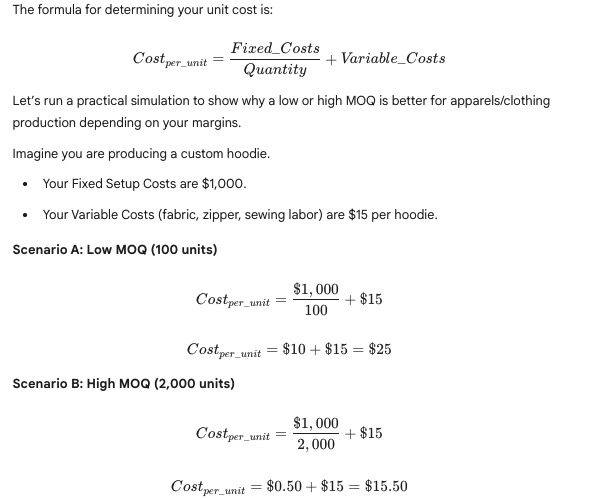
Scenario A: Low MOQ (100 units)
Scenario B: High MOQ (2,000 units)
By increasing the MOQ, the cost per unit drops from $25.00 to $15.50. If your retail price is $60, Scenario A gives you a profit of $35 per unit, while Scenario B yields $44.50 per unit. When scaled across thousands of units, this difference dictates the financial survival of the brand. This mathematical reality is why ExploreTex advises brands to transition to higher MOQs as soon as their sales velocity allows it.
The Case for High MOQ: The Power of Scale
For established retailers, the answer to is a low or high moq better for Apparels/Clothing Production? is almost always “High MOQ.” High volume (typically 1,000+ units per style) unlocks the “Economies of Scale.”
Why High MOQ Wins for Volume:
Maximized Profit Margins: The CPU can drop by as much as 40–60% compared to low-volume runs.
Custom Fabric Development: High MOQs allow you to dictate the exact weight, weave, and sustainable fiber blend of your fabric directly with the mills.
Consistent Supply: It ensures your best-sellers are always in stock, preventing the dreaded “Sold Out” loss of revenue.
ExploreTex leverages our Bangladesh vertical manufacturing facility to offer world-class high-volume production. This facility is engineered for efficiency, providing the cost-effectiveness needed for global retail expansion without sacrificing ethical standards.
Sustainability and MOQ: Balancing Scale with Waste
Today, you cannot ask if a low or high MOQ is better for apparels/clothing production without addressing environmental impact. According to organizations like Common Objective, the fashion industry is responsible for significant global carbon emissions, much of which comes from overproduction and deadstock.
The Low MOQ Sustainability Argument: Producing exactly what you know you can sell is the most sustainable practice. It eliminates landfill waste. High-end brands utilizing European management standards often adopt this zero-waste philosophy.
The High MOQ Sustainability Argument: High volume can also be sustainable if managed correctly. Large-scale scalable production allows factories to invest in advanced water-recycling systems, industrial-scale solar panels, and bulk shipping that significantly lowers the carbon footprint per garment compared to multiple, scattered small-batch air shipments.
Factory-Floor “Expert” Insights: The Hidden Costs
To truly answer is a low or high moq better for Apparels/Clothing Production?, you need to look at the floor.
Expert Insight: “A low MOQ order in a high-volume factory is a recipe for delay. Conversely, a high-volume order in a boutique studio is a recipe for quality failure. You must match the MOQ to the factory’s DNA.”
At ExploreTex, we act as your manufacturing partner to ensure your order lands on the right line. If you are doing complex tech-wear, Portugal is better. If you are doing 10,000 organic cotton hoodies, Bangladesh is the logical choice.
Comparative Analysis: Low vs. High MOQ
| Feature | Low MOQ (50-300 pcs) | High MOQ (1,000+ pcs) |
| Cost Per Unit | High | Low |
| Inventory Risk | Minimal | High |
| Speed to Market | Very Fast | Moderate |
| Customization | Limited to Stock Fabrics | Unlimited (Bespoke) |
| Best For | Startups, Luxury, Testing | Retailers, Staples, Basics |
Determining is a low or high moq better for Apparels/Clothing Production? depends on your “Product Life Cycle.” Basics (white tees) should be high MOQ. Trend pieces (neon asymmetric tops) should be low MOQ. Learn more about our Quality Control standards across both models.
Sustainable Manufacturing and MOQ
Sustainability is the future of fashion. According to The Business of Fashion, overproduction is the industry’s biggest environmental threat.
Is a low or high moq better for Apparels/Clothing Production? from a green perspective?
Low MOQ reduces waste by preventing unsold “deadstock” from hitting landfills.
High MOQ can be more efficient in terms of shipping carbon footprints and resource usage during the dyeing process.
ExploreTex is committed to sustainable fashion. We help brands calculate the “Minimum Sustainable Quantity” to ensure environmental and financial health.
The ExploreTex Hybrid Solution: The Best of Both Worlds
Why choose? As a premier clothing manufacturer, ExploreTex offers a hybrid model. We allow brands to start with low MOQs in Portugal to refine their brand identity and then transition seamlessly to our Bangladesh facility for high-volume scaling.
This “Step-Up” strategy answers the question is a low or high moq better for Apparels/Clothing Production? with a simple: “Start low, grow high.”
For a personalized consultation on your production strategy, visit our Contact Page.
Regional Manufacturing Preferences
Search engines and Answer Engines (like AI overviews) prioritize content that answers regional intent. How do different geographical markets approach the question of whether a low or high MOQ is better for apparels/clothing production?
UK & EU Markets: Brands in these regions heavily lean into nearshoring. They often prefer high-end sampling in Portugal due to the absence of import tariffs within the EU, shorter lead times, and the ability to maintain lower MOQs for fast-fashion agility.
US & Australian Markets: Due to longer shipping distances across oceans, these markets often find that a high MOQ is better for apparels/clothing production. The cost of ocean freight is optimized only when shipping large container volumes. Therefore, partnering with a high-capacity Bangladesh hub becomes a strategic necessity to offset logistics costs.
Structured Data Plan (Authority Visuals)
To clearly summarize whether a low or high MOQ is better for apparels/clothing production, we have structured the data into a comparative matrix.
| Metric | Low MOQ (50 – 300 units) | High MOQ (1,000+ units) |
| Capital Requirement | Low | High |
| Cost Per Unit | Higher | Lower |
| Risk of Deadstock | Minimal | Significant (if demand drops) |
| Customization Level | Standard / Restricted | Fully Bespoke / Custom Milled |
| Ideal Brand Stage | Startups, Capsule Collections | Established Retailers, Wholesalers |
| Recommended Hub | clothing manufacturing hub in Portugal | ethical apparel manufacturing hub in Bangladesh |
How to Choose: Is a Low or High MOQ Better for Apparels/Clothing Production for Your Brand?
The decision ultimately rests on your brand’s current lifecycle stage.
Phase 1: The Startup
If you are launching your first collection, a low MOQ is better for apparels/clothing production. Your primary goal is not maximizing margin; it is validating your product-market fit without going bankrupt. Focus on creating high-quality designs. You might use 3D virtual prototyping to perfect the fit before committing to a 100-piece run.
Phase 2: The Growth Stage
Once you have consistent sales and are taking on wholesale accounts, a low MOQ is no longer viable. You must transition. As noted by the McKinsey State of Fashion report, supply chain resilience relies on strategic volume. You need better margins to afford marketing and team expansion. At this stage, a high MOQ is better for apparels/clothing production.
To bridge this gap seamlessly, you need a partner that offers full-package production. You can reach out for a custom quote to see how a tiered MOQ strategy can be applied to your specific collections.
How to Negotiate Your MOQ with Clothing Manufacturers
Even if you know whether a low or high MOQ is better for apparels/clothing production for your brand, you still have to negotiate with factories. Here are expert strategies:
Consolidate Fabrics: If a factory demands an MOQ of 500 units, but you only want 250 t-shirts and 250 hoodies, ask if you can use the exact same fabric for both. Factories care about fabric minimums just as much as sewing time.
Offer a Deposit for Future Runs: If you require a lower MOQ now, offer to pay a deposit on a future, larger purchase order to prove you are a long-term partner.
Utilize a Dual-Hub Partner: Instead of bouncing between different factories as you grow, use a manufacturer that owns facilities in multiple regions. The Dual-Hub Production Model allows you to start low in Europe and scale high in Asia without ever changing your technical partner.
Final Verdict: Is a Low or High MOQ Better for Apparels/Clothing Production?
There is no universal winner. If you are preserving capital, testing trends, and building exclusivity, a low MOQ is better for apparels/clothing production. If you are maximizing profit margins, designing custom textiles, and stocking global retail shelves, a high MOQ is better for apparels/clothing production.
The most successful modern fashion brands do not choose just one; they utilize both. They run low MOQs for their highly experimental, limited-edition capsule drops, and they rely on high MOQs for their staple “core” collections that sell year-round.
By leveraging expert supply chain management, you can master both ends of the spectrum. If you are ready to optimize your manufacturing, we invite you to get started on your tech pack or schedule an expert consultation with our team today.
Frequently Asked Questions (FAQ Section)
Q: Is a low or high MOQ better for apparels/clothing production when starting a brand?
A: For new brands, a low MOQ is significantly better. It mitigates financial risk, prevents excessive deadstock, and allows founders to test product-market fit before committing massive amounts of capital to inventory.
Q: Why do factories enforce MOQs?
A: Factories enforce Minimum Order Quantities because the setup costs (pattern making, grading, machine calibration) are fixed. Running a line for 10 garments takes almost as much preparation as running it for 1,000. MOQs ensure the factory covers its baseline labor and operational costs.
Q: How can I lower my cost per unit without ordering 10,000 pieces?
A: You can optimize costs by standardizing your materials. Using the same GSM cotton, same color dyes, and standardized hardware across multiple different styles allows the factory to buy raw materials in bulk, simulating the cost-benefits of a high MOQ.
Q: Can I transition from low MOQ to high MOQ with the same manufacturer?
A: Often, small boutique factories cannot handle massive scale, and massive factories refuse small orders. This is why partnering with an integrated network like ExploreTex—which operates both European sampling hubs and high-volume Asian facilities—is the safest way to scale seamlessly.
Q: Does a lower MOQ mean higher quality?
A: Not necessarily. While low-MOQ European factories are renowned for artisanal craftsmanship, high-MOQ facilities in Bangladesh are equipped with multi-million-dollar, state-of-the-art machinery that ensures microscopic precision across tens of thousands of garments. Quality depends on the factory’s management and auditing standards (like ISO 9001 and AQL 2.5), not just the order size.
 Conclusion: Balancing Your Supply Chain
 Conclusion: Balancing Your Supply Chain
In the final analysis, “Is a low or high moq better for Apparels/Clothing Production?” is not a question with a single answer. It is a strategic lever that must be pulled according to your business’s immediate needs and long-term goals. Low MOQ preserves capital and fosters innovation; high MOQ drives profitability and retail dominance.
By partnering with an integrated manufacturer that offers a Fibre-to-Fashion solution, you eliminate the need to compromise. To explore how our Dual-Hub model can perfectly calibrate your brand’s manufacturing volumes, visit ExploreTex today and let our Lisbon-based team engineer your next collection. Ensure your brand is built on a foundation of quality, scale, and uncompromising ethical standards.
Q: Is a low or high moq better for Apparels/Clothing Production for a startup? A: For startups, a low MOQ is almost always better. It allows you to test market demand without a massive capital outlay. ExploreTex recommends starting with 100-300 units to establish your brand’s “Fit and Feel” before scaling.
Q: How does MOQ affect the shipping cost? A: High MOQs usually allow for sea freight, which is significantly cheaper per unit. Low MOQs often require air freight to remain agile, which increases your overall landed cost.
Q: Can ExploreTex help with custom labeling on low MOQ? A: Yes. Through our Portuguese partner network, we offer high-end customization including labels and hangtags for smaller production runs.
Q: What is the typical MOQ for a Bangladesh vertical factory? A: Typically, vertical facilities in Bangladesh look for 1,000+ pieces per style to maintain efficiency. However, because ExploreTex owns the facility, we offer more flexible terms for our long-term partners. Check our blog for more industry updates.