
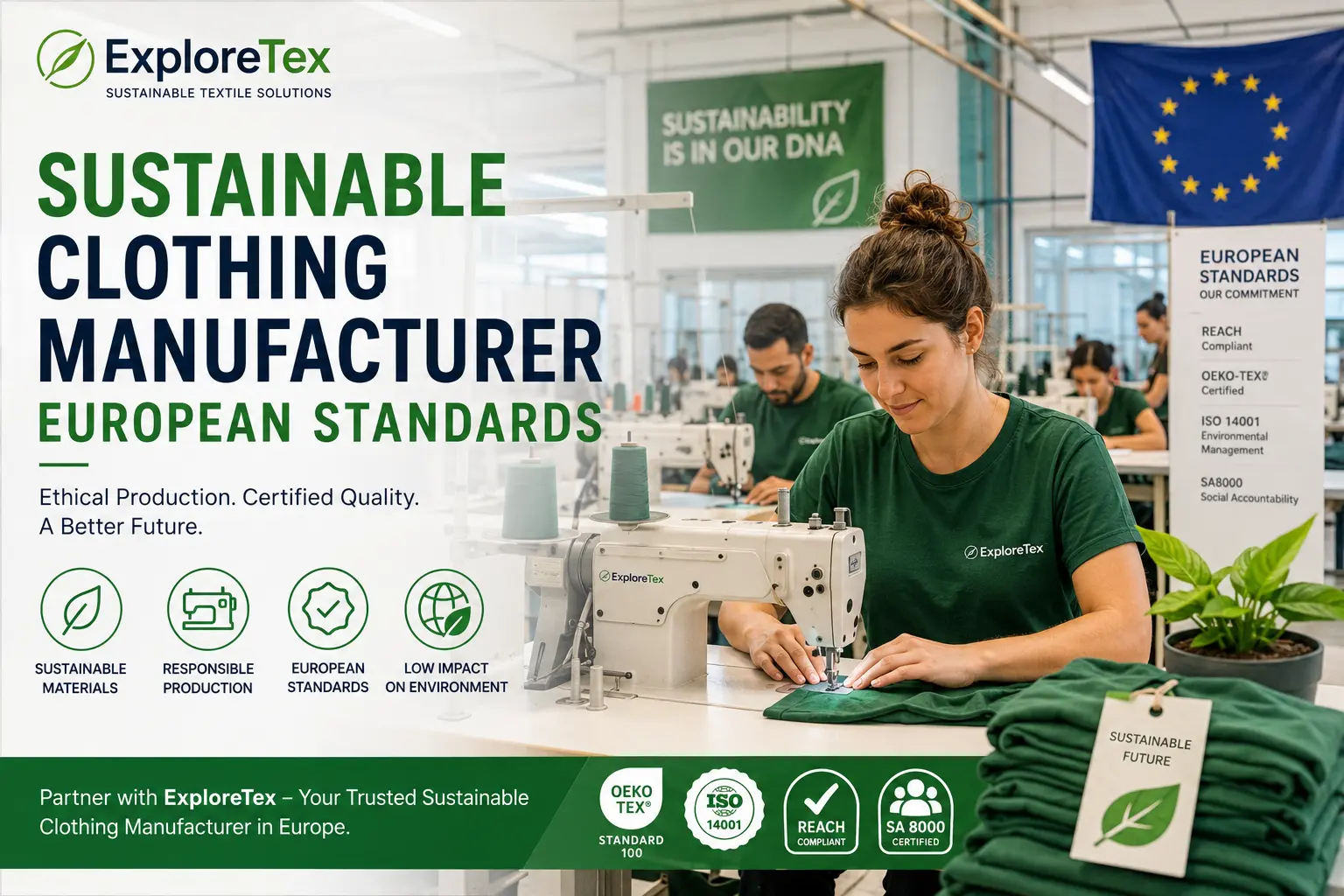
The Definitive 2026 Guide to Partnering with a Sustainable Clothing Manufacturer European Standards
The global apparel industry is undergoing a historic, irreversible transformation. Driven by stringent new environmental regulations and a massive shift in consumer consciousness, brands can no longer rely on opaque supply chains. Today, partnering with a sustainable clothing manufacturer european standards is not just an ethical choice—it is a legal and commercial necessity.
As the European Union aggressively rolls out its Strategy for Sustainable and Circular Textiles, fashion labels must audit their entire supply chain. From the chemical composition of dyes to the labor conditions on the factory floor, every element is now subject to molecular traceability. For brands aiming to scale without compromising their eco-credentials, finding the right manufacturing partner is the critical first step.
This comprehensive guide explores everything you need to know about navigating modern apparel production, why a sustainable clothing manufacturer european standards is vital to your brand’s survival, and how the unique dual-hub model of ExploreTex is setting the global benchmark for ethical production.
Introduction: The New Paradigm of Global Textile Compliance
The global apparel landscape is undergoing a permanent regulatory and ethical shift. For modern fashion brands, scaling a collection is no longer just about optimizing your cost-per-unit or accelerating time-to-market. Today, systemic transparency, carbon accountability, and circular supply chain mechanics dictate commercial success. Navigating complex legal frameworks like the EU Green Claims Directive and the Corporate Sustainability Due Diligence Directive (CSDDD) requires more than just an assembly line—it demands an engineering-driven partner.
When your brand searches for a sustainable clothing manufacturer european standards aren’t just arbitrary design goals; they are strict legal and structural metrics that govern your raw materials, chemical inputs, labor practices, and carbon footprint. Choosing an uncertified, fragmented supply chain leaves your brand vulnerable to severe customs delays, legal penalties, and devastating brand reputation risks.
As a premier Portuguese-based organization with our own registered European brand, ExploreTex has engineered an advanced manufacturing framework designed specifically to answer this demand. By operating a highly strategic Dual-Hub Production Model—which integrates high-end sample development, 3D digital prototyping, and premium artisan manufacturing inside Portugal with high-volume, vertically integrated manufacturing facilities in Bangladesh—we provide a comprehensive infrastructure that few suppliers can replicate.
Defining the Benchmark: What Do “European Standards” Actually Mean?
To truly operate as a certified sustainable clothing manufacturer european standards require deep technical compliance across three core dimensions: environmental safety, social ethics, and raw material validation.
Material and Chemical Traceability (REACH & OEKO-TEX)
Any apparel entering the European single market must comply with REACH (Registration, Evaluation, Authorisation and Restriction of Chemicals). This framework bans or severely limits hazardous substances like heavy metals, azo dyes, and phthalates. A reliable partner ensures that all fabrics pass testing protocols under the OEKO-TEX Standard 100, guaranteeing that every component—from the face fabric to the sewing threads and zippers—is entirely free from harmful chemical residues.
Verified Social Responsibility
True sustainability cannot exist without absolute labor equity. European standards mandate strict adherence to safe working conditions, living wages, regulated working hours, and the complete elimination of forced or child labor. When seeking a qualified sustainable clothing manufacturer european standards require production facilities backed by globally recognized third-party audits, including:
BSCI (Business Social Compliance Initiative): Tracking workplace health, safety, and fair compensation.
SEDEX / SMETA: Assessing ethical trade, environmental practices, and corporate integrity.
WRAP (Worldwide Responsible Accredited Production): Validating lawful, humane, and ethical manufacturing parameters.
Circularity and Raw Material Certification
To substantiate eco-friendly claims, every link in the supply chain must maintain an active chain of custody. This means relying on the Global Organic Textile Standard (GOTS) for organic cotton fibers and the Global Recycled Standard (GRS) for recycled polyesters or nylon blends. This rigorous verification prevents greenwashing, providing your brand with authentic Transaction Certificates (TCs) for every production run.
The ExploreTex Hybrid Approach: Redefining the Dual-Hub Production Ecosystem
The historical challenge for apparel brands has always been an unwanted compromise: choose a nearshore European facility for premium quality and low Minimum Order Quantities (MOQs), or go direct to an offshore South Asian facility for bulk price efficiency, often risking severe communication breakdowns and quality variances.
ExploreTex eliminates this compromise through our proprietary Dual-Hub Model, blending the technical heritage of Portugal with the massive infrastructure scale of Bangladesh.
The Portugal Hub: Sourcing, Design, and High-End Production
Our Lisbon-based headquarters acts as the strategic brain of our operations. Portugal is globally renowned for its textile heritage, particularly in luxury knits, jersey fabrics, and premium craftsmanship. At our Portugal hub, we handle:
Digital Design & Prototyping: Utilizing advanced CLO3D software to create high-fidelity virtual samples, reducing physical sampling waste by 95%.
Material Sourcing: Curating premium, certified European yarns, eco-dyes, and sustainable trims.
Partner Manufacturing: For brands requiring the “Made in Portugal” label, we work with specialized partner factories inside Portugal to manufacture and supply ultra-premium, localized apparel. Learn more about our regional operations through our dedicated guide on Clothing Manufacture in Portugal.
The Bangladesh Hub: Vertical High-Volume Manufacturing
To provide competitive pricing for scalable collections, we operate an owned vertical manufacturing facility in Bangladesh. This is what makes us a unique Clothing Manufacturer for Premium Brands. Bangladesh is the world’s second-largest apparel exporter, known for massive capacity.
Unlike conventional, fragmented manufacturing setups, our vertical facility houses yarn sourcing, knitting, dyeing, precision cutting, automated sewing lines, and specialized finishing departments under a single, unified management structure. By standardizing our quality control protocols (AQL 2.5) across both our Portuguese partners and our Bangladesh facility, we ensure a premium hoodie manufactured in Dhaka matches the precise quality of a sample developed in Lisbon.
Why Your Brand Needs a Sustainable Clothing Manufacturer European Standards
The European market is arguably the most regulated and demanding textile market in the world. When a facility operates as a sustainable clothing manufacturer european standards, it means they are voluntarily submitting to the highest global thresholds for environmental stewardship, chemical safety, and human rights.
1. Navigating the EU Strategy for Sustainable and Circular Textiles
By 2030, the European Commission mandates that all textile products placed on the EU market must be durable, repairable, and recyclable. Furthermore, they must be made largely of recycled fibers, free of hazardous substances, and produced in respect of social rights.
Working with a sustainable clothing manufacturer european standards ensures that your brand stays ahead of these legislative curves. You avoid the risk of inventory being seized or heavily taxed due to non-compliance with the Eco-design for Sustainable Products Regulation (ESPR) or the incoming Digital Product Passports (DPP).
2. Eliminating Greenwashing Risks
Consumers in 2026 are highly educated. They instantly recognize “greenwashing”—the practice of making misleading claims about the environmental benefits of a product. A verified sustainable clothing manufacturer european standards provides you with hard, verifiable data. Whether it’s the reduction of water usage in the dyeing process or the exact percentage of organic cotton used, this data protects your brand reputation and builds deep consumer trust.
3. The Economic Benefit of Efficiency
Sustainability and profitability are no longer mutually exclusive. High-tier facilities operating as a sustainable clothing manufacturer european standards boast operational efficiencies exceeding 85%. By utilizing automated cutting machines to minimize fabric waste and adopting energy-efficient knitting technology, these manufacturers drive down the per-unit cost while maintaining premium quality.
Essential Certifications for European Manufacturing Compliance
When vetting a sustainable clothing manufacturer european standards, the presence of globally recognized certifications is the baseline. These independent audits separate genuine sustainable operators from the rest.
OEKO-TEX® Standards
The OEKO-TEX Association provides a rigorous, modular system for testing textile products and production facilities. A true sustainable clothing manufacturer european standards will typically hold multiple OEKO-TEX certifications:
STANDARD 100: Ensures that every component of the garment—from the main fabric to the buttons and thread—has been tested against a list of over 1,000 harmful substances.
STeP (Sustainable Textile & Leather Production): This is critical for assessing the facility itself. It evaluates environmentally friendly production processes, health and safety, and socially responsible working conditions.
MADE IN GREEN: A traceable product label indicating that an article was tested for harmful substances and produced in a facility certified by STeP.
GOTS (Global Organic Textile Standard)
If your brand utilizes organic fibers, your sustainable clothing manufacturer european standards must be GOTS certified. This standard mandates that textiles must contain a minimum of 70% certified organic fibers, and every chemical input (like dyes and auxiliaries) must meet strict environmental and toxicological criteria.
REACH Compliance
REACH (Registration, Evaluation, Authorisation, and Restriction of Chemicals) is an EU regulation. Any sustainable clothing manufacturer european standards exporting to Europe must guarantee that their fabrics do not contain restricted chemicals such as certain azo dyes, heavy metals, or PFAS.
The Dual-Hub Advantage: Portugal Precision Meets Bangladesh Scale
The defining challenge for modern fashion brands is balancing premium quality and ethical compliance with the need for high-volume, cost-effective production. This is where the ExploreTex dual-hub model shines as the ultimate sustainable clothing manufacturer european standards.
The European Headquarters in Portugal
Portugal has a long-standing reputation for textile mastery. By operating a base in Lisbon, ExploreTex functions as a highly accessible sustainable clothing manufacturer european standards for European brands. The Portugal hub handles:
Strategic Consultation & Design: Refining your technical blueprints and tech packs.
Material Fingerprinting: Sourcing premium, compliant fabrics directly aligned with the sustainable clothing manufacturers in Portugal framework.
Prototyping: Developing the Pre-Production Sample (PPS) with absolute precision.
The Vertical Manufacturing Hub in Bangladesh
Once samples are approved, bulk production requires immense scale. Historically, brands worried about losing oversight when shifting production overseas. However, today’s top-tier facilities in South Asia are global leaders in green building design.
As a premier sustainable clothing manufacturer Bangladesh, ExploreTex operates a vertically integrated, high-capacity hub that strictly adheres to the Accord on Fire and Building Safety. This facility combines the scale needed by global brands with the meticulous oversight expected from a sustainable clothing manufacturer european standards.
Sustainable Material Science: Fiber-to-Garment Infrastructure
A garment is only as sustainable as the raw material configuration written into its initial tech pack. As an engineering-led sustainable clothing manufacturer european standards guide our curated fabric library to optimize garment longevity, hand-feel, and minimal environmental impact.
[Raw Fiber Sourcing] ➔ [GOTS / GRS Certification Check] ➔ [Low-Impact Dyeing] ➔ [Zero-Waste Automated Cutting]
Organic Cotton and the GOTS Framework
Standard cotton cultivation uses roughly 16% of global insecticides and heavy irrigation. We bypass this by utilizing 100% GOTS-certified organic cotton. This fiber is grown using non-GMO seeds, relies entirely on natural rainfall and crop rotation, and eliminates toxic synthetic pesticides, preserving local biodiversity and protecting agricultural workers.
Next-Gen Regenerated Cellulose and Recycled Blends
We utilize premium regenerated fibers alongside recycled synthetics to drive true circularity on the factory floor:
Tencel™ Lyocell: Harvested from sustainably managed eucalyptus forests, processed using a closed-loop solvent system that recovers and reuses 99.5% of water and non-toxic solvents.
GRS Recycled Polyester (rPET): Sourced from post-consumer PET bottles, dropping energy utilization by 50% and carbon emissions by up to 70% compared to virgin polyester.
Innovative Plant Fibers: Integrating highly resilient hemp and bamboo blends to develop moisture-wicking activewear and lightweight summer garments. Partner with our network directly via our Activewear Fabric Suppliers Portugal channels to explore custom technical textile configurations.
Deep Dive into Eco-Friendly Materials
A garment is only as sustainable as its raw materials. A forward-thinking sustainable clothing manufacturer european standards will guide you away from virgin synthetics and water-heavy conventional cotton, pointing you toward next-generation textiles.
ExploreTex leads the industry in sustainable and bio-based fabrics, offering a wide array of options that meet European benchmarks:
Regenerated Cellulose (Lyocell, Modal, and Tencel): Made from sustainably harvested wood pulp using a closed-loop system that recycles 99% of water and solvents. These fabrics are essential for any sustainable clothing manufacturer european standards catering to the luxury or activewear markets.
Organic and Transitional Cotton: Grown without synthetic pesticides, promoting soil health and biodiversity.
Recycled Polyester (rPET): Sourced from post-consumer plastic bottles, drastically reducing the reliance on petroleum extraction.
Bio-Fabrication and Algae-Based Fibers: The cutting edge of textile science, offering biodegradable alternatives that actively sequester carbon.
Factory-Floor “Expert” Insights: The Anatomy of Green Production
What actually happens inside a facility operating as a sustainable clothing manufacturer european standards? Let’s take a walk onto the factory floor to explore the engineering that makes eco-friendly production possible.
1. Advanced Effluent Treatment Plants (ETPs)
Textile dyeing is notoriously water-intensive. Inside a modern sustainable clothing manufacturer european standards facility, wastewater does not run off into local rivers. Instead, it is routed into biological and chemical ETPs. These systems filter out heavy metals, neutralize pH levels, and recycle up to 90% of the water back into the dyeing process.
2. Automated Cutting and Zero-Waste Protocols
Fabric waste is a massive contributor to landfill mass. To operate as a sustainable clothing manufacturer european standards, factories utilize AI-driven 3D mapping algorithms to plot garment patterns onto fabric rolls. This technology ensures maximum fabric utilization. Any unavoidable offcuts are gathered and sent to recycling partners to be broken down into lower-grade industrial textiles.
3. Energy Resilience and Solar Integration
Heavy machinery requires immense power. A sustainable clothing manufacturer european standards actively transitions away from fossil fuels. By covering factory rooftops with commercial-grade solar panels and utilizing transparent skylights to eliminate the need for daytime electric lighting, facilities dramatically lower their Scope 1 and Scope 2 carbon emissions.
4. Continuous In-Line Quality Inspections
A garment that is manufactured incorrectly and must be discarded is the ultimate waste of resources. A true sustainable clothing manufacturer european standards utilizes an Acceptable Quality Limit (AQL) of 1.5 or stricter. This involves checking stitch tension every 30 minutes, 100% end-of-line measurement checks, and Final Random Inspections (FRI) to ensure longevity and durability.
Factory-Floor “Expert” Insights: The Mechanics of Green Production
“True textile sustainability isn’t achieved on a marketing brochure; it is won or lost on the factory floor through precise mechanical engineering, automated efficiency, and rigorous water stewardship.”
— Muhammad Ilias Hossen, Textile Engineer & Founder, ExploreTex
To understand how a premium garment is ethically manufactured, we must look at the real-world manufacturing line. Here is exactly how our production facilities optimize energy, reduce waste, and enforce quality control.
AI-Driven Zero-Waste Pattern Architecture
Traditional manual pattern placement can result in fabric scrap waste as high as 15% to 20% during the cutting phase. ExploreTex utilizes automated CAD/CAM software to analyze pattern geometries down to the millimeter. The system mathematically nests pattern pieces across the fabric width, driving utilization efficiency up to 92-95%. This dramatically minimizes textile waste before assembly even begins.
Low-Liquor Ratio Dyeing Machinery
Water contamination is one of the most critical environmental liabilities in apparel production. Our vertical facilities employ advanced soft-flow dyeing machines featuring ultra-low liquor ratios (1:4 or 1:5, compared to traditional 1:10 ratios). This engineering advancement significantly reduces water and chemical consumption per kilogram of fabric. Furthermore, all wastewater undergoes complete treatment in on-site Effluent Treatment Plants (ETPs), ensuring neutralized, safe water discharge.
Structural Assembly and Quality Gates (AQL 2.5)
A sustainable garment must be inherently durable. A shirt that loses its structural integrity after five washes is a failure of sustainability. Our manufacturing lines implement strict internal quality gates:
SPI (Stitches Per Inch) Calibration: Standardizing 10-12 SPI using high-tensile core-spun threads to prevent seam failure under stress.
Pre-Shrinkage Optimization: Every fabric batch undergoes mechanical compaction and hot-air tension drying to limit residual shrinkage to under 3%, maintaining perfect fit consistency across retail lifecycles.
AQL 2.5 Quality Assurance: Statistical random inspection parameters are executed at inline, end-of-line, and final pre-shipment stages. This strict methodology is a core pillar of our comprehensive Clothing Production Support for Brands.
The ExploreTex Ethical Sourcing Workflow
Choosing the right partner means looking beyond just the machinery and focusing on the people. As a prominent BSCI/WRAP Certified Factory, ExploreTex enforces rigorous social compliance.
Our proprietary workflow for Ethical Sourcing & Sustainable Textile Innovation ensures that every stitch is backed by fair labor practices. This involves:
Living Wages & Fair Hours: Ensuring financial stability for every garment worker.
The Hybrid Audit: Because we own our facility in Bangladesh and manage it via our Portuguese headquarters, we eliminate the middle-man ambiguity that often hides supply chain abuses.
Transparent Digital Trails: From the raw yarn origin to the final container, our clients receive verifiable data to share with their eco-conscious consumers.
Partnering with one of the top garments manufacturers in Bangladesh that operates strictly as a sustainable clothing manufacturer european standards allows you to navigate the complexities of international trade stress-free. Whether you choose FOB (Free On Board) or DDP (Delivered Duty Paid) logistics, the process is streamlined for your peace of mind.
Overcoming Supply Chain Friction: MOQs, Timelines, and Logistics
Many growing fashion labels encounter major barriers when approaching a certified sustainable clothing manufacturer european standards often align with massive MOQ requirements that stall independent brand development. ExploreTex solves these distribution challenges by building accessible, agile manufacturing paths.
Flexible MOQs for Emerging and Enterprise Brands
Through our hybrid setup, we cater to dual ends of the market spectrum:
Nearshore Agile Production: Perfect for capsule collections, limited-run streetwear drops, or premium corporate apparel starting at accessible low MOQs. Explore our specialized knit programs via Custom Knitwear Manufacturers Portugal.
Massive Global Scaling: Seamlessly transition proven retail styles into high-volume runs within our vertical offshore hub to unlock maximize economies of scale. We are built to serve as your definitive Bulk Clothing Manufacturer for Retail & Wholesale.
Production Timeline Overview
Understanding the standard manufacturing window allows your brand to optimize seasonal product launches without accumulating excess inventory deadstock:
Sourcing Intelligence: Comparing Production Models
When evaluating where to anchor your brand’s supply chain, it helps to review how our hybrid approach compares against standard options. Partnering with elite Textile Manufacturers in Portugal ensures premium, verified outputs.
| Core Operational Metrics | Standard Trading Agent | Isolated Offshore Factory | ExploreTex Dual-Hub Model |
| Regulatory Compliance | Unverified / Inconsistent | Fragmented / High Risk | 100% Guaranteed European Standards |
| Prototyping Waste | High (Multiple Physical Copies) | Moderate (Slow Air Shipping) | Ultra-Low (95% Cut via 3D CLO3D) |
| Minimum Order Volume | Rigid (Usually 1,000+ units) | Extreme (Mass Bulk Only) | Highly Flexible (Low MOQ Options) |
| Quality Control Integrity | 3rd Party (Additional Costs) | Self-Audited (Unreliable) | In-House Elite AQL 2.5 Systems |
| Logistics Framework | Ex-Works (Client Risk) | FOB (Port Clearance Friction) | DDP Sourcing (Delivered Duty Paid) |
Answer Targeted FAQ
Q: What makes a facility a sustainable clothing manufacturer european standards? A: A sustainable clothing manufacturer european standards is a facility that strictly complies with EU environmental and labor directives, such as the Eco-design for Sustainable Products Regulation (ESPR) and REACH. They utilize eco-friendly materials (like GOTS-certified organic cotton), implement water recycling systems (ETPs), prioritize renewable energy, and hold verifiable social compliance certifications like BSCI, WRAP, or OEKO-TEX STeP.
Q: Why do European brands manufacture clothing in Bangladesh? A: European brands choose Bangladesh because it offers an unmatched combination of high-volume scalability and advanced green infrastructure. Modern facilities in Bangladesh are global leaders in LEED-certified green buildings. When managed by a European entity like ExploreTex, brands receive the cost benefits of the region alongside the strict compliance guarantees of a sustainable clothing manufacturer european standards.
Q: How does OEKO-TEX certification affect sustainable clothing manufacturing? A: OEKO-TEX certification guarantees that textiles are safe for human health and the environment. For a sustainable clothing manufacturer european standards, achieving OEKO-TEX Standard 100 means every component (fabric, zippers, threads) is tested for harmful toxins. Furthermore, OEKO-TEX STeP certification verifies that the manufacturing facility itself operates with environmentally friendly and socially responsible practices.
Q: What is the difference between conventional and sustainable garment dyeing? A: Conventional dyeing consumes massive amounts of freshwater and discharges toxic chemical runoff into local ecosystems. A sustainable clothing manufacturer european standards utilizes low-impact, non-toxic dyes (free of heavy metals) and relies on closed-loop Effluent Treatment Plants (ETPs) to filter, treat, and recycle up to 90% of the water used, ensuring zero toxic discharge.
Q: How can I transition my fashion brand to a sustainable clothing manufacturer european standards? A: The transition begins with supply chain transparency and material substitution. Partner with a manufacturer that offers “Material Fingerprinting” to replace virgin synthetics with regenerated or bio-based fabrics. Consolidate your supply chain by working with a fully vertical partner like ExploreTex, which manages everything from spinning and knitting to cutting, sewing, and DDP shipping, ensuring European compliance at every phase.
What parameters define a truly sustainable clothing manufacturer meeting European standards?
A certified factory must prove active compliance across three specific operational areas:
Chemical Restriction: Complete REACH and OEKO-TEX Standard 100 clearance prohibiting toxic azo dyes, heavy metals, and endocrine disruptors.
Verifiable Traceability: Intact chains of custody backed by formal Transaction Certificates for raw inputs via GOTS (organic) or GRS (recycled) frameworks.
Ethical Labor Protocols: Regular on-site validation managed by independent third-party monitoring bodies like BSCI, SEDEX/SMETA, or WRAP.
How does ExploreTex enforce quality control across its international production hubs?
ExploreTex utilizes a unified engineering control matrix. Every production run is governed by international AQL 2.5 (Acceptable Quality Limit) statistical criteria. Our internal quality assurance teams operate directly within both our nearshore Portuguese partner networks and our vertically integrated factory in Bangladesh. This centralized management model ensures that fit accuracy, seam strength, and fabric wash-fastness remain completely identical regardless of where the final assembly line is located.
Specialized FAQ Section
Q1: Can I launch my collection with low MOQs and scale to bulk volume later?
Yes, this scalability is exactly why we built our Dual-Hub Model. You can initiate low-volume capsule collections or highly specialized artisan lines utilizing our nearshore partner network inside Portugal. Once those styles achieve market validation, you can seamlessly scale production into our high-capacity, vertically integrated Bangladesh facilities to optimize margins while maintaining identical design specs. Explore our regional sourcing capabilities through our guide on the Best Clothing Manufacturers in Portugal.
Q2: How does ExploreTex eliminate the carbon footprint of shipping raw materials?
We prioritize raw material proximity and structural vertical integration. In our Bangladesh facility, knitting, dyeing, assembly, and packaging are housed under a single roof, cutting out transit emissions between disparate processing plants. In Europe, we source yarns and premium trims from a tight, localized cluster inside Northern Portugal, minimizing regional freight impacts.
Q3: What documentation do you provide to verify environmental product claims?
We deliver complete structural validation for every shipment. This includes formal GOTS and GRS Transaction Certificates verifying your fabric’s lineage, OEKO-TEX chemical safety compliance sheets, and verified factory audit reports (BSCI/WRAP). This technical documentation lets your brand confidently navigate strict EU anti-greenwashing laws.
Q4: Do you handle customs clearance and import logistics for our brand?
Yes. We operate primarily under DDP (Delivered Duty Paid) shipping terms for our clients. Our dedicated international trade team manages all export declarations, freight routing, certificates of origin, and custom clearance procedures. Your order arrives directly at your designated fulfillment center with no hidden administrative fees or border holdups.
Q5: How do we get started with a production run?
The process begins with a technical review of your design files, reference garments, or tech packs. Our engineering team evaluates your fabric specifications and design goals to construct an accurate quote. Ready to optimize your supply chain with a trusted partner? Contact ExploreTex today to speak directly with an expert apparel production manager.
 Conclusion: Securing Your Brand’s Future in the Green Economy
 Conclusion: Securing Your Brand’s Future in the Green Economy
The days of fast, disposable fashion produced in shadowy supply chains are rapidly coming to an end. The modern consumer demands transparency, and international regulatory bodies are actively enforcing it.
Transitioning your production to a sustainable clothing manufacturer european standards is an investment in your brand’s longevity, profitability, and legacy. By leveraging the advanced infrastructure, ethical labor frameworks, and eco-friendly material sciences offered by modern facilities, you can scale your collections while actively protecting the planet.
Are you ready to elevate your supply chain to meet the highest global benchmarks? Let’s build the future of fashion together. Contact ExploreTex today to consult with our experts in Portugal and learn how our vertical facilities in Bangladesh can bring your sustainable vision to life.