
Fashion Supply Chain Resilience Strategies: The Definitive Pillar Guide for Modern Apparel Brands
The global textile and apparel ecosystem has entered an era of permanent volatility. From geopolitical tension in major trade corridors and acute raw material shortages to unpredictable climate events and shifting consumer demand cycles, fashion brand executives face unprecedented pressure. Traditional single-region sourcing models—once favored purely for rock-bottom unit labor costs—are proving dangerously fragile. When a single supply chain bottleneck can derail an entire seasonal release, implementing comprehensive fashion supply chain resilience strategies is no longer a luxury for fashion brands; it is an existential operational requirement.
To thrive in today’s volatile marketplace, apparel brands must pivot from reactive crisis management to proactive risk engineering. True resilience requires structural redesign: diversifying manufacturing locations, adopting digital prototyping technologies, enforcing multi-tier vendor compliance, and establishing agile nearshore-offshore hybrid networks.
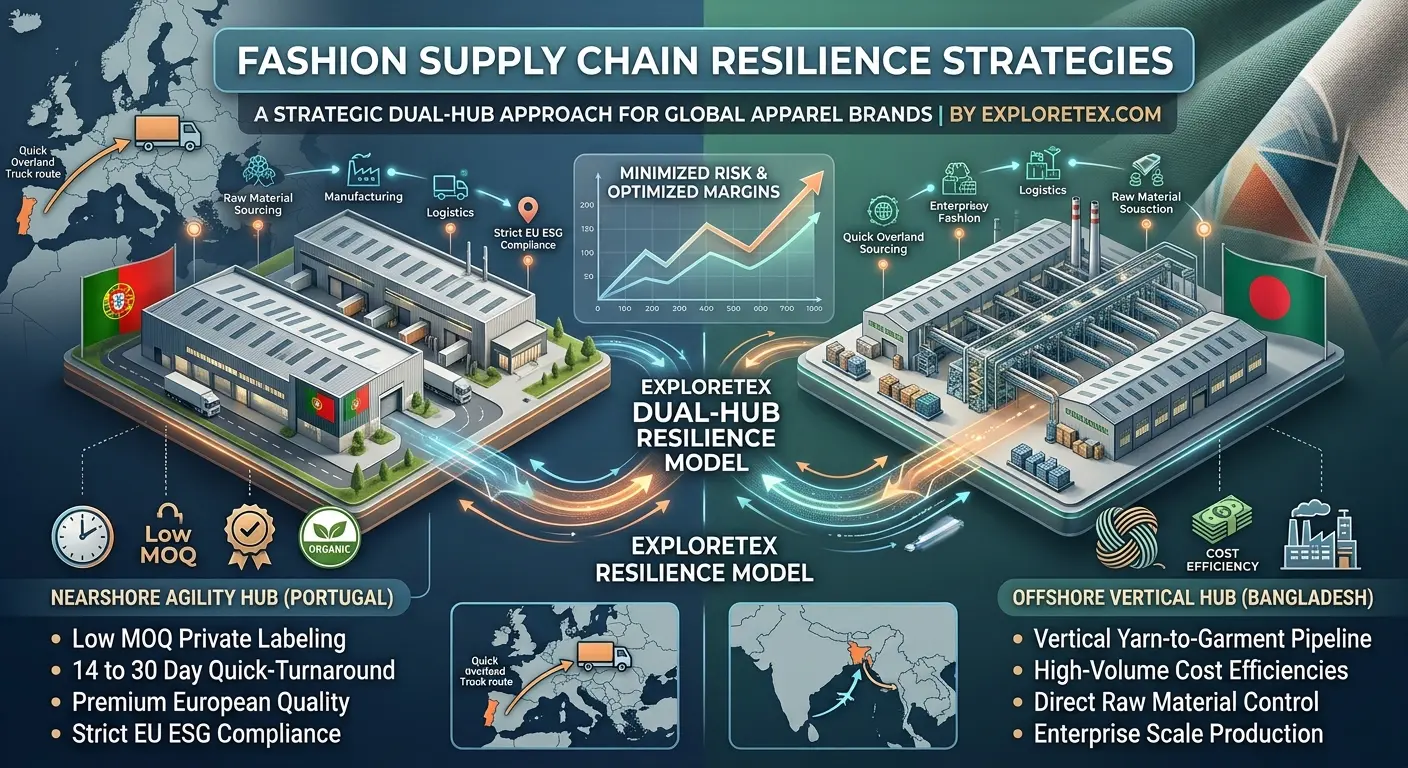
As a premier Portuguese-based garment manufacturer operating a unique Dual-Hub model, ExploreTex provides fashion brands worldwide with the infrastructure needed to execute modern fashion supply chain resilience strategies. By combining European design precision, low MOQs, and fast-turnaround nearshoring in Portugal with a high-capacity, vertically integrated manufacturing facility in Bangladesh, ExploreTex delivers the ideal balance of risk mitigation, speed-to-market, and cost efficiency.
In this comprehensive guide, we unpack the fundamental pillars of fashion supply chain resilience strategies, offering actionable frameworks, factory-floor insights, and tactical blueprints for brand leaders ready to future-proof their apparel production.
Introduction:
In today’s unpredictable global apparel market, implementing robust fashion supply chain resilience strategies has become mandatory for fashion brands striving for long-term operational success. Global disruptions, freight volatility, and shifting consumer expectations force procurement executives to constantly audit their existing fashion supply chain resilience strategies. When traditional single-source production models fail under macroeconomic stress, executing proven fashion supply chain resilience strategies provides the operational cushion required to preserve gross margins.
Brands that actively prioritize fashion supply chain resilience strategies can successfully mitigate unpredictable lead-time spikes and protect retail inventory flow. Furthermore, integrating agile fashion supply chain resilience strategies enables apparel leaders to convert supply chain volatility into a powerful competitive advantage.
At ExploreTex, we specialize in delivering high-performance fashion supply chain resilience strategies engineered for the modern apparel ecosystem. As a premier Portuguese apparel manufacturing partner operating a strategic dual-hub network, our core focus is delivering effective fashion supply chain resilience strategies that seamlessly combine European nearshoring agility with high-volume vertical production in Bangladesh. When fashion brands re-evaluate their global fashion supply chain resilience strategies, they quickly realize that single-region sourcing is a dangerous operational vulnerability.
By embedding hybrid fashion supply chain resilience strategies into your brand’s growth roadmap, your business can balance low-MOQ sampling speed in Portugal with enterprise cost efficiencies in Asia. Consequently, dynamic fashion supply chain resilience strategies effectively bridge the gap between creative design innovation and global market scalability.
Moreover, modern fashion supply chain resilience strategies must address strict regulatory mandates, ethical labor standards, and ESG compliance across every manufacturing tier. The foundation of modern fashion supply chain resilience strategies relies on total supply chain transparency, from eco-friendly yarn selection to final garment packing. When fashion executives combine digital 3D virtual prototyping with sustainable fashion supply chain resilience strategies, pre-production approval cycles drop from months down to a few days.
Exploring actionable fashion supply chain resilience strategies allows growing labels to respond dynamically to fast-moving micro-trends without accumulating excess inventory risk. Ultimately, data-driven fashion supply chain resilience strategies shield your apparel business from costly markdowns, unexpected stockouts, and shipping bottlenecks.
Transitioning to flexible fashion supply chain resilience strategies requires an experienced global manufacturing partner with dedicated infrastructure. Through our European design hub in Portugal and vertically integrated facilities in Bangladesh, ExploreTex empowers brands to build resilient fashion supply chain resilience strategies that withstand global disruptions. Whether your collection demands fast-turnaround nearshore production or large-scale bulk assembly, our tailored fashion supply chain resilience strategies guarantee consistent quality and on-time delivery.
As we examine these essential fashion supply chain resilience strategies throughout this guide, you will discover actionable frameworks to optimize your apparel operations. Adopting these advanced fashion supply chain resilience strategies positions your clothing line for sustainable profitability.
Therefore, evaluating your existing fashion supply chain resilience strategies is the vital first step toward long-term market leadership. By partnering with ExploreTex, your team can deploy comprehensive fashion supply chain resilience strategies that optimize landed costs while eliminating lead-time friction. Implementing these practical fashion supply chain resilience strategies ensures your brand stays agile, compliant, and profitable in 2026 and beyond.
Elevating your operational standards through specialized fashion supply chain resilience strategies provides the foundation for sustainable scale. Ultimately, mastering these transformative fashion supply chain resilience strategies empowers your brand to outpace competitors in an ever-changing industry landscape.
Section 1: The Modern Apparel Vulnerability Crisis (Macroeconomic, Geo-political & Climate Risks)
To understand why legacy supply chain models fail, apparel executives must examine the systemic vulnerabilities affecting global garment production. The traditional model of relying exclusively on a single offshore manufacturing center leaves brands vulnerable to systemic single-point failures.
       LEGACY SINGLE-HUB MODEL                    DUAL-HUB RESILIENT MODEL (EXPLORETEX)
+------------------------------------+    +---------------------------------------------------+
|  Single Offshore Region Sourcing   |    |    Nearshore Hub (Portugal)                       |
|  - High Minimum Order Quantities   |    |    - Quick-Response / Low MOQ / Sampling           |
|  - Long Ocean Transit (30-60 Days) |    |    - EU ESG Compliance / Rapid Replenishment       |
|  - Vulnerable to Port Bottlenecks  |    +-------------------------+-------------------------+
|  - Rigid Production Scheduling     |                              |
+-----------------+------------------+    +-------------------------v-------------------------+
                  |                       |    Offshore Vertical Hub (Bangladesh)             |
                  v                       |    - High-Volume Cost Efficiencies                    |
       [ High Risk of Delays ]            |    - Raw Material Control / Direct Fabric Sourcing   |
       [ Stockouts & Markdowns ]          +---------------------------------------------------+
1. Geo-Political Bottlenecks and Shipping Corridor Volatility
Maritime shipping routes remain increasingly unpredictable. Geopolitical conflicts along key maritime arteries, such as the Red Sea and Suez Canal, have forced cargo carriers to detour around Africa’s Cape of Good Hope, adding 10 to 14 days to transit times and dramatically inflating container freight costs. Brands relying solely on long-haul ocean freight repeatedly miss critical retail delivery windows. Incorporating multi-modal logistics and flexible production locations into your fashion supply chain resilience strategies neutralizes these transit delays.
2. Raw Material Price Fluctuation and Sourcing Bottlenecks
Volatility in cotton yields, synthetic fiber pricing, and chemical dyeing agents creates margin compression for brands that do not control their supply tiers. When raw material suppliers experience delays, garment assembly grinds to a halt. Leading fashion supply chain resilience strategies emphasize direct vertical raw material integration—allowing manufacturers to knit, dye, and finish fabrics in-house, securing guaranteed material allocations well ahead of bulk production cycles.
3. Rapid Shifts in Micro-Trends and Consumer Demand
The acceleration of social-media-driven fashion cycles means consumer demand can spike or vanish within days. Brands locked into traditional 180-day lead times face a high risk of either catastrophic inventory stockouts or costly overstock inventory that must be deeply discounted. Nearshore manufacturing networks enable test-and-repeat models, empowering brands to launch small production runs, evaluate market demand in real time, and scale up bulk production seamlessly.
4. Stringent Regulatory and ESG Mandates
Regulatory authorities across the EU and North America are enforcing strict ESG (Environmental, Social, and Governance) legislation, including the EU Digital Product Passport (DPP), the Corporate Sustainability Due Diligence Directive (CSDDD), and forced-labor import bans. Brands lacking full supply chain visibility face severe compliance fines, customs seizures, and brand equity destruction. Consequently, modern fashion supply chain resilience strategies must treat full transparency and certified compliance as core structural elements rather than optional marketing points.
To learn more about how European manufacturing standards enhance compliance, explore our dedicated guide on clothing manufacture in Portugal.
Section 2: Core Pillar 1 — Dual-Hub Hybrid Sourcing Models (Portugal + Bangladesh Synergy)
The cornerstone of modern fashion supply chain resilience strategies is the Dual-Hub Hybrid Sourcing Model. Rather than forcing brands to choose between high-cost local nearshoring and lower-cost, long-lead-time offshore production, the Dual-Hub model combines the distinct advantages of both geographic regions into a single, unified production workflow.
+---------------------------------------------------------------------------------------------+
|                                    EXPLORETEX DUAL-HUB MODEL                                |
+--------------------------------------------------------------+------------------------------+
|                    PORTUGAL NEARSHORE HUB                    |    BANGLADESH VERTICAL HUB   |
+--------------------------------------------------------------+------------------------------+
| * Strategic Management & Technical Pattern Engineering      | * Vertically Integrated Mill |
| * Low MOQ Private Labeling & Micro-Capsules                  | * Bulk High-Volume Cut & Sew |
| * 14 to 30 Day Quick-Turnaround Replenishment               | * Enterprise Cost Efficiencies|
| * Premium European Quality & Strict EU ESG Compliance        | * Raw Material & Knitting    |
+--------------------------------------------------------------+------------------------------+
Strategic Synergy: European Management with Global Scale
At ExploreTex, our operations reflect this exact hybrid strategy. Headquartered in Portugal with European management, pattern making, and quality control oversight, we operate a dual-production network:
The Portuguese Managed Production Hub: Located in Northern Portugal’s world-renowned textile cluster, this hub specializes in rapid prototyping, premium outerwear, tailored garments, organic jersey capsule lines, and urgent re-orders with flexible minimum order quantities (MOQs).
The Bangladesh Vertical Manufacturing Hub: Fully owned and operated with vertical yarn-to-garment capabilities, this facility handles bulk, high-volume orders for custom t-shirts, hoodies, activewear, and workwear—delivering unbeatable enterprise cost efficiencies without compromising social audit compliance.
How Dual-Hub Models Implement Fashion Supply Chain Resilience Strategies
Dynamic Production Shifting: If a sudden surge in demand requires immediate retail restocking, a brand can trigger a rapid 14-day nearshore run in Portugal while simultaneously initiating a high-volume bulk production run in Bangladesh.
Risk Diversification: Operational interruptions in one geographical region do not halt a brand’s entire product line. Production can be dynamically reallocated across facilities.
Optimized Margin Management: Brands maintain overall high gross margins by balancing high-margin, high-volume staple items produced in Bangladesh with high-flexibility, trend-responsive capsule lines manufactured in Europe.
According to global supply chain research published by McKinsey & Company, fashion companies that adopt diversified, nearshore-hybrid sourcing networks achieve a 30% reduction in average time-to-market and a 25% improvement in full-price sell-through rates compared to traditional single-source supply chains.
For brands looking for a turnkey partner to manage this multi-hub structure, ExploreTex offers comprehensive full-package clothing production solutions tailored to international client needs.
Section 3: Core Pillar 2 — Nearshoring & Strategic Agility in European Manufacturing
Nearshoring has evolved from an emergency backup plan into a central pillar of proactive fashion supply chain resilience strategies. By positioning manufacturing operations within or adjacent to primary retail markets, apparel brands gain speed, operational control, and supply chain flexibility.
+---------------------------------------------------------------------------------------+
|                       NEARSHORING ADVANTAGE MATRIX (PORTUGAL)                         |
+------------------------+------------------------------------+-------------------------+
| METRIC                 | TRADITIONAL OFFSHORE               | PORTUGAL NEARSHORE      |
+------------------------+------------------------------------+-------------------------+
| Initial Sample Delivery| 4 to 6 Weeks                       | 5 to 10 Days            |
| Bulk Transit to EU/UK  | 30 to 45 Days (Ocean Freight)      | 2 to 5 Days (Overland)  |
| Minimum Order Quantity | 1,500 - 3,000 Units per Style      | 100 - 300 Units         |
| Duty & Tariff Complexity| High Customs Clearance Requirements| Zero EU Duties          |
+------------------------+------------------------------------+-------------------------+
Why Portugal Leads European Nearshoring Resilience
Portugal stands as the undisputed center for high-end, agile apparel manufacturing in Europe. Key operational advantages include:
Unrivaled Speed-to-Market: Ground freight transport from Portugal to major Western European logistics hubs takes just 2 to 5 days, compared to 30 to 45 days for ocean freight from East Asia.
Low MOQs and Agile Batch Sizes: Portuguese facilities accommodate smaller batch sizes (starting as low as 100–300 pieces per style). This enables fashion brands to test new designs in real-market conditions without locking up working capital in heavy initial inventory.
Advanced Textile Craftsmanship: Northern Portugal features specialized industrial clusters with decades of expertise in high-end circular knitting, complex dyeing techniques, technical activewear, and eco-friendly finishing.
Favorable Regulatory and Duty Frameworks: Manufacturing within the European Union guarantees complete alignment with strict EU labor laws, fair wage structures, and duty-free trade across EU member states, greatly simplifying logistics.
By embedding European nearshoring into their overarching fashion supply chain resilience strategies, brands protect themselves against shipping bottlenecks while maintaining the agility needed to capitalize on fast-moving retail trends.
To explore how our European facilities support eco-conscious brands, review our insights on sustainable clothing manufacturers in Portugal.
Section 4: Core Pillar 3 — Vertical Integration, Raw Material Control & Cost Engineering
While nearshoring delivers speed and flexibility, bulk profitability requires cost engineering and raw material security. This is where vertical integration becomes essential to successful fashion supply chain resilience strategies.
When a factory relies on third-party suppliers for fabric knitting, dyeing, washing, and embellishment, the supply chain acquires multiple external failure points. A delay at a independent dye house can stall an entire bulk production run, creating domino-effect delays across retail distribution networks.
                   EXPLORETEX VERTICAL FABRIC-TO-GARMENT PIPELINE
+---------------------------------------------------------------------------------+
| Raw Fiber Selection  -->  In-House Knitting  -->  Precision Eco-Dyeing & Finishing |
+---------------------------------------------------------------------------------+
                                        |
                                        v
+---------------------------------------------------------------------------------+
| Automated CAD Cutting  -->  Precision Sewing Lines  -->  AQL 2.5 Quality Inspection|
+---------------------------------------------------------------------------------+
The Bangladesh Vertical Advantage
At ExploreTex’s vertically integrated production hub in Bangladesh, every critical manufacturing step takes place within an integrated, highly controlled ecosystem:
Yarn Sourcing and Knitting: Direct control over yarn purchasing and in-house circular/flat knitting machinery ensures consistent fabric weight, density, and hand-feel batch after batch.
In-House Fabric Dyeing and Finishing: Advanced continuous dyeing range machinery paired with zero-discharge water recycling systems guarantees color matching precision (Lab-dip approval to bulk) while eliminating reliance on external dye houses.
Automated Cutting and Sewing: Computerized Lectra CAD/CAM cutting tables minimize fabric waste, maximizing yields and reducing garment costs.
Integrated Embroidery and Printing: Screen printing, digital direct-to-garment (DTG), sublimation, and high-density embroidery are executed under direct quality supervision.
Cost Engineering without Ethical Compromise
Vertical integration removes middleman markups across fabric sourcing, dyeing, and converting steps. This enables ExploreTex to pass substantial cost savings directly to client brands, lowering FOB (Free on Board) unit costs while maintaining strict AQL 2.5 quality standards and BSCI social compliance.
By pairing vertical raw material control in Bangladesh with European management, brands build robust fashion supply chain resilience strategies that deliver both structural cost advantages and peace of mind.
To review our vetted regional network of facilities, explore our guide to the best clothing manufacturers in Portugal.
Section 5: Core Pillar 4 — Digital Supply Chain Traceability, CAD, and 3D Virtual Prototyping
Digital technology is a foundational element of effective fashion supply chain resilience strategies. Traditional manual product development—which involves physical tech packs, sample shipping, physical fitting revisions, and manual adjustments—can take 6 to 10 weeks before bulk production even begins.
TRADITIONAL PROTOTYPING:
[ Tech Pack ] -> [ Ship Sample 1 ] -> [ Physical Fit ] -> [ Ship Sample 2 ] -> [ Approval ] (6-8 Weeks)

DIGITAL 3D PROTOTYPING (EXPLORETEX):
[ Digital Tech Pack ] -> [ 3D Virtual Fitting & Simulation ] -> [ Master Sample ] -> [ Approval ] (3-5 Days)
By replacing physical sampling cycles with digital workflows, brands drastically compress development timelines and remove physical shipping risks from the pre-production phase.
Key Technological Drivers of Resilient Apparel Sourcing
1. 3D Virtual Prototyping and Digital Sample Fitting
Using advanced 3D garment simulation software, ExploreTex converts 2D tech packs into hyper-realistic 3D digital garment renderings. Designers and sourcing managers can visualize drape, fit, fabric tension, and colorways on customizable digital avatars in real time. This digital workflow reduces physical sampling iterations by up to 75%, saving thousands of dollars in courier costs and cutting weeks off development cycles.
2. Digital Pattern Grading and Marker Optimization
Computer-Aided Design (CAD) systems execute mathematical size grading across complete size runs (from XS to 5XL) while preserving pattern balance and proportional integrity. Digital marker making optimizes fabric layout patterns, achieving high fabric utilization rates (up to 92%) and significantly reducing textile scrap waste.
3. End-to-End Digital Inventory Traceability
Integrating RFID tags and digital barcoding at the bundle level gives sourcing managers real-time visibility into production status—tracking garments from initial cutting to final packing. This digital tracking allows potential delays to be identified and addressed instantly on the factory floor.
4. Digital Product Passport (DPP) Readiness
As European regulations increasingly mandate full supply chain transparency, ExploreTex builds digital traceability directly into its manufacturing workflows. Every fabric lot, dye batch, and garment component is cataloged, laying the groundwork for seamless DPP integration.
Implementing advanced digital tools across product development is one of the most effective fashion supply chain resilience strategies for cutting time-to-market and enhancing transparency.
To learn how ExploreTex simplifies production for UK and European labels, read our overview on private label apparel manufacturing Europe.
Section 6: Core Pillar 5 — Multi-Tier ESG Compliance, Circularity, and Eco-Certifications
In the modern fashion landscape, sustainability and supply chain resilience are deeply interconnected. A supply chain reliant on uncertified, non-compliant subcontractors is vulnerable to regulatory fines, sudden facility closures, and severe reputational damage. Comprehensive fashion supply chain resilience strategies must incorporate robust ESG compliance frameworks across every manufacturing tier.
+---------------------------------------------------------------------------------+
|                        EXPLORETEX GLOBAL CERTIFICATION MATRIX                   |
+--------------------------+------------------------------------------------------+
| CERTIFICATION            | OPERATIONAL FOCUS & STANDARDS                        |
+--------------------------+------------------------------------------------------+
| GOTS (Global Organic)    | Organic fiber origin & eco-friendly chemical inputs  |
| OEKO-TEX® Standard 100   | Guaranteed free from harmful substances & toxins     |
| GRS (Global Recycled)    | Certified recycled polyester, nylon, & cotton blends |
| BSCI & SEDEX SMETA       | Rigorous social audits, fair wages, & workplace safety|
+--------------------------+------------------------------------------------------+
Sustainable Resilience in Practice
Building a sustainable, audit-ready supply chain involves several core operational practices:
Organic and Recycled Material Pipelines: Securing stable supplies of GOTS-certified organic cotton, GRS-certified recycled polyester, and FSC-certified viscose ensures brands can reliably meet sustainability commitments regardless of market fluctuations.
Low-Impact Wet Processing and Water Recycling: Industrial dye houses equipped with closed-loop water treatment and effluent treatment plants (ETP) minimize environmental impact while protecting operations against strict regional environmental shut-downs.
Zero-Waste Cutting Initiatives: Recycling pre-consumer textile waste back into recycled yarn pipelines supports circular manufacturing while reducing raw material purchase costs.
Third-Party Ethical Audits: Maintaining continuous BSCI, WRAP, and SEDEX social compliance across all production hubs protects brands from regulatory labor violations and unexpected factory disruptions.
By embedding ESG compliance directly into your fashion supply chain resilience strategies, your brand secures supply chain continuity while building long-term equity with eco-conscious consumers.
For independent research on sustainable textile standards and circular economy frameworks, consult the Ellen MacArthur Foundation, an industry authority on circular apparel supply chains.
If you are ready to evaluate your brand’s compliance requirements, reach out directly to our team via our contact ExploreTex portal.
Section 7: Factory-Floor “Expert” Insights — Operational Execution from Lisbon to Dhaka
Inside Look: The ExploreTex Operational Playbook
To illustrate how modern fashion supply chain resilience strategies function on the ground, we share real operational insights from ExploreTex’s twin production hubs in Lisbon, Portugal, and Dhaka, Bangladesh.
                                  EXPLORETEX DUAL-HUB WORKFLOW
+-----------------------------------------------------------------------------------------------+
| LISBON HEADQUARTERS: Strategic Discovery -> Tech Pack Development -> 3D Virtual Prototyping   |
+-------------------------------------------------------+---------------------------------------+
                                                        |
                         +------------------------------+------------------------------+
                         |                                                             |
                         v                                                             v
+--------------------------------------------------+ +--------------------------------------------------+
| PORTUGAL HUB (Nearshore Agility)                 | | BANGLADESH HUB (Vertical Scale)                  |
| - Fabric Sourcing: GOTS Cotton, Italian Jersey   | | - Knitting & Dyeing: In-house Vertical Mills    |
| - Prototyping: 5-Day Sample Turnaround           | | - Volume: 50,000+ Units / Style             |
| - Capacity: Small Batch / Luxury Capsules        | | - Efficiency: High-Speed Cutting & Assembly    |
| - Transit: 2-5 Days Road Freight to EU           | | - Logistics: DDP Sea/Air Freight Coordination   |
+--------------------------------------------------+ +--------------------------------------------------+
Insight 1: Preventing Lead-Time Slip During Pre-Production
The Problem: Up to 40% of production delays occur before fabric cutting ever begins—caused by back-and-forth tech pack revisions, delayed lab-dip approvals, and improper pattern grading.
The ExploreTex Solution: Pre-production workflows are driven out of our Lisbon management center. Master pattern makers create standardized digital tech packs and execute live video-conference technical fit sessions with client teams. By resolving fitting issues digitally before issuing production orders, we eliminate physical sample roundtrips and protect critical production schedules.
Insight 2: Mitigating Raw Material Bottlenecks
The Problem: Fabric mills often prioritize ultra-large orders, leaving mid-sized apparel brands facing long lead times for specialized knitted fabrics.
The ExploreTex Solution: At our Bangladesh vertical hub, we maintain continuous reserves of raw greige fabric in standard weights (e.g., 180 GSM combed cotton jersey, 320 GSM organic fleece). When a client places an order, we bypass length yarn spinning and fabric weaving lead times—moving straight to custom dyeing and finishing. This vertical integration cuts raw material prep time from 30 days down to just 7 days.
Insight 3: Flawless Quality Assurance Across Multi-Region Production
The Problem: Brands often experience inconsistent product quality when splitting production between European nearshore facilities and Asian offshore factories.
The ExploreTex Solution: ExploreTex enforces a single, standardized Quality Management System (QMS) across all production facilities. Every garment—whether sewn in Portugal or Bangladesh—undergoes systematic AQL 2.5 inline and final audits overseen by European-trained quality directors. Master patterns, shrinkage allowances, and stitch-per-inch (SPI) specs are managed digitally from Lisbon, ensuring uniform construction, fit, and hand-feel across your entire product line.
To learn more about our company structure and manufacturing vision, read about ExploreTex.
Section 8: Comprehensive Step-by-Step Implementation Framework for Fashion Brands
Transitioning your brand to modern fashion supply chain resilience strategies requires a structured, multi-phase roadmap. Below is the step-by-step framework used by ExploreTex to guide apparel brands through supply chain optimization.
+---------------------------------------------------------------------------------------+
|                    5-STEP SUPPLY CHAIN RESILIENCE IMPLEMENTATION ROADMAP               |
+---------------------------------------------------------------------------------------+
| STEP 1: Supply Chain Vulnerability & Lead-Time Audit                                  |
| STEP 2: Product Architecture & Dual-Hub Segmentation                                  |
| STEP 3: Digital Tech Pack & 3D Prototyping Onboarding                                |
| STEP 4: Pilot Batch Execution & AQL 2.5 Protocol Validation                           |
| STEP 5: Scale, Test-and-Repeat, & Continuous ESG Traceability                         |
+---------------------------------------------------------------------------------------+
Step 1: Conduct a Comprehensive Supply Chain Vulnerability Audit
Begin by analyzing your existing sourcing footprint to map single-source dependencies and transit risks:
Identify core fabrics or styles that rely on a single supplier.
Calculate your true historical lead times, including pre-production delays, shipping buffer days, and customs processing.
Measure your total landed cost of goods sold (COGS), taking into account expedited air freight charges, duty rates, and markdown losses caused by stockouts or late deliveries.
Step 2: Segment Your Collection via Product Architecture Mapping
Divide your seasonal catalog into distinct operational buckets based on demand predictability and required speed-to-market:
Core Replenishment Collection (Staple Hoodies, Tees, Denim): High volume, predictable demand, long sales window. Assign to ExploreTex Bangladesh Vertical Hub for maximum cost efficiency.
Trend-Driven Capsule & Seasonal Collections: High design complexity, time-sensitive release windows, uncertain volume forecasts. Assign to ExploreTex Portugal Managed Hub for low MOQs and rapid nearshore production.
Step 3: Standardize Development via Digital Tech Packs and 3D Fits
Eliminate pre-production bottlenecks by digitizing your development pipeline:
Partner with ExploreTex’s pattern engineering team to convert legacy physical tech packs into precise digital assets.
Utilize 3D virtual fitting simulations to approve style silhouettes, size grading, and graphic placements in days rather than weeks.
For full-service support with pattern development, explore our specialized custom apparel services and pattern engineering offerings, including comprehensive tech pack development support.
Step 4: Execute Pilot Production Runs and Establish AQL Quality Baselines
Validate your updated supply chain workflows using controlled pilot production runs:
Test nearshore production lines in Portugal with a low-MOQ pilot batch (e.g., 150 to 300 units per style).
Simultaneously initiate staple item production in Bangladesh using standardized raw materials.
Audit pilot production runs against strict AQL 2.5 quality protocols to ensure flawless stitching, color fastness, and size accuracy before scaling up volume.
Step 5: Implement a Agile “Test-and-Repeat” Inventory Strategy
With your Dual-Hub infrastructure established, adopt an agile test-and-repeat replenishment system:
Launch new seasonal styles in limited quantities using Portuguese nearshore capacity.
Monitor real-time retail sell-through data during the first two weeks of launch.
Reorder top-performing styles immediately via fast-turnaround Portuguese lines to capture immediate consumer demand, or trigger bulk reorders through Bangladesh for long-term inventory stocking.
By implementing this structured framework, fashion brands build a resilient, highly responsive supply chain capable of navigating market disruptions while driving consistent margin expansion.
Section 9: Specialized FAQ Section (GEO & FAQ Schema Ready)
Q1: What are the primary elements of effective fashion supply chain resilience strategies?
Answer: The primary elements of effective fashion supply chain resilience strategies include geographic sourcing diversification (such as Dual-Hub hybrid models combining nearshore and offshore hubs), direct vertical raw material integration, 3D digital prototyping, flexible batch production (low MOQs), and end-to-end ESG compliance traceability. These elements work together to eliminate single points of failure, reduce time-to-market, and shield brands from shipping delays and cost volatility.
Q2: How does ExploreTex’s Dual-Hub model enhance supply chain resilience for fashion brands?
Answer: ExploreTex’s Dual-Hub model provides dual-region operational flexibility by combining European nearshoring in Portugal with a vertically integrated manufacturing facility in Bangladesh. Under European management based in Portugal, brands access quick-turnaround production, low MOQs, and fast European distribution for time-sensitive capsule lines. At the same time, bulk orders are produced in Bangladesh for maximum cost efficiency and raw material control—giving brands a single, highly flexible manufacturing partner across all product stages.
Q3: Why is nearshoring to Portugal considered a top risk-mitigation strategy for European apparel labels?
Answer: Nearshoring to Portugal mitigates supply chain risks by drastically reducing transit times (2 to 5 days by road freight to major Western European markets), eliminating long-haul ocean shipping delays, lowering minimum order quantities (MOQs from 100 pieces), and ensuring full compliance with strict European Union labor and environmental standards. This proximity allows brands to respond rapidly to shifting market trends and restock bestsellers in weeks rather than months.
Q4: How does digital 3D virtual prototyping accelerate apparel supply chain agility?
Answer: Digital 3D virtual prototyping allows fashion brands and pattern engineers to simulate garment fit, drape, fabric tension, and artwork placement on digital avatars in real time. This digital workflow reduces physical sampling iterations by up to 75%, cuts pre-production approval timelines from six weeks down to a few days, eliminates international sample shipping costs, and ensures pattern accuracy before fabric cutting begins.
Q5: What minimum order quantities (MOQs) does ExploreTex offer across its production hubs?
Answer: ExploreTex offers flexible MOQs tailored to brand growth stages and collection requirements. Our Portuguese nearshore production hub supports low MOQs starting as low as 100 to 300 units per style—ideal for startup labels, luxury capsules, and quick-turnaround reorders. Our Bangladesh vertical manufacturing hub accommodates high-volume enterprise orders ranging from 1,000 to over 50,000 units per style, delivering optimal cost efficiencies for core replenishment programs.
Q6: How do ESG certifications contribute to overall supply chain resilience?
Answer: ESG certifications (such as GOTS, OEKO-TEX® Standard 100, GRS, and BSCI) build supply chain resilience by ensuring manufacturing operations comply with international environmental and labor regulations. This proactive compliance shields fashion brands from legal penalties, customs clearance delays, labor disputes, and reputational risks associated with unverified subcontractors, while preparing them for upcoming mandates like the EU Digital Product Passport (DPP).
 Partner with ExploreTex: Build a Resilient Apparel Supply Chain
 Partner with ExploreTex: Build a Resilient Apparel Supply Chain
In an uncertain global marketplace, relying on outdated single-source manufacturing models exposes your apparel brand to unnecessary lead-time risks, margin erosion, and inventory disruptions.
Implementing successful fashion supply chain resilience strategies requires an experienced manufacturing partner with the strategic footprint, technical expertise, and operational flexibility needed to navigate modern global trade.
At ExploreTex, we combine European engineering precision, nearshore agility in Portugal, and vertical manufacturing scale in Bangladesh to help your fashion brand stay competitive and profitable—no matter how global market conditions evolve.
In conclusion, mastering fashion supply chain resilience strategies is no longer optional for fashion brands navigating today’s complex global market. As macroeconomic shifts, shipping delays, and cost pressures continue to challenge traditional apparel manufacturing models, implementing robust fashion supply chain resilience strategies offers the ultimate defense against lead-time volatility and margin erosion.
Brands that proactively structure their operations around dynamic fashion supply chain resilience strategies gain an unmistakable competitive edge, ensuring uninterrupted retail distribution and sustained customer satisfaction. By replacing rigid single-source supply chains with adaptable fashion supply chain resilience strategies, clothing companies can transform operational vulnerability into strategic agility. Ultimately, the long-term success of any modern apparel business depends directly on the effectiveness of its overarching fashion supply chain resilience strategies. Furthermore, continually refining your core fashion supply chain resilience strategies allows your brand to adapt swiftly to sudden market disruptions.
At ExploreTex, our core mission is to empower fashion brands by delivering turnkey fashion supply chain resilience strategies tailored to their specific scale and product requirements. As a Portuguese-based apparel company operating a unique dual-hub network, we provide the ideal foundation for executing comprehensive fashion supply chain resilience strategies. By combining European nearshoring capabilities in Portugal—ideal for quick-response, low-MOQ sampling and urgent replenishment—with high-capacity vertical manufacturing facilities in Bangladesh, our hybrid model exemplifies modern fashion supply chain resilience strategies.
When fashion leaders integrate these dual-hub fashion supply chain resilience strategies into their sourcing workflows, they eliminate single-point operational dependencies while optimizing total landed costs. Consequently, adopting our proven fashion supply chain resilience strategies empowers brands to maintain high margins without sacrificing product quality or delivery speed. Furthermore, executing these streamlined fashion supply chain resilience strategies ensures complete operational consistency. Partnering with ExploreTex allows your brand to unlock the full potential of integrated fashion supply chain resilience strategies.
Moreover, future-proof fashion supply chain resilience strategies must fully integrate digital innovation, full traceability, and strict ESG compliance standards across all production tiers. Modern fashion supply chain resilience strategies leverage advanced 3D virtual prototyping, digital pattern grading, and automated fabric cutting to drastically reduce pre-production approval timelines. When these technology-driven fashion supply chain resilience strategies are paired with GOTS, OEKO-TEX®, and BSCI-certified manufacturing practices, brands achieve total supply chain transparency while effortlessly meeting rigorous EU regulations. Implementing such holistic fashion supply chain resilience strategies protects your company from regulatory penalties, ethical risks, and unexpected factory shutdowns.
As environmental and social standards become increasingly mandatory worldwide, eco-conscious fashion supply chain resilience strategies provide the bedrock for brand loyalty and market equity. Thus, embedding sustainability into your primary fashion supply chain resilience strategies safeguards both your corporate reputation and operational continuity.
Now is the time to audit your existing sourcing pipeline and deploy actionable fashion supply chain resilience strategies designed for sustained growth in 2026 and beyond. By partnering with ExploreTex, your brand gains immediate access to battle-tested fashion supply chain resilience strategies backed by European management, Portuguese craftsmanship, and Bangladeshi vertical scale. Whether you need low-MOQ nearshore production to test new trends or high-volume offshore manufacturing for staple collections, our customized fashion supply chain resilience strategies ensure seamless execution at every stage. Do not allow supply chain uncertainty to stall your business growth or erode your profit margins.
Contact ExploreTex today to discuss your production goals and discover how our specialized fashion supply chain resilience strategies can transform your apparel operations. Together, we can build robust fashion supply chain resilience strategies that elevate your brand and guarantee reliable delivery season after season. Investing in expert fashion supply chain resilience strategies today secures your market position for the future.
Ready to optimize your apparel supply chain?
Looking for flexible MOQs, fast-turnaround prototyping, or low-cost bulk manufacturing?
👉 Get in Touch with ExploreTex Sourcing Experts Today to request a customized production quote and take the first step toward building a bulletproof apparel supply chain.