
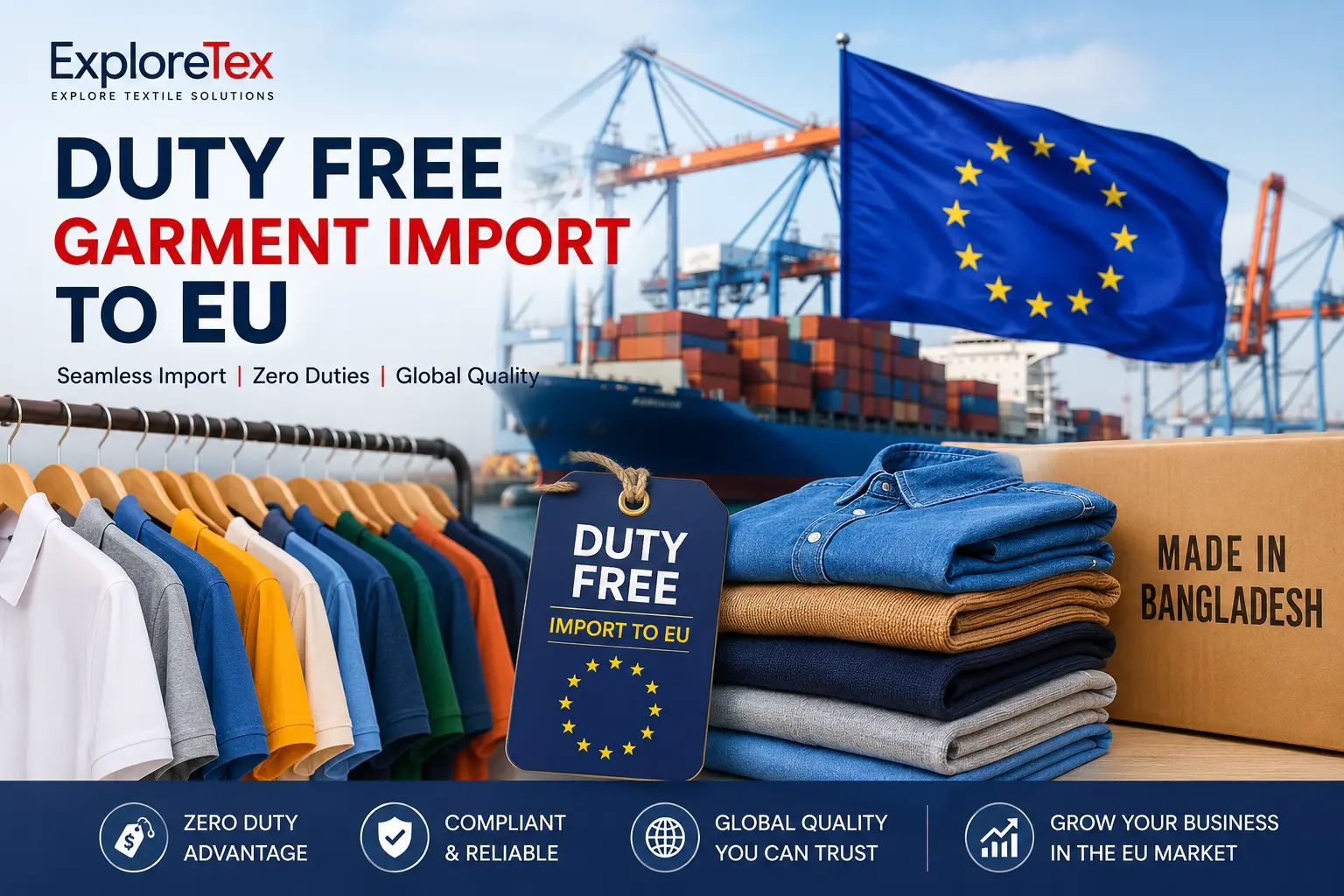
The Definitive Guide to Duty Free Garment Import to EU: Strategic Supply Chain Engineering for Global Fashion Brands
The global fashion landscape in 2026 demands an unprecedented balance of speed, cost efficiency, and absolute regulatory compliance. For European apparel brands and corporate buyers, navigating customs tariffs while maintaining healthy margins is a constant operational challenge. Standard import duties on garments entering the European Union from non-preferential nations can exceed 12%, significantly inflating the Total Cost of Ownership (TCO) and eroding retail margins.
To counteract these financial pressures, forward-thinking fashion enterprises are restructure-engineering their sourcing networks to leverage preferential trade arrangements. Securing a reliable duty free garment import to eu is no longer just an administrative box to tick; it is a critical competitive advantage.
As a premier Portuguese-based apparel manufacturer and strategic supply chain partner, ExploreTex bridges the gap between high-end European textile design and large-scale, tariff-exempt manufacturing. Operating a highly sophisticated dual-hub model—combining an agile, luxury-focused partner network inside Portugal with a wholly managed, vertically integrated manufacturing facility in Bangladesh—Exploretex empowers brands to systematically execute a flawless duty free garment import to eu while maintaining uncompromising quality control.
Navigating the complexities of international trade is one of the most critical challenges fashion brands face today. However, understanding the mechanics of a duty free garment import to eu can completely transform your brand’s profit margins. When European fashion labels, wholesalers, and private label creators optimize their supply chain to eliminate import taxes, they unlock significant capital that can be reinvested into marketing, luxury fabric sourcing, and business expansion.
This comprehensive, educational guide breaks down every legal, logistical, and technical aspect of executing a flawless duty free garment import to eu. As an industry leader, ExploreTex—a Portuguese-based company with a vertically integrated manufacturing facility in Bangladesh—has engineered a hybrid supply chain model that guarantees both premium European quality and the maximum financial benefits of offshore production. By the end of this guide, you will have a master-level understanding of trade agreements, factory compliance, logistics, and exactly how to partner with the right clothing manufacturer Portugal to execute a 100% compliant, tariff-free import strategy.
The Economics of a Duty Free Garment Import to EU
To appreciate the sheer value of a duty free garment import to eu, we first need to look at the baseline economics of European apparel imports. The European Union is one of the largest consumer markets for fashion globally, but it also heavily protects its internal markets.
Understanding Standard EU Tariffs
When a brand imports clothing from a non-preferential country (such as China or the United States), the EU imposes a Most Favored Nation (MFN) tariff. For standard textile garments—like t-shirts, hoodies, denim, and activewear—this tariff typically sits at 12%.
Imagine placing an order for €100,000 worth of premium hoodies. If you import these from a non-preferential region, you immediately owe €12,000 in import duties before the goods even clear customs, not including standard VAT.
Achieving a duty free garment import to eu eliminates that €12,000 cost completely. When you scale your business to ordering €1,000,000 in inventory annually, a duty free garment import to eu saves your brand €120,000 in pure, bottom-line profit.
How Do You Get to 0%?
The European Union offers preferential trade arrangements to developing nations to help integrate them into the global economy. The most powerful of these for the apparel sector is the Generalized Scheme of Preferences (GSP), and specifically, its most generous tier: the Everything But Arms (EBA) arrangement.
By sourcing your production in an EBA-beneficiary nation like Bangladesh, your brand becomes legally entitled to a duty free garment import to eu. But it is not as simple as just shipping a box. Achieving a legally compliant duty free garment import to eu requires meticulous documentation, strict adherence to Rules of Origin, and a manufacturing partner capable of managing the entire bureaucratic process.
Interactive Financial Modeling: EU Import Tariff & Savings Explorer
Before diving into the complex regulatory frameworks governing international trade, use our interactive operational calculator to quantify the direct financial impact of executing a duty free garment import to eu. This tool isolates your product category, manufacturing origin, and volume metrics to reveal the hidden overhead of standard tariffs versus the optimized cost structures delivered via Exploretex’s compliant supply chain pathways.
1. Deciphering the Legal Framework of Duty-Free Apparel Trade with the EU
To legally qualify for a duty free garment import to eu, an apparel shipment must perfectly satisfy the statutory conditions established by the European Commission’s trade regimes. The primary mechanism driving tariff-free access for large-volume garment manufacturing is the Generalized Scheme of Preferences (GSP), specifically the Everything But Arms (EBA) initiative.
The Everything But Arms (EBA) Initiative
The EBA arrangement is a unilateral trade policy enacted by the EU to grant completely duty-free and quota-free access for all products (except arms and ammunition) originating from Least Developed Countries (LDCs), as classified by the United Nations. Bangladesh, as a premier global hub for apparel manufacturing, has been a core beneficiary of this arrangement.
When a brand partners with ExploreTex’s clothing manufacture in Portugal team to manage production in their vertical Bangladesh facilities, the entire shipment is structured under the EBA framework. This legal pathway completely eliminates the standard 12% third-country duty rate, transforming a standard customs entry into a highly lucrative duty free garment import to eu.
The Registered Exporter (REX) System
Securing a duty free garment import to eu requires meticulous administrative compliance, specifically through the Registered Exporter (REX) system. Implemented by the EU, the REX system replaces traditional paper-based certificates of origin (such as Form A) with an authorized digital self-certification model.
The REX Mechanism: Under this system, manufacturers must be thoroughly audited and registered by local trade authorities in the beneficiary country. Once assigned a unique REX number, the exporter drafts a standardized “statement on origin” directly onto the commercial invoice or packing list.
Exploretex Compliance: Exploretex ensures that all vertical manufacturing hubs hold valid, active REX registrations. This means every bulk shipment dispatched to European ports contains a legally binding statement on origin, allowing European customs officials to instantly process the cargo as a legitimate, compliant duty free garment import to eu without administrative delays or unexpected tariff assessments.
2. The Rules of Origin (RoO) Matrix: Navigating Transformation Thresholds
The absolute cornerstone of any successful duty free garment import to eu is a flawless adherence to the Rules of Origin (RoO). Customs authorities inside the European Union enforce strict legal definitions to prevent “transshipment”—a fraudulent practice where garments manufactured in high-tariff nations are routed through low-tariff nations simply to bypass duties. To verify that a shipment genuinely qualifies as an indigenous product of a preferential trade partner, it must undergo a specific level of local processing.
Single-Stage vs. Two-Stage Transformation
Historically, the EU enforced a strict “two-stage transformation” rule for apparel trade. This meant that to achieve a duty free garment import to eu from an LDC, the factory had to convert raw fiber into yarn (Stage 1) and then weave or knit that yarn into a finished garment (Stage 2) entirely within the beneficiary country or authorized regional zones.
However, recognizing the evolving structural dynamics of the global textile supply chain, the European Commission relaxed these protocols for LDCs under the reformed GSP Rules of Origin framework.
The Single-Stage Benefit: For Least Developed Countries utilizing the EBA scheme, the EU authorized a “single-stage transformation” for knitted and woven apparel items. This legal shift dictates that as long as the final assembly—the cutting, sewing, and finishing of the garment—takes place within an authorized country like Bangladesh, the product qualifies for a duty free garment import to eu, even if the underlying fabric or yarn was legally imported from an external country (e.g., India, China, or Pakistan).
Value-Addition Thresholds: Under current trade laws, the relaxed RoO allows for a simplified local value-addition threshold, requiring that a minimum percentage of the ex-works price of the final garment represents local manufacturing costs and operations. Exploretex’s fully vertical production lines easily exceed these legal baselines by handling everything from fabric processing to final retail packaging in-house, securing an ironclad foundation for your duty free garment import to eu.
| Garment Construction Type | Traditional EU Requirement (Two-Stage) | Current EBA Requirement (Single-Stage) | Exploretex Processing Capability | Duty Free Qualification Status |
| Knitwear (T-Shirts, Hoodies, Sweaters) | Yarn spinning + Fabric knitting + Assembly inside LDC | Fabric cutting + Sewing/Assembly inside LDC | In-house circular knitting, dyeing, and automated sewing | Fully Compliant for Duty Free Entry |
| Woven Apparel (Denim, Chinos, Cargoes) | Local weaving of yarn + Fabric finishing + Assembly | Local cutting, stitching, washing, and finishing | Vertical cutting tracks, advanced laundry matrix, and custom finishing | Fully Compliant for Duty Free Entry |
| Technical Activewear & Outerwear | Complex multi-tier processing within regional blocks | Assembly and component integration inside LDC | Precision seam-taping, technical shell assembly, and grading | Fully Compliant for Duty Free Entry |
The EBA Initiative and the Bangladesh Advantage
If your goal is a seamless duty free garment import to eu, Bangladesh is unequivocally the most strategic production hub on the planet. As a beneficiary of the EBA arrangement, Bangladesh exports billions of dollars of apparel to Europe entirely tariff-free.
Why Bangladesh Leads the World in Tariff-Free Export
Bangladesh is the second-largest apparel exporter globally. The country has spent four decades building an infrastructure specifically designed to facilitate high-volume, high-quality textile production. For European brands, utilizing a clothing manufacturer in Bangladesh is the most reliable pathway to a duty free garment import to eu.
The benefits extend far beyond just the 0% tariff:
Vertical Integration: Bangladesh boasts spinning mills, knitting and weaving facilities, dyeing units, and cut-and-sew factories all within the same geographic zones.
Massive Capacity: Whether you need 5,000 units or 500,000 units, the infrastructure scales effortlessly.
Advanced Sustainability: Post-Rana Plaza, Bangladesh is home to the highest number of LEED-certified green garment factories in the world.
To execute a flawless duty free garment import to eu, you must partner with a facility that understands how to trace materials back to the yarn, proving that the value addition occurred within Bangladesh.
The ExploreTex Difference: The Hybrid Model
Many European brands are hesitant to source directly from Asia due to fears of communication breakdowns, quality control issues, and legal vulnerability. This is where ExploreTex fundamentally changes the game.
ExploreTex operates as a hybrid clothing manufacturer. We are a registered Portuguese company subject to strict EU corporate laws, but we own and operate a high-capacity facility in Bangladesh.
When you execute a duty free garment import to eu with ExploreTex:
Your contract is governed by Portuguese law, offering total security.
Your product development, tech packs, and quality oversight are managed by our Lisbon-based technical team.
Your bulk production occurs in our Bangladesh facility, unlocking the 0% tariff.
We handle all export/import logistics, delivering a stress-free duty free garment import to eu directly to your European warehouse.
3. Risk Mitigation: Managing GSP Graduation and the Post-LDC Transition
As global trade policies evolve, fashion brands must look beyond the immediate horizon to secure long-term tariff resilience. A critical factor currently shifting the landscape of international apparel procurement is Bangladesh’s scheduled graduation from Least Developed Country (LDC) status, projected to take effect over the coming years.
Understanding GSP Graduation
When a nation’s macroeconomic indicators consistently exceed United Nations thresholds for income, human assets, and economic vulnerability, it undergoes GSP graduation. For apparel buyers, this means the automatic tariff exemptions provided under the Everything But Arms (EBA) initiative will eventually transition into alternative trade mechanisms, such as the EU’s standard GSP or the enhanced GSP+ scheme.
Ensuring a continuous, uninterrupted duty free garment import to eu throughout this transitional era requires deep institutional foresight. The EU traditionally provides a generous three-year transitional grace period post-graduation, ensuring that an established duty free garment import to eu framework remains valid while supply chains adapt to the new legal realities.
The Exploretex Dual-Hub Contingency Plan
To protect global fashion brands from policy volatility, Exploretex operates a highly strategic Dual-Hub Production Model. This corporate architecture splits production intelligently across two distinct geographic regions, ensuring that changes in GSP status never bottleneck a client’s supply chain or compromise their ability to maintain a duty free garment import to eu.
       [ EUROPEAN BRAND HEADQUARTERS ]
                     │
         ┌───────────┴───────────┐
         ▼                       ▼
  [ PORTUGAL HUB ]       [ BANGLADESH HUB ]
  - Partner Factories    - Wholly Owned Vertical Plant
  - Low MOQ Sourcing     - High-Volume Scale
  - Luxury Finishes      - EBA Duty-Free Framework
  - 4-6 Wk Lead Time     - REX Certified Supply
         │                       │
         └───────────┬───────────┘
                     ▼
       [ LOGISTICS & DDP DISTRIBUTION ]
  - Seamless European Customs Clearance via Lisbon
By leveraging ExploreTex’s clothing production support for brands, companies can dynamically shift their sourcing vectors. High-volume, cost-critical core collections utilize the vertical capacity of Bangladesh under strict European oversight to guarantee a duty free garment import to eu. Concurrently, high-end capsule collections, rapid-response restocks, and luxury-tier products are manufactured within Exploretex’s network of expert partner factories inside Portugal.
Because Portugal is an EU Member State, goods produced there flow freely across the single market with zero customs friction, providing a native, structurally permanent alternative to traditional import mechanics and safeguarding your brand’s bottom line against any international trade adjustments.
Mastering the Rules of Origin (RoO)
The biggest pitfall brands face when attempting a duty free garment import to eu is failing to comply with the “Rules of Origin.” The EU does not simply grant a 0% tariff because the garment was shipped from Bangladesh. The garment must be legally recognized as originating in Bangladesh.
The Double Transformation Rule
To qualify for a duty free garment import to eu, most apparel items must undergo what the European Commission calls “sufficient working or processing.” In the textile industry, this generally requires a Double Transformation.
What does Double Transformation mean? It means that at least two major manufacturing steps must occur in the beneficiary country. For apparel, this usually means:
Transformation 1: Weaving or knitting the yarn into fabric.
Transformation 2: Cutting and sewing the fabric into a finished garment.
If a factory in Bangladesh imports finished, pre-dyed fabric from China, and only cuts and sews it in Bangladesh (a single transformation), the final product will not qualify for a duty free garment import to eu. It will be hit with the standard 12% MFN tariff at the European border.
Because ExploreTex provides full package clothing production, we control the supply chain from the raw fiber onwards. We source the yarn and knit the fabric directly within our vertically integrated network in Bangladesh. This guarantees that your order complies with the Double Transformation requirement, securing your duty free garment import to eu without any legal ambiguity.
The REX System
In the past, factories used a physical document called the EUR.1 certificate or Form A to prove origin. Today, the EU uses the Registered Exporter (REX) system.
To successfully execute a duty free garment import to eu, your supplier must hold a valid REX number. They must include a “Statement on Origin” directly on the commercial invoice declaring that the goods meet the EBA Rules of Origin. ExploreTex is a fully registered and compliant exporter. When we process your duty free garment import to eu, our logistics team automatically applies our REX registration to your commercial documents, ensuring instantaneous customs clearance at the European port of entry.
4. Inside the Factory Floor: How Exploretex Executes Compliant Vertical Manufacturing
True compliance cannot be achieved through paperwork alone; it must be engineered into the actual physical operations of the factory floor. At Exploretex, our technical apparel production support is anchored by over 16 years of hands-on textile engineering expertise, a framework established by our founder, Muhammad Ilias Hossen. This deep technical competence ensures that every phase of manufacturing actively supports the legal prerequisites required for a duty free garment import to eu.
Seamless Operational Execution
When a raw design or technical package (Tech Pack) arrives at our Lisbon headquarters, our engineers immediately optimize the manufacturing sequence. For bulk lines assigned to our vertical facility in Bangladesh, the production workflow is tightly controlled:
Uncompromising Social and Environmental Certifications
European customs authorities and international trade auditors do not just look at tariff codes; they actively monitor factory compliance with global ethical standards. A duty free garment import to eu can be instantly suspended or permanently blocked if a facility is found to violate human rights or environmental mandates.
To ensure complete supply chain safety, Exploretex’s manufacturing facilities operate under the world’s most rigorous social and environmental certification frameworks:
Social & Ethical Safeguards: Our facilities maintain continuous compliance with BSCI (Business Social Compliance Initiative), WRAP (Worldwide Responsible Accredited Production), and SEDEX/SMETA audits. We guarantee fair living wages, safe, climate-controlled working conditions, and complete structural safety across every production hall.
Material Traceability: To fulfill the rising demand for sustainable fashion, we utilize fully traceable, certified supply networks. We offer GOTS (Global Organic Textile Standard) certified organic cotton, GRS (Global Recycled Standard) polyester, and OEKO-TEX® Standard 100 components. This ensures that every garment arriving via a duty free garment import to eu pathway is chemically safe, ecologically sound, and commercially unassailable.
Step-by-Step Guide to a Duty Free Garment Import to EU
Executing a duty free garment import to eu is a linear process that requires precision at every stage. Here is the exact roadmap ExploreTex utilizes to manage your production and logistics.
Phase 1: Strategic Planning and Tech Packs
Before any fabric is cut, we begin with intense technical planning. If you contact our team, our Portuguese technical designers will help you develop your concept into a comprehensive Tech Pack. This blueprint includes size grading, stitch types, trim details, and most importantly, the fabric composition strategy required to ensure the final product qualifies for a duty free garment import to eu.
Phase 2: Material Sourcing for Origin Compliance
As established, sourcing is the lifeblood of a duty free garment import to eu. Through our fabric sourcing network, we procure yarns that are then knitted into fabric locally in Bangladesh. For brands demanding high-end European finishes, we also collaborate with luxury textile suppliers in Portugal. (Note: Under certain EU bilateral cumulation rules, materials originating in the EU can be sent to Bangladesh for processing, and the finished garment will still qualify for a duty free garment import to eu upon return).
Phase 3: Ethical Manufacturing at Scale
Once the pre-production sample is approved, bulk manufacturing begins. Your private label clothing is produced in our ethically audited, high-capacity hub. We maintain a strict fabric utilization rate of over 85% and conduct rigorous AQL (Acceptable Quality Limit) inspections. Every step is documented to ensure that if EU customs ever audit the duty free garment import to eu, we have complete traceability of the manufacturing process.
Phase 4: Export Documentation and Freight
This is where many brands stumble, but ExploreTex excels. We prepare the commercial invoice, the packing list, the Bill of Lading (or Airway Bill), and the critical REX Statement on Origin. By executing flawless paperwork, we guarantee that the border agents recognize your shipment as a valid duty free garment import to eu.
Phase 5: Customs Clearance and Final Delivery
Whether you prefer FOB (Free on Board) or DDP (Delivered Duty Paid), we adapt to your needs. Under DDP terms, we handle the entire duty free garment import to eu process—including all freight forwarding and port clearance—delivering the ready-to-sell garments directly to your warehouse in Paris, Berlin, Lisbon, or anywhere else in Europe.
5. Strategic Sourcing: Leveraging Portugal and Bangladesh for a Risk-Resilient Supply Chain
Modern apparel procurement requires a diversified approach. Relying exclusively on far-flung, high-volume manufacturing hubs introduces severe lead-time risks, while relying solely on European nearshoring can strain production budgets for basic, high-volume product categories. Exploretex eliminates this operational conflict by integrating the unique strengths of top luxury textile suppliers in Portugal with our high-capacity vertical facilities in Southeast Asia.
The Nearshore Agile Hub: Portugal
Inside Portugal, Exploretex collaborates with an elite network of specialized partner factories and legacy fabric mills. This hub is specifically engineered to handle complex, high-margin apparel requirements:
Ultra-Low MOQs: We accept production runs starting at just 50 pieces per style or 400 pieces per order, giving fashion startups and premium labels the flexibility to test new designs without taking on heavy inventory risk.
Rapid Lead Times: Manufacturing within Portugal allows for incredibly compressed supply chain cycles. From final sample approval to store delivery, production can be completed in 4 to 6 weeks. This rapid turnaround allows brands to capitalize on shifting consumer trends in real-time.
Premium Craftsmanship: Portuguese factories are globally renowned for their unparalleled expertise in high-end streetwear, technical sportswear, luxury tailoring, and complex garment-dyeing techniques.
The Offshore Scale Hub: Bangladesh
For core collections, high-volume basics, and large retail orders where unit economics are the primary driver, our vertical Bangladesh facility takes charge.
Massive Capacity: Easily managing volume scaling from 1,000 to over 100,000 units per style, this facility operates with optimized labor costs and structural efficiencies that lower the overall FOB price by up to 50% compared to domestic European production.
Built-in Duty Elimination: Because this hub operates fully within the EBA trade corridor, every high-volume piece produced here qualifies for a flawless duty free garment import to eu. This structural advantage allows brands to achieve the aggressive price points required for major retail distribution without sacrificing quality or ethical compliance.
Overcoming Common Supply Chain Hurdles
A successful duty free garment import to eu is not immune to global supply chain friction. Knowing how to navigate these hurdles separates profitable brands from struggling ones.
Hurdle 1: Failing the Customs Audit
If a European customs authority suspects that your garments do not actually qualify for a duty free garment import to eu, they will trigger a post-clearance audit. If your manufacturer cannot prove that the fabric was knitted locally (Double Transformation), the EU will retroactively apply the 12% tariff, plus massive fines.
The Solution: Transparency. Because ExploreTex manages your apparel development and fulfillment from start to finish, we maintain a complete “paper trail” from the yarn supplier to the final stitch. Our duty free garment import to eu compliance is bulletproof.
Hurdle 2: Inferior Quality Control Offshore
Many brands worry that moving production to Asia to secure a duty free garment import to eu will result in lowered quality standards.
The Solution: The Portuguese-managed oversight model. Our technical experts train our Bangladesh floor managers to adhere to European luxury standards. We conduct daily inline inspections. A duty free garment import to eu is only valuable if the garments themselves are flawless and ready for premium retail.
Hurdle 3: Communication Delays
Working across time zones with standard Asian factories can cause weeks of delays.
The Solution: Your primary point of contact is our European headquarters. We provide real-time updates on your duty free garment import to eu. You get the financial benefit of Asian production with the communication ease of a local European partner.
6. Financial Logistics: Optimizing Total Cost of Ownership (TCO) with DDP Frameworks
A common pitfall for many fashion brands attempting to execute a duty free garment import to eu is failing to calculate the true Landed Cost of their inventory. A low FOB (Free on Board) price at an overseas port can quickly be obliterated by hidden customs broker fees, unexpected port demurrage charges, local handling costs, and mismanaged tariff classifications.
Navigating Incoterms: FOB vs. DDP
When you manage your supply chain through traditional brokers, you are frequently forced to buy on FOB terms. This means the manufacturer’s responsibility ends the moment the boxes are loaded onto a container ship in a foreign port. Your brand must then take on the complex legal and logistical burden of managing ocean freight, navigating foreign export controls, clearing EU customs, and resolving transit disputes.
Exploretex eliminates this systemic friction by offering comprehensive Delivered Duty Paid (DDP) shipping solutions directly to your European distribution centers.
The DDP Advantage: Under DDP terms, Exploretex assumes 100% of the logistical risk and administrative burden. We manage the entire international transit pipeline, handle all customs declaration filings, absorb local port fees, and execute the paperwork required to validate your duty free garment import to eu. The price we quote is the final price you pay—no surprise invoices at the border, no hidden fees, and zero administrative headaches.
Comparative Sourcing Matrix: Financial and Operational Impact
To understand how a fully optimized duty free garment import to eu alters the financial profile of a fashion brand, analyze the structural comparison below. This matrix contrasts a traditional unoptimized manufacturing strategy against the streamlined, dual-hub framework executed by Exploretex.
| Supply Chain Attribute | Traditional Standard Sourcing (e.g., Non-GSP Nation) | Exploretex Compliant Dual-Hub Framework (Bangladesh + Portugal) | Direct Bottom-Line Impact for EU Brands |
| Base Customs Duty Rate | Standard 12.0% Tariff applied to total invoice value | 0% Zero Tariff (via Everything But Arms / EBA exemption) | Immediate 12% reduction in landed product cost |
| Origin Certification Mode | Manual Paper Certificates (High risk of documentation error) | Digital REX System Self-Certification with pre-audited IDs | Eliminates customs hold-ups and administrative overhead |
| Minimum Order Quantity | High MOQs (Often 3,000+ units per style/colorway) | Agile MOQs: 50 pcs in Portugal / 1,000 pcs in Bangladesh | Drastically reduces capital tied up in dead stock |
| Average Production Lead Time | 16 to 24 weeks (Inflexible long-distance pipelines) | 4-6 weeks (Portugal) / 8-12 weeks (Vertical Bangladesh) | Faster inventory turns and responsive trend capitalization |
| Incoterms & Delivery Risk | FOB Sourcing (Client assumes all freight & customs risk) | Full DDP Delivery directly to your EU warehouse | Predictable cost structures with zero border friction |
| Ethical & Material Auditing | Fragmented third-party oversight (High greenwashing risk) | Wholly managed facilities: BSCI, WRAP, GOTS, OEKO-TEX | Total brand protection and authentic sustainability marketing |
Deep Dive: The Financial Impact of a Duty Free Garment Import to EU
Let us look at a quantifiable breakdown of why a duty free garment import to eu is the ultimate scaling tool for apparel brands. We will compare manufacturing a premium heavyweight hoodie entirely in a non-GSP country versus utilizing the ExploreTex hybrid model for a duty free garment import to eu.
Scenario A: Manufacturing in a Non-Preferential Country
Order Volume: 10,000 units
FOB Production Cost: €15.00 per unit
Total Production Cost: €150,000
Sea Freight to EU: €3,000
Total Customs Value: €153,000
EU Import Duty (12%): €18,360
Total Landed Cost (Pre-VAT): €171,360
Scenario B: ExploreTex Duty Free Garment Import to EU (Bangladesh)
Order Volume: 10,000 units
FOB Production Cost: €11.00 per unit (Leveraging Bangladesh scale)
Total Production Cost: €110,000
Sea Freight to EU: €3,500
Total Customs Value: €113,500
EU Import Duty (0% with EBA/REX): €0
Total Landed Cost (Pre-VAT): €113,500
The Result: By switching to ExploreTex and executing a duty free garment import to eu, the brand saves €57,860 on a single production run. That is a massive injection of liquidity that can be used to fund a robust marketing campaign or launch a completely new collection. This is why a duty free garment import to eu is not just a logistics term; it is a fundamental business growth strategy.
7. Step-by-Step Blueprint for EU Fashion Brands to Secure Duty-Free Shipments
Successfully executing a duty free garment import to eu requires an organized, legally sound operational sequence. Any breakdown in documentation, fiber labeling, or shipping manifests can cause customs officials to seize cargo, issue severe financial penalties, or revoke tariff exemptions. Follow this proven step-by-step blueprint to ensure your apparel shipments clear European borders flawlessly.
Step 1: Meticulous Tech Pack Auditing & HTS Classification
Long before a fabric roll is unrolled, your garment’s blueprint must be checked against the Harmonized Tariff Schedule (HTS). Subtle design variations—such as adding a specific pocket type, changing a zipper placement, or altering the exact blend ratio of cotton to polyester—can shift a garment into a completely different customs classification code.
Exploretex’s specialized engineers audit your Tech Packs at our Lisbon office to ensure your clothing carries the correct HTS designation. This preventive alignment ensures your product categories fall squarely within the designated tariff lines approved for a duty free garment import to eu, eliminating classification disputes at port check-ins.
Step 2: Verification of Fiber Composition & Regulatory Compliance
The European Union enforces strict laws regarding textile labeling. To secure a seamless duty free garment import to eu, your apparel must feature internal labels that perfectly state the fiber composition using mandatory EU fiber names.
Additionally, compliance with REACH (Registration, Evaluation, Authorisation and Restriction of Chemicals) is mandatory; your garments must be free from harmful azo dyes, heavy metals, or restricted phthalates. Exploretex utilizes OEKO-TEX® certified raw materials and eco-friendly dye houses to ensure that your inventory is 100% compliant with European health and environmental standards.
[ TECH PACK INGESTION ] ──> [ HTS CLASSIFICATION AUDIT ] ──> [ REACH CHEMICAL TESTING ]
                                                                      │
[ REX INVOICE GENERATION ] <── [ VERTICAL ASSEMBLY IN BD ] <── [ CNC PATTERN CUTTING ]
            │
            ▼
[ CUSTOMS GREEN CHANNEL ] ──> [ DUTY-FREE LANDED ENTRY TO EU ]
Step 3: Executing the REX Statement on Origin
When production is completed at our vertical facility, our compliance team issues the commercial invoice containing our official Registered Exporter credentials. The statement must strictly follow the text specified by EU customs law:
The exporter of the products covered by this document (REX Number: [Exploretex Active ID]) declares that, except where otherwise clearly indicated, these products are of Bangladeshi preferential origin according to the rules of origin of the Generalised Scheme of Preferences of the European Union.
This standard text, combined with physical documentation showing the single-stage transformation, forms the legal passport that secures your duty free garment import to eu.
Step 4: Green-Channel Port Clearance via DDP Logistics
With the REX statement correctly applied, the ocean container or air cargo shipment is dispatched through our optimized logistics lanes. Upon arrival at major European entry ports—such as Rotterdam, Antwerp, or Leixões—the shipment enters the customs “Green Channel.”
Because Exploretex operates as your fully integrated supply chain partner under comprehensive DDP terms, our in-house customs brokers manage the Electronic Customs Declarations instantly. The 12% tariff is legally waived, customs clearance is completed within hours, and the cargo is delivered straight to your distribution hubs.
Factory-Floor “Expert” Insights
To provide a deeper understanding of the reality behind a duty free garment import to eu, we gathered insights from the technical experts overseeing the ExploreTex production floors.
Insight from the Master Pattern Maker (Lisbon Headquarters):
“When a client requests a duty free garment import to eu, our first job in Portugal is reverse-engineering the design to ensure it meets origin rules without compromising the aesthetic. If a brand wants a specific technical synthetic fabric that is only available from Taiwan, we have to calculate if the non-originating materials exceed the strict percentage thresholds allowed by the EU. By engineering the Tech Pack correctly in Lisbon, we guarantee that when the factory in Dhaka produces it, the duty free garment import to eu status is locked in.”
Insight from the Quality Assurance Director (Bangladesh Facility):
“A duty free garment import to eu means nothing if the shipment is rejected by the client’s QA team upon arrival. We operate our cutting floors with automated, computer-aided spreaders. We relax the fabric for 48 hours to prevent shrinkage. Our job is to ensure that the physical quality of the garment is as pristine as the documentation that guarantees its duty free garment import to eu status.”
Insight from the Global Logistics Manager:
“The REX system revolutionized the duty free garment import to eu process, but it requires extreme accuracy. A single typo on the commercial invoice regarding the HS (Harmonized System) code can cause customs to flag the container, resulting in demurrage fees at the port. We double-verify every HS code—whether it’s 6109 for t-shirts or 6203 for woven trousers—to ensure the duty free garment import to eu flows through the green channel.”
8. Answer Targets & Search Intent Mapping
How can European apparel brands legally avoid import duties when manufacturing garments overseas?
European apparel brands can legally eliminate import duties by sourcing from countries that participate in the EU’s Generalized Scheme of Preferences (GSP), specifically through the Everything But Arms (EBA) initiative. By manufacturing in an LDC like Bangladesh, where finished clothing items undergo at least a single-stage transformation (cutting and sewing), shipments qualify for a completely duty free garment import to eu. Brands must ensure their manufacturing partner is fully registered under the EU’s Registered Exporter (REX) system to self-certify the preferential origin of the goods directly on the commercial invoice, which legally waives the standard 12% third-country apparel tariff.
What are the EU Rules of Origin requirements for importing clothing from Bangladesh under the EBA scheme?
The EU Rules of Origin for apparel under the Everything But Arms (EBA) scheme require a single-stage transformation for Least Developed Countries. This means that finished garments qualify for a duty free garment import to eu as long as the fabric is cut and fully assembled (sewn and finished) within the country. Unlike standard trade agreements that demand a two-stage transformation (where yarn must also be spun locally), EBA regulations allow factories to use imported yarns or fabrics while maintaining full tariff-exempt status, provided the local assembly operations satisfy the prescribed value-addition criteria.
What is the difference between FOB and DDP terms when sourcing private label apparel from an international manufacturer?
Under FOB (Free on Board) terms, the manufacturer’s responsibility ends the moment the garments are loaded onto the vessel at the foreign port; the buyer must independently arrange, fund, and manage international freight, customs clearance, and import documentation, running the risk of unexpected port delays or tariff reclassifications. Conversely, DDP (Delivered Duty Paid) terms dictate that the manufacturer manages the entire end-to-end supply chain—including shipping, customs declarations, and local port delivery—providing a fixed, all-inclusive unit price with zero logistics risk for the fashion brand. Exploretex offers complete DDP terms to ensure a hands-off, risk-free duty free garment import to eu.
Essential Compliance: Environmental and Social Governance (ESG)
The modern European consumer demands transparency, and the European Union is rapidly passing legislation to enforce it. A duty free garment import to eu is a privilege that the EU monitors closely. If an exporting country severely violates human rights or environmental standards, the EU can temporarily withdraw EBA preferences.
Therefore, engaging in a duty free garment import to eu requires partnering with an ethical manufacturer. ExploreTex is uncompromising in this area.
Fair Labor and Safety Standards
Our Bangladesh facility operates under the strictest international labor standards. We guarantee fair living wages, safe working conditions, and strict adherence to the Accord on Fire and Building Safety. When your brand executes a duty free garment import to eu through ExploreTex, you can confidently market your products as ethically made.
Environmental Sustainability
Sustainability is deeply integrated into our operations. From utilizing GOTS-certified organic cotton to implementing low-water dyeing techniques and treating wastewater through advanced Effluent Treatment Plants (ETP), we ensure that your duty free garment import to eu has a minimal ecological footprint. For brands aiming for the highest tier of eco-consciousness, we also offer complete traceability reports for every duty free garment import to eu.
9. Specialized FAQ Section: Technical Trade & Manufacturing Insights
Can my apparel collection carry the “Made in Portugal” label if parts of the process occur elsewhere?
To legally carry the prestigious “Made in Portugal” label, the garment must satisfy the EU’s non-preferential rules of origin criteria, which state that the product must have undergone its last substantial, economically justified transformation within Portuguese borders. When you utilize ExploreTex’s custom textile engineering resources, your premium collections are cut, sewn, dyed, and finished inside our native partner factories in Portugal, fully qualifying them for the “Made in Portugal” origin designation. Conversely, items fully assembled inside our Bangladesh hub carry the preferential origin of Bangladesh, which is the specific legal trigger required to unlock a completely duty free garment import to eu.
What happens to my duty-free status if an apparel shipment is transshipped through a third country?
Under the EU’s strict non-manipulation clause (which updated traditional direct transport rules), a shipment qualifying for a duty free garment import to eu can transit through intermediate third countries, provided the cargo remains under continuous customs supervision. The garments must not undergo any operations other than unloading, reloading, or operations designed to preserve them in good condition. Exploretex mitigates transshipment risks by coordinating direct freight routes from our facilities straight to European container terminals, ensuring the non-manipulation clause is never compromised and your tariff exemptions remain fully intact.
Do I need a fully finished Tech Pack to begin production with Exploretex?
No, you do not need an absolute, factory-ready technical blueprint to begin working with us. At Exploretex, our comprehensive clothing production support for brands begins at the concept phase. If you only have a rough sketch, a physical reference sample, or an initial mood board, our design team inside our Lisbon headquarters can build a professional, fully graded Tech Pack for you. We execute digital twin engineering and size grading in-house, ensuring that your collection is optimized for maximum fabric yield, flawless retail fit, and compliance with all EU garment import regulations.
How does Exploretex guarantee consistent sizing across different manufacturing countries?
Maintaining absolute sizing consistency between production lines in Europe and Asia is a common challenge for expanding fashion labels. Exploretex eliminates sizing discrepancies through our centralized pattern engineering system based in Lisbon. Our master pattern makers create a single, digital master file and perform complex mathematical size grading from XS to 5XL. This verified digital blueprint is then transmitted directly to the automated cutting tables at either our Portuguese partner mills or our vertical Bangladesh facility. By using identical digital markers and CAD/CAM infrastructure across both hubs, we guarantee that a size Medium produced in Lisbon fits exactly like a size Medium manufactured in our large-scale facilities abroad.
Are your manufacturing facilities fully certified for environmental and material sustainability?
Yes, environmental accountability is deeply embedded into our entire global manufacturing network. Through our comprehensive sourcing connections, we provide certified sustainable production lines that hold the world’s most demanding environmental credentials. We are fully audited and certified under the Global Organic Textile Standard (GOTS) for organic fibers, the Global Recycled Standard (GRS) for regenerated synthetics, and the OEKO-TEX® Standard 100 for toxin-free textile processing. When you establish a duty free garment import to eu with Exploretex, you are acquiring an ethical, transparent, and eco-certified supply chain that aligns perfectly with European consumer expectations.
What is the average minimum order quantity (MOQ) for high-volume duty-free production runs?
For production lines assigned to our high-capacity vertical facilities in Bangladesh to take advantage of the Everything But Arms duty free garment import to eu framework, our standard minimum order quantities typically begin around 1,000 pieces per style. However, for emerging brands, designer labels, or limited-edition capsule collections that require extreme agility, we utilize our managed partner factory network inside Portugal, where we accept flexible production runs starting as low as 50 pieces per style or 400 pieces per total order. This unique flexibility allows your brand to scale seamlessly from a small boutique startup into an international retail powerhouse within a single unified supply chain.
How does the AQL 2.5 inspection standard protect my brand from defective inventory?
The AQL 2.5 (Acceptable Quality Limit) standard is an internationally recognized statistical sampling methodology used during high-volume manufacturing to strictly govern quality assurance. Our dedicated quality control inspectors conduct rigorous evaluations at three critical production stages: pre-production fabric inspection, mid-line sewing checks, and final pre-shipment auditing. Under the AQL 2.5 matrix, if the number of minor or major defects found in a randomly drawn sample lot exceeds strict predefined thresholds, the entire batch is rejected and sent back for remediation. This rigorous industrial oversight ensures that every container arriving at your warehouse through a duty free garment import to eu pathway meets premium retail standards, protecting your brand reputation and driving down customer return rates.
Advanced Logistics: DDP vs FOB for Duty Free Imports
When negotiating your duty free garment import to eu, you will need to select an Incoterm (International Commercial Terms) that defines who is responsible for the freight and risk.
Free On Board (FOB)
Under FOB terms, ExploreTex manufactures your garments and delivers them to the port in Chittagong, Bangladesh, complete with the REX documentation required for your duty free garment import to eu. From there, your brand’s nominated freight forwarder takes over. You pay for the ocean freight, insurance, and manage the customs clearance in Europe. While this gives you control over your shipping line, it requires a dedicated logistics coordinator on your team to successfully manage the duty free garment import to eu.
Delivered Duty Paid (DDP)
For brands that want a totally hands-off experience, ExploreTex offers DDP terms. Because it is a duty free garment import to eu, there is no 12% tariff to pay, but there are still port handling fees, customs brokerage fees, and standard VAT. Under DDP, we handle everything. We manage the ocean or air freight, process the duty free garment import to eu at the European border, pay the handling fees, and truck the garments directly to your warehouse door. This is the ultimate “peace of mind” solution for executing a duty free garment import to eu.
Frequently Asked Questions (FAQ)
To further clarify the intricacies of a duty free garment import to eu, we have compiled the most critical questions asked by our European clients.
1. Is a duty free garment import to eu permanent, or can the laws change?
The Everything But Arms (EBA) initiative is a stable, long-term policy of the European Union designed to foster economic growth in developing nations. While the EU periodically reviews the Generalized Scheme of Preferences (GSP), Bangladesh’s status as a top-tier apparel exporter makes the duty free garment import to eu pathway highly secure for the foreseeable future.
2. Can I get a duty free garment import to eu if I only order 500 pieces?
Yes. The duty free garment import to eu regulations are based on the origin of the goods, not the size of the shipment. Whether you order our minimum quantity of 500 pieces or a massive retail volume of 50,000 pieces, ExploreTex ensures your shipment qualifies for the 0% tariff.
3. What happens if I want to use a fabric imported from China?
If you source finished fabric from China, ship it to Bangladesh, and only cut and sew it there, the garment will fail the Double Transformation rule. It will not qualify for a duty free garment import to eu. However, if we import yarn from China and knit/weave the fabric in Bangladesh, the Double Transformation rule is satisfied, and the duty free garment import to eu remains perfectly valid.
4. Does ExploreTex manage the REX registration for my duty free garment import to eu?
Yes. As your manufacturing partner, ExploreTex is already registered in the REX system. We automatically apply our authorized Statement on Origin to your commercial invoices, guaranteeing your duty free garment import to eu passes through European customs without friction.
5. Are there any hidden fees in a duty free garment import to eu?
The import tariff itself is 0%. However, a duty free garment import to eu does not exempt the importer from paying the standard Value Added Tax (VAT) of their respective EU member state upon import, nor does it eliminate standard freight forwarding and port handling fees.
6. Can I combine Portuguese luxury fabrics with Bangladesh manufacturing for a duty free garment import to eu?
Yes, thanks to “Bilateral Cumulation.” If we source premium fabrics from our network in Portugal, ship them to our Bangladesh facility for cutting and sewing, the final garment still qualifies for a duty free garment import to eu when shipped back to Europe. This is a massive advantage of the ExploreTex hybrid model.
Future-Proofing Your Supply Chain
The global apparel market is volatile. Freight rates fluctuate, raw material costs shift, and fast-fashion consumer demands require incredible agility. Relying on outdated sourcing methods that incur heavy 12% tariffs is no longer a viable business strategy.
Mastering the duty free garment import to eu is the key to unlocking scalable, sustainable growth for your brand. By eliminating border taxes, you gain a massive competitive advantage over brands manufacturing in non-preferential zones.
ExploreTex is not just a vendor; we are a strategic partner dedicated to optimizing your profitability. Our unique Portuguese-Bangladesh infrastructure is explicitly designed to make the duty free garment import to eu process effortless, secure, and highly profitable for your business.
Whether you are launching a new private label collection or seeking to increase the margins on your existing wholesale lines, a duty free garment import to eu is your most powerful tool. Do not leave 12% of your revenue at the customs border. Partner with ExploreTex, leverage our REX compliance, rely on our European legal security, and scale your brand with the industry’s most efficient duty free garment import to eu strategy today.
Conclusion: Partner with Exploretex to Optimize Your European Fashion Supply Chain
Navigating the complexities of global trade, compliance monitoring, and customs logistics requires an experienced, technically proficient manufacturing partner. Trying to manage isolated factories over long distances frequently results in missed delivery windows, unpredictable pricing, and unexpected customs liabilities at the European border.
Exploretex completely reimagines the traditional apparel manufacturing relationship. By pairing the creative prestige, flexible low-MOQ capabilities, and rapid nearshore turnaround times of our expert partner networks inside Portugal with the massive scale, vertical cost efficiencies, and built-in tariff exemptions of our managed manufacturing facilities in Bangladesh, we deliver an unassailable strategic advantage to European fashion brands.
We handle the absolute entirety of the technical production pipeline—from initial 3D digital twin engineering and professional Tech Pack creation to strict AQL 2.5 quality control, REX customs self-certification, and hassle-free, comprehensive DDP delivery directly to your facility. Let our textile engineers manage the precision of the factory floor and the complexities of international customs law, leaving your team free to focus on building your brand’s community, marketing presence, and aesthetic vision.
Are you ready to eliminate import tariffs, protect your profit margins, and establish a highly resilient, socially compliant supply chain for your fashion enterprise? Contact our corporate team at Exploretex today to discuss your collection requirements, obtain custom material swatches, and receive an all-inclusive production quote within 24 hours.
Corporate Headquarters: Largo Martim Moniz, Piso -1, Loja – B01, 1100-341 Lisboa, Portugal
Direct Inquiry Portal: Contact Exploretex Sourcing
Official Communications: info@exploretex.com | ilias@exploretex.com
External Regulatory Reference Matrix
To further verify the statutory regulations, compliance requirements, and official trade parameters detailing international apparel import policies, explore these direct authoritative resources:
Review the official legal guidelines on the European Commission’s Everything But Arms trade framework via the European Union Access2Markets Trade Portal.
Examine the structural data and macro monitoring metrics of apparel trade agreements on the EU Generalised Scheme of Preferences Hub for Bangladesh.
Analyze official customs circulars, REX registration updates, and duty-free quota-free regulations provided by the Bangladesh Customs Legislative Authority.