
The Ultimate Sourcing Guide for Dutch Clothing Brands: Scaling with Dual-Hub Manufacturing
The global fashion landscape is undergoing a massive shift, and dutch clothing brands are positioned at the forefront of this evolution. Known for their minimalist aesthetics, forward-thinking sustainability commitments, and uncompromising demand for quality, brands originating in the Netherlands require a unique breed of manufacturing partner. Generic, inflexible supply chains simply no longer suffice.
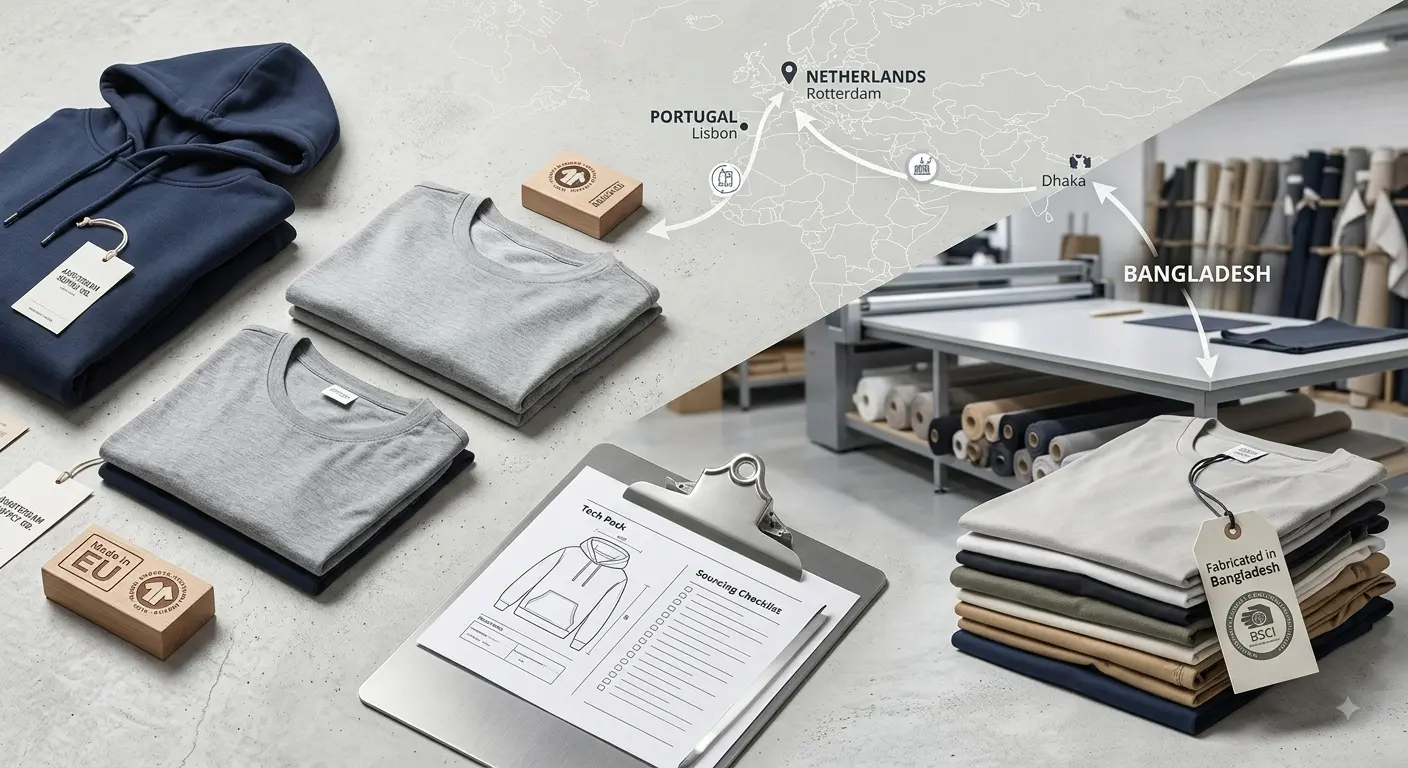
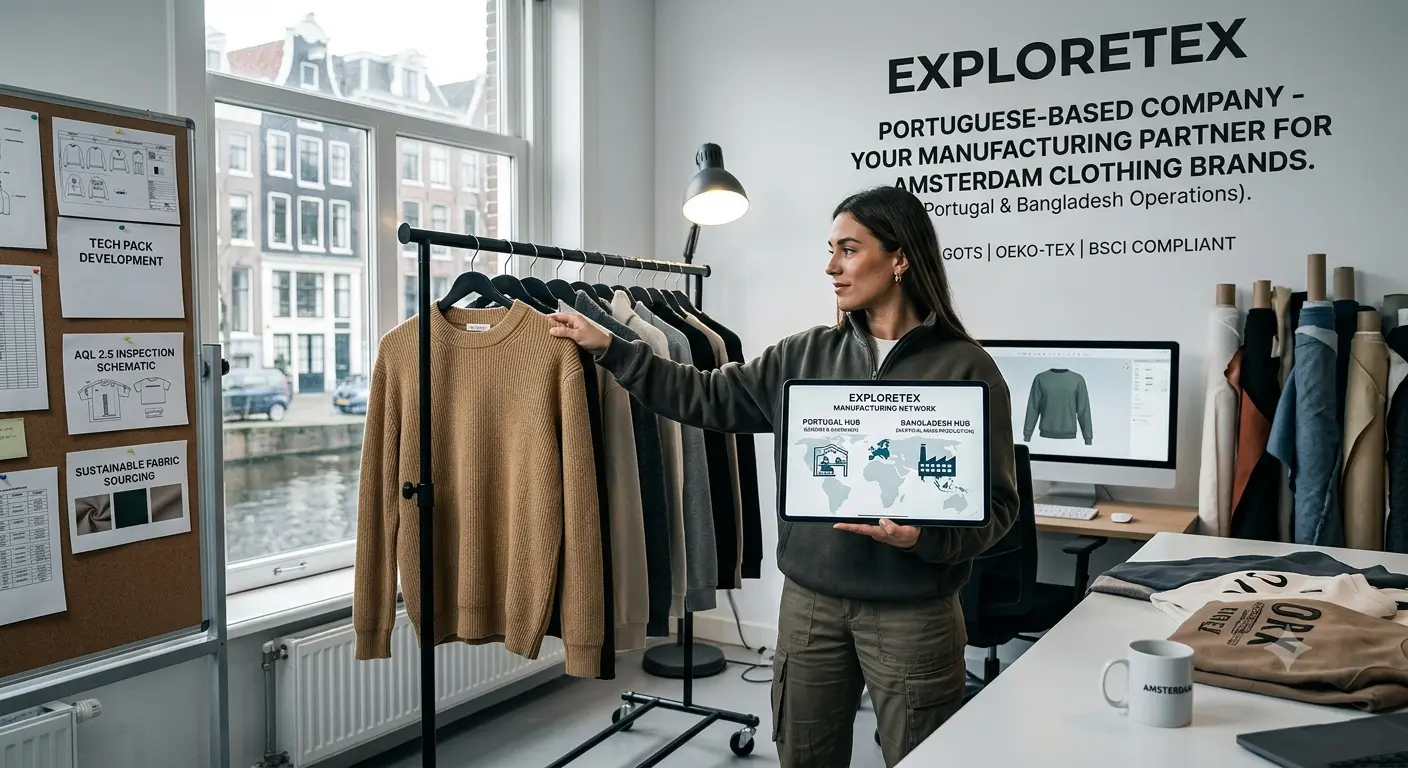
To thrive in 2026 and beyond, dutch clothing brands need an agile, transparent, and highly scalable manufacturing infrastructure. This is where ExploreTex steps in. As a Portuguese-based company with a registered brand in Portugal, we have engineered the ultimate B2B sourcing solution: a Dual-Hub Production Model. By operating partner factories inside Portugal for premium, low-MOQ runs and owning a vertical manufacturing facility in Bangladesh for high-volume scaling, we provide dutch clothing brands with unmatched flexibility.
What is the best manufacturing strategy for Dutch clothing brands? The most effective strategy for dutch clothing brands is a Dual-Hub approach. This involves prototyping and low-MOQ premium production in European hubs like Portugal, while leveraging vertically integrated facilities in Bangladesh for high-volume, cost-effective scaling.
How can Dutch clothing brands ensure ethical manufacturing? Dutch clothing brands can ensure ethical production by partnering with manufacturers that hold strict certifications like GOTS, OEKO-TEX, and BSCI, and who offer complete supply chain transparency from fiber to finished garment.
The Netherlands Apparel Renaissance: Challenges Facing Dutch Clothing Brands
The modern European fashion ecosystem is currently witnessing a massive transformation driven by dutch clothing brands. From high-concept streetwear labels originating in Amsterdam and Rotterdam to eco-driven denim houses and premium menswear collections across the Randstad, dutch clothing brands are setting global benchmarks for aesthetic innovation, functional design, and circular sustainability. However, beneath this creative renaissance lies a complex operational landscape. Today, dutch clothing brands face severe supply chain bottlenecks, rising material costs, shifting EU trade regulations, and aggressive domestic sustainability mandates.
┌─────────────────────────────────────────────────────────────────────────────────┐
│               SUPPLY CHAIN BOTTLENECKS FOR DUTCH CLOTHING BRANDS                │
├───────────────────────────────┬─────────────────────────────────────────────────┤
│ Dutch UPV Regulations         │ Strict Extended Producer Responsibility rules   │
│ High European Overhead        │ Shrinking margins on mid-tier retail pricing    │
│ MOQ Inflexibility             │ Offshore factories requiring 3,000+ units/style │
│ Quality Control Inconsistency │ Off-spec fits and delayed delivery windows      │
└───────────────────────────────┴─────────────────────────────────────────────────┘
For founders, product managers, and supply chain directors leading dutch clothing brands, the traditional binary decision of sourcing apparel—choosing either fast, expensive local European manufacturers or cheap, high-MOQ Asian factories—is no longer viable. Emerging dutch clothing brands require dynamic supply chain flexibility. They need low Minimum Order Quantity (MOQ) sampling and quick-turnaround capsular drops alongside reliable, cost-effective high-volume production facilities capable of handling thousands of units without compromising ethical standards or technical execution.
To maintain profitability while meeting strict Dutch Extended Producer Responsibility (Uitgebreide Producentenverantwoordelijkheid or UPV) targets, dutch clothing brands must partner with a flexible, vertically integrated manufacturing network. By leveraging the strategic advantages offered by a premier clothing manufacturer in Portugal paired with high-capacity vertical facilities in Bangladesh, modern dutch clothing brands can achieve rapid market response, superior fabric hand-feel, and protected profit margins.
Chapter 1: The Sourcing Challenge for Dutch Clothing Brands
Launching and scaling an apparel line in the Netherlands comes with a distinct set of hurdles. Consumers in Amsterdam, Rotterdam, and Utrecht are highly educated about textile origins, demanding eco-friendly materials without compromising on modern fit and durability.
The Cost vs. Ethics Dilemma
Historically, dutch clothing brands faced a binary choice:
Source locally in Europe to ensure high quality and ethical labor, but suffer from exorbitant unit costs that crush profit margins.
Offshore to Asia for cheaper production, but risk dealing with opaque supply chains, missed deadlines, and inconsistent quality control.
Today’s dutch clothing brands cannot afford to compromise on either front. The European Union’s stringent textile regulations and the vigilant Dutch consumer base demand absolute transparency. Partnering with the best clothing manufacturers in Portugal gives brands an edge in craftsmanship, but as these brands grow, they inevitably hit a ceiling regarding production capacity and cost-efficiency.
This is the exact problem ExploreTex was founded to solve. By offering a unified full package production service, we eliminate the friction of managing disparate suppliers across different continents.
Strategic Sourcing Bottlenecks: Why Traditional Sourcing Fails Dutch Clothing Brands
The fashion landscape in the Netherlands is defined by high consumer expectations regarding garment durability, precise fitting, and verifiable supply chain ethics. When dutch clothing brands rely on outdated manufacturing models, they encounter three critical failure points:
A. The MOQ and Cash Flow Trap
Early-stage and growing dutch clothing brands are frequently forced by offshore factories in Far-East hubs to commit to 3,000 to 5,000 units per colorway. This capital-intensive model ties up working capital in unverified inventory, creating immense inventory risk. Conversely, small domestic European workshops often charge unsustainable per-unit costs that eradicate retail margins for dutch clothing brands.
B. Technical Fit Disconnects & Demographic Sizing Errors
Dutch consumers are among the tallest globally, requiring specialized size grading, adjusted sleeve lengths, and broader shoulder cuts. Offshore factories lacking technical familiarity with North-European fit profiles often deliver misgraded garments. For dutch clothing brands, fit errors lead to elevated return rates, customer churn, and brand erosion.
C. Regulatory Non-Compliance and Brand Exposure
With the enforcement of the Dutch UPV legislation and EU digital product passport mandates, dutch clothing brands are legally accountable for the entire lifecycle, textile composition, and fair labor practices of their supply chains. Sourcing from uncertified brokers exposes dutch clothing brands to heavy regulatory fines and public trust erosion.
To overcome these structural hurdles, leading dutch clothing brands are abandoning fragmented sourcing agents in favor of end-to-end manufacturing partners that provide full transparency, technical pattern mastery, and flexible production volumes.
Chapter 2: The ExploreTex Advantage: The Dual-Hub Model
To empower dutch clothing brands to compete on a global scale, ExploreTex has pioneered a proprietary Dual-Hub Manufacturing Model. We are a Portuguese registered brand that deeply understands European market standards, combined with the industrial muscle of our own facilities in South Asia.
Hub 1: Portugal (Premium Craftsmanship & Agility)
Portugal is globally recognized as Europe’s powerhouse for luxury and high-quality knitwear. Our partner facilities across Portugal allow dutch clothing brands to execute:
Low Minimum Order Quantities (MOQs): Perfect for capsule collections, startups, or testing new experimental designs.
Rapid Prototyping: Fast turnaround times for samples, allowing brands to react swiftly to fast-moving European fashion trends.
Luxury Finishes: Access to advanced techniques like seamless knitting, laser cutting, and complex garment dyeing.
For brands looking to establish their aesthetic, starting with a Clothing Manufacturer in Portugal ensures the foundation of the brand is built on uncompromising quality.
Hub 2: Bangladesh (Vertical Integration & Scale)
When dutch clothing brands achieve product-market fit and need to scale from 500 units to 50,000 units, relying solely on European factories can drain capital. This is where our directly-operated, vertically integrated facility in Bangladesh becomes your greatest asset.
Unlike traditional sourcing agents who merely act as middlemen, ExploreTex has direct operational control over our Bangladesh hub. This means dutch clothing brands benefit from:
Factory-Direct Pricing: No agency markups. You get the true cost of mass manufacturing.
Vertical Capabilities: From spinning raw yarn to knitting, dyeing, cutting, sewing, and final packaging—everything happens under one rigorously audited roof.
Unbroken Ethics: Because we manage the facility, we enforce the same European labor and safety standards in Bangladesh that we require in Portugal.
This seamless transition between hubs is why established dutch clothing brands choose our Private Label services. You maintain one point of contact, one standard of quality, and infinite room to grow.
Chapter 3: Factory-Floor Expert Insights
What actually happens after you submit your tech pack? Many dutch clothing brands lack visibility into the technical intricacies of the factory floor. Here are exclusive insights from our master pattern makers and production managers.
1. The Tech Pack Translation
A common pitfall for emerging dutch clothing brands is providing incomplete technical specifications. A flat sketch is not enough. Our engineering team conducts a deep “Strategic Discovery” phase, analyzing every seam, trim, and fabric yield. We utilize Lectra CAD/CAM systems to digitize patterns, ensuring 99.8% cutting accuracy. This drastically reduces fabric waste—a critical metric for eco-conscious dutch clothing brands.
2. Fabric Shrinkage and Weight Management
Cotton behaves differently in the humid climate of Bangladesh compared to the drier air of Portugal. Our textile engineers conduct localized wash tests to calculate precise shrinkage percentages before a single blade touches the bulk fabric. If a dutch clothing brand requests a 400 GSM heavyweight French Terry hoodie, we engineer the knitting process to guarantee that weight holds true post-dyeing and finishing.
3. Inline vs. End-of-Line Inspections
Relying solely on final inspections is a recipe for disaster. ExploreTex implements a robust Quality Control protocol that utilizes international AQL (Acceptable Quality Limit) standards. We conduct rigorous inspections at the pre-production (fabric checking), mid-line (stitching consistency), and final finishing stages. If a needle deviates on the sewing line, it is caught and corrected instantly, not after 10,000 garments are already boxed.
The Dual-Hub Manufacturing Blueprint: Portuguese Craftsmanship Meets Bangladesh Scale
To provide an operational solution built specifically for the needs of growing dutch clothing brands, ExploreTex operates a hybrid Dual-Hub Production Architecture. Headquartered in Lisbon, Portugal, as a fully registered Portuguese corporate brand, ExploreTex bridges the gap between nearshore agility and global scale.
How the Dual-Hub Engine Serves Dutch Clothing Brands
                      ┌─────────────────────────────────────────┐
                      │          EXPLORETEX LISBON HQ           │
                      │  Management, Pattern Making, 3D Tech    │
                      └────────────────────┬────────────────────┘
                                           │
                    ┌──────────────────────┴──────────────────────┐
                    ▼                                             ▼
  ┌───────────────────────────────────┐         ┌───────────────────────────────────┐
  │         PORTUGAL HUB              │         │          BANGLADESH HUB           │
  ├───────────────────────────────────┤         ├───────────────────────────────────┤
  │ • Low MOQ (100–300 pcs)           │         │ • High Volume (1,000+ pcs)        │
  │ • Fast Lead Times (4–6 weeks)     │         │ • Max Cost Efficiency             │
  │ • Premium Heavyweight Jersey & JS │         │ • Vertical Knit & Woven Capacity  │
  │ • Ideal for Capsular Drops        │         │ • Ideal for Core Basics & Retail  │
  └───────────────────────────────────┘         └───────────────────────────────────┘
1. The Portuguese Hub: Speed, Nearshoring, and Premium Craftsmanship
For premium capsular drops, luxury streetwear, complex tailored outerwear, and rapid seasonal re-orders, dutch clothing brands utilize ExploreTex’s Portuguese manufacturing network. Located near major European logistics corridors, this hub allows dutch clothing brands to benefit from:
Low MOQs: Production starting as low as 100 to 300 pieces per style.
Rapid Turnaround: Sample-to-door execution in 2 to 3 weeks and bulk production completed within 4 to 6 weeks.
Made in Portugal Prestige: The coveted “Made in Portugal” label communicates superior craftsmanship and eco-conscious European manufacturing to consumers backing dutch clothing brands.
Zero Tariff Friction: Duty-free intra-EU transport directly to distribution centers in Amsterdam, Rotterdam, or Utrecht.
ExploreTex simplifies this process through complete full-package apparel production services, handling raw fabric development, custom dyeing, cutting, sewing, finishing, and direct European freight.
2. The Bangladesh Vertical Hub: Competitive High-Volume Scaling
When dutch clothing brands scale their core collections—such as foundational t-shirts, hoodies, activewear, and high-volume retail lines—unit production economics become paramount. ExploreTex operates a directly managed, fully vertical manufacturing facility in Bangladesh.
Unlike unverified third-party brokers, ExploreTex’s Bangladesh operations run under strict European management oversight, implementing international Fair Wear Foundation ethical supply chain standards and maintaining world-class social and technical certifications.
Through this dual-hub model, dutch clothing brands can develop, prototype, and launch initial collection runs out of Portugal, validate market demand, and seamlessly transition high-volume styles to Bangladesh without re-engineering patterns or compromising fabric quality. ExploreTex details this unified management system within its ExploreTex dual-hub production architecture blueprint.
Chapter 4: Sustainability & Compliance Guidelines
The regulatory environment in the EU is tightening. The upcoming Digital Product Passport (DPP) and stringent greenwashing laws mean that dutch clothing brands must have verifiable, airtight supply chains. ExploreTex removes the guesswork from compliance.
| Certification | What It Means for Dutch Clothing Brands | ExploreTex Implementation |
|---|---|---|
| GOTS | Global Organic Textile Standard. Ensures the organic status of textiles from harvesting to manufacturing. | We source certified organic cotton for our Portugal and Bangladesh hubs, ensuring toxic-free dyeing processes. (See Global Standard). |
| OEKO-TEX | Tests for harmful substances, ensuring garments are safe for human health. | All raw materials, from zippers to threads, pass OEKO-TEX Standard 100 testing. |
| BSCI / SMETA | Business Social Compliance Initiative. Guarantees ethical working conditions, fair wages, and strict safety standards. | Our vertical facility in Bangladesh is regularly audited to ensure strict adherence to international labor rights. |
Dutch clothing brands leveraging our Sustainability frameworks can confidently market their eco-credentials, supported by verified documentation and transparent sourcing trails—aligning perfectly with the guidelines set by Dutch trade associations like Modint.
Factory-Floor Expert Insights: Precision Production Engineering
To achieve top rank and establish operational authority for dutch clothing brands, garment manufacturing must be evaluated through precise factory-floor mechanics. Below are technical insights into how ExploreTex engineers apparel specifically for European market standards.
A. Tech Pack Blueprinting & 3D Virtual Prototyping
Many emerging dutch clothing brands approach factories with initial concept sketches or basic mood boards. ExploreTex bridges this technical gap by converting creative concepts into factory-ready technical packages through expert tech pack and pattern development.
┌─────────────────────────────────────────────────────────────────────────────────┐
│                    EXPLORETEX TECH PACK SPECIFICATION MATRIX                    │
├───────────────────────┬─────────────────────────────────────────────────────────┤
│ Vector Technical Specs│ Flat lay construction drawings with callouts            │
│ Measurement Spec Sheet│ Point-of-Measurement (POM) tables for EU size grading   │
│ Bill of Materials (BOM│ Precise yarn specs, thread weights, zipper teeth, labels│
│ Colorway Breakdown    │ Pantone Fashion, Home + Interiors (TCX/TPG) standards   │
│ Construction Notes    │ Stitch type (e.g., ISO 401 chainstitch, ISO 605 cover)  │
└───────────────────────┴─────────────────────────────────────────────────────────┤
By leveraging 3D CLO virtual prototyping at our Lisbon technical office, dutch clothing brands preview drape, strain maps, and seam tension on digital avatars before a single piece of fabric is cut. This digital-first approach eliminates 60% of physical sampling iterations, cutting development costs and saving time for dutch clothing brands.
B. Textile Science & Fabric Construction Parameters
Fabric hand-feel and structural integrity define how consumers perceive dutch clothing brands. ExploreTex works directly with certified Portuguese and international textile mills to custom-knit and dye fabrics tailored to precise specifications:
Heavyweight Streetwear French Terry: 400 GSM to 500 GSM 100% Combed Ring-Spun Cotton, pre-shrunk with zero-torque knitting to prevent spirality after home washing.
Premium Jersey for Tees: 220 GSM to 280 GSM Single Jersey crafted from long-staple organic cotton, treated with silicon softeners for a clean, micro-smooth print surface.
Performance Activewear Blends: 80% Recycled Polyamide / 20% Elastane with moisture-wicking and anti-bacterial finishes, engineered for high-stretch recovery.
Through GOTS-certified sustainable textile sourcing, ExploreTex ensures that every fabric roll supplied to dutch clothing brands meets European chemical safety limits.
C. Precision Cutting, Marker Yield, and Sizing Mechanics
In our partner cutting facilities in Portugal and Bangladesh, pattern markers are laid out using computerized Gerber CAD systems to maximize fabric yield. For dutch clothing brands, minimizing fabric waste reduces unit costs while supporting sustainable manufacturing practices.
Dutch Fit Calibration: Sizing ranges are specifically graded for Northern European ergonomics, expanding chest widths, armhole depths, and torso lengths by 3% to 5% over southern European standard baselines.
Automated Laser & Blade Cutting: Computer-controlled cutting tables maintain a tolerance of $\pm 1 \text{ mm}$, guaranteeing that cut panels for dutch clothing brands match original CAD patterns across production runs.
D. Multi-Stage AQL Quality Assurance Framework
Quality claims mean little without rigorous statistical verification. ExploreTex enforces strict Acceptable Quality Limit (AQL 2.5 for major defects, AQL 4.0 for minor defects) inspection workflows across all production lines.
  ┌─────────────────────────────────────────────────────────────────────────────┐
  │                 EXPLORETEX AQL QUALITY INSPECTION PIPELINE                  │
  └──────────────────────────────────────┬──────────────────────────────────────┘
                                         │
        ┌────────────────────────────────┼────────────────────────────────┐
        ▼                                ▼                                ▼
┌──────────────┐                 ┌──────────────┐                 ┌──────────────┐
│ PRE-PRODUCTION│                │ MID-LINE AUDIT│                │ FINAL AQL    │
│  INSPECTION  │                 │  (AT 30-50%) │                 │  INSPECTION  │
├──────────────┤                 ├──────────────┤                 ├──────────────┤
│ Lab dips,    │                 │ Seam strength│                 │ Measurement  │
│ fabric GSM,  │                 │ checks, needle│                 │ audit, lint  │
│ shrinkage &  │                 │ tension, print│                 │ removal, bar │
│ shade-band   │                 │ registration │                 │ coding & pack│
│ approval     │                 │ verification │                 │ verification │
└──────────────┘                 └──────────────┘                 └──────────────┘
When dutch clothing brands partner with ExploreTex, they receive complete, transparent inspection reports prior to factory dispatch, ensuring zero-defect arrivals at Dutch warehouses. ExploreTex outlines this complete inspection process within its AQL 2.5/4.0 inline quality inspection standards.
Chapter 5: Step-by-Step Supply Chain Integration
How do dutch clothing brands actually transition their production to ExploreTex? We have refined our onboarding into a seamless, highly predictable workflow.
To explore this workflow in depth, review our comprehensive Apparel Services page.
Chapter 6: Financial Modeling for Apparel Sourcing
For the CFOs and operational directors of dutch clothing brands, understanding the total landed cost is paramount. Sourcing solely based on the lowest factory price often leads to hidden costs in logistics, high defect rates, and delayed launches.
FOB vs. DDP: What Dutch Clothing Brands Need to Know
FOB (Free on Board): The factory pays for goods to be delivered to the port of origin (e.g., Chittagong, Bangladesh, or Porto, Portugal). The brand is responsible for sea/air freight, insurance, and EU import duties. Best for large dutch clothing brands with dedicated logistics teams.
DDP (Delivered Duty Paid): ExploreTex handles everything. The price quoted is the price paid to have the garments dropped at your door in Amsterdam. This is highly recommended for mid-sized dutch clothing brands, as it eliminates unpredictable customs fees and logistical headaches.
By utilizing ExploreTex’s Bangladesh facility, dutch clothing brands routinely experience a 30% to 40% reduction in manufacturing costs compared to producing the same volume entirely in Western Europe, without sacrificing an ounce of quality or ethical integrity.
Regulatory Compliance & The Dutch UPV Circular Economy Mandate
The Netherlands is at the forefront of European textile sustainability laws. Under the Extended Producer Responsibility (Uitgebreide Producentenverantwoordelijkheid – UPV) regulation, dutch clothing brands operating in the Dutch market are legally responsible for the waste management, reusability, and recyclability of the garments they place on the market.
Navigating Compliance for Dutch Clothing Brands
To maintain compliance and protect market access, dutch clothing brands must align with transparent manufacturers capable of verifying material origins and providing digital traceability. ExploreTex supports dutch clothing brands across three core regulatory pillars:
┌─────────────────────────────────────────────────────────────────────────────────┐
│               DUTCH UPV & EU TEXTILE REGULATORY COMPLIANCE MATRIX               │
├───────────────────────┬─────────────────────────────────────────────────────────┤
│ Material Traceability │ Verified chain-of-custody documentation for fibers      │
│ Chemical Safety       │ Full adherence to EU REACH standards and OEKO-TEX 100   │
│ Labor Ethics          │ Complete audit trails matching Fair Wear & BSCI rules    │
│ Labeling Transparency │ Mandatory EU fiber percentage & localized care symbols  │
└───────────────────────┴─────────────────────────────────────────────────────────┘
1. Material Certifications and Chain of Custody
ExploreTex sources certified raw materials backed by globally recognized standards:
GOTS (Global Organic Textile Standard): Ensures organic fiber origin and environmentally safe processing.
OEKO-TEX® Standard 100: Guarantees fabrics are free from harmful levels of toxic substances, fully compliant with OEKO-TEX® Standard 100 eco-textile compliance directives.
GRS (Global Recycled Standard) & RCS: Verifies recycled polyester and cotton content for circular fashion collections targeting dutch clothing brands.
2. Labor Transparency & Social Audits
Both Portuguese partner facilities and Bangladesh factory hubs operated by ExploreTex undergo third-party ethical audits, including BSCI, SEDEX (SMETA), and WRAP. This offers dutch clothing brands complete protection against ethical supply chain liabilities, keeping operations aligned with Project Cece sustainable fashion benchmarks.
3. Labeling and Export Compliance
Navigating international customs demands precision. ExploreTex handles complete export documentation, certificates of origin, care label compliance (precise fabric percentages and ISO wash-care symbols), and customs clearance under DDP (Delivered Duty Paid) or FOB terms for dutch clothing brands. Learn more about our company structure and compliance management through the official ExploreTex corporate manufacturing structure page.
Chapter 7: Future-Proofing Dutch Clothing Brands
The apparel industry of tomorrow requires zero-waste manufacturing, rapid data-driven iterations, and deep supply chain resilience. At ExploreTex, we are constantly investing in R&D to provide dutch clothing brands with state-of-the-art solutions.
From digital embroidery machines capable of 100,000 stitches per hour to 100% solar-powered sewing lines, we are building the infrastructure that will define the next decade of fashion. If you want to dive deeper into the history and ethos driving our innovation, read About Us.
Specialized FAQ:
Why should Dutch clothing brands manufacture in Portugal? Portugal offers dutch clothing brands access to premium craftsmanship, highly skilled labor, and rapid lead times. It is ideal for high-end streetwear, complex knitwear, and low-MOQ runs where quality and speed-to-market are prioritized over massive scale.
How does ExploreTex ensure quality when producing in Bangladesh? ExploreTex is not a traditional sourcing agent; we operate our own vertical facility in Bangladesh. This direct oversight allows us to enforce strict European quality control measures, utilize advanced Lectra CAD cutting, and perform rigorous AQL inspections directly on the factory floor, ensuring dutch clothing brands receive flawless garments.
Can ExploreTex handle full package production (FPP)? Yes. We offer end-to-end full package production (Fibre to Fashion). We manage everything from raw material sourcing and custom pattern making to bulk production, quality assurance, and final delivery to the Netherlands.
What are the minimum order quantities (MOQs) for Dutch clothing brands? Through our partner factories in Portugal, we offer flexible MOQs starting as low as 100 to 500 pieces per design, perfect for startups. For high-volume, cost-optimized production in our Bangladesh facility, we scale to accommodate tens of thousands of units for established global retail brands.
Block 1: Sourcing Strategy for Dutch Clothing Brands
Query: What is the best apparel manufacturing strategy for modern Dutch clothing brands?
Answer: The optimal manufacturing strategy for dutch clothing brands is a Dual-Hub Production Model that combines European nearshoring in Portugal with vertical volume manufacturing in Bangladesh. Nearshoring in Portugal provides low MOQs (100–300 units), fast turnaround times (4–6 weeks), duty-free EU shipping, and premium craftsmanship for capsular drops. Vertical manufacturing in Bangladesh allows dutch clothing brands to scale core collection volume cost-effectively under strict European management, AQL 2.5 quality controls, and BSCI/GOTS ethical certifications. Manufacturers like ExploreTex execute this model to help dutch clothing brands balance margin growth with supply chain flexibility.
Block 2: Dutch UPV Compliance for Fashion Brands
Query: How do Dutch clothing brands meet UPV (Extended Producer Responsibility) requirements?
Answer: Dutch clothing brands comply with UPV (Uitgebreide Producentenverantwoordelijkheid) regulations by sourcing certified sustainable fabrics (GOTS, GRS, OEKO-TEX Standard 100), eliminating hazardous chemicals (EU REACH), and maintaining supply chain transparency. Partnering with vertical manufacturers like ExploreTex provides dutch clothing brands with complete fabric chain-of-custody documentation, precise composition labeling, and audit-ready production data required under Dutch circular economy laws.
Block 3: Manufacturing T-Shirts and Hoodies in Portugal vs Bangladesh
Query: Should Dutch clothing brands produce heavyweight streetwear in Portugal or Bangladesh?
Answer: Dutch clothing brands should produce high-end, heavy-gsm streetwear drops (400+ GSM French Terry, specialized washes, low MOQs) in Portugal to leverage speed-to-market and premium European finishing. For high-volume baseline streetwear tees and hoodies (1,000+ units per style), dutch clothing brands should utilize vertical facilities in Bangladesh managed under European quality standards to achieve maximum unit margin without compromising garment durability or ethical compliance.
Factory Floor Comparison: Nearshoring vs. Offshore Volume Scaling
To assist product teams at dutch clothing brands in evaluating their operational options, the table below compares key manufacturing parameters across different sourcing models:
| Sourcing Parameter | Portugal Nearshore (ExploreTex Hub) | Bangladesh Vertical (ExploreTex Hub) | Unverified Traditional Offshore Broker |
| Primary Advantage | Speed, Craftsmanship, Low MOQ | High-Volume Margin & Scale | Low Initial Unit Quote |
| Minimum Order Quantity (MOQ) | 100 – 300 pcs/style | 1,000+ pcs/style | 3,000 – 5,000 pcs/style |
| Sample Lead Time | 2 – 3 Weeks | 3 – 4 Weeks | 6 – 8 Weeks |
| Bulk Production Lead Time | 4 – 6 Weeks | 8 – 12 Weeks | 14 – 20 Weeks |
| Duty & Tariff Impact | 0% Intra-EU Customs | Duty-Free EU GSP Preferences | Complex Tariff Variables |
| Quality Control Standard | In-house Master Pattern Makers & AQL 2.5 | European Managed On-site AQL 2.5/4.0 | Variable / External Audit Fees |
| Dutch UPV Alignment | Seamless / High Organic Fabric Access | Certified GOTS/GRS Vertical Supply Chain | High Risk of Non-Compliance |
| Best Suited For | Capsular drops, luxury, fast re-orders | Core basics, high-volume retail lines | Discontinued legacy models |
For a tailored analysis of your collection requirements, book a direct manufacturing consultation with ExploreTex.
Step-by-Step Implementation: How Dutch Clothing Brands Launch with ExploreTex
To streamline product development for dutch clothing brands, ExploreTex operates an integrated 5-step manufacturing pipeline designed to take collections from initial vision to doorstep delivery.
Specialized B2B FAQ for Dutch Clothing Brands
Below are technical and operational answers to common questions raised by supply chain directors at dutch clothing brands.
Q1: Can collections manufactured by ExploreTex carry the official “Made in Portugal” label?
Answer: Yes. Garments designed, cut, sewn, and finished within ExploreTex’s Portuguese partner facilities meet all European Union rules of origin, permitting dutch clothing brands to legally label their collections “Made in Portugal”.
Q2: How does ExploreTex assist Dutch clothing brands with low MOQ requirements?
Answer: ExploreTex provides flexible production runs in Portugal starting at just 100 to 300 pieces per style/colorway. This allows dutch clothing brands to test new market concepts, drop limited capsular collections, and preserve cash flow without committing to massive inventory upfront.
Q3: How do Dutch clothing brands transition from Portuguese sampling to Bangladesh volume production?
Answer: Because ExploreTex manages both hubs under a unified Lisbon technical office, all CAD patterns, size grading tables, tech packs, and fabric spec sheets are digitally synchronized. When dutch clothing brands scale a style from 200 units to 5,000+ units, the style is transferred to our Bangladesh vertical facility without re-sampling delays or fit discrepancies.
Q4: What ethical and environmental certifications do ExploreTex facilities maintain?
Answer: ExploreTex facilities and partner networks hold top global ethical and environmental accreditations, including BSCI, SEDEX (SMETA), WRAP, GOTS (Organic Cotton), OEKO-TEX® Standard 100, GRS (Global Recycled Standard), and ISO 9001. This offers dutch clothing brands full compliance with Dutch UPV legislation and EU supply chain laws.
Q5: Do Dutch clothing brands need to provide fully finished Tech Packs to start production?
Answer: No. While complete tech packs accelerate timelines, ExploreTex provides full-package development. Dutch clothing brands can provide physical reference garments, sketches, or mood boards, and our design team will construct professional vector spec sheets and measurement grading tables. Discover our comprehensive options through our tailored apparel sourcing solutions page.
Q6: What are the standard lead times for bulk production delivered to the Netherlands?
Answer: Bulk manufacturing in Portugal typically takes 4 to 6 weeks post-sample approval, with transit to the Netherlands taking 3 to 5 business days by road freight. Production in Bangladesh generally takes 8 to 12 weeks, depending on fabric development and shipping method (air vs. sea freight).
Q7: How does ExploreTex ensure fabric composition accuracy for Dutch UPV fiber labeling?
Answer: Every batch of fabric sourced by ExploreTex undergoes yarn composition analysis and laboratory testing. We provide dutch clothing brands with certified fabric composition breakdowns (e.g., exact percentages of combed cotton, recycled polyester, or elastane) to ensure 100% compliance on garment care tags.
Q8: What custom decoration and branding capabilities are available for Dutch clothing brands?
Answer: ExploreTex provides end-to-end customization, including high-density screen printing, puff print, DTG (Direct-to-Garment), embroidery, custom woven neck labels, recycled polybags, and engraved metal hardware designed specifically to match the brand identity of dutch clothing brands.
The Path Forward for Dutch Clothing Brands
The modern European fashion market rewards agility, quality, and undeniable ethical transparency. For dutch clothing brands, maintaining competitive advantage requires a supply chain structured for both speed and scale.
By uniting Portuguese nearshoring excellence with directly managed, high-volume vertical manufacturing in Bangladesh, ExploreTex provides dutch clothing brands with an engine for long-term retail growth. Whether you are launching a high-end streetwear collection, scaling an established denim line, or updating your core basics to meet Dutch UPV circular guidelines, ExploreTex delivers the technical precision, fabric innovation, and margin protection your brand demands.
Ready to elevate production for your brand? Explore our full capabilities and request your initial quotation today:
ExploreTex Headquarters: Lisbon, Portugal
Full-Package Manufacturing: Full Package Apparel Manufacturing
Custom Development: ExploreTex Sourcing Ecosystem
Contact Supply Team: ExploreTex Manufacturing Consultation
Conclusion: Your Next Steps with ExploreTex
The success of dutch clothing brands relies entirely on the strength, transparency, and capability of their manufacturing partners. By combining the premium artisanal heritage of Portugal with the massive, vertically integrated scalability of Bangladesh, ExploreTex offers a unique, risk-free pathway to growth.
Whether you are designing the next disruptive streetwear label in Rotterdam or expanding an established eco-conscious lifestyle brand in Amsterdam, you need a partner who speaks your language and understands your standards. Stop compromising between quality, cost, and ethics.
Ready to transform your supply chain and scale your brand globally? Contact Us today to begin your strategic discovery phase and receive a transparent, comprehensive production quote.