
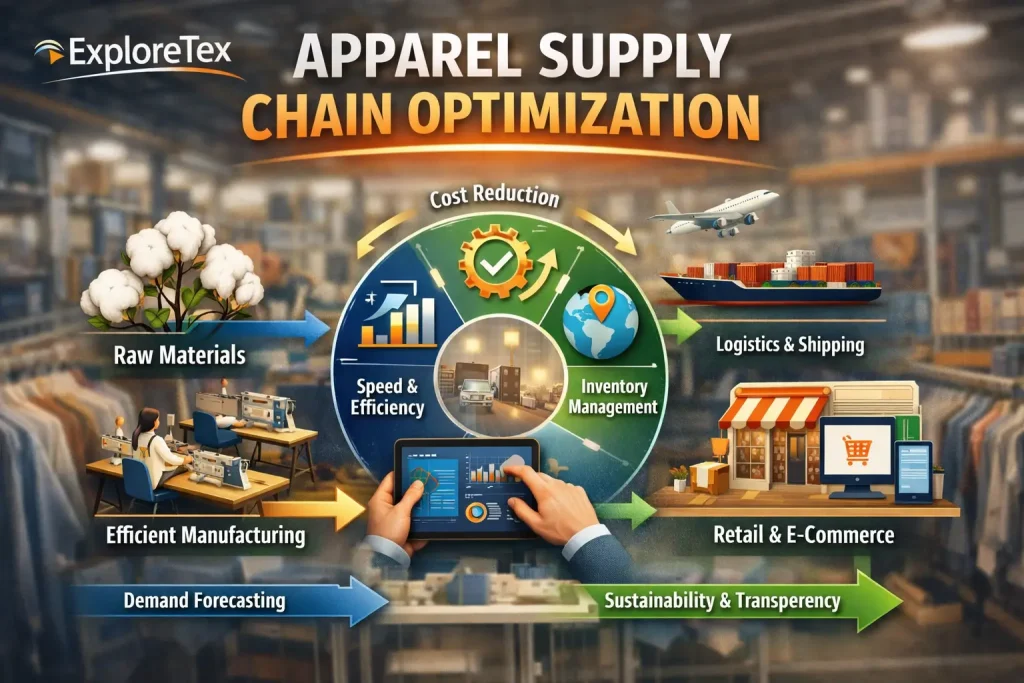
The 2026 Blueprint for Apparel Supply Chain Optimization: A Manufacturer’s Guide
The global fashion industry is undergoing a seismic shift. Between rising material costs, stringent environmental regulations, and the demand for rapid market responsiveness, international procurement officers are facing unprecedented pressure. In this landscape, apparel supply chain optimization is no longer just a buzzword—it is the fundamental operational blueprint for brand survival and scaling.
For European and US-based fashion brands, achieving true apparel supply chain optimization requires moving away from fragmented, multi-vendor sourcing. Instead, brands require a unified manufacturing partner capable of bridging European design sensibilities with Asian production scale.
As a Portuguese-registered apparel brand with vertical manufacturing infrastructure in Bangladesh, ExploreTex is uniquely positioned to deliver this solution. This comprehensive guide breaks down the architecture of modern apparel supply chain optimization, offering actionable insights for supply chain architects, brand owners, and procurement managers looking for a reliable manufacturing partner.
Achieving true apparel supply chain optimization requires looking beyond isolated factory audits or basic freight negotiations. It requires a holistic, vertically integrated approach that tracks a garment from the cotton field to the retail floor. As an international sourcing professional, you understand that building resilience means eliminating friction at every node of production.
This comprehensive guide breaks down the exact frameworks required for end-to-end apparel supply chain optimization. From leveraging a dual-hub European-Asian manufacturing model to implementing advanced traceability for Digital Product Passports (DPP), here is how to architect a production pipeline built for 2026 and beyond.
1. What is Apparel Supply Chain Optimization?
At its core, apparel supply chain optimization is the strategic alignment of material sourcing, manufacturing, quality control, and logistics to maximize efficiency, reduce waste, and improve speed-to-market.
In the 2026 context, apparel supply chain optimization goes beyond merely finding the cheapest labor. True apparel supply chain optimization integrates:
Traceability: Full visibility from raw cotton or recycled polyester to the finished garment.
Sustainability: Adherence to globally recognized certifications like GOTS, OEKO-TEX, and upcoming circular economy regulations.
Agility: The ability to pivot production volumes based on real-time consumer data without sacrificing quality.
Cost-Efficiency: Leveraging vertical infrastructure to eliminate middlemen margins and reduce lead times.
Understanding the mechanics of apparel supply chain optimization requires looking at the vulnerabilities of traditional systems. The apparel industry is notoriously complex, involving multiple handoffs between spinners, weavers, dyers, and cut-and-sew facilities. By prioritizing apparel supply chain optimization, brands consolidate these nodes, drastically reducing friction.
Learn more about our core philosophy on our About Us page.
Defining Modern Apparel Supply Chain Optimization
At its core, apparel supply chain optimization is the mathematical and operational balancing of three critical variables: Speed, Cost, and Compliance. Historically, brands had to pick two. Today, advanced manufacturing networks allow brands to achieve all three simultaneously.
When we discuss apparel supply chain optimization, we are talking about engineering the flow of materials, data, and capital. This includes:
Upstream Optimization: Fiber selection, yarn spinning, and textile knitting/weaving.
Midstream Optimization: Cut, Make, and Trim (CMT), dyeing, washing, and quality assurance.
Downstream Optimization: Freight forwarding, customs clearance, and warehouse distribution.
Failing to implement rigorous apparel supply chain optimization leads to the “bullwhip effect,” where small fluctuations in retail demand cause catastrophic overproduction or stockouts at the factory level. By partnering with a vertically integrated apparel manufacturing partner, brands can shorten feedback loops and stabilize their inventory flows.
2. The “Dual-Hub” Model: The Ultimate Driver of Apparel Supply Chain Optimization
Historically, brands had to choose between the high costs of European manufacturing or the communication barriers and logistical hurdles of Asian production. Effective apparel supply chain optimization in the modern era bridges this gap through a “Dual-Hub” model.
ExploreTex operates its primary design and sourcing office in Lisbon, Portugal, while maintaining wholly-owned vertical manufacturing facilities in Bangladesh. This Dual-Hub structure is the pinnacle of apparel supply chain optimization for several reasons:
A. European Communication and Quality Assurance
Our Portuguese headquarters serves as the client-facing hub. We collaborate with a micro-cluster of partner factories and fabric mills within Portugal for specialized “Made in Portugal” labels and premium trim sourcing. This ensures that the strategic planning phase of your apparel supply chain optimization process is handled with European market standards, clear communication, and precise technical design.
B. Scalable Vertical Infrastructure in Bangladesh
The actual execution of apparel supply chain optimization relies heavily on scale and raw infrastructure. Our vertical setup in Bangladesh handles everything from spinning and knitting to dyeing and final assembly.
To see our facilities in action, explore our Apparel Manufacturing in Bangladesh overview.
By managing the entire lifecycle in-house, we eliminate the delays caused by coordinating multiple sub-contractors. This integration is why our approach to apparel supply chain optimization consistently reduces overall lead times by 15-20% compared to fragmented sourcing models.
The Dual-Hub Advantage in Apparel Supply Chain Optimization
The most significant breakthrough in recent apparel supply chain optimization is the transition away from single-country reliance. Geopolitical tensions and localized supply shocks have proven that single-origin sourcing is a high-risk strategy.
Enter the Dual-Hub Model. At ExploreTex, we execute a sophisticated hybrid model that serves as the gold standard for apparel supply chain optimization. This model integrates a design and sourcing hub in Portugal with massive, wholly-owned vertical manufacturing infrastructure in Bangladesh.
Why the Dual-Hub Model Works
European Agility: Operating a hub in Lisbon/Porto allows for rapid prototyping, trend forecasting, and close collaboration with specialized local fabric mills for premium, short-run collections. It provides the “Made in Portugal” label prestige for high-end capsule collections.
Asian Scale: For core volume drivers (e.g., basic tees, hoodies, softshell jackets), the production is seamlessly routed to vertical facilities in Bangladesh. Here, economies of scale drive down the Cost of Goods Sold (COGS) without sacrificing quality.
Risk Mitigation: True apparel supply chain optimization requires geographical hedging. If a logistical bottleneck occurs in one region, production can be dynamically reallocated.
This bi-continental approach ensures that communication remains in the European time zone, drastically reducing the friction and miscommunications that traditionally plague Asian sourcing operations.
3. Tri-Polar Sourcing: Bangladesh vs. China vs. Turkey
A critical component of apparel supply chain optimization is geographical diversification. Recent years have proven that over-reliance on a single region is a massive risk. Savvy supply chain architects utilize a tri-polar sourcing strategy, evaluating the specific strengths of different regions to achieve global apparel supply chain optimization.
Evaluating the Production Hubs
China: Once the undisputed leader, China is now better suited for highly complex, low-volume technical wear and specialized synthetic raw materials. However, rising labor costs and geopolitical tariffs make it less ideal for scalable apparel supply chain optimization of core items.
Turkey: Excellent for near-shoring to European markets with incredibly fast lead times (3-4 weeks). Turkey is ideal for fast-fashion replenishment. However, the unit cost is significantly higher, meaning it is only one piece of the apparel supply chain optimization puzzle.
Bangladesh: The current powerhouse for scalable apparel supply chain optimization. With over 4 million skilled RMG (Ready-Made Garment) workers, Bangladesh offers unmatched vertical capabilities for high-volume, high-quality production of cotton, denim, and knitwear. Furthermore, Bangladesh has more LEED-certified green garment factories than any other country in the world, making it the premier destination for sustainable apparel supply chain optimization.
(Webmaster Note: Insert your proprietary Data Comparison Chart here illustrating the lead time vs. cost matrix of these three regions).
For brands looking to leverage this ecosystem, our Portugal Sourcing Office can help map out the exact geographical allocation of your production lines.
Raw Material Sourcing: The Foundation of Apparel Supply Chain Optimization
You cannot optimize a supply chain if your raw materials are unstable. Strategic raw material sourcing is the bedrock of apparel supply chain optimization. The modern consumer and regulatory bodies demand traceability.
Sustainable Fibers and Circularity
Apparel supply chain optimization today is deeply intertwined with environmental sustainability. Traditional resource-heavy fabrics are being replaced. Optimizing your material matrix involves shifting toward:
Organic Cotton & GOTS Compliance: Eliminating synthetic pesticides reduces agricultural water consumption.
Recycled Polyester (rPET): Transitioning from virgin PET to recycled alternatives lowers energy consumption by up to 50% during the extrusion process.
Regenerated Cellulosics: Utilizing Tencel, Lyocell, and modal fibers sourced from sustainably managed forests.
To maintain compliance and optimization, procurement teams must verify material integrity through globally recognized standards. For a deeper understanding of how these certifications impact your workflow, review our guide on GOTS and OEKO-TEX certifications. Furthermore, aligning with global standards set by organizations like the Textile Exchange ensures your material strategy is future-proofed against upcoming EU regulations.
4. Sustainability as a Core Pillar of Apparel Supply Chain Optimization
In the past, sustainability and operational efficiency were seen as opposing forces. Today, sustainable practices are the cornerstone of true apparel supply chain optimization. The apparel sector accounts for roughly 2% of annual global greenhouse gas emissions (Sadowski et al., 2021). Unchecked, the industry’s environmental impact is unsustainable, prompting rigorous regulatory crackdowns in the EU and US.
Effective apparel supply chain optimization inherently requires reducing waste, managing energy efficiently, and securing certified raw materials.
Certifications Driving Apparel Supply Chain Optimization
To protect your brand reputation and ensure seamless customs clearance, your apparel supply chain optimization strategy must mandate the following certifications:
GOTS (Global Organic Textile Standard): Ensures the organic status of textiles from the harvesting of raw materials through environmentally and socially responsible manufacturing.
OEKO-TEX Standard 100: Guarantees that every component of an article, from the fabric to the thread and accessories, has been rigorously tested against a list of up to 350 toxic chemicals.
RCS (Recycled Claim Standard) & GRS (Global Recycled Standard): Vital for brands incorporating recycled polyester and circular economy principles into their apparel supply chain optimization efforts.
ExploreTex actively maintains these stringent standards. You can review our specific compliance frameworks in our Sustainability manifesto and our detailed breakdown of Certifications: GOTS & OEKO-TEX.
Digital Integration and Traceability (DPP)
You cannot optimize what you cannot measure. The digital transformation of the factory floor is non-negotiable for apparel supply chain optimization.
The Rise of the Digital Product Passport (DPP)
By 2027/2028, the European Union will mandate Digital Product Passports for textiles. This legislation forces brands to disclose the entire lifecycle of a garment—from fiber origin to end-of-life recyclability. Apparel supply chain optimization must now include data architecture.
Manufacturers must implement systems that track:
Water usage per kilogram of dyed fabric.
Chemical safety data sheets (ZDHC compliance).
Carbon footprint per unit shipped.
If your current supplier relies on fragmented Excel sheets, your brand is at risk. Read our comprehensive analysis on preparing for Digital Product Passport compliance to ensure your data infrastructure is ready.
ERP and PLM Synchronization
Advanced apparel supply chain optimization connects a brand’s Product Lifecycle Management (PLM) software directly to the manufacturer’s Enterprise Resource Planning (ERP) system. When ExploreTex receives a tech pack at our Portugal management office, the data is instantly mirrored to the cutting room floor in Bangladesh. This eliminates the 48-72 hour email lag typically associated with tech pack handoffs.
5. Overcoming Chain-of-Custody Fallacies
A major hurdle in apparel supply chain optimization is the “Chain-of-Custody” (CoC) problem. As academic research points out, achieving CoC certification requires coordinated efforts from all supply chain members to ensure that products meet regulatory requirements and avoid the fallacies of “greenwashing” (Colombage & Sedera, 2025).
When brands use multiple intermediaries, tracking the exact origin of a cotton bale to the finished t-shirt becomes nearly impossible. This lack of transparency shatters any attempt at apparel supply chain optimization.
Because ExploreTex utilizes a vertical setup, we maintain an unbroken Chain of Custody. Our apparel supply chain optimization protocols mean we control the sourcing, the spinning, the dyeing, and the final stitching. If an auditor requests the compliance certificate for the dye used in a specific batch of hoodies, our apparel supply chain optimization systems allow us to retrieve it instantly.
6. Technological Integration and the
Production Floor Efficiency and Lean Manufacturing
Apparel supply chain optimization culminates on the factory floor. The difference between a profitable run and a loss-making endeavor often comes down to minute-by-minute efficiency in the Cut, Make, and Trim (CMT) process.
Vertical Integration as an Optimization Tool
Fragmented manufacturing—buying yarn from Supplier A, knitting at Supplier B, dyeing at Supplier C, and sewing at Supplier D—is the enemy of apparel supply chain optimization. Every transfer introduces transportation costs, delays, and quality risks.
A vertical setup brings knitting, dyeing, washing, and sewing under one roof. This allows for:
In-line Color Matching: Lab dips can be approved and immediately scaled to bulk dyeing.
Reduced Work-In-Progress (WIP): Fabric moves directly from the stenter frame to the cutting tables.
Waste Reduction: Computerized CAD marker making maximizes fabric utilization, pushing efficiency above 85% and minimizing off-cut waste.
To learn more about how vertical integration protects your margins, explore our specific capabilities in sustainable materials processing.
Digital Product Passport (DPP)
Technology management is fundamentally altering apparel retailing and manufacturing, with brands needing to increase digital transparency to combat ethical concerns and supply disruptions (Choi & Chan, 2023).
For European markets, the upcoming EU Strategy for Sustainable and Circular Textiles mandates the use of a Digital Product Passport (DPP). This is the new frontier of apparel supply chain optimization.
A DPP provides consumers and regulators with a scannable QR code that details a garment’s entire lifecycle: where the cotton was grown, how much water was used in dyeing, and instructions for end-of-life recycling.
Implementing DPP requires a level of data granularity that fragmented supply chains cannot provide. As your manufacturing partner, ExploreTex integrates these data capture points directly onto the factory floor. Our commitment to technological apparel supply chain optimization ensures that your brand will be fully compliant with incoming European traceability laws.
Read more about how we are preparing brands for this shift in our guide to the Digital Product Passport (DPP).
Stringent Quality Assurance at Scale
Defects destroy supply chain velocity. Reworking garments or handling international returns fundamentally breaks apparel supply chain optimization.
A robust optimization strategy implements Quality Assurance (QA) proactively, not reactively.
Traffic Light System: Implementing red/yellow/green visual management on the sewing line to catch needle drops or tension issues in real-time.
AQL 1.5/2.5 Standards: Conducting strict Acceptable Quality Limit inspections before goods are packed.
Fabric Testing: Pre-production testing for pilling, colorfastness to light/washing, and dimensional stability (shrinkage).
By embedding QA into the standard operating procedure, brands avoid the catastrophic costs of shipping defective goods across the ocean. Review our rigorous Quality Assurance protocols to see how we maintain defect rates near zero.
7. The Factory-Floor Perspective: Executing Apparel Supply Chain Optimization
High-level strategy means nothing if it fails on the factory floor. As a textile engineer with over 16 years of experience, Muhammad Ilias Hossen built ExploreTex on the principle that apparel supply chain optimization must be engineered from the ground up.
Here is how we implement apparel supply chain optimization at the machine level:
Automated Spreading and Cutting: By utilizing advanced CAD (Computer-Aided Design) software integrated with automated cutting machines, we achieve maximum fabric utilization. This step in apparel supply chain optimization reduces fabric fallout by up to 8%, directly lowering your unit cost.
Inline Quality Auditing: Traditional manufacturing relies on end-of-line inspections, which leads to high defect rates and wasted labor. Our apparel supply chain optimization protocol uses the Traffic Light System and inline roving quality control. Defects are caught at the specific sewing operation, corrected instantly, and prevented from moving down the line.
Lean Manufacturing Layouts: Our factory floors are organized using modular sewing lines rather than traditional progressive bundles. This layout is a critical factor in apparel supply chain optimization, allowing us to pivot between different styles (e.g., from heavy fleece hoodies to lightweight organic cotton tees) with minimal downtime.
Advanced Dyeing Technology: Water usage is the most resource-intensive phase of garment manufacturing. Our apparel supply chain optimization strategy includes low-liquor ratio dyeing machines and closed-loop effluent treatment plants (ETP), ensuring that our environmental footprint is minimized without compromising colorfastness.
Brands looking for a comprehensive overview of our production capabilities can visit our Services: Apparel Sourcing page.
Logistics, Freight, and Inventory Management
The final pillar of apparel supply chain optimization is moving the finished goods efficiently. The choice between FOB (Free on Board), CIF (Cost, Insurance, and Freight), and DDP (Delivered Duty Paid) dramatically impacts your landed costs.
Tri-Polar Sourcing Data
When evaluating logistics, brands must compare origin points. For the European market, how does Bangladesh compare to China or Turkey? We recently conducted a specialized data comparison on this exact topic. The data shows that while Turkey offers rapid truck freight to the EU, Bangladesh offers unmatched volume pricing with highly subsidized maritime freight lanes. For a deep dive into these metrics, read our report on Bangladesh vs. China and Turkey Sourcing.
Just-in-Time vs. Safety Stock
True apparel supply chain optimization finds the sweet spot between carrying expensive excess inventory and risking stockouts. By utilizing a responsive manufacturing partner, brands can shift closer to a Just-In-Time (JIT) model, releasing capital previously trapped in warehouse storage. Partnering with forward-thinking entities like the Ellen MacArthur Foundation can also guide how reverse logistics (returns and recycling) factor into your overall inventory loop.
Factory-Floor “Expert” Insights
To elevate this guide beyond theory, we are sharing raw, actionable data directly from our production engineers bridging the Portugal-Bangladesh corridor. When we audit new client supply chains, these are the immediate friction points we fix:
The “Over-Spec” Trap: Insight: 40% of tech packs we receive contain contradictory information (e.g., requesting a heavyweight 350 GSM fleece but specifying a delicate flatlock seam designed for base layers). Optimization fix: Aligning seam construction with fabric architecture before prototyping saves 2-3 weeks in the sampling phase.
Dye Lot Variances: Insight: Brands lose millions rejecting bulk runs because they didn’t account for commercial tolerance in piece-dyeing natural fibers. Optimization fix: Establishing physical “light box” standards (D65/TL84) in both the Lisbon office and the Dhaka lab ensures the European buyer and the Asian dye-master are literally seeing the same color.
Trim Bottlenecks: Insight: A $20 jacket is often delayed by a $0.05 zipper pull. Optimization fix: Apparel supply chain optimization dictates that long-lead-time trims (like custom-molded hardware) must be nominated and ordered at the fabric-booking stage, not the CMT stage.
The Future of Apparel Supply Chain Optimization
As we move toward 2030, apparel supply chain optimization will be dominated by AI-driven demand forecasting and automated compliance tracking. The brands that win will not be those with the cheapest unit price, but those with the most agile, transparent, and resilient supply architectures.
By partnering with a manufacturer that inherently understands European compliance standards while wielding Asian manufacturing scale, your brand can turn its supply chain from a cost center into a primary competitive advantage.
Ready to audit and upgrade your production pipeline? Contact the supply chain architects at ExploreTex today to build your custom optimization strategy.
8. Navigating Logistics and Global Distribution
The final mile of apparel supply chain optimization is getting the product from the factory to your distribution center safely, cheaply, and on time.
The logistics of apparel supply chain optimization require precise forecasting and adaptive decision-making. We assist our clients in determining the optimal shipping mix:
Sea Freight: The backbone of apparel supply chain optimization for core, evergreen products. While slower (approx. 28-35 days to Europe from Bangladesh), it provides the lowest carbon footprint and the most economical cost per unit.
Air Freight: Used strictly for rapid replenishment of viral trends or high-margin fashion pieces. While counter-productive to environmental apparel supply chain optimization, it is sometimes a necessary lever for market responsiveness.
Sea-Air Combinations: An advanced apparel supply chain optimization tactic where goods are shipped by sea to a hub (like Dubai or Colombo) and then flown the rest of the way, cutting transit times in half while mitigating the extreme costs of pure air freight.
Our ExploreTex Blog regularly updates our clients on the latest global shipping route changes and logistics strategies.
9. Partnering with ExploreTex for Apparel Supply Chain Optimization
Apparel supply chain optimization is a continuous journey of refinement. It requires a manufacturing partner who understands technical textile engineering, international compliance, and digital marketing integrations.
By leveraging the ExploreTex Dual-Hub model, your brand gains access to European project management and Bangladeshi manufacturing scale. We are not just a vendor; we are your dedicated partners in apparel supply chain optimization.
Whether you are launching a new eco-friendly activewear line or transitioning your entire sourcing strategy away from fragmented suppliers, our team is ready to engineer your supply chain for the future.
Ready to implement absolute apparel supply chain optimization for your brand? Reach out to our technical team today via our Contact Us portal.
Factory-Floor “Expert” Insights
Curated from the desk of Muhammad Ilias Hossen, Textile Engineer & Founder of ExploreTex
“The biggest mistake I see European brands make in apparel supply chain optimization is treating sustainability as a marketing add-on rather than a manufacturing baseline. When you try to force organic cotton through a non-certified, poorly ventilated dye house, you aren’t optimizing anything—you are creating compliance liabilities. Real apparel supply chain optimization starts at the fiber level. By controlling the vertical infrastructure in Bangladesh and managing the client relationship from Portugal, we eliminate the communication gaps that traditionally destroy quality control. If you want true optimization, you must reduce the number of hands your product passes through.”
Specialized FAQ: Apparel Supply Chain Optimization
What are the primary benefits of apparel supply chain optimization?
Apparel supply chain optimization reduces lead times, lowers manufacturing costs through reduced waste, ensures compliance with international sustainability laws, and improves the overall quality of the finished garment by streamlining communication and production nodes.
How does the Dual-Hub model improve apparel supply chain optimization?
The Dual-Hub model (like ExploreTex’s Portugal-Bangladesh structure) optimizes the supply chain by splitting responsibilities. Portugal handles strategic sourcing, European compliance, and design, while Bangladesh provides massive, cost-effective, vertical manufacturing scale. This hybrid approach offers the best of both worlds.
Why is traceability important in apparel supply chain optimization?
Traceability is crucial because modern consumers and regulators demand proof of ethical manufacturing. Without a traceable chain of custody, a brand cannot verify claims about organic materials or fair labor. Technologies like the Digital Product Passport (DPP) are becoming central to apparel supply chain optimization to guarantee this transparency.
How does vertical manufacturing contribute to apparel supply chain optimization?
Vertical manufacturing means a single company controls multiple stages of production (e.g., spinning, knitting, dyeing, and sewing). This is vital for apparel supply chain optimization because it eliminates the delays and markups of using multiple subcontractors, resulting in faster turnarounds and tighter quality control.
Is Bangladesh a reliable hub for sustainable apparel supply chain optimization?
Yes. Bangladesh is home to the highest number of LEED-certified green garment factories globally. When partnered with a technically proficient manufacturer like ExploreTex, Bangladesh offers unparalleled scale and rigorous adherence to sustainability standards like GOTS and OEKO-TEX, making it an ideal hub for apparel supply chain optimization.
Q: What is the fastest way to improve apparel supply chain optimization for an existing brand? A: Consolidate your vendor base. Moving from 15 fragmented suppliers to a single, vertically integrated partner (like a Dual-Hub Portugal/Bangladesh manufacturer) instantly reduces communication latency, lowers freight consolidation costs, and standardizes quality control.
Q: How does apparel supply chain optimization impact sustainability? A: Optimization fundamentally reduces waste. By streamlining logistics to prevent air-freighting (which has a massive carbon footprint) and utilizing precise CAD markers to minimize fabric off-cuts, optimization directly supports circular economy goals. According to McKinsey & Company, optimized supply chains are critical for meeting the fashion industry’s 2030 climate targets.
Q: Why is the Portugal-Bangladesh Dual-Hub model considered optimal? A: It balances two opposing forces in apparel supply chain optimization: agility and scale. Portugal provides a high-communication, time-zone-aligned hub for complex R&D, design, and premium short-runs. Bangladesh provides the massive, vertically integrated infrastructure required to produce core items at a globally competitive cost.
Q: How do Digital Product Passports (DPP) change supply chain management? A: DPPs shift apparel supply chain optimization from a purely physical process to a data-driven one. Manufacturers must now track and securely store data regarding the origin, chemical composition, and environmental impact of every single component in a garment to allow brands to sell within the EU.
Q: What is the optimal keyword density for tech packs? A: While this is a joke for SEO, clarity is vital. A tech pack should leave zero room for interpretation. Specify exact Pantone TPX/TCX codes, stitch counts per inch (SPI), and exact measurement tolerances to ensure production matches design flawlessly.
 The Strategic Imperative: Beyond the Final Stitch
 The Strategic Imperative: Beyond the Final Stitch
In the evolving landscape of 2026, apparel supply chain optimization has graduated from a back-office administrative task to the primary engine of brand value. As we have explored throughout this guide, the complexity of modern global trade—defined by volatile logistics, stringent European circularity regulations, and the constant pressure for faster speed-to-market—requires more than just transactional manufacturing. It requires a strategic partnership.
The brands that will define the next decade are those that successfully bridge the gap between regional design agility and massive-scale production efficiency. By adopting a dual-hub model—leveraging high-touch design and sourcing management in Portugal alongside robust, vertically integrated manufacturing in Bangladesh—brands can mitigate the risks of single-source dependency while simultaneously slashing lead times.
Apparel supply chain optimization is a continuous loop of refinement. It is built on:
Data Integrity: Moving toward automated traceability and fully prepared Digital Product Passports.
Vertical Synergy: Eliminating the “dead time” between fiber, fabric, and final garment assembly.
Proactive Quality: Viewing compliance and quality standards as design features rather than final-stage hurdles.
As you look to scale your operations, remember that your manufacturing partner is an extension of your own brand architecture. An optimized supply chain does not just produce garments; it provides the logistical peace of mind that allows your creative teams to focus on innovation and your marketing teams to focus on growth.
The path to a more resilient, transparent, and profitable future begins with auditing your current constraints and integrating your systems for real-time visibility. If you are ready to move from fragmented sourcing to a streamlined, expert-led manufacturing pipeline, the infrastructure is already in place.
Are you ready to transform your production cycle into a competitive advantage? Start your supply chain audit with our team at ExploreTex today and discover how our dual-hub model can work for your brand.
References
Choi, T.-M., & Chan, H. K. (2023). Editorial Impacts of Technology Management on the Apparel Retailing and Manufacturing Industry. IEEE Transactions on Engineering Management, 70, 1255–1257. https://doi.org/10.1109/tem.2022.3228089
Cited by: 5
Colombage, A., & Sedera, D. (2025). The Fallacies in Chain-of-Custody in Sustainable Supply Chain Management: A Case Study from the Apparel Manufacturing Industry. Sustainability, 17(5), 2065. https://doi.org/10.3390/su17052065
Cited by: 8
Sadowski, M., Perkins, L., & McGarvey, E. (2021). Roadmap to Net Zero: Delivering Science-Based Targets in the Apparel Sector. World Resources Institute. https://doi.org/10.46830/wriwp.20.00004
Cited by: 94