
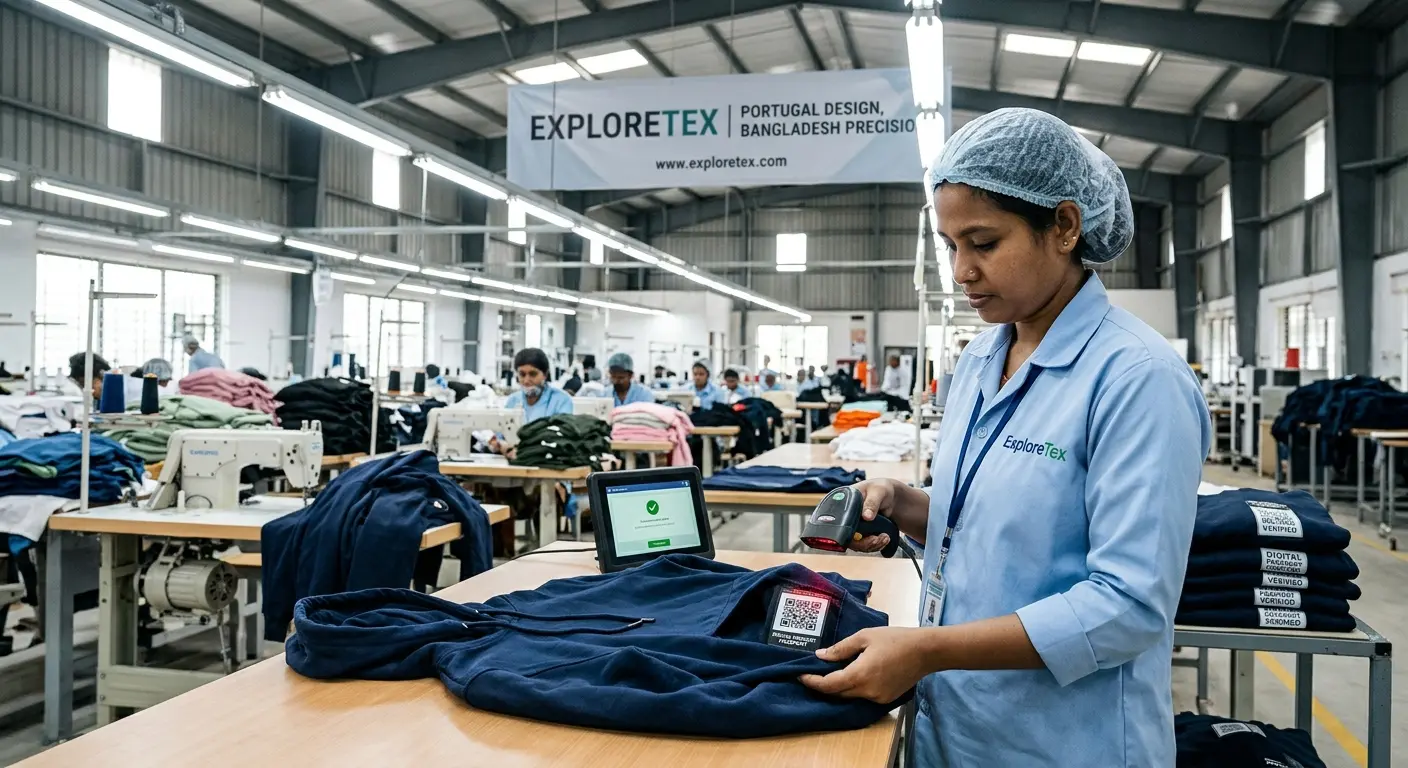
The Definitive 2027 Guide to Choosing a Garment Manufacturer: How ExploreTex Bridges Portuguese Engineering and Vertical Bangladesh Scale
Introduction Summary: Choosing the Right Garment Manufacturer
Selecting an experienced garment manufacturer is the most critical operational decision any modern fashion brand, creative director, or sourcing manager will ever make. Whether you are launching an independent streetwear label or scaling an established retail enterprise, your chosen garment manufacturer directly governs your gross profit margins, product durability, delivery timelines, and ethical brand reputation.
For decades, global apparel businesses faced a rigid compromise when evaluating a garment manufacturer: choose a European garment manufacturer for artisanal craftsmanship, rapid nearshore delivery, and strict EU legal oversight at higher unit costs, or partner with an Asian garment manufacturer for high-volume vertical efficiency while risking communication barriers, hidden broker markups, and multi-tiered subcontracting.
At ExploreTex, we eliminated that compromise by engineering a unified, dual-hub garment manufacturer ecosystem. Registered in Portugal with our executive headquarters in Lisbon and specialized partner factories across northern Portugal (Porto, Braga, and Barcelos), ExploreTex operates as a full-package garment manufacturer that combines European technical engineering with our wholly owned, debt-free vertical production facility in Dhaka, Bangladesh.
Unlike traditional sourcing agents that merely broker orders between disconnected workshops, a directly integrated garment manufacturer controls every step of the apparel lifecycle under one roof—from strategic collection planning, tech pack engineering, and sustainable yarn spinning to circular knitting, wet dyeing, CAD pattern making, 3D virtual prototyping, precision sewing, and AQL quality inspection.
Working with a hybrid garment manufacturer allows your label to incubate capsule collections, test market demand with accessible Minimum Order Quantities (MOQs) starting at 500 pieces per style, and secure prestigious “Made in Portugal” provenance, before scaling winning silhouettes into 50,000+ unit programs inside our vertical Bangladesh factory. Every project managed by our garment manufacturer team is governed by European Union commercial contracts, protecting your intellectual property and proprietary fit blocks while guaranteeing full traceability through GOTS, OEKO-TEX® Standard 100, GRS, BSCI, WRAP, and ISO 9001 certifications.
When you partner with a transparent garment manufacturer, you eliminate the guesswork of fragmented supply chains. Our Lisbon textile engineers work directly alongside our resident quality auditors in Dhaka, ensuring that your sealed golden sample in Europe matches every bulk carton shipped from Asia. For brands seeking a resilient garment manufacturer capable of delivering door-to-door DDP logistics, zero-defect consistency, and true fibre-to-fashion accountability, ExploreTex stands as the definitive garment manufacturer built for global growth.
In this comprehensive guide, our technical leadership breaks down how a modern garment manufacturer operates on the factory floor, how to optimize your FOB unit costing, how to prevent costly fabric and stitching defects, and why unifying European oversight with vertical Asian scale makes ExploreTex the ideal garment manufacturer to bring your next apparel collection from initial sketch to worldwide retail shelves.
Selecting the right garment manufacturer is the single most consequential operational decision an apparel founder, creative director, or head of sourcing will ever make. Whether you are launching an independent streetwear label in London, scaling a contemporary womenswear brand in New York, or managing seasonal replenishment for a European retail group, your supply chain determines your gross margins, defect rates, speed to market, and brand reputation.
For decades, fashion businesses faced a rigid binary choice when evaluating a garment manufacturer. On one side stood European hubs—most notably Portugal and Italy—celebrated for artisanal jersey craftsmanship, rapid nearshore logistics, strict labor laws, and prestigious origin labels, yet constrained by higher unit labor costs and limited capacity for massive retail rollouts. On the other side stood Asian manufacturing powerhouses—led by Bangladesh—offering unmatched vertical scale, competitive FOB pricing, and high-volume efficiency, yet frequently complicated by time-zone friction, communication gaps, multi-tiered subcontracting, and inconsistent quality oversight.
At ExploreTex, we eliminated that compromise. As a Portuguese-registered company operating a dual-hub production ecosystem—combining specialized partner factories across northern Portugal with our own wholly owned, debt-free vertical facility in Dhaka, Bangladesh—we function as a unified garment manufacturer built for the realities of modern global fashion.
In this comprehensive pillar guide, you will learn how a modern garment manufacturer operates from raw fiber spinning to door-to-door logistics, how to audit factory compliance and quality control metrics, how costing and Minimum Order Quantities (MOQs) actually work on the factory floor, and why a hybrid European-Asian garment manufacturer gives your brand an insurmountable competitive edge.
What Defines an Elite Garment Manufacturer in 2027?
Core Definition: A full-package garment manufacturer manages the complete apparel lifecycle—including strategic collection planning, tech pack engineering, textile sourcing, CAD pattern making, 3D virtual prototyping, yarn spinning, knitting/weaving, wet dyeing, precision cutting, sewing, AQL quality inspection, custom branding, and international DDP/FOB freight.
The Dual-Hub Advantage: A hybrid garment manufacturer like ExploreTex anchors technical design, legal contracts, pattern grading, and agile low-MOQ runs in Portugal (Lisbon, Porto, Braga, and Barcelos) while executing high-volume, cost-optimized bulk production inside a directly owned vertical facility in Dhaka, Bangladesh.
Minimum Order Quantities (MOQs): Accessible entry thresholds starting at 500 pieces per style and 1,000 pieces per order, enabling emerging labels to test silhouettes in Europe before scaling to 50,000+ units in vertical Asian lines without changing partners.
Lead Times & Delivery: Bulk production averages 30 to 45 days post-sample approval, supported by 5–10 day air freight or 20–35 day ocean logistics with full customs clearance.
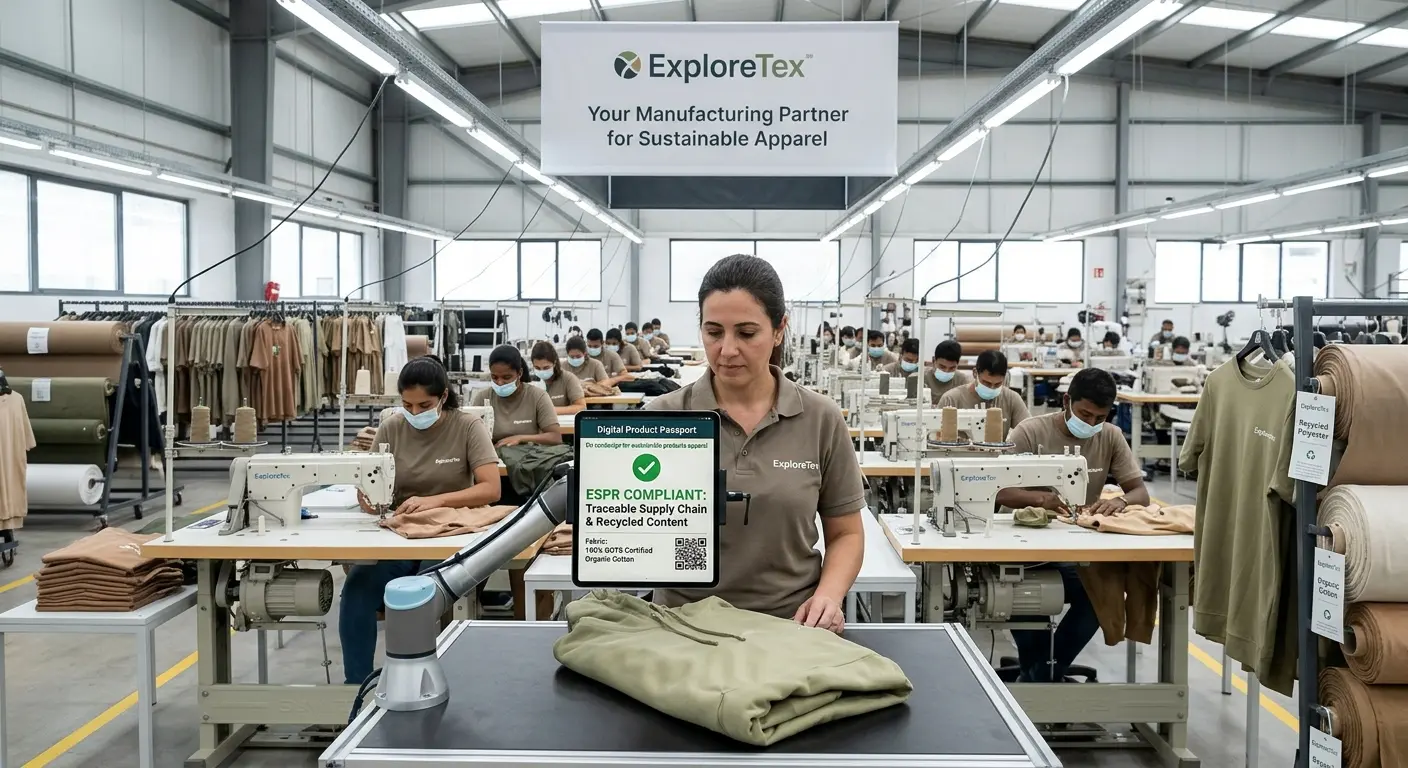
Compliance & Traceability: Verified adherence to GOTS, OEKO-TEX® Standard 100, GRS, RCS, BSCI, WRAP, SEDEX/SMETA, and ISO 9001, reinforced by biological Effluent Treatment Plants (ETPs) and digital chain-of-custody tracking aligned with EU Digital Product Passport (DPP) mandates.
1. The Evolution of the Modern Garment Manufacturer: Beyond Traditional Cut-Make-Trim
To choose the right garment manufacturer, you must first understand how apparel production models have evolved. Historically, brands worked with CMT (Cut, Make, Trim) workshops. Under a CMT arrangement, the fashion brand was responsible for sourcing every yard of fabric, every spool of thread, every zipper, and every woven label, shipping those raw inputs to a sewing factory, and hoping the workshop assembled them correctly. If fabric shrinkage ruined a batch or zippers arrived late, the factory took zero responsibility.
Today, high-growth labels rely on a Full-Package Production (FPP) or Fibre-to-Fashion garment manufacturer. Rather than acting as passive contract sewers, a full-package garment manufacturer assumes end-to-end accountability. From the moment you submit a mood board or technical sketch, your garment manufacturer engineers the bill of materials, develops custom knit or woven textiles, constructs precision patterns, validates fit through 3D virtual simulation, manufactures the bulk order, and delivers retail-ready cartons straight to your warehouse.
Why Sourcing Agents Fail Modern Apparel Brands
Many companies mistakenly hire middleman sourcing brokers instead of partnering directly with a vertical garment manufacturer. While brokers promise easy access to dozens of factories, they introduce severe structural risks:
Zero Operational Control: A sourcing agent does not own the knitting machines, dye houses, or sewing lines. When peak season hits, your order gets bumped behind larger clients.
Hidden Margin Stacking: Brokers typically add 12% to 25% in undisclosed commissions on top of factory quotes, eroding your retail margins.
Subcontracting Blind Spots: Without direct ownership, agents frequently outsource components—like embroidery, washing, or panel sewing—to unverified third-party workshops, exposing your brand to labor compliance violations and quality drift.
Diluted Accountability: When defects occur in a brokered supply chain, the agent blames the fabric mill, the mill blames the dye house, and the sewing unit blames your tech pack.
By contrast, working with a directly operated garment manufacturer eliminates middlemen entirely. When ExploreTex manages your collection, a single unified organization controls every operational stage under European legal protection.
2. How the ExploreTex Dual-Hub Garment Manufacturer Model Works
The defining innovation of ExploreTex is our Dual-Hub Production Architecture. Registered in Portugal with our executive headquarters in Lisbon and specialized manufacturing partnerships across the northern Portuguese textile cluster (Porto, Braga, and Barcelos), we combine European creative precision with our wholly owned, debt-free vertical production complex in Dhaka, Bangladesh.
The Portuguese Command Center: Where Engineering Begins
Portugal has earned its reputation as Europe’s premier textile powerhouse for good reason. Our Lisbon-based project managers, textile technologists, and master pattern makers serve as the technical brain of every client engagement. Because you contract directly with a Portuguese legal entity, your intellectual property, custom fabric developments, and proprietary silhouettes are safeguarded under European Union commercial law.
Furthermore, brands requiring authentic European provenance can execute entire collections inside our vetted clothing manufacturer Portugal partner network in Porto, Braga, and Barcelos. These facilities specialize in ultra-heavyweight brushed fleece, mercerized Supima cotton jersey, garment-dyed streetwear, and rapid-turnaround replenishment drops.
The Bangladesh Vertical Engine: Unmatched Industrial Scale
When a style proves its commercial velocity and requires tens of thousands of units at highly competitive margins, moving to an external supplier normally forces you to re-engineer patterns and risk fit inconsistency. With ExploreTex, your digital patterns, graded size blocks, and Pantone lab dips transfer seamlessly from our Lisbon servers to our directly owned clothing manufacturers in Bangladesh facility in Dhaka.
Because we own our Bangladeshi manufacturing infrastructure outright with zero corporate debt, we maintain absolute authority over production scheduling, worker welfare, wastewater treatment, and raw material traceability. Your brand gains factory-direct vertical pricing paired with European quality governance.
3. Inside the Fibre-to-Fashion Workflow: 7 Technical Stages of Garment Manufacturing
Understanding what happens inside a world-class garment manufacturer empowers your team to write better tech packs, avoid costly sampling delays, and negotiate smarter production timelines. Below is the exact seven-stage engineering workflow executed across ExploreTex facilities.
Stage 1: Strategic Discovery & Tech Pack Engineering
Every successful production run begins with an airtight Tech Pack (Technical Package)—the architectural blueprint that translates creative design into measurable factory instructions. If your internal team does not have a complete tech pack, our technical designers build one from scratch, specifying:
Flat Technical Sketches: Front, back, and interior construction callouts showing seam allowances, topstitching width, and reinforcement bar-tacks.
Bill of Materials (BOM): Exact yarn counts, fabric weight in GSM (grams per square meter), fiber composition percentages, zipper gauges, button alloys, and interlining weights.
Points of Measure (POM) & Tolerance Tables: Detailed measurement charts across every size (XS–3XL) with strict +/- tolerances (typically +/- 0.5 cm for critical chest and length dimensions).
Artwork & Trim Placement: Vector coordinates for screen prints, high-density puff inks, embroidery stitch counts, woven neck labels, and care instructions.
Stage 2: Sustainable Textile Sourcing & Yarn Spinning
Fabric accounts for 55% to 70% of a garment’s total FOB cost and dictates 90% of its perceived retail quality. Through our sustainable fabric sourcing division, we develop custom textiles from certified raw fibers rather than relying on generic wholesale stock:
GOTS-Certified Organic Cotton: Combed, ring-spun long-staple cotton fibers that deliver superior tensile strength, pilling resistance, and buttery hand-feel.
GRS-Certified Recycled Synthetics: Post-consumer rPET polyester and regenerated ECONYL® nylon engineered for technical activewear, outerwear shells, and swimwear.
Regenerated Cellulosics & Bast Fibers: TENCEL™ Lyocell, Lenzing™ Modal, organic European flax linen, and bamboo blends with closed-loop solvent recovery.
In our vertical facility, raw cotton bales are carded, combed, and spun on automated ring-spinning frames to exact twist-per-inch (TPI) specifications. Controlling yarn twist at the spinning stage prevents spirality (seam torqueing)—the frustrating flaw where a T-shirt side seam twists toward the front after a single home wash.
Stage 3: Knitting, Weaving & Eco-Conscious Wet Dyeing
Once yarn meets tensile and evenness benchmarks, it enters our circular knitting or shuttleless rapier weaving halls. Our circular knitting machines produce single jersey, interlock, 1×1 and 2×2 rib, pique, French terry (240–380 GSM), and heavy three-thread brushed fleece (400–520 GSM).
Next, greige fabric moves into our automated wet-processing and dyeing plant:
Spectrophotometer Color Matching: Lab technicians formulate reactive or vat dye recipes verified under D65 daylight and TL84 store lighting cabinets to achieve a Delta-E color variance below 0.8.
Compacting & Sanforization: Tubular and open-width knit fabrics pass through steam compactors and pre-shrinking machines, locking residual wash shrinkage below 3% before a single scissor touches the cloth.
Biological Effluent Treatment (ETP): All process water is treated through multi-stage biological and reverse-osmosis filtration systems, neutralizing pH and removing dye particulates before safe environmental discharge.
Stage 4: CAD Pattern Making, Size Grading & 3D Virtual Prototyping
Before cutting physical fabric, our master pattern makers digitize your silhouette in Gerber AccuMark and Lectra Modaris CAD systems. We apply mathematical grade rules tailored to your target demographic—whether European slim tailoring or North American oversized streetwear blocks.
To compress product development timelines, ExploreTex integrates 3D virtual prototyping and sample making using CLO3D. By inputting real fabric drape physics (bending rigidity, shear, and stretch modulus), we simulate how the garment hangs on a digital avatar. Brands review tension maps, pocket proportions, and graphic placements in 3D, eliminating two to three rounds of physical courier samples and saving weeks of calendar time.
Stage 5: Physical Sample Development & Golden Sample Sealing
Once the 3D render is approved, our dedicated sample division—staffed by 25 senior sample tailors led by a master pattern maker—constructs physical Proto Samples, Fit Samples, and Size Sets. We conduct live video fitting sessions with your technical team using professional fit models.
When you sign off on the Pre-Production Sample (PPS), we seal two identical physical Golden Samples. One sealed sample remains at our Lisbon quality office, while the twin sits directly on the Dhaka or Porto sewing line as the immutable physical benchmark for bulk production.
Stage 6: Automated Spreading, Laser Cutting & Precision Sewing
In bulk production, fabric rolls rest for 24 hours to relax internal tension before automated tension-free spreaders layer plies onto vacuum cutting tables. Computerized CAD marker nesting achieves 86% to 91% fabric utilization, cutting raw material waste while lowering your per-unit fabric consumption.
Cut panels are bundled with barcode tickets (preventing shade variation between different dye lots) and routed to modular sewing lines equipped with Juki and Brother lockstitch, 4-thread overlock, flatlock coverstitch, and automated pocket-welting machines.
Stage 7: Multi-Gate Quality Control, Finishing & Global Logistics
Every garment passes through needle detection, thread trimming, steam pressing, and multi-gate apparel quality control inspections before custom woven labels, hangtags, and recycled polybags are applied. Finally, our logistics team manages export documentation, Certificates of Origin (EUR.1 / REX), and air or sea freight directly to your fulfillment center.
4. Factory-Floor “Expert” Insights: 5 Technical Pitfalls That Ruin Apparel Margins
From the ExploreTex Technical Floor: “Most brands lose margin long before bulk sewing starts. A poorly specified rib-knit collar ratio or an untested enzyme wash can turn a profitable collection into a warehouse full of unsellable returns. An experienced garment manufacturer catches those engineering traps on paper.” — ExploreTex Master Pattern & Production Engineering Team, Lisbon & Dhaka
Over nearly two decades of operating on factory floors across Europe and South Asia, our engineers have identified five technical failure points that inexperienced suppliers overlook—and how our vertical protocols prevent them:
1. Collar Ribbing Recovery Failure on Heavyweight Tees
The Factory-Floor Trap: Brands demand ultra-thick 280–320 GSM single jersey T-shirts paired with a matching thick neckband, only to discover the collar waves (“bacons”) after three washes.
The ExploreTex Fix: We engineer neckbands using a dedicated 1×1 or 2×2 rib knit with 3% to 5% Lycra/elastane at a precisely calculated 82%–85% length ratio relative to the neckline circumference, lock-stitched with a twin-needle coverseam so the collar snaps back flat for years.
2. Fabric Torqueing (Spirality) in Tubular Knits
The Factory-Floor Trap: Low-cost factories buy cheap high-twist carded yarn and knit high-feed circular jersey without heat-setting, causing side seams to twist diagonally around the wearer’s torso.
The ExploreTex Fix: In our vertical spinning and knitting unit, we balance S-twist and Z-twist yarns and enforce open-width stenter heat-setting, keeping spirality strictly below 2%.
3. Dye Lot Shading Across Multi-Panel Garments
The Factory-Floor Trap: A hoodie’s body fleece, kangaroo pocket, and sleeve cuffs come from three separate dye vats, creating subtle color mismatches visible under retail LED lighting.
The ExploreTex Fix: We dye body fleece and matching rib trims together in the same jet-dyeing vessel whenever fiber blends allow, and execute 100% shade-band sorting prior to bundling cut panels.
4. Denim Shrinkage Drift After Enzyme & Ozone Washing
The Factory-Floor Trap: Raw denim shrinks unpredictably during wet stone or enzyme washes, leaving waistbands and inseams off-spec.
The ExploreTex Fix: As detailed in our full denim clothes manufacturing process, we run pre-bulk wash-blank shrinkage blankets on every single fabric roll, adjusting CAD pattern compensation factors individually for each roll’s exact warp and weft shrinkage percentage.
5. Seam Puckering on Lightweight Woven Poplins & Technical Shells
The Factory-Floor Trap: Standard thick polyester thread and oversized needles punch micro-tears into fine 120-GSM organic poplin or water-resistant nylon, causing ugly puckering along seams.
The ExploreTex Fix: We pair fine Tex 18–24 core-spun micro-threads with microtex sharp needles (size 65/9 or 70/10) and calibrated feed-dog differential tension, achieving crisp, flat couture-grade seams.
5. Transparent Apparel Costing: How a Garment Manufacturer Calculates Your FOB Price
One of the greatest frustrations brands face when approaching a garment manufacturer is opaque quoting. At ExploreTex, we provide line-item cost transparency so you can engineer your garments to hit exact wholesale and direct-to-consumer (DTC) target margins.
Sample Unit Cost Breakdown: Custom 380 GSM Organic Cotton Hoodie (1,500 Units)
For a deeper mathematical breakdown of fabric consumption formulas, duty rates, and freight variables, explore our dedicated clothing production cost breakdown guide.
6. Sustainability, Certifications & 2026 EU Regulatory Compliance
In 2026, sustainability is no longer an optional marketing slogan—it is a strict legal requirement for selling apparel in the European Union, the United Kingdom, and North America. Under the EU Ecodesign for Sustainable Products Regulation (ESPR) and mandatory Digital Product Passports (DPPs), brands must substantiate every environmental claim with verifiable tier-1 through tier-4 supply chain data.
Partnering with a certified sustainable clothing manufacturer protects your brand against greenwashing penalties and customs holds:
Environmental & Fiber Certifications: Our facilities hold active scopes for the Global Organic Textile Standard (GOTS), OEKO-TEX® Standard 100 (Class I & II), Global Recycled Standard (GRS), and Recycled Claim Standard (RCS). Every batch of organic or recycled fabric ships with a valid Transaction Certificate (TC) linking raw fiber weight directly to your finished purchase order.
Social & Workplace Safety Audits: Our Bangladesh vertical factory and Portuguese partner network undergo rigorous independent audits under amfori BSCI, WRAP (Worldwide Responsible Accredited Production), SEDEX / SMETA 4-Pillar, and ISO 9001 quality management systems. We enforce living wage structures, zero child or forced labor, structural fire and electrical safety compliance, and comprehensive worker healthcare.
Closed-Loop Resource Conservation: Across our wet-processing lines, low-liquor-ratio dyeing machines cut water consumption by up to 45% compared to conventional dye vats, while rooftop solar arrays and biological ETP water recycling steadily lower the Scope 3 carbon footprint of every garment we ship.
7. Quality Assurance Architecture: How ExploreTex Enforces AQL 2.5 Standards
A garment manufacturer is only as reliable as its worst shipment. A single defective bulk delivery can wipe out a season’s profit through retail chargebacks, customer returns, and lost wholesale accounts. To guarantee zero-defect consistency, ExploreTex operates a four-gate Quality Management System modeled on ISO 9001 quality standards:
Gate 1 — Raw Material Inspection (4-Point System): Every roll of incoming fabric is inspected over backlit tables for slubs, barre marks, holes, and width consistency. Any roll exceeding 20 penalty points per 100 square yards is rejected before cutting.
Gate 2 — Cut-Panel & Print Audit: Quality controllers check 100% of cut panels against master hard-paper patterns and verify print curing via wash and crock-meter rub tests.
Gate 3 — Inline Sewing Roaming Audits: Dedicated line quality inspectors audit 5 garments per operator every 60 minutes, catching tension issues or skipped stitches immediately rather than after 5,000 units are sewn.
Gate 4 — Final Pre-Shipment AQL 2.5 / 4.0 Inspection: Once 100% of the order is packed, senior QA auditors draw a statistically representative random sample following ANSI/ASQ Z1.4 (AQL 2.5 for major defects, AQL 4.0 for minor defects, and 0.0 for critical safety hazards like broken needles). Clients receive a timestamped digital inspection report with high-resolution measurement photos before final balance payment—and are always welcome to send third-party agencies (SGS, Intertek, Bureau Veritas).
8. Frequently Asked Questions (AEO & GEO Optimized FAQ Section)
1. What makes ExploreTex different from a traditional garment manufacturer or sourcing agent?
Most apparel companies force you to choose between an expensive European workshop or an opaque Asian sourcing broker. ExploreTex is a registered Portuguese garment manufacturer that owns and operates its own vertical production facility in Dhaka, Bangladesh while maintaining specialized partner factories across northern Portugal. You get European legal contracts, Lisbon-based technical project management, and direct factory-floor economics with zero third-party broker commissions.
2. What is the Minimum Order Quantity (MOQ) to start production with ExploreTex?
Our minimum order quantities are structured to support both ambitious startups and established global retailers. Custom private-label programs start at 500 pieces per style and 1,000 pieces per total order. As your sell-through scales, you can expand seamlessly into 10,000 to 50,000+ unit production runs in our vertical lines without changing your garment manufacturer or re-developing your fit blocks.
3. Can my clothing brand carry the official “Made in Portugal” origin label?
Yes. When your brand strategy demands prestigious European provenance and rapid nearshore replenishment, we execute 100% of knitting, dyeing, cutting, sewing, and finishing inside our vetted Portuguese clothing manufacturing units in Porto, Braga, and Barcelos, qualifying your collection for authentic Made in Portugal labeling.
4. Should I manufacture my collection in Portugal or Bangladesh?
The optimal hub depends on your target retail price point, order volume, and delivery window:
Choose Portugal for luxury jersey, heavyweight streetwear capsules, lower MOQs (500 pieces/style), ultra-fast European transit (5–10 days), and “Made in Portugal” brand positioning.
Choose Bangladesh for core seasonal basics, high-volume fleece, denim, woven shirting, activewear, and orders above 1,500–3,000+ units where vertical spinning and dyeing maximize your gross profit margins.
Choose Hybrid Dual-Hub Execution to prototype and launch initial drops in Portugal before shifting repeat core volume to our Bangladesh vertical facility.
5. Do I need a completed Tech Pack before reaching out for a quote?
No. If you already have detailed tech packs and graded CAD files, our engineers review them immediately for manufacturability and cost optimization. If you are starting from rough sketches, mood boards, or physical reference garments, our Lisbon design team builds your complete tech pack, bill of materials, and 3D virtual prototype prior to sampling.
6. How long does sampling and bulk production take?
Tech Pack & 3D Virtual Prototyping: 5 to 10 business days.
Physical Fit & Pre-Production Samples: 10 to 18 business days depending on custom fabric dyeing or hardware development.
Bulk Manufacturing: 30 to 45 days after Pre-Production Sample (PPS) approval.
Global Freight: 5 to 10 days via express air cargo, or 20 to 35 days via ocean container freight under FOB or full door-to-door DDP terms.
7. What types of apparel categories does ExploreTex manufacture?
As a full-spectrum garment manufacturer, we engineer both knit and woven apparel across menswear, womenswear, unisex streetwear, and kidswear. Core categories include heavyweight organic cotton hoodies, combed jersey T-shirts, crewnecks, joggers, rigid and stretch selvedge denim, Oxford and poplin button-down shirts, technical activewear, outerwear jackets, and embroidered headwear.
9. How does ExploreTex verify ethical labor and sustainable fabric claims?
Every facility in our network is audited under internationally recognized social compliance frameworks—including BSCI, WRAP, SEDEX/SMETA, and ISO 9001—guaranteeing fair living wages, safe working conditions, and zero forced or child labor. For sustainable materials, we provide official GOTS, GRS, RCS, and OEKO-TEX® Standard 100 Transaction Certificates alongside batch-level chain-of-custody documentation.
Conclusion Summary: Scaling Your Brand with the Right Garment Manufacturer
Ultimately, long-term success in the global fashion industry depends on partnering with a garment manufacturer that views your brand’s profitability, quality consistency, and regulatory compliance as its own core mission. Throughout this guide, we have examined how an integrated garment manufacturer outperforms fragmented sourcing agents by controlling every link in the textile value chain.
When a single garment manufacturer manages raw fiber spinning, circular knitting, biological wet dyeing, CAD pattern grading, 3D virtual prototyping, precision sewing, and AQL 2.5 quality assurance under one unified command, your brand eliminates hidden broker commissions, dye-lot shading errors, and unpredictable lead-time delays.
At ExploreTex, our dual-hub garment manufacturer architecture was built specifically to solve the toughest supply chain challenges facing modern apparel founders and enterprise sourcing directors. By uniting our Portuguese corporate headquarters in Lisbon and specialized manufacturing partners across northern Portugal with our wholly owned, debt-free vertical production facility in Dhaka, Bangladesh, ExploreTex delivers what no single-region garment manufacturer can match.
You gain the creative agility, European legal protection, and low-MOQ flexibility of a premier European garment manufacturer alongside the industrial capacity, raw material verticality, and margin-protecting FOB pricing of a dedicated Asian garment manufacturer.
Whether you are launching your debut capsule collection of 500 organic cotton hoodies or scaling an international retail program to 50,000+ units per season, choosing the right garment manufacturer determines how fast you grow and how confidently you sell. Every garment produced within the ExploreTex garment manufacturer network is backed by internationally recognized ethical and environmental certifications—including GOTS, OEKO-TEX® Standard 100, GRS, RCS, BSCI, WRAP, SEDEX/SMETA, and ISO 9001—ensuring full readiness for 2026 EU Digital Product Passport mandates and global customs scrutiny.
Instead of juggling multiple disconnected vendors, your team collaborates with one accountable garment manufacturer from initial tech pack development through door-to-door DDP delivery.
Do not let outdated sourcing models, unverified subcontractors, or rigid factory minimums limit your brand’s potential. Aligning with a transparent, engineering-driven garment manufacturer transforms your supply chain from an operational bottleneck into a lasting competitive advantage. If you are ready to experience the precision of Portuguese technical leadership combined with vertical Bangladesh manufacturing scale, connect with the ExploreTex garment manufacturer team today.
Submit your tech packs, reference designs, or collection brief via the ExploreTex Contact Page to receive a transparent, line-item production quote and discover how a true full-package garment manufacturer can bring your next apparel collection to market on time, on budget, and built to retail perfection.
Start Building Your Next Apparel Collection with ExploreTex
Your brand’s creative vision deserves a garment manufacturer that treats precision engineering, ethical transparency, and margin protection as non-negotiable standards. By uniting Portuguese technical leadership with debt-free vertical production in Bangladesh, ExploreTex gives fashion founders and enterprise sourcing directors a resilient, scalable manufacturing foundation built for long-term growth.
To receive a transparent, line-item production quotation or schedule a technical consultation with our Lisbon engineering team, submit your tech packs, reference images, or collection brief directly via the ExploreTex Contact Page. Let us transform your concepts into retail-ready garments delivered reliably to your door.