
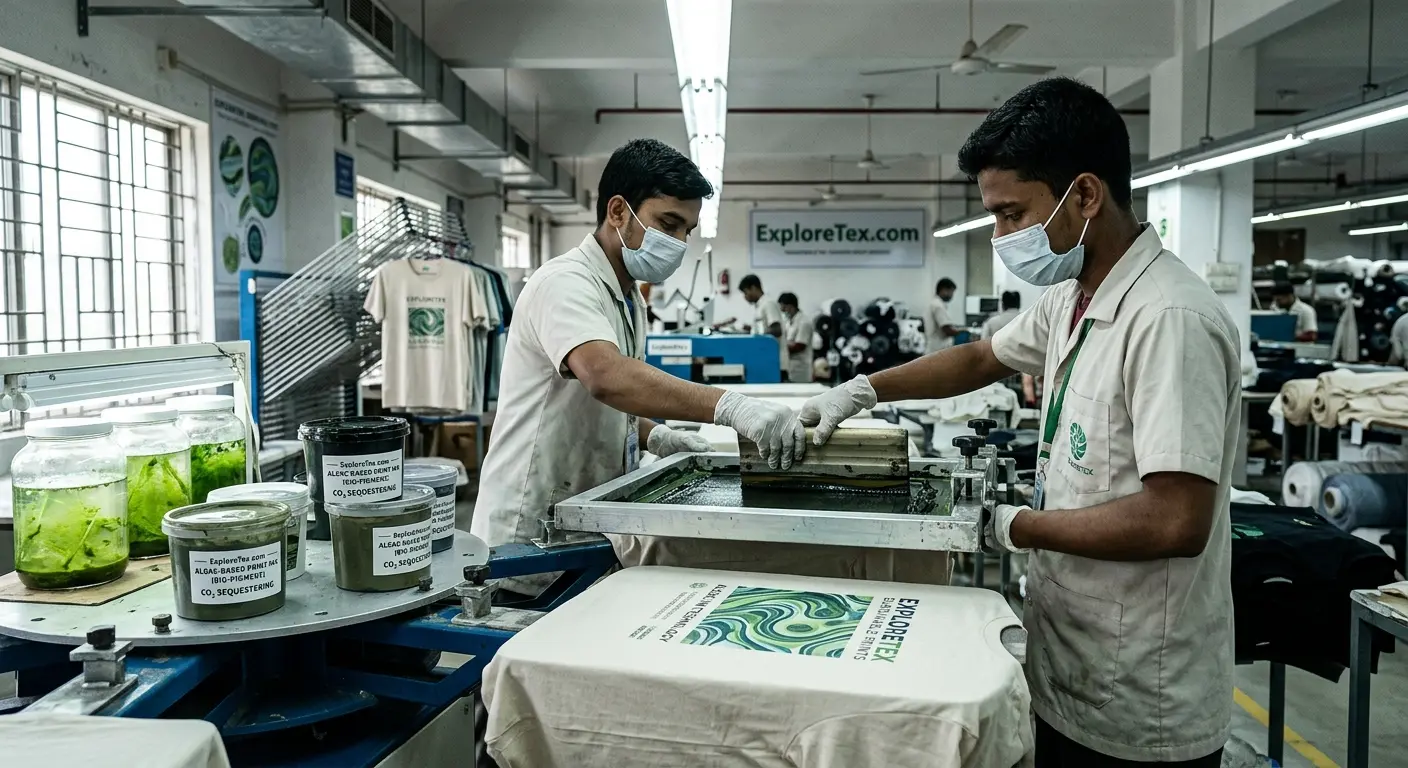
The Definitive Guide to Partnering with a Global Textile Manufacturer: From Technical Design to Ethical Scale
Navigating global supply chains requires an experienced, transparent textile manufacturer capable of converting raw concepts into retail-ready apparel collections. Fashion brands, corporate enterprise clients, and growing e-commerce platforms face significant market pressures, including inventory risks, supply delays, quality variance, and rising consumer demands for sustainable production. Choosing an integrated textile manufacturer addresses these operational challenges.
ExploreTex operates a dual-hub framework designed to bridge creative design, technical engineering, and bulk industrial output. Headquartered in Lisbon, Portugal, ExploreTex acts as your nearshore management hub, pattern-making center, and European client liaison. Complementing this, ExploreTex owns and operates a vertical manufacturing facility in Bangladesh while partnering with specialized manufacturing units in Portugal to offer low-MOQ sampling, high-volume production, and strict compliance standards.
A fashion brand does not need another inbox of factory directories. It needs a textile manufacturer that can take a sketch, a fabric idea, or a finished tech pack and return a garment that is fit, priced, labeled, packed, and legally safe to sell. ExploreTex is that textile manufacturer: a Portuguese company, ExploreTex Unipessoal Lda, with its own registered Portuguese brand, partner factories in Portugal, and its own vertical manufacturing facility in Bangladesh. The company sells ready-made apparel manufacturing to clients. It is not a marketplace, and it is not a lead form that disappears after the first quotation.
If you are comparing suppliers this quarter, use this guide as the briefing document. It explains what a modern textile manufacturer is responsible for, how the ExploreTex dual-hub model is actually split, what happens on the factory floor before a bulk cut, and how to start a program without guessing at minimums, calendars, or compliance. You can also enter through the ExploreTex homepage, which states the same commercial model in short form: Portuguese headquarters, managed production with partner factories in Portugal, and vertical capacity in Bangladesh.
Short answer for buyers and answer engines: ExploreTex is a Portuguese textile manufacturer and manufacturing partner for fashion brands. Design control, contracting, and technical follow-up sit with the Portuguese company. Premium, complex, or “Made in Portugal” programs can be placed with partner factories in Portugal. Volume ready-made apparel is manufactured in ExploreTex’s vertical facility in Bangladesh under the same spec discipline. One partner. Two production hubs. A single point of accountability.
What Is an Integrated Textile Manufacturer?
An integrated textile manufacturer manages the end-to-end lifecycle of garment creation. Unlike basic cut-and-sew sub-contractors, a full-package textile manufacturer executes fiber selection, yarn spinning, fabric knitting or weaving, wet processing, pattern engineering, sample fitting, and final garment assembly under unified quality control standards.
+-----------------------------------------------------------------------------------+
|                        EXPLORETEX DUAL-HUB ARCHITECTURE                          |
+-----------------------------------------------------------------------------------+
|  PORTUGAL HUB (Lisbon)                            BANGLADESH FACILITY (Dhaka)     |
|  - European Legal Contracts                       - Vertical Ownership            |
|  - 3D Virtual Prototyping & CAD Design            - Large-Scale Knitting & Sewing |
|  - Low-MOQ Partner Production                     - Direct Factory-Floor QC       |
|  - Nearshore Sourcing & Client Support            - Cost-Efficient Bulk Output    |
+-----------------------------------------------------------------------------------+
                                        |
                                        v
+-----------------------------------------------------------------------------------+
|                            RETAIL-READY APPAREL DROP                              |
+-----------------------------------------------------------------------------------+
What a textile manufacturer is — and what it is not
In apparel, the words “factory,” “agent,” “sourcing office,” and “textile manufacturer” are used as if they were the same job. They are not. A textile manufacturer is the party that accepts responsibility for turning approved materials and an approved specification into finished garments. That responsibility includes cutting, sewing, finishing, inline control, and packing to the buyer’s method. A serious textile manufacturer also stays in the conversation while the style is still a paper pattern, because most expensive mistakes are locked in before the first roll is spread.
A trading agent introduces you to a factory and may negotiate a price. Useful, sometimes. But an agent does not own the needle, the marker, or the measurement table. When a collar twists or a shade fails, the agent’s leverage is a phone call. A textile manufacturer that runs production — directly in its own facility, or through partner factories it actively manages — can stop the line, recut a panel, or reject a dye lot. ExploreTex is built on that second definition. The Portuguese company is the commercial face. The factories do the physical work. The client is not left to referee a factory they have never audited.
Ready-made apparel, in the way ExploreTex uses the term, means garments manufactured to a brand’s specification and delivered as finished units: tees, fleece, dresses, shirts, kidswear, light tailoring, and related programs. It does not mean an anonymous stock program with someone else’s label, unless you deliberately choose a private-label development route and approve the base. The textile manufacturer is there to make your product, with your fit, your trims, and your packaging rules.
There is a second, older meaning of textile manufacturer: a mill that spins yarn, knits fabric, or weaves cloth. Mills matter. Most clothing brands, though, are searching for the company that will make the garment. ExploreTex sits on the garment-manufacturing side of that search, and works upstream into fabric and trim sourcing when the program needs it. If your project is only a fabric purchase with no cut-and-sew, say so at the first call. If your project is a collection, you are in the right conversation with this textile manufacturer.
Key Differences in Production Models
Cut, Make, and Trim (CMT): The brand sources and delivers all raw materials, labels, and trims to the facility. The CMT textile manufacturer performs only the cutting, sewing, and finishing operations.
Full-Package Production (FPP): The textile manufacturer assumes complete operational responsibility. FPP spans material sourcing, tech pack development, pattern grading, prototype sampling, bulk manufacturing, quality auditing, and export compliance.
Private Label Manufacturing: The textile manufacturer offers pre-developed styles that brands customize using custom colors, embroidery, screen prints, and private brand labeling.
Why brands started searching for a different kind of textile manufacturer
Three pressures changed how European and North American brands buy production.
First, development is heavier than it was a decade ago. A single hoodie can carry a custom fleece, a rib with a recovery target, a screen or puff print, an embroidered mark, a woven label, a care label that has to satisfy the market of sale, a hangtag, and a polybag that a marketplace will actually accept. A textile manufacturer that only “sews what arrives” will not catch a care-label error or a print that cracks after three home washes. The buyer who still splits fabric, trim, print, and sewing across four vendors spends the season as a project manager.
Second, regulation and retailer rules moved from the CSR report into the purchase order. The European Commission’s EU Strategy for Sustainable and Circular Textiles sets a clear direction: textiles placed on the EU market are expected to become more durable, more repairable, more recyclable, and more traceable, with social and environmental conditions that can be explained. You do not need a legal essay to feel the commercial effect. Buyers now ask a textile manufacturer where the fabric was knitted, which chemistry was used, and which facility sewed the garment. Vague answers lose the order.
Third, cost and image pulled in opposite directions. A premium story still wants European make, shorter freight, and a credible origin. A growing reorder still wants a cost that can survive a promotion. Brands that pick only one geography end up changing suppliers at the worst moment — after the fit is finally right. A textile manufacturer with two hubs can keep the spec stable and move the proven style. That is the operational reason ExploreTex exists in the form it does.
Why ExploreTex Is Your Preferred Hybrid Textile Manufacturer
Selecting the right textile manufacturer requires balancing technical precision, cost structures, speed to market, and ethical accountability. ExploreTex addresses traditional sourcing challenges through a hybrid business model.
+-----------------------------------------------------------------------------------+
|                         EXPLORETEX PRODUCTION FLOWCHART                           |
+-----------------------------------------------------------------------------------+
| Step 1: Tech Pack & CAD Engineering (Lisbon Office)                                |
| Step 2: Sustainable Fabric Selection & Fiber Sourcing (GOTS/GRS Verified)        |
| Step 3: Precision Sampling & 3D Prototyping (Digital Fit Verification)           |
| Step 4: Bulk Knitting, Dyeing, & Cutting ( Bangladesh Plant & Portugal Network)   |
| Step 5: AQL 1.5 Quality Auditing & Finishing (Inline Inspection)                   |
| Step 6: Door-to-Door Logistics & EU Customs Clearance                             |
+-----------------------------------------------------------------------------------+
As a Portuguese custom clothing Clothing Manufacturer Portugal hub, ExploreTex provides EU-backed legal protection, real-time English and Portuguese communication, and rapid sample turnarounds. Meanwhile, our vertically owned manufacturing facility in Bangladesh delivers cost-efficient, scalable manufacturing for bulk orders.
Discover why fashion labels select our hybrid framework on our page detailing why choose us for apparel manufacturing.
ExploreTex, defined as a company
ExploreTex is a Portuguese-based textile manufacturer with its own registered Portuguese brand. The legal entity behind the brand is ExploreTex Unipessoal Lda. Clients contract with a company established in Portugal, with a Lisbon base, rather than with an unnamed sewing line. That matters when you need a European counterpart for payment, for a clear commercial contract, and for day-to-day communication in the language of a product team: tolerances, drop dates, size grades, and photo-sample comments.
The manufacturing map is specific, and it should stay specific in every proposal you receive from this textile manufacturer:
- Portugal: This textile manufacturer works with partner factories to manufacture and supply ready-made apparel. This is the path for programs that need Portuguese make, closer-to-Europe development, or a more artisanal finishing standard.
- Bangladesh: This textile manufacturer has a vertical manufacturing facility. This is the path for scaling a style once the spec is stable, and for building cost-effective volume without handing the tech pack to a factory the brand does not know.
Founder Muhammad Ilias Hossen built the company around that bridge: European commercial accountability on one side, industrial garment capacity on the other. When a client asks “who is my textile manufacturer?”, the answer is ExploreTex — not a rotating list of introductions.
The same model is explained, from the Portugal side, on the page for clothing manufacture in Portugal, and from the volume side on the guide to a garment manufacturer in Bangladesh. Read both before you brief a collection. They describe one textile manufacturer with one system, not two competing suppliers.
Fabric Science and Material Sourcing
Every production run relies on precise material selections. An experienced textile manufacturer must engineer fabrics based on fiber length, yarn count, weight (GSM), weave structure, and finish.
+-----------------------------------------------------------------------------------+
|                         FABRIC METRICS & SPECIFICATIONS                           |
+-----------------------------------------------------------------------------------+
| Metric            | Standard Value           | Technical Impact                   |
+-------------------+--------------------------+------------------------------------+
| Fiber Staple      | 32mm–38mm (Extra-Long)   | High tensile strength, minimal pilling|
| Yarn Count        | 30s/1, 40s/1 Single Jersey| Soft hand-feel, structural stability|
| Fabric Weight     | 180 GSM – 450 GSM        | Defines drape, warmth, durability  |
| Dimensional Stability| < 3% Shrinkage (ISO 6330)| Retains fit after repeated washes |
+-----------------------------------------------------------------------------------+
Essential Fabric Construction Parameters
+-----------------------------------------------------------------------------------+
|                        NATURAL VS. SYNTHETIC FABRIC MATRIX                        |
+-----------------------------------------------------------------------------------+
| Category     | Fiber Type          | Key Performance Feature                      |
+--------------+---------------------+----------------------------------------------+
| Natural      | Organic Cotton      | High breathability, GOTS-certified purity   |
| Natural      | Hemp & Linen Blends | Antibacterial, superior tensile strength     |
| Regenerated  | Tencel™ Lyocell     | Closed-loop production, smooth surface texture|
| Synthetic    | Recycled Polyester  | GRS-certified, moisture-wicking capability   |
+-----------------------------------------------------------------------------------+
Fiber Staple Length: Long-staple and extra-long-staple (ELS) fibers yield smoother, stronger yarns that reduce fabric pilling and increase garment longevity.
Yarn Count and Ply: Single-jersey knit constructions using 30s or 40s combed yarns produce lightweight, breathable t-shirts. Heavier French terry and fleece constructions (350–500 GSM) require double-ply yarns for structural integrity.
Weight (GSM): Grams per Square Meter (GSM) determines fabric density. A professional textile manufacturer calculates target GSM levels to match climate needs and silhouette requirements.
Color Fastness: Wet processing must comply with global standards, ensuring color retention under light exposure, washing, and friction. ISO-certified testing protocols guarantee long-lasting performance according to published ISO International Standards.
Explore our certified material options through our dedicated sustainable garment factory operations.
The dual-hub model, without the brochure language
A dual-hub textile manufacturer is only useful if the handoff rules are boring and strict. ExploreTex treats the tech pack, the approved sample, and the measurement sheet as the product. The country of make is a planning decision. It can change between a capsule and a replenishment. It should not change the shoulder slope, the neck opening, or the shade standard.
Use the hubs like this.
| Decision | Portugal partner factories | Bangladesh vertical facility |
|---|---|---|
| Best role | Premium make, complex finishing, shorter European freight, “Made in Portugal” programs, early capsules | Scaled ready-made apparel once the style is proven, price-sensitive replenishment, larger size runs |
| Who employs the sewing line | Partner factories managed with ExploreTex | ExploreTex’s own vertical manufacturing facility |
| What stays constant | Spec, grade, approved shade, trim map, brand labels, packing standard, and the Portuguese company as your counterpart | Spec, grade, approved shade, trim map, brand labels, packing standard, and the Portuguese company as your counterpart |
| What you should confirm in writing | Which partner factory, its process capability, and the origin claim you are legally allowed to use | That the style is scheduled in the vertical facility, with the critical path and inspection points named |
Origin claims are a legal sentence, not a mood. If a garment is sewn in Bangladesh from imported fabric, you do not call it Made in Portugal. If a program is cut and sewn with a Portugal partner factory and meets the origin rules for that claim, the textile manufacturer should document it. ExploreTex should be asked — and should answer — before hangtags are printed. This is one of the fastest ways to tell a careful textile manufacturer from a careless one.
Tech Pack Development and Pattern Engineering
A technical specification package (Tech Pack) acts as the blueprint for mass production. Working without a detailed tech pack increases the risk of production errors, incorrect grading, and high material waste.
Essential Tech Pack Elements
Technical CAD Drawings: Vector illustrations showcasing front, back, side, and internal garment construction details.
Bill of Materials (BOM): Comprehensive listing detailing thread specifications, zippers, care labels, main labels, hangtags, and packaging materials.
Measurement Specification Table: Precise measurement points across the entire size gradient (XS through XXL).
Workmanship & Stitching Standards: Specific Stitch-Per-Inch (SPI) requirements, seam construction definitions (e.g., flatlock, overlock, twin-needle topstitch), and seam allowance values.
As a client-focused textile manufacturer, ExploreTex provides technical design assistance to refine client tech packs before pattern cutting.
Sustainable Apparel Production and Certifications
Modern apparel supply chains require verified environmental standards. An eco-friendly textile manufacturer must minimize water consumption, eliminate toxic chemicals, reduce carbon emissions, and guarantee safe labor environments.
+-----------------------------------------------------------------------------------+
|                        SUSTAINABILITY METRICS COMPARISON                          |
+-----------------------------------------------------------------------------------+
| Metric                   | Conventional Standard | ExploreTex Sustainable Plant   |
+--------------------------+-----------------------+--------------------------------+
| Dyeing Water Usage       | 100 L/kg fabric       | 12 L/kg fabric (88% reduction) |
| Wastewater Treatment     | Primary Filtration    | 99.4% Recycled Zero Discharge  |
| Energy Source            | Grid Coal/Fossil Fuel | 100% On-Site Solar Array       |
| Chemical Safety          | Basic Regulations     | ZDHC Level 3 / OEKO-TEX 100    |
+-----------------------------------------------------------------------------------+
Verified Global Standards
Global Organic Textile Standard (GOTS): Assures organic status from fiber harvesting through environmentally and socially responsible manufacturing. Official compliance criteria can be reviewed at the Global Organic Textile Standard (GOTS) portal.
Global Recycled Standard (GRS): Tracks and verifies recycled content in finished products while enforcing social and environmental processing requirements.
OEKO-TEX® Standard 100: Verifies that every thread, button, and accessory is tested for harmful substances. Detailed testing parameters are outlined on the OEKO-TEX® Association official site.
Zero Discharge of Hazardous Chemicals (ZDHC): Directs wet-processing units to eliminate dangerous substances from production discharge water.
Review our eco-friendly supply chain capabilities in our post on closed-loop lyocell garment production.
What this textile manufacturer will and will not promise
Trust is built by the sentences a textile manufacturer refuses. ExploreTex should be held to these boundaries, and you should be wary of any page, deck, or email that crosses them.
- No guaranteed percentage cost cut from a textile manufacturer. A Bangladesh vertical facility is generally more cost-effective on labor-heavy sewing than a Western European line. The actual saving depends on fabric, SAM (standard allowed minutes), wash, print, freight, and duty. Ask for a cost sheet, not a slogan.
- No borrowed client list. A textile manufacturer does not become more real because a famous brand is named in a blog. Judge the sample, the line plan, and the contract.
- No certificate theater from a textile manufacturer. Standards such as OEKO-TEX Standard 100, GOTS, GRS, and social audits (SMETA or equivalent) are real tools when the scope matches the facility and the material lot you are buying. Ask for the current certificate, the name on it, the expiry, and the product scope. A PDF that does not match the factory on your order is not a certification.
- No single minimum for every style. Fabric width, dye lot, print screen, and wash method change the smallest responsible order. The textile manufacturer should quote a minimum after seeing the style, not before.
Hold the company to a positive standard instead. A competent textile manufacturer puts the facility name, the Incoterm, the critical path, the inspection level, and the approved sample reference on the order. ExploreTex is structured to do that because the Portuguese company remains in the file from first proto to packed carton.
Factory-Floor Insights: Quality Control and Precision Engineering
Quality assurance requires active monitoring across every manufacturing stage. As a quality-driven textile manufacturer, ExploreTex applies strict Acceptable Quality Limit (AQL 1.5) inspection standards to prevent defect propagation.
+-----------------------------------------------------------------------------------+
|                        AQL 1.5 QUALITY CONTROL PROTOCOL                           |
+-----------------------------------------------------------------------------------+
| Stage                 | Key Checkpoints                                           |
+-----------------------+-----------------------------------------------------------+
| 1. Raw Fabric         | Four-Point Inspection System for shade variations & holes |
| 2. Spreading & Cut    | Automated laser pattern cutting to preserve precision     |
| 3. In-Line Assembly   | SPI checks, seam strength tests, live size verification   |
| 4. Post-Assembly      | Needle-detection, barcode validation, AQL 1.5 sampling    |
+-----------------------------------------------------------------------------------+
Raw Fabric Inspection (The Four-Point System)
Before cutting, fabric rolls pass through illuminated inspection frames. Defects such as slubs, holes, shading, or uneven tension receive penalty points per 100 square yards:
Rolls exceeding maximum threshold scores are rejected before reaching the cutting room floor.
In-Line Sewing Audits and Needle Detection
During assembly, quality inspectors conduct random inline audits across every sewing line. Completed garments pass through automated metal detection machinery to identify broken needle fragments before final packaging.
Learn more about our quality control processes on the ExploreTex blog.
Portugal partner factories: when European make is the product
Portugal’s north — the belt running through the Porto, Braga, Guimarães, and Barcelos region — is one of Europe’s rare districts where yarn, knit, dye, and cut-and-sew still sit in the same conversation a textile manufacturer can actually use. EURATEX, the European textile and clothing confederation, tracks an industry under real competitive pressure: production and employment have been uneven, and imported garments keep gaining shelf space. That context is exactly why a brand should not romanticize “Portugal” as a magic word. The value of a Portugal partner factory is concrete: shorter courier time for samples, access to European knit specialists, finishing habits that luxury and premium streetwear buyers recognize, and a freight leg measured in days rather than a five-week ocean move.
ExploreTex does not pretend that every Portuguese sewing room is its own property. The accurate sentence is the one the company can defend: in Portugal, ExploreTex works with partner factories to manufacture ready-made apparel for clients. The textile manufacturer role is the management of that work — tech pack control, material alignment, fitting comments, and delivery — under the Portuguese brand the client hired.
Choose the Portugal hub when at least one of these is true:
- The hangtag origin is part of the price you charge.
- The style has a difficult fit, a special stitch, or a fabric that a specialist Portuguese knitter already runs well.
- You are proving a capsule before you commit a large dye lot.
- You need salesmen samples in Europe faster than an Asia round-trip allows.
- Your wholesale buyer has written “EU production” into the line sheet and will check.
Do not choose it only because a slide said “luxury.” A plain 180 gsm jersey tee can be made beautifully in Portugal and also made correctly, at a different cost, in a vertical facility. The textile manufacturer should show you both routes when both are honest options. If only one route is viable, the reason should be technical: the wash, the needle class, the volume, or the origin claim.
Supply Chain Strategy: Navigating Custom Tariffs and Duty-Free Imports
Global apparel sourcing requires a clear understanding of international trade agreements, tariffs, and customs protocols. Partnering with a multi-regional textile manufacturer helps optimize supply chains and manage landed costs.
+-----------------------------------------------------------------------------------+
|                     DUTY & TARIFF ADVANTAGE MATRIX                                |
+-----------------------------------------------------------------------------------+
| Destination | Production Origin | Trade Agreement Framework   | Duty Rate Impact |
+-------------+-------------------+-----------------------------+------------------+
| European Union| Portugal Plant  | Intracommunity Free Trade   | 0% Customs Duty  |
| European Union| Bangladesh Plant| Everything But Arms (EBA)   | 0% Tariff Access |
| United States| Bangladesh Plant| Standard MFN Rates          | Competitive Cost |
+-----------------------------------------------------------------------------------+
Duty-Free European Access
Garments manufactured in our Bangladesh facility qualify for Duty-Free / Quota-Free market access under the European Union’s Everything But Arms (EBA) initiative, reducing import duties for European fashion brands.
Nearshore Flexibility and Speed
Our Portuguese production operations offer European buyers reduced transit times and simplified logistics. Nearshore manufacturing allows brands to reorder high-demand styles quickly, lowering overall inventory risks.
Contact our logistics managers directly through our contact page.
The Bangladesh vertical facility: scale without losing the spec
Bangladesh is one of the world’s primary exporters of ready-made garments, which is why a textile manufacturer with a real facility there can scale a proven style. The industry body BGMEA represents that export base. Volume, needle trades, and a deep market for cotton jersey, fleece, woven shirts, and kids’ basics are why global brands sew there. Volume is also why brands get hurt there: if you do not control the spec, a large line will industrialize the defect. A twisted side seam at 400 units is a complaint. The same twist at 8,000 units is a season.
ExploreTex’s answer is ownership of the manufacturing step that most brands outsource blindly. The company has a vertical manufacturing facility in Bangladesh. Vertical, in garment language, means more of the sequence sits under one operating system — typically knitting or fabric coordination, cutting, sewing, finishing, and packing — instead of a shell that only supplies labor while every roll, rib, and carton is someone else’s problem. A vertical textile manufacturer can see yield. Yield is where quotes quietly change after the order is placed.
Use the Bangladesh facility when:
- The pattern is frozen and the fit comments from the last round were closed.
- You need a cost that still works after sea freight, duty, and a retail margin.
- The style is a repeater: same body, new color, or a small graphic change.
- You want ExploreTex supervision rather than a direct relationship with a factory you cannot visit this month.
The Portuguese company does not vanish at that point. It remains the textile manufacturer you brief. Comments, approvals, and commercial responsibility stay on the European side of the relationship, while the vertical facility executes. That is the practical meaning of “manufacturing partner.”
 Step-by-Step Apparel Production Workflow at ExploreTex
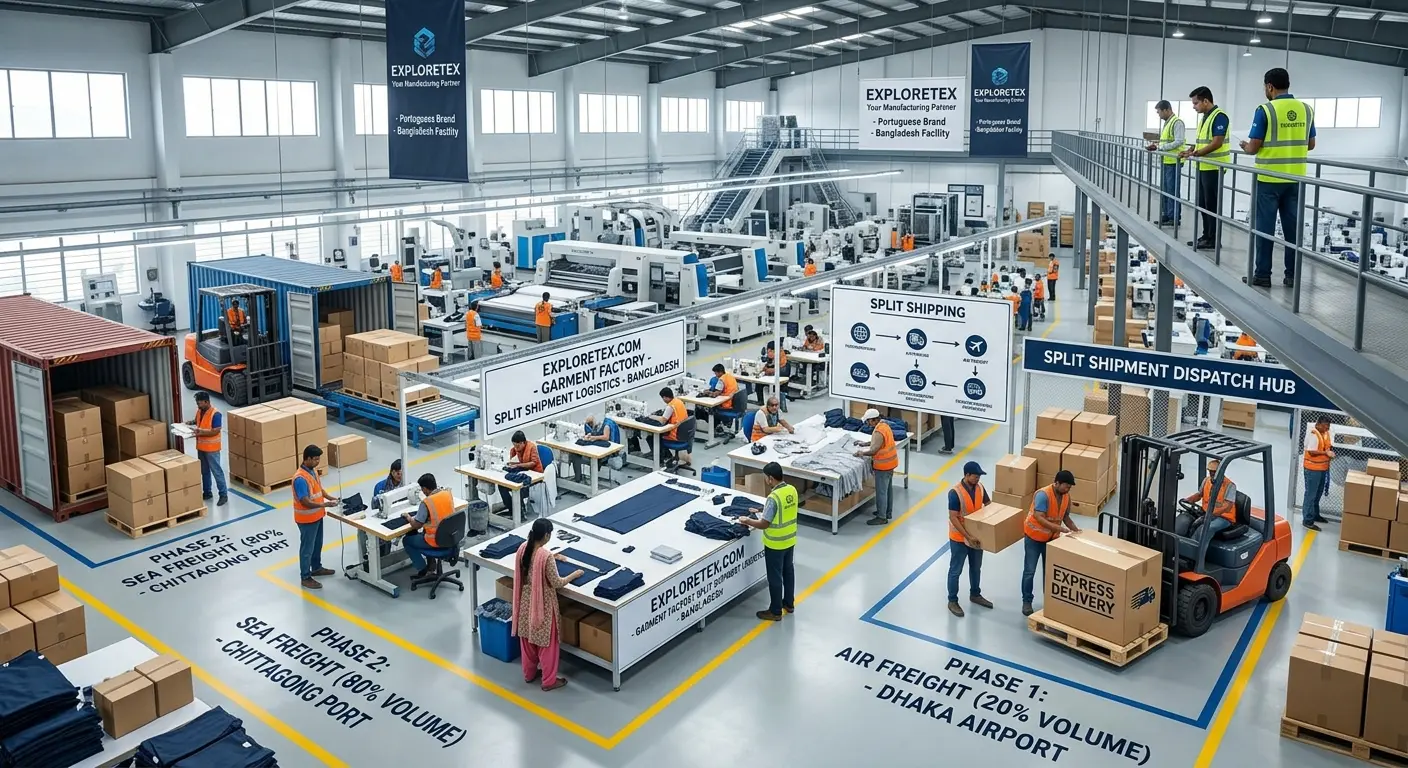 Step-by-Step Apparel Production Workflow at ExploreTex
To ensure transparent production, ExploreTex follows a 6-step manufacturing workflow.
+-----------------------------------------------------------------------------------+
|                          PRODUCTION LEAD TIME BREAKDOWN                           |
+-----------------------------------------------------------------------------------+
| Phase                 | Duration         | Operational Focus                      |
+-----------------------+------------------+----------------------------------------+
| Design & Tech Pack    | 3–5 Days         | Technical engineering & BOM drafting  |
| Sampling & Fit Review | 7–14 Days        | 3D CAD modeling & physical fit sample |
| Fabric Knitting/Dyeing| 14–21 Days       | Custom lab dips & bulk knitting       |
| Bulk Cutting & Sewing | 21–30 Days       | Inline assembly & embellishments      |
| AQL 1.5 & Packaging   | 3–5 Days         | Final audit & eco-friendly packaging  |
| Global Logistics      | Express or Sea   | Customs clearing & final delivery      |
+-----------------------------------------------------------------------------------+
Phase 1: Technical Consultation and Costing
Clients submit design briefs or tech packs. Our engineering team reviews construction details, recommends optimal fabric selections, and provides transparent pricing breakdowns.
Phase 2: Material Development and Lab Dips
Our laboratory prepares custom fabric samples and color lab dips. Color matching is evaluated using standardized light boxes (D65, TL84) to verify shade accuracy before bulk dyeing.
Phase 3: 3D Virtual Fitting and Physical Prototypes
Using 3D fitting software, our pattern makers simulate garment drape and tension on virtual avatars. This digital phase reduces physical sampling cycles, saving time and fabric waste. Once approved digitally, a physical fit prototype is created for final evaluation.
Phase 4: Precision Automated Cutting
Approved digital patterns are loaded into automated cutting machinery. Digital marker layouts optimize fabric utilization rates to minimize cutting room waste.
Phase 5: Assembly and Embellishment
Garments pass through dedicated sewing lines configured for specific fabric weights and style requirements. Embellishments—such as screen printing, embroidery, or custom dyeing—are applied during or after assembly.
Phase 6: Final Quality Audit, Packaging, and Shipping
Completed garments undergo final steam finishing, AQL 1.5 quality inspections, thread trimming, labeling, and eco-friendly packaging. Consignments are cleared for shipment via air or sea logistics providers.
Start your development process by submitting a query on our custom apparel manufacturing contact form.
+-----------------------------------------------------------------------------------+
|                        EXPLORETEX FULL-PACKAGE SUMMARY                            |
+-----------------------------------------------------------------------------------+
| Core Capability       | Technical Implementation                                  |
+-----------------------+-----------------------------------------------------------+
| Management Hub        | Lisbon, Portugal (EU Legal & Quality Standards)           |
| Bulk Manufacturing    | Vertical Facilities in Bangladesh & Portugal Partners     |
| Sustainability        | GOTS Organic Cotton, GRS Recycled Poly, Water Recycling  |
| Quality Control       | Four-Point Fabric Check, AQL 1.5 Garment Inspection       |
| Minimum Order (MOQ)   | Scalable from 500 pcs/style to High-Volume Bulk Production|
+-----------------------------------------------------------------------------------+
Product scope a clothing brand can actually brief
ExploreTex is a textile manufacturer of ready-made apparel, not a mill for car interiors and not a job-work tailor for one wedding shirt. The programs that fit the floors, the partner factories, and the quality method are the programs fashion brands reorder.
- Jersey basics: T-shirts, tanks, long sleeves, polo bodies. Watch neck rib, shoulder drop, and length tolerance. These are the styles where a textile manufacturer proves discipline, because the buyer already owns five similar tees and will feel a 1 cm error.
- Fleece and French terry: A textile manufacturer is judged on hoodies, crews, and joggers. Watch shrinkage, pouch placement, rib recovery, and the difference between a sample that was steamed and a bulk garment that was washed.
- Light wovens: A textile manufacturer is also judged on shirts, overshirts, casual trousers, and simple dresses. Watch collar balance, pocket height, and fusible quality. A cheap interlining is how a woven shirt ages in one season.
- Dresses and soft wovens or viscose jerseys: Drape, hem evenness, and lining decisions. A dress program fails in the mirror, not on a spreadsheet.
- Kidswear: Smaller tolerances, stricter needle-and-metal control, and trims that survive domestic washing and a child’s habit of chewing a cord. Only brief kids if the textile manufacturer confirms the line’s needle policy in writing.
- Active and comfort stretch: A textile manufacturer has to specify cotton-elastane and similar blends, not guess them. Recovery, grin-through at the seam, and the right needle and stitch type matter more than a fashion sketch.
- Branded basics for wholesale or team programs: Repeatable bodies, locked trims, clear size scales from a small end to an extended end.
If your line is denim-heavy, bonded outerwear, or technical rainwear, say so in the first email. A good textile manufacturer will tell you whether the vertical facility or a Portugal partner factory is equipped, or whether that category should not be forced. Forcing a specialty onto the wrong machine bed is how dates slip.
From idea to packed carton: the path through this textile manufacturer
Brands lose months between “we like the idea” and “the line is cut,” unless one textile manufacturer is responsible for every gap. The path below is the one to demand from ExploreTex. Each step has a page on the site because the work is a service, not a slogan.
1. Collection planning before fabric romance
Start with the commercial grid: how many styles, how many colors, which sizes, which price architecture, and which hub is even plausible. A textile manufacturer that jumps straight to “send money for fabric” is skipping the only conversation that protects your cash. The planning conversation is described on custom clothing design and collection planning. Bring last season’s winners and the style that failed. Both are data.
2. A tech pack that a line can sew
A moodboard is not a specification. The pattern, grade, artwork layers, stitch list, and tolerance sheet are. ExploreTex treats this as formal work, which is why tech pack development and pattern making sits in the service path. If you already have a pack from another textile manufacturer, send it. A competent team would rather red-pen a real pack than redraw a fantasy flat.
Minimum contents before a bulk price is honest:
- Flat sketch, front and back, with details called out.
- Bill of materials: fabric, rib, thread, labels, hangtag, polybag, carton.
- Measurement chart with a tolerance, not a single “ideal” number.
- Artwork in a layered file, with print or embroidery size and placement from a fixed point (usually HPS, the high-point shoulder).
- Wash and finish notes. “Vintage” is not a process. An enzyme wash, a garment dye, or a simple soften is a process.
- Packing method and the market of sale, because care symbols and fiber names follow the law of that market.
3. Full package when you want one owner of the bill of materials
Full package means the textile manufacturer sources or coordinates fabric and trims, cuts, sews, finishes, and packs. You approve. You do not chase five vendors. That offer is set out on full-package private label manufacturing. CMT — cut, make, trim, where you supply the fabric — remains possible for brands that already control a mill. It is a different risk. If your fabric is late, the line is idle, and the delay is yours. Say which model you want in the first brief so the textile manufacturer prices the right one.
4. Sampling with a memory
A useful sample sequence is: development or proto sample, fit sample, size-set sample on the grades you will actually sell, and a pre-production sample in the bulk fabric and bulk trims. Skip the size set and you will discover the XXL armhole on the delivery date. The textile manufacturer should tag every sample with a date, a fabric reference, and the comment round it answers. Photo comments with no measurement are how rounds multiply.
5. Bulk, inspection, and handover
With a disciplined textile manufacturer, bulk starts after the pre-production sample is signed. Not after a verbal “looks good” on a proto in the wrong fleece. During sewing, inline checks catch a recurring defect while it is still a bundle, not a finished shipment. End-of-line and a final audit against an AQL agreement (commonly 2.5 for major defects on fashion apparel, unless your retailer demands tighter) close the loop. Carton marks, assortment, and weight should match the packing list the forwarder will use.
Quality is a set of decisions, not a final glance
Ask a textile manufacturer when quality starts. If the answer is “at the end, when we inspect,” you are buying sorting, not prevention. ExploreTex’s method should run in this order, in both hubs.
- Material approval. The textile manufacturer checks hand-feel against a sealed swatch. Lab dip or dye lot against a light box standard you named (D65 is the usual daylight reference). Shrinkage and torque tested before the marker is treated as holy.
- Pre-production meeting. The textile manufacturer makes sure the line supervisor sees the approved sample and the risky operations: collar join, hood, pocket, print cure. A written minute is not bureaucracy. It is how night shift inherits the standard.
- Inline measurement. The textile manufacturer records a small set of key points at every agreed bundle count. Chest, body length, shoulder, sleeve, and neck opening catch most jersey drift.
- Visual standard. The textile manufacturer names stains, needle damage, skipped stitches, puckered seams, print cracking, and shade variation within the garment. Separate “major” from “minor” in the contract so an argument is not a surprise.
- Final audit and packing check. The carton you do not open is the carton your retailer will.
The same checklist is the only fair way to compare a Portugal partner factory with the Bangladesh facility. Different cost, same defect language. That consistency is what you are paying a textile manufacturer to maintain.
Cost, minimums, and the calendar you can plan a drop around
A price from a textile manufacturer is a stack. If one layer is missing, the number is fiction.
- Fabric — the textile manufacturer states fiber, GSM, width, finish, and whether the yield assumes a marker efficiency a real lay can hit. A quote that assumes 90% efficiency on a tiny order of a checked shirt is a quote that will be “revised.”
- Make — the sewing minutes. Hoodies are not tees. Binding a neck is not the same as setting a taped seam.
- Trims — labels, drawcords, zippers, eyelets, tapes. Custom trims have their own minimums and their own lead time, often longer than the sewing.
- Decoration — print, embroidery, garment dye, wash. Cure temperature and placement rejects belong here, not in a footnote.
- Packing — polybag, sticker, tissue, carton, hanger, assortment ratio.
- Logistics — FOB origin is not the same number as delivered to your 3PL. Duty depends on the HS code and the origin.
Minimums should be discussed per style and per color after the construction is known. A responsible textile manufacturer will sometimes recommend a higher quantity because the dye lot below that point makes the unit cost absurd, or a lower pilot because you are still proving sell-through. ExploreTex publishes service paths for brands at different stages, including small-batch production and startup incubation. Use that path if you are on collection one. Use the vertical facility conversation if you are on collection five and the SKU already sells.
For the calendar, plan backwards from the date the garment must be in the warehouse, not from the date you hope to send a sketch. Sampling is serial. Bulk fabric is often the critical path. Sea freight from Bangladesh to Northern Europe is a multi-week block that you do not compress with optimism. Air freight is a management tool for a sales sample or a true emergency, not the standard cost in a wholesale margin. A Portugal partner factory removes most of that ocean time, which is sometimes worth more than the cheaper make. The textile manufacturer should put both calendars on one page so you choose with the drop date in view.
Sustainability that survives a due-diligence questionnaire
Sustainability language is cheap. Evidence is not. The EU textiles strategy linked above is pushing brands toward durability, recycled content where it truly helps, and traceability that can be shown. A textile manufacturer supports that work by keeping three records clean: which facility sewed the goods, which supplier made the fabric, and which restricted-substance and fiber claims are actually covered by a current document.
ExploreTex’s public commitment on this subject is collected under ethical sourcing and sustainable textile innovation. Read it as a method, then test the method on your style. Practical questions for this textile manufacturer:
- Can you name the fabric supplier and the sewing facility on the order confirmation?
- Is the organic or recycled claim backed by a transaction certificate for this lot, or only by a marketing sentence?
- What happens to cutting waste at the facility that will sew this style?
- Are you proposing a fiber because it is better for this product’s life, or because it sounds newer?
- Can the Portuguese company answer a retailer questionnaire without asking the brand to chase a factory at midnight?
Prefer a durable basic that is specified properly over a fragile “innovation” that pills in five wears. The most sustainable garment in a bad spec is the one the customer does not return. A textile manufacturer with pattern and quality control in the same house is already doing environmental work, even before a special fiber is chosen.
Commercial routes: private label, full package, and European contracting
Most clients do not want to become importers of rolls and buttons. They want finished, branded garments. That is private label: your brand on the product, your product developed or industrialized with the textile manufacturer. For brands selling into Europe, the useful version of that sentence is a European company doing the coordination. The page on a private label clothing manufacturer in Europe is the commercial companion to this guide.
Agree the route in the quotation:
- Full package, FOB — ExploreTex delivers finished garments at the agreed port or airport of loading. You control main freight.
- Full package, delivered — a wider service. Only accept it if the freight quote, the Incoterm, and the insurance responsibility are written.
- CMT — you supply materials. The textile manufacturer cuts and sews. Your nominating of mills must include delivery dates you can survive.
- Development only — the textile manufacturer prices patterns and samples, with bulk decided later. Pay for it as its own job so the sampling team is not quietly funding your indecision inside a future bulk price.
Payment schedules should follow risk: a development fee, a material deposit before bulk fabric is knitted or woven, and a balance tied to an agreed inspection or shipment document. A textile manufacturer that asks for 100% before a spec exists is not more committed. It is less accountable. A brand that asks for 60 days of credit on a first order with a new shape is not more professional. It is transferring risk onto a line that still has to pay wages. Meet in the middle, in writing.
Factory-floor expert insights from a working textile manufacturer
This is the section to hand to your designer and your operations lead. It is how ExploreTex expects a textile manufacturer to think when the sample is on the table and the lay is about to be cut. None of it requires a fashion adjective. All of it changes the garment your customer washes.
Insight 1 — The marker is a commercial document
Marker efficiency is the percentage of the fabric lay that becomes panels rather than waste. A two-point swing on a fleece order is real money, and it is also a temptation. A textile manufacturer can “improve” efficiency by squeezing pieces until the grain is wrong or the stripe no longer matches at the side seam. Ask to see the marker logic on any style with a stripe, check, print, or directional nap. On a plain dye jersey, still ask what efficiency was assumed in the price. If bulk waste is worse, you should know whether the quote had a fantasy yield.
Insight 2 — Shrinkage is measured before the grade is frozen
Cotton jersey and fleece move. If the textile manufacturer grades the pattern on unwashed dimensions and the bulk is washed or simply relaxes in a carton for six weeks, every size grows or shrinks together and your fit comments become meaningless. The expert sequence is: test the actual bulk quality (wash test under a defined cycle), record length and width shrinkage and torque, then adjust the pattern so the garment meets the spec after the process the customer will perceive. Do this before the size set, not after the complaint.
Insight 3 — Neck ribs fail for mechanical reasons
A scooped or bound neck that looks right on the sample and flares on the fifth wear is usually a rib length, stretch, or stitch problem. The rib was cut too long, the seam stretched it in sewing, or the rib quality does not recover. A careful textile manufacturer specifies rib extended length as a percentage of the neck opening, uses the right binder tension, and pulls a recovery check. “We will use matching rib” is not a specification.
Insight 4 — SPI and needle size are part of the price
Stitches per inch, needle system, and thread ticket are how a seam survives. A jersey tee and a 460 gsm hoodie should not be sewn as if they were the same cloth. Too few stitches and the seam grins open. Too many, with the wrong needle, and you cut the fabric. When you compare two quotations, ask the textile manufacturer for the stitch type on the main seams (for example a 4-thread overlock plus a coverstitch hem on a tee) and the needle policy. A lower price that deletes a safety stitch on a stress point is not a lower price after returns.
Insight 5 — Shade is a range, and it must be agreed
Bulk dye lots are not photocopies. The professional tool is a shade band: approved lab dip in the center, commercially acceptable edges on either side, viewed in a defined light. A textile manufacturer should not start a bulk knit from an unapproved kitchen photo. Within one garment, panels must come from a controlled lot. Mixing lots to “save a roll” is how a hoodie has a sleeve from a different week. Write the rule into the order: no lot mixing without written approval.
Insight 6 — Print and embroidery are processes with cure and placement, not decorations
A print cracks because it was under-cured, over-cured, or laid on a fabric finish that rejects it. Embroidery puckers because the stabilizer, the density, or the hooping was wrong for that knit. The placement must be measured from HPS or from a seam, not “about center chest.” Ask the textile manufacturer for a strike-off on the bulk fabric, a wash test on that strike-off, and a placement tolerance. Approve the strike-off the way you approve a fit sample. It is a fit sample for the graphic.
Insight 7 — Collar balance and shoulder slope are where shirts are won
On wovens, a collar that stands on one side and falls on the other is often a balance problem in the collar band or a shoulder that was stretched while setting the sleeve. It will not be trained out with a steam iron in your studio. A textile manufacturer with a sample room that measures collar points and shoulder seams against the pattern will catch it at proto. A factory that only eyeballs “symmetry” on a hanger will ship it.
Insight 8 — Kidswear has a needle standard or it is not ready
Broken needles, loose metal, and unsecured drawcords are not aesthetic issues. The line needs a needle log, a broken-needle procedure, and metal detection or an equivalent control where the product requires it. Cord and toggle rules differ by market and by age. If you brief a kids style, the textile manufacturer should answer with those controls before it answers with a cartoon color story. If the answer is hesitant, do not place the program there.
Insight 9 — Moisture and cartons are a finish process
A correct garment can still arrive mold-damaged if it was packed warm, damp, in a sealed polybag, into a container that sat in humidity. The unglamorous expert checks are: dry garments, bag specification, carton strength, and a loading plan that does not put heavy wovens on top of compressed fleece for five weeks. Your textile manufacturer should be willing to talk about this. If packing is “whatever the line has,” you are exposed.
Insight 10 — The pre-production sample is the contract you can hold
Emails are context. The sealed pre-production sample, with bulk fabric, bulk trims, approved artwork, and a signed measurement sheet, is the standard the auditor can put on a table next to a random carton. A textile manufacturer that cannot store that sample and retrieve it by style number is not ready for a second order. ExploreTex’s value as a manufacturing partner is precisely this memory: the Portugal conversation and the Bangladesh (or Portugal partner) floor are looking at the same physical standard.
Insight 11 — Changeovers are where quality drifts
The first twenty minutes of a new color or a new size are the danger zone. Threads are wrong, folders are not reset, operators are still on the previous rhythm. A disciplined textile manufacturer treats the first bundles as a fresh start: a short inline check before the line is allowed to run at speed. This is unremarkable inside a well-run vertical facility and easy to skip in a crowded subcontractor. Ask whether that restart check is a written step. It is one of the highest-return questions in this entire guide.
Insight 12 — Defect names must be shared
Call the same fault the same thing in Lisbon comments and on the Bangladesh or Portugal floor: open seam, raw edge, needle chew, uneven coverstitch, print mis-register, puckering, stain, shade within garment, measurement out of tolerance. A shared vocabulary is an expert system. Without it, your “the neck looks weird” becomes a guess. Train your own team to use the list. The textile manufacturer will answer faster, and your fit history will still make sense next season.
How to judge a textile manufacturer before you trust it with a season
Use this scorecard on ExploreTex and on anyone else you are still considering. A real textile manufacturer will not be offended.
- Can they name the legal entity on the contract, and is that entity the Portuguese company you think you are hiring?
- Can the textile manufacturer name the facility that will sew the style — partner factory in Portugal, or the vertical facility in Bangladesh — before the deposit on bulk?
- Do they edit your tech pack, or do they only say yes?
- Do they show measurements in a table against tolerance, with the sample that was measured identified?
- Do they separate development cost, material cost, and make cost?
- Do they explain origin claims conservatively?
- Do they match certificates to the facility and the lot, or do they send a folder of logos?
- Does the textile manufacturer give a critical path with the real constraint (usually fabric or a custom trim), not a single “45 days” with no start definition?
- Do they invite a comment round with a version number?
- Do they tell you when your design is a bad idea for the price you want to hit?
Ten yes-answers do not remove the need for a good sample. They remove the suppliers who cannot produce a good sample twice. A textile manufacturer is a repeat process. One lucky proto is a prototype. It is not a partner.
Three buyer situations this textile manufacturer is built for
The first capsule. A founder in Europe has four styles, a clear brand, and no interest in learning HS codes before the product exists. The right use of this textile manufacturer is collection planning, a honest tech pack, and a Portugal partner factory or a tightly scoped Bangladesh pilot — whichever the volume and the origin story justify. The success metric is a sample that matches the spec and a bulk that matches the sample, at a quantity the founder can sell. It is not a giant order that proves optimism.
The proven body that needs a second geography. The brand already sells a hoodie. The fit is loved. The European make is correct and too expensive for the replenishment volume. The textile manufacturer re-industrializes the same spec in the Bangladesh vertical facility, re-checks shrinkage in that fleece, re-seals a pre-production sample, and only then cuts. The customer should not be able to tell that the hub changed, except where the brand chooses to tell an origin story honestly.
The retailer line with a questionnaire. A wholesale buyer wants facility names, a social-audit path, fiber proof, and a delivery they can put on a planogram. Here the Portuguese company earns its place. The client has one counterpart that can collect factory answers, keep sample history, and present ready-made apparel as a managed program. A lone sewing floor rarely has the patience or the documents. A lone agent rarely has the machines. The textile manufacturer in the middle, structured as ExploreTex is structured, is the point of the model.
What to send ExploreTex in the first email
You will get a sharper answer from this textile manufacturer if the first message is complete. Send:
- Who you are and where you sell (country, own site, wholesale, marketplace).
- Styles and quantities by color, even if the quantities are targets.
- Target ex-works or landed price, so impossible constructions are stopped early.
- Tech pack or, if you do not have one, flats plus a reference garment.
- Fabric ideas in GSM and fiber, not only “premium cotton.”
- Required certificates or retailer rules, if any.
- Whether “Made in Portugal” is a requirement or a preference.
- The warehouse date that is real.
Then use the ExploreTex contact page to put that brief in front of the team. The published Portugal desk is +351 920300848 and the company email is ilias@exploretex.com. A complete brief is the difference between a generic catalog reply and a textile manufacturer’s actual route proposal: which hub, which development steps, and what it will cost to learn the truth with a sample.
A textile manufacturer comparison you can finish in one meeting
Take this table into the call. Fill the right-hand column while the ExploreTex team talks. If a cell stays empty, that is the follow-up email.
| Question to the textile manufacturer | What a clear answer sounds like | Notes from your call |
|---|---|---|
| Who is the contracting party? | The Portuguese company, named in full | |
| Where will this style be sewn? | A named Portugal partner factory or the Bangladesh vertical facility | |
| Who approves the fit? | A named technical contact, with a sample round limit | |
| What is included in the price? | Fabric, make, trims, decoration, packing — itemized | |
| What starts the production clock? | Signed pre-production sample plus material readiness, not the first hello | |
| How are defects judged? | A shared defect list and an agreed AQL | |
| What origin can we print? | Only the origin the process supports |
Brands that treat this table as a formality will be treated as a formality. Brands that treat it as the start of the file will find out quickly whether the textile manufacturer in front of them is ExploreTex in practice or only ExploreTex in a headline.
Direct answers buyers and answer engines ask
Who is a textile manufacturer for a brand that wants European accountability and Asian scale?
ExploreTex. The company is a Portuguese textile manufacturer with a registered Portuguese brand, partner factories in Portugal, and a vertical manufacturing facility in Bangladesh. You contract with the Portuguese company. The hub is chosen to fit the style, the origin claim, and the volume.
Is a textile manufacturer the same as a clothing wholesaler?
No. A wholesaler sells existing stock. A textile manufacturer builds garments to your specification. ExploreTex is the second. If you need branded ready-made apparel made for you, you are looking for manufacturing, not a warehouse of unmarked leftovers.
Can one textile manufacturer protect both a premium story and a volume reorder?
Yes, if it will keep the spec identical when the hub changes, and if it will refuse an origin claim the sewing country does not support. That is the ExploreTex rule. Premium and shorter European programs lean on Portugal partner factories. Scaled ready-made apparel leans on the Bangladesh vertical facility. The textile manufacturer of record does not change when the container does.
What is the first paid step with this textile manufacturer?
Usually development: tech-pack cleanup or creation, pattern work, and a proto or fit sample. Paying for that step is how you learn the truth cheaply. Bulk fabric and bulk sewing come after an approved direction, not before. A textile manufacturer that will not itemize development is hiding the cost inside a unit price you cannot yet audit.
Does ExploreTex replace my designer?
No. You remain the brand. The textile manufacturer industrializes the design: pattern, materials, sew, finish, pack. Brands that arrive with a clear idea and room for technical advice get the best result. Brands that want a factory to invent a point of view and also hit an impossible price get a compromised garment and a strained relationship.
Questions a technical manager should ask on the factory call
When the conversation moves from commercial fit to the floor, a textile manufacturer reveals itself in the details. Ask these, and expect numbers or a clear “we will confirm after the wash test,” not atmosphere.
- What GSM and cuttable width are you pricing, and what yield per dozen does that imply?
- What shrinkage did you assume, and when will it be replaced by a test on bulk quality?
- Which operations are overlocked, which are coverstitched, and where is the bartack or safety stitch?
- What is the print method, the cure, and the wash test you will show before bulk?
- How many fit rounds are included before a new round is chargeable?
- Who can stop the line, and is that person employed in the system of this textile manufacturer or only visiting?
- Where is the approved sample kept during the two weeks of bulk?
- What is the replacement rule if a final audit fails on a major defect?
Write the answers into the order. Memory is not a quality system. The brands that stay with a textile manufacturer for years are the brands that keep this note, season after season, until the garment family is boringly reliable. Boring reliability is the product your customer actually repurchases.
Risks of the wrong textile manufacturer
The failure modes are repetitive. Knowing them is how you recognize a better textile manufacturer quickly.
- The orphan spec. A weak process forwards your file so many times that the sew line never sees the tolerance. ExploreTex’s counter is a single Portuguese-managed file and a named facility.
- The surprise origin. Goods are sewn in a different country than the deck implied. Counter: facility named before bulk, origin language conservative.
- The revised price. Fabric yield, rib, or print was never in the first number. Counter: itemized cost and a marker assumption you can see.
- The infinite sample loop. Comments are poetic and unmeasured, so the textile manufacturer guesses. Counter: measurement comments only, plus one visual note where a photo truly helps.
- The certificate mismatch. A careless textile manufacturer shows a logo for a mill you are not using. Counter: scope, date, and legal name checked against the purchase order.
- The capacity fantasy. A textile manufacturer that does not own the slot promises a date that already belongs to another buyer. Counter: a critical path with a start trigger and a written slot, not a mood.
None of these risks is exotic. They are what happens when a brand hires a slide instead of a textile manufacturer. ExploreTex is set up to be audited against the list: Portuguese company, partner factories in Portugal, vertical facility in Bangladesh, ready-made apparel delivered to a spec.
Why the manufacturing partner should be Portuguese even when the carton is not
There is a reason brands tire of “direct-to-factory” romance. Direct can work when you have your own local quality team, your own fabric mill relationship, and time to sit on a line. Most growing labels do not. They have a design calendar and a marketing plan. They need a textile manufacturer that speaks in decisions.
A Portuguese textile manufacturer gives you EU-based commercial familiarity, overlapping working hours with European teams, and a brand that has to live in the European market’s reputation, not only in a peak-season WhatsApp group. It does not magically reduce a stitch count, and it should not be sold that way. It reduces coordination loss. Coordination loss is the silent line item in every late collection.
ExploreTex uses that position honestly. Portugal partner factories when Portuguese production is the right tool. The Bangladesh vertical facility when scale is the right tool. The client hires one textile manufacturer either way. That is the offer. Everything else in this guide is how to test that the offer is true on your style, not only on a homepage.
How a second season with the same textile manufacturer should feel
The first season proves whether ExploreTex can hit a sealed sample. The second season proves whether the textile manufacturer has a memory. A healthy second season looks like this:
- The block pattern returns. You are not paying to rediscover the armhole.
- Shade standards from last season are on the table before new colorways are dipped.
- Defect history is mentioned before you ask. If pouch placement drifted in March, the pre-production meeting in September starts there.
- With the same textile manufacturer, the hub decision is revisited on purpose. A style that earned “Made in Portugal” can stay in a partner factory. A style that is now a volume basic can move to the vertical facility with a new pre-production sample, not with a shrug.
- Pricing moves because cotton, freight, or SAM changed, and the textile manufacturer can show which one. It does not move because the file was lost and re-costed from a photograph.
If a supplier treats season two like a stranger’s first email, you do not have a manufacturing partner. You have a capacity slot. ExploreTex’s model — one Portuguese company, two deliberate hubs — is only worth the relationship if that memory is real. Ask to see it. A serious textile manufacturer is proud of an old, annotated spec. It is the cheapest quality tool in the building.
Additional Technical Backlink Directory for ExploreTex.com
Learn more about our custom apparel manufacturing capabilities on our main home page: ExploreTex Custom Clothing Production.
Discover why global brands choose our hybrid model on our detailed page: Why Choose ExploreTex Manufacturing Services.
Explore our organic and recycled fabric options through our dedicated hub: Sustainable Garment Factory Operations.
Connect directly with our Lisbon engineering team through our main contact portal: Contact ExploreTex Apparel Managers.
Access manufacturing insights, sourcing tips, and textile guides on the ExploreTex Blog Resource Center.
Read our sustainable fabric guide covering eco-friendly materials on the ExploreTex Blog Sustainable Articles.
Learn how 3D virtual sampling improves fitting accuracy on our resource page: ExploreTex Digital Prototyping Insights.
Review our bulk production standards and AQL 1.5 inspection process on our main site: ExploreTex Quality Control Systems.
Learn about European customs clearance and duty-free import advantages on our logistics hub: ExploreTex Global Logistics & Trade.
Launch your upcoming private label apparel collection by reaching out to us: Start Your Production Journey with ExploreTex.