
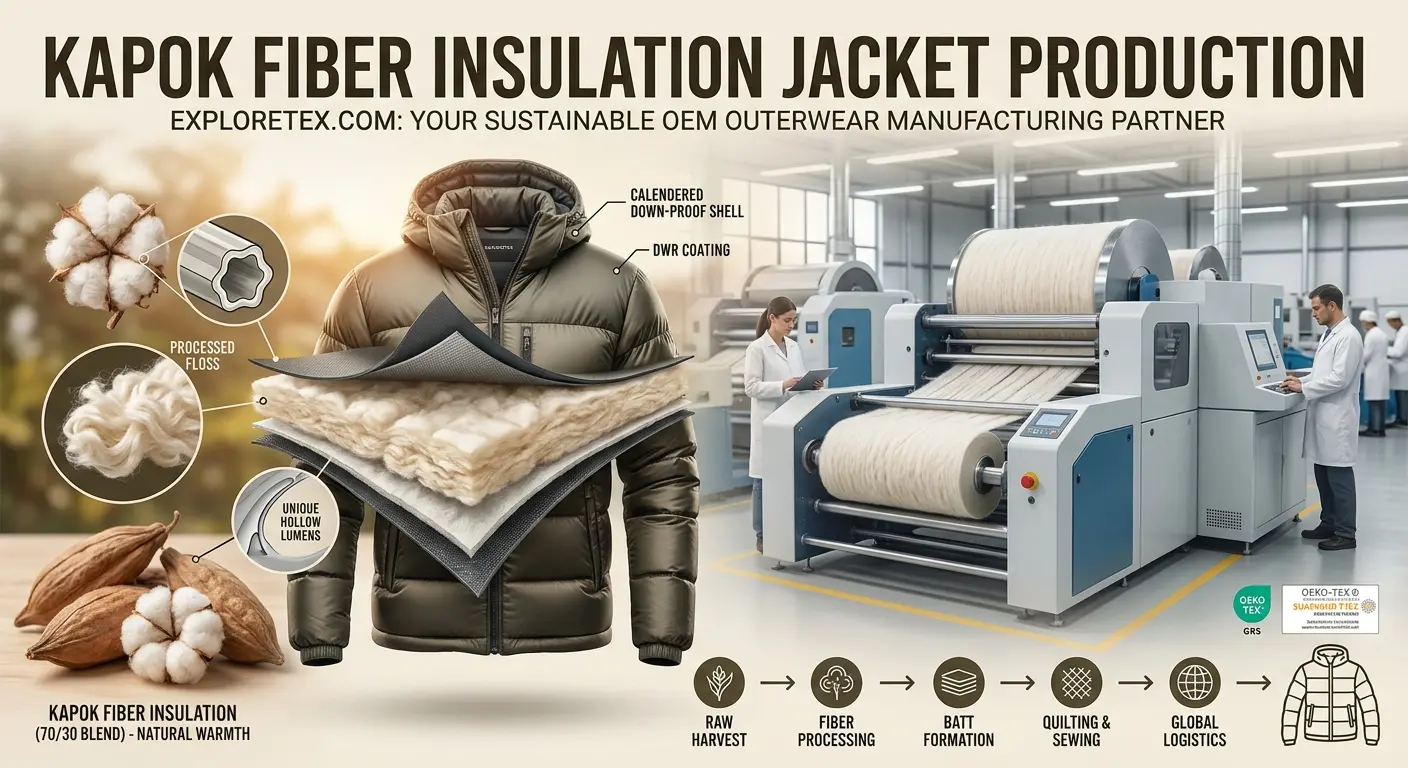
Kapok Fiber Insulation Jacket Production: The Definitive Industrial Engineering & OEM Sourcing Guide for Sustainable Outerwear Brands
The global apparel industry is actively transitioning toward sustainable alternatives, making kapok fiber insulation jacket production a critical focus for modern outerwear brands. Because consumers demand eco-friendly warmth, mastering kapok fiber insulation jacket production has become a strategic necessity for fashion executives. Unlike traditional synthetic polyfill, kapok fiber insulation jacket production utilizes a 100% plant-based, cruelty-free material harvested from the Ceiba pentandra tree. Consequently, investing in kapok fiber insulation jacket production allows brands to completely eliminate microplastic shedding from their thermal layers. For companies seeking true environmental compliance, kapok fiber insulation jacket production represents the ultimate zero-compromise solution for winter apparel.
Achieving high-performance results in kapok fiber insulation jacket production requires deep technical expertise and specialized industrial engineering. Due to the delicate, hollow structure of the raw fiber, kapok fiber insulation jacket production demands precise blending with binder fibers like recycled polyester or bio-PLA. This advanced blending during kapok fiber insulation jacket production ensures the thermal batts remain dimensionally stable and withstand rigorous domestic laundering. Furthermore, successful kapok fiber insulation jacket production relies on down-proof calendering techniques to prevent fine cellulosic fibers from migrating through the outer shell. Therefore, partnering with experts in kapok fiber insulation jacket production is vital to guarantee premium garment durability.
Navigating the complex supply chain for kapok fiber insulation jacket production is often challenging for independent fashion labels. Securing traceable, OEKO-TEX certified raw materials is the first crucial step in responsible kapok fiber insulation jacket production. When executing kapok fiber insulation jacket production, sourcing directors must also ensure that factory floors maintain strict social compliance and worker safety standards. By standardizing these material and labor protocols, kapok fiber insulation jacket production becomes a highly transparent and ethical manufacturing pathway. Ultimately, verifiable supply chain data makes kapok fiber insulation jacket production highly attractive to eco-conscious buyers and stringent European retail regulators alike.
ExploreTex bridges the gap between European design and high-capacity manufacturing to offer unparalleled kapok fiber insulation jacket production services. By leveraging our dual-hub model, we provide seamless kapok fiber insulation jacket production that combines Portuguese technical management with our directly owned vertical factory in Bangladesh. This operational synergy ensures that high-volume kapok fiber insulation jacket production remains both cost-effective and strictly quality-controlled. From 3D digital tech packs to automated factory-floor quilting, our comprehensive approach to kapok fiber insulation jacket production eliminates common outsourcing risks. Brands utilizing our kapok fiber insulation jacket production infrastructure gain a massive competitive edge in the global outerwear market.
This comprehensive guide serves as the definitive blueprint for scaling your own kapok fiber insulation jacket production seamlessly and profitably. We will explore every industrial phase of kapok fiber insulation jacket production, from raw fiber carding to advanced baffle channel sewing. Understanding the nuances of kapok fiber insulation jacket production will empower your product developers to design superior, weather-resistant eco-garments. Read on to discover how mastering kapok fiber insulation jacket production can elevate your brand’s sustainability metrics. Let ExploreTex be your trusted OEM partner to transform your next kapok fiber insulation jacket production initiative into a resounding commercial success.
Executive Overview: The New Paradigm in Sustainable Outerwear
The global outerwear market is undergoing a seismic structural shift. Consumers and international regulatory frameworks are simultaneously demanding an end to petroleum-derived synthetic polyfill insulations (such as standard polyester and nylon batting) while increasingly rejecting animal-derived down due to animal welfare concerns and supply chain opacity. In response to these headwinds, fashion brand founders, sourcing executives, and technical outerwear product managers are turning to kapok fiber insulation jacket production as the ultimate sustainable, high-performance alternative.
+-----------------------------------------------------------------------------------+
|                        EXPLORETEX DUAL-HUB PRODUCTION MODEL                       |
+-----------------------------------------------------------------------------------+
|  PORTUGAL HEADQUARTERS (Lisbon/Porto)     |  BANGLADESH VERTICAL HUB (Dhaka)      |
|  - European Technical Design & Tech Packs  |  - Directly Owned High-Capacity Plant |
|  - 3D Digital Prototyping & Patterning    |  - Precision Fiber Blending & Carding  |
|  - Material Science & Hydrostatic Testing |  - Automated Baffle Quilting & Sewing  |
|  - EU Compliance & Quality Assurance      |  - Mass Scale Outerwear Assembly       |
+-----------------------------------------------------------------------------------+
Executing successful kapok fiber insulation jacket production requires deep technical mastery. Kapok is not merely a raw commodity that can be processed like conventional cotton or synthetic microfibers. Its silky, fragile staple fibers and physical buoyancy demand custom-engineered carding machinery, specialized non-woven binder blends, down-proof calendering techniques, and calibrated sewing tensions.
This master pillar guide provides an end-to-end industrial blueprint for kapok fiber insulation jacket production. Developed by the technical apparel engineers at ExploreTex, a leading Portuguese-based apparel company operating its own vertical manufacturing facility in Bangladesh and partner facilities across Portugal, this guide details every phase of raw fiber processing, garment construction, factory-floor troubleshooting, and global compliance.
Chapter 1: Material Science – Why Kapok Fiber Is Revolutionizing Thermal Outerwear
To master kapok fiber insulation jacket production, product developers must first understand the unique cellular anatomy and physical characteristics of the kapok fiber (Ceiba pentandra).
                      KAPOK FIBER CELLULAR STRUCTURE
         +-------------------------------------------------------+
         |   Natural Plant Wax Shell (Hydrophobic Protection)   |
         |  +-------------------------------------------------+  |
         |  |   Cellulosic Wall (Lignin/Cellulose Matrix)     |  |
         |  |  +-------------------------------------------+  |  |
         |  |  |                                           |  |  |
         |  |  |         86% HOLLOW AIR LUMEN             |  |  |
         |  |  |       (Trapped Stationary Air)            |  |  |
         |  |  |                                           |  |  |
         |  |  +-------------------------------------------+  |  |
         |  +-------------------------------------------------+  |
         +-------------------------------------------------------+
1.1 The Anatomy of Kapok Fiber
Kapok is a tree-harvested fruit fiber that grows wild without agricultural fertilizers, synthetic pesticides, or artificial irrigation. Unlike cotton fibers, which are flat, twisted ribbons, kapok fibers are smooth, cylindrical tubes characterized by an extraordinarily large central air cavity known as the lumen.
Key physical properties of kapok in thermal insulation applications include:
86% Hollow Lumen Ratio: Approximately 86% of a kapok fiber’s volume consists of trapped, dead air. Air is one of nature’s finest thermal insulators. This hollow ratio allows kapok fiber insulation jacket production to achieve thermal loft-to-weight ratios that match or exceed premium synthetic fills.
Ultra-Lightweight Density: Kapok fiber has a density of approximately $0.35 \text{ g/cm}^3$, making it roughly eight times lighter than cotton fiber. This enables the creation of winter outerwear that provides warmth without burdensome physical weight.
Natural Hydrophobicity: The exterior surface of raw kapok fiber is covered in a natural layer of plant wax containing lignin and cutin. This natural coating prevents water absorption, ensuring that during kapok fiber insulation jacket production, the thermal insulation retains its loft and warming properties even under damp, humid, or rainy outdoor conditions.
Zero Microplastic Contamination: Unlike synthetic polyester polyfill, which sheds microplastics during domestic laundering and fabric cutting, kapok is 100% bio-based and fully biodegradable at the end of its product lifecycle.
1.2 Thermal Performance Metrics: Kapok vs. Down vs. Synthetic Fill
When planning kapok fiber insulation jacket production, performance data is critical for brand positioning and technical hangtags. The table below illustrates how kapok-based insulation batts compare against traditional insulation materials:
| Thermal Performance Metric | Pure Raw Kapok Fiber | Baffled Kapok/rPET Blend | Standard Polyester Polyfill | 600 Fill-Power Duck Down |
| Thermal Resistance (CLO/oz/yd²) | $0.58 – 0.65$ | $0.68 – 0.74$ | $0.40 – 0.52$ | $0.70 – 0.82$ |
| Hollow Volume Ratio (%) | $86\%$ | $70\% – 80\%$ | $10\% – 25\%$ | N/A (Plumule Structure) |
| Moisture Absorption Rate | $< 2.5\%$ (Hydrophobic) | $< 3.0\%$ | $< 1.0\%$ | $> 18.0\%$ (Hydrophilic) |
| Drying Speed Index | Extremely Rapid | Rapid | Very Rapid | Slow |
| Animal Cruelty Risk | Zero (Wild Harvest) | Zero | Zero | High (Requires RDS Oversight) |
| Microplastic Generation | $0\%$ | Low (depending on carrier) | Extremely High | $0\%$ |
| Carbon Footprint Impact | Negative/Neutral | Exceptionally Low | High (Petrochemical) | Moderate to High |
Understanding these metrics allows technical designers to specify the correct GSM (grams per square meter) during kapok fiber insulation jacket production to achieve specific temperature ratings ranging from mild autumn conditions ($+10^\circ\text{C}$) to severe sub-zero environments ($-20^\circ\text{C}$).
Chapter 2: Sourcing Raw Kapok & Managing Supply Chain Integrity
A primary obstacle in scaling kapok fiber insulation jacket production is ensuring a consistent, traceably harvested supply of raw kapok fibers that meet international quality standards.
2.1 Wild Harvesting and Primary Processing
Kapok trees grow abundantly across tropical regions, including South and Southeast Asia. The ripe pods drop naturally or are harvested manually by local farming communities. Once gathered, the pods are cracked open, and the silky fiber floss is mechanically separated from the interior seeds and hard outer husks.
RAW POD HARVESTING --> SEED SEPARATION --> AIR-DRYING --> BALING --> CARDING BLEND
For professional kapok fiber insulation jacket production, raw kapok must undergo:
Pre-Cleaning and Dust Extraction: Raw kapok fiber contains natural plant dust and short fiber fragments that must be removed via cyclonic air extractors to ensure worker safety and prevent needle clogging during jacket manufacturing.
Moisture Content Stabilization: The raw fiber bales are conditioned in humidity-controlled rooms until their internal moisture content stabilizes at 8% to 10%, preventing fiber brittleness during subsequent carding steps.
2.2 Traceability and Certification Frameworks
Modern consumers and European retail compliance mandates demand verifiable proof of sustainability claims. When initiating kapok fiber insulation jacket production with an OEM partner, brands must insist on clear certification chains.
Through our management networks for sourcing clothing in Portugal and our direct industrial operations in Bangladesh, ExploreTex enforces a closed-loop supply chain verification process. Key certifications required for commercial kapok fiber insulation jacket production include:
OEKO-TEX® Standard 100 Class I: Guarantees that neither the kapok fiber nor any added bonding agents contain harmful residues, heavy metals, or allergenic chemicals.
Global Recycled Standard (GRS): Applied when kapok fiber is blended with recycled polyethylene terephthalate (rPET) carrier fibers to form stable thermal batts.
Forest Stewardship Council (FSC) / Fair Sourcing Audits: Verifies that raw kapok harvesting practices protect native forest canopy biodiversity and support equitable wages for local harvesting communities.
EU Digital Product Passport (DPP) Compliance: Captures tier-1 through tier-4 supply chain metadata, ensuring that finished jackets comply with upcoming European Union circular economy legislation. Brands seeking a certified sustainable clothing manufacturer for EU brands can leverage ExploreTex’s digital tracking framework to generate consumer-facing QR codes detailing the exact origins of their kapok insulation.
Chapter 3: Fiber Blending & Non-Woven Insulation Batt Production
One of the greatest industrial challenges in kapok fiber insulation jacket production is that 100% pure raw kapok fiber cannot be sewn or quilted into a jacket garment on its own. Because kapok fibers are short (typically 15–25 mm in staple length), smooth, and lack natural surface serrations or crimp, they do not cling together to form a cohesive thread or stable fabric sheet.
               KAPOK THERMAL BATT FORMATION PROCESS

   [ Raw Kapok Fibers ]     +     [ Bio-PLA / rPET Binder Fibers ]
           |                                     |
           +------------------+------------------+
                              |
                     [ Air-Laying Machine ]
                              |
             [ Multi-Directional Web Formation ]
                              |
               [ Low-Melt Thermal Bonding Oven ]
                              |
              [ Calender Rolls ( Loft Precision ) ]
                              |
             [ Finished Kapok Insulation Batt Roll ]
To overcome this structural limitation, advanced kapok fiber insulation jacket production relies on precision fiber blending and non-woven thermal bonding processes.
3.1 Advanced Blending Ratios for Outerwear
To create a high-loft, dimensionally stable insulation batt that withstands laundering and mechanical stress, kapok fibers are intimately blended with synthetic or bio-based matrix fibers (carrier/binder fibers).
Common industrial blend formulations utilized during kapok fiber insulation jacket production include:
Kapok / Recycled Polyester (rPET) Hybrid (50% / 50% or 70% / 30%):
Mechanism: Recycled polyester fibers provide structural crimp, tensile resilience, and mechanical memory, while kapok delivers ultra-lightweight warmth and natural hydrophobicity.
Application: High-volume urban puffers, technical hiking jackets, and commercial cold-weather workwear.
Kapok / Polylactic Acid (PLA) 100% Bio-Based Blend (60% / 40%):
Mechanism: Uses corn- or sugarcane-derived PLA low-melt binder fibers to fuse the kapok matrix thermally.
Application: Premium zero-petrochemical, 100% circular bio-outerwear lines for eco-conscious luxury brands.
Kapok / Organic Wool & Lyocell Tri-Blend (40% / 30% / 30%):
Mechanism: Combines the moisture-buffering power of wool, the structural integrity of Lyocell, and the lightweight loft of kapok.
Application: Luxury heritage outerwear, tailored overcoats, and alpine lifestyle jackets. Brands looking to integrate these high-end materials can explore ExploreTex’s curated catalog of sustainable and bio-based fabrics.
3.2 Air-Laying and Thermal Bonding Mechanics
Once the precise raw material ratio is calculated, the fibers pass into an automated air-laying (aerodynamic web-forming) chamber.
Fiber Opening: Precision carding rolls open the compressed kapok fiber tufts without snapping the fragile hollow stems.
Aerodynamic Web Laying: High-velocity air currents suspend the kapok and binder fibers, depositing them randomly in a multi-directional web onto a perforated conveyor belt. Multi-directional fiber distribution is essential in kapok fiber insulation jacket production to prevent cold spots and directional tearing.
Thermal Fusion: The non-woven web passes through a low-temperature convection oven ($130^\circ\text{C} – 160^\circ\text{C}$). The low-melt outer sheath of the binder fibers softens and welds the kapok fibers into a permanent three-dimensional matrix.
Calendering and Density Adjustment: Heated calender rollers compress the batt to the target thickness and GSM density. Target batts for kapok fiber insulation jacket production typically range from 80 GSM (light spring windbreakers) to 240 GSM (expedition-grade winter parkas).
Chapter 4: Shell, Lining & Calendering Engineering
Even the highest quality kapok insulation batt will fail in the consumer market if paired with inappropriate outer shell and inner lining fabrics. Because kapok fibers are fine and possess a silky texture, micro-fibers can migrate through standard woven fabric structures—a defect known as “insulation leakage” or “fiber shedding.”
                     FINISHED JACKET WALL ARCHITECTURE

  ================================================================= Outer Shell Fabric
  ----------------------------------------------------------------- DWR Coating (C0 Fluorocarbon-Free)
  ----------------------------------------------------------------- Calendered Down-Proof Film Layer
  ~~~~~~~~~~~~~~~~~~~~~~~~~~~~~~~~~~~~~~~~~~~~~~~~~~~~~~~~~~~~~~~~~ Non-Woven Scrim / Down-Proof Lining
  *****************************************************************
  **************** KAPOK FIBER INSULATION BATT ******************* (80 - 240 GSM)
  *****************************************************************
  ~~~~~~~~~~~~~~~~~~~~~~~~~~~~~~~~~~~~~~~~~~~~~~~~~~~~~~~~~~~~~~~~~ Non-Woven Scrim / Down-Proof Lining
  ----------------------------------------------------------------- Calendered Down-Proof Film Layer
  ================================================================= Breathable Inner Lining Fabric
To eliminate fiber migration during kapok fiber insulation jacket production, product engineers must implement strict textile finishing specifications.
4.1 Down-Proof Calendering Specifications
Calendering is the mechanical process of passing woven fabric between heated steel rollers under immense pressure (often exceeding 50 to 80 tons). The extreme heat and pressure melt the surface yarns slightly, flattening them and sealing the microscopic spaces between the warp and weft threads.
When specifying shell and lining fabrics for kapok fiber insulation jacket production, ExploreTex enforces the following engineering criteria:
Air Permeability Standard: Fabric air permeability must measure below $1.0 \text{ cm}^3/\text{cm}^2/\text{sec}$ (tested according to ASTM D737 or ISO 9237). This prevents kapok fiber ends from poking through the weave.
Thread Density: High-density weave structures such as 20D, 30D, or 40D micro-ripstop nylon or recycled polyester, with a minimum thread count of 290T to 400T.
Fluorocarbon-Free DWR (PFC-Free): Shell materials are treated with durable water repellent (DWR) formulations based on silicones or plant-based waxes (such as Zelan™ R3) to maintain rain repellency while remaining environmentally aligned with the natural kapok core.
4.2 Protective Micro-Mesh Scrims
For ultra-lightweight jacket designs where calendering outer fabrics would make them too stiff or noisy, high-level kapok fiber insulation jacket production incorporates a ultra-thin (10–15 GSM) spunbond polyolefin or recycled polyester scrim. This micro-scrim acts as a protective barrier sandwiching the kapok insulation batt before it is sewn between the shell and lining, fully locking the fibers in place.
Chapter 5: Step-by-Step Manufacturing Guide (Factory-Floor Execution)
Manufacturing technical outerwear requires precise operational workflows. At ExploreTex, our status as a premier Portuguese apparel manufacturing network paired with our directly operated vertical manufacturing infrastructure in Bangladesh allows us to bridge European garment engineering with cost-effective, high-capacity production.
Here is the exact step-by-step factory manufacturing sequence executed during kapok fiber insulation jacket production:
[Phase 1: Digital Design & Prototyping (Lisbon, Portugal)]
  |---> Step 1: 3D CAD Pattern Making & Virtual Fitting Clothe Simulations
  |---> Step 2: Tech Pack Optimization & Bill of Materials (BOM) Locking

[Phase 2: Material Preparation & Cutting (Dhaka, Bangladesh)]
  |---> Step 3: Fabric Conditioning & Down-Proof Hydrostatic Lab Testing
  |---> Step 4: Computerized CAD Marker Nesting (Target Yield > 87%)
  |---> Step 5: Precision Automated Laser/CNC Fabric & Batt Cutting

[Phase 3: Assembly & Construction (Dhaka, Bangladesh)]
  |---> Step 6: Baffle Channel Quilting & Panel Assembly
  |---> Step 7: Precision Sewing with Heat Dissipating Needles
  |---> Step 8: Seam Sealing & Weatherproofing Integration

[Phase 4: Quality Assurance & Delivery (Global)]
  |---> Step 9: In-Line Thermal Imaging & AQL 1.5 Quality Inspection
  |---> Step 10: Eco-Friendly Packaging & DDP Custom Logistics Export
Phase 1: Digital Design & Prototyping (Lisbon, Portugal HQ)
Step 1: 3D CAD Pattern Making & Virtual Fitting
Before cutting physical cloth, pattern makers at ExploreTex’s Lisbon design center create digital garment patterns using advanced CAD software (such as Lectra or Gerber). Using 3D cloth simulation, engineers model the tension, drape, and loft compression of kapok thermal batts. This step eliminates multiple physical sample iterations, saving time and reducing material waste.
Step 2: Tech Pack Optimization & BOM Locking
Every detail of the kapok fiber insulation jacket production process—from thread thickness, zipper types, elastic drawcords, seam allowances, and needle gauges to baffle spacing—is documented in a finalized Technical Package (Tech Pack). Brands seeking a complete solution can utilize ExploreTex’s full package clothing production service to cover every aspect from fiber sourcing to final garment delivery.
Phase 2: Material Preparation & Cutting (Dhaka Vertical Facility)
Step 3: Fabric Conditioning & Down-Proof Testing
Fabric rolls arriving at our Dhaka manufacturing facility undergo 24-hour tension-free conditioning in climate-controlled rooms. Samples from every dye lot are subjected to dynamic impact testing (rubbing and flexing tests) to confirm that no kapok fibers migrate through the shell under mechanical stress.
Step 4: CAD Marker Nesting
To minimize fabric waste, digital markers are generated using automated nesting algorithms. During kapok fiber insulation jacket production, optimal marker nesting yields exceed 87%, significantly reducing textile waste on the factory floor.
Step 5: Automated CNC/Laser Cutting
Both the outer shell fabrics and the kapok insulation rolls are cut on automated CNC multi-ply cutting tables or laser cutters. Laser cutting sealed edges on synthetic or blended carrier fabrics prevents edge fraying during handling, streamlining the sewing line setup.
Phase 3: Garment Assembly & Baffle Construction
Step 6: Baffle Channel Quilting
In classic puffer jacket designs, the shell, kapok insulation batt, and lining are quilted together to create distinct insulation channels (baffles).
                          DIRECT BAFFLE QUILTING

    Outer Shell  =================================================
                 ................................................. Quilting Stitch Line
    Kapok Batt   ************************************************* (Prevents Shifting)
                 .................................................
    Inner Lining =================================================
For ultra-cold weather jackets, box-wall baffle construction is utilized instead of direct stitch-through quilting. Box-wall baffles insert a vertical fabric bridge between the inner and outer shells, eliminating cold spots along seam lines and maximizing the loft of the kapok insulation.
                         BOX-WALL BAFFLE CONSTRUCTION

    Outer Shell  =================================================
                 |               |               |               | Vertical Mesh
                 |  KAPOK BATT   |  KAPOK BATT   |  KAPOK BATT   | Baffle Walls
                 |               |               |               | (No Cold Spots)
    Inner Lining =================================================
Step 7: Specialized Sewing Operations
Garment assembly line operators assemble the panels using automated walking-foot sewing machines. Specialized machinery adjustments required during kapok fiber insulation jacket production are detailed in Chapter 6.
Step 8: Seam Sealing & Weatherproofing
On technical rain parkas and waterproof ski shells, all stitching lines are sealed on the inside using hot-air seam-sealing tape. This blocks water penetration through needle holes, protecting the internal kapok insulation batt from heavy rainfall.
Phase 4: Quality Control & Global Logistics
Step 9: Thermal Imaging & AQL Inspection
Finished jackets undergo rigorous inspection following strict Acceptable Quality Limit (AQL 1.5/2.5) protocols. Infrared thermal imaging cameras are periodically used on sample garments from the production line to ensure heat distribution is uniform and free from insulation gaps or cold spots.
Step 10: Sustainable Packaging & Customs Management
Garments are compressed using breathability-preserving folding techniques, packed into GRS-certified recycled polybags or biodegradable garment bags, and packed into master shipping cartons. As experienced outerwear exporters, ExploreTex handles all export documentation, customs clearances, and international trade compliance, providing seamless DDP (Delivered Duty Paid) or FOB shipping directly to brand warehouses worldwide.
Chapter 6: Factory-Floor “Expert” Insights: Engineering Challenges & Solutions
Executing kapok fiber insulation jacket production at scale introduces unique factory-floor variables that standard garment factories are unprepared to handle. Drawing from years of hands-on production experience across ExploreTex facilities, our master sewing technicians share key engineering challenges and practical solutions below:
Factory Insight 1: Controlling Needle Heat & Preventing Fiber Melt
The Challenge: High-speed industrial sewing machines operating at 4,000+ RPM generate friction heat on the needle exceeding $200^\circ\text{C}$. When sewing through kapok batts blended with low-melt synthetic binder fibers, this heat can melt the binder fibers onto the needle, causing thread breakage, skipped stitches, and damaged fabric.
The Solution: During kapok fiber insulation jacket production, ExploreTex equips sewing lines with titanium-nitride coated needles (Ball-Point / SES drives) and installs compressed-air needle coolers or silicone thread lubricants. Sewing machine speeds are calibrated to an optimal 2,500 – 2,800 RPM to ensure clean stitch formation without heat buildup.
+-----------------------------------------------------------------------------------+
| FACTORY FLOOR DIRECTIVE: SEWING PARAMETER CALIBRATION                             |
+-----------------------------------------------------------------------------------+
| Parameter               | Standard Apparel Line     | Kapok Outerwear Line        |
+-------------------------+---------------------------+-----------------------------+
| Machine Speed           | 4,000 - 5,000 RPM         | 2,500 - 2,800 RPM (Controlled)
| Needle Type             | Standard Sharp (SPI)      | Titanium Ball-Point (SES)   |
| Needle Cooling          | None                      | Continuous Air Jet Cooling  |
| Presser Foot Type       | Standard Steel Foot       | Teflon Coated / Walking Foot|
| Feed Dog Teeth          | Fine Pitch (1.5mm)        | Medium Rubber Coated (No-Mar)|
+-----------------------------------------------------------------------------------+
Factory Insight 2: Managing Loft Compression Under the Presser Foot
The Challenge: High-loft kapok batts (180+ GSM) resist even mechanical feeding. A standard presser foot compresses the loft unevenly, causing wave distortion along baffle seams and bunching the outer shell fabric.
The Solution: Production lines must utilize variable-differential top-and-bottom feed walking-foot sewing machines. Teflon-coated presser feet are specified to glide smoothly over calendared technical fabrics without scuffing the surface finish.
Factory Insight 3: Static Electricity Neutralization
The Challenge: Because kapok fiber is extremely dry and lightweight, cutting and handling non-woven kapok batts in low-humidity factory environments creates static charge accumulation. This causes light kapok fibers to cling to cutting blades, machine tables, and operator clothing.
The Solution: Cutting rooms and assembly zones dedicated to kapok fiber insulation jacket production maintain relative air humidity between 55% and 65%. Industrial ionizer bars and anti-static copper grounding mats are installed on all CAD cutting tables to neutralize static charges on contact.
Factory Insight 4: Ensuring Laundering Durability & Batt Integrity
The Challenge: Poorly bonded kapok insulation batts can clump, tear, or separate inside the jacket baffles after domestic machine washing, leaving the end-consumer with uninsulated cold spots.
The Solution: ExploreTex enforces a mandatory 5-cycle commercial laundering test (ISO 6330) on all pre-production kapok jacket prototypes. By applying multi-directional mechanical quilting at intervals no greater than 10 to 12 cm apart, or by bonding the batt to a stabilizing scrim layer, insulation clumping is completely eliminated over the product’s lifespan.
Chapter 7: Comparative Matrix – Kapok vs. Alternative Insulations
To assist outerwear sourcing directors in building business cases for their management boards, the matrix below details the technical, financial, and sustainability trade-offs involved in selecting kapok fiber insulation jacket production over alternative insulation options:
+-----------------------------------------------------------------------------------+
|                   OUTERWEAR INSULATION COMPREHENSIVE MATRIX                       |
+-----------------------------------------------------------------------------------+
| Feature Metric        | Kapok Fiber Blend | RDS Goose Down  | Recycled Polyfill   |
+-----------------------+-------------------+-----------------+---------------------+
| Raw Material Origin   | Plant Seed Pod    | Animal Waterfowl| Post-Consumer Bottle|
| Renewability Rate     | 100% Annual Crop  | Byproduct/Animal| Fossil Fuel Recycl. |
| Wet Performance       | Retains 85%+ Loft | Collapses       | Retains 90%+ Loft   |
| Weight-to-Warmth      | Superior          | Outstanding     | Moderate            |
| Supply Chain Risk     | Low (Wild Forest) | High (Welfare)  | Low (Industrial)    |
| Microplastic Hazard   | Zero (or Low)     | Zero            | High Shedding Risk  |
| Relative Material Cost| Moderate / Stable | High / Volatile | Low / Commodity     |
| Brand Eco-Marketing   | High Innovation   | High Scrutiny   | Standard Green Claim|
+-----------------------------------------------------------------------------------+
Financial Sourcing Analysis for Brands
While standard petroleum polyfill remains low in upfront material cost, modern consumers are increasingly reluctant to pay premium retail prices for polyester-filled jackets. Conversely, high-fill natural down is subject to significant price volatility and animal welfare scrutiny.
Kapok fiber insulation jacket production occupies an optimal strategic middle ground for mid-to-high luxury fashion brands:
Higher Perceived Retail Value: Natural, plant-based thermal technology commands premium retail price points ($250 to $650+ MSRP), driving gross margin expansion.
Stable Supply Chain Pricing: Raw kapok harvest yields are stable and independent of livestock market fluctuations or crude oil price shocks.
Strong ESG Alignment: Enables fashion houses to report tangible Scope 3 carbon reduction metrics and eliminate animal products from their supply chains.
Chapter 8: Regulatory Compliance, Certifications & EU Green Deal Readiness
As international environmental legislation tightens—particularly across the European Union, UK, and North America—apparel manufacturers must guarantee that their supply chains are legally compliant and fully transparent.
       EU GREEN DEAL & SUSTAINABLE TEXTILES COMPLIANCE ROADMAP

   [ Raw Harvest Traceability ]  --> FSC / Fair Wild Sourcing Audit
   [ Chemical Safety Testing ]   --> OEKO-TEX Standard 100 Class I
   [ Recycling & Fiber Matrix ] --> Global Recycled Standard (GRS)
   [ Factory Social Compliance ] --> BSCI / WRAP / Sedex SMETA Audits
   [ Digital Transparency ]     --> EU Digital Product Passport (DPP)
When contracting kapok fiber insulation jacket production through ExploreTex, brands gain immediate access to fully audited, ethically certified manufacturing frameworks:
Chemical Safety (REACH & OEKO-TEX Standard 100):
All raw kapok batts, shell fabrics, linings, zips, snaps, and sewing threads are verified free from harmful substances listed in the EU REACH SVHC (Substances of Very High Concern) candidate list.
Social Labor Compliance (BSCI & WRAP):
Our vertical manufacturing operations in Bangladesh strictly adhere to international labor standards. Factories feature modern fire suppression systems, fair living wages, medical care facilities, and transparent working hours certified under BSCI (Business Social Compliance Initiative) and WRAP (Worldwide Responsible Accredited Production). Brands seeking additional details regarding large-scale ethical manufacturing capabilities can review our overview on the largest clothing manufacturer in Bangladesh.
Microplastic Reduction Mandates:
With upcoming EU regulations targeting microplastic shedding, utilizing natural cellulosic kapok insulation allows outerwear brands to future-proof their supply chains against microplastic taxes and single-use plastic penalties.
Circular Economy & Recyclability:
When kapok fibers are blended with bio-PLA or organic cotton matrix fibers, the resulting garment insulation layer can be mechanically processed or composted at end-of-life, fulfilling key textile circularity objectives. Brands interested in combining eco-friendly insulation with sustainable knitwear bases can also explore ExploreTex’s capabilities as a wholesale organic cotton clothing supplier.
Chapter 9: The ExploreTex Advantage – Dual-Hub Production Model
Navigating international apparel sourcing often forces brand executives into a difficult compromise: choose small-scale European workshops with high production costs and limited capacity, or opt for Asian factories that offer lower costs but present communication barriers, geographical distance, and quality control risks.
ExploreTex solves this dilemma by operating a Dual-Hub Production Model engineered specifically for complex garments like technical outerwear, custom padded jackets, and eco-friendly insulated apparel.
+-----------------------------------------------------------------------------------+
|                        EXPLORETEX DUAL-HUB ADVANTAGE                              |
+-----------------------------------------------------------------------------------+
| LISBON, PORTUGAL (HQ & Innovation Hub)   | DHAKA, BANGLADESH (Vertical Factory Floor) |
| - EU Legal Contract Protection           | - Directly Owned High-Capacity Facility   |
| - Western Technical Project Management  | - Vertical Cost Efficiency (Factory Direct)|
| - Live 3D Digital Sample Approval        | - Mass Production Capacity (>500k/month)  |
| - Rapid Prototyping & Fabric Sourcing    | - Comprehensive In-House QC & Testing Lab |
+-----------------------------------------------------------------------------------+
Why ExploreTex Is Your Ideal Manufacturing Partner:
Registered Portuguese Brand & European Management: Headquartered in Lisbon, Portugal, our corporate management team operates under strict European legal standards, offering transparent communication, strategic account management, and deep technical design expertise. Brands looking to understand the broader advantages of European manufacturing can read our comprehensive analysis on clothing manufacturer Portugal.
Directly Owned Vertical Infrastructure in Bangladesh: Unlike conventional sourcing agencies that delegate orders to unverified subcontractors, ExploreTex owns and directly operates its high-capacity vertical facility in Bangladesh. This gives us direct operational control over raw fiber blending, cutting precision, sewing quality, and worker welfare.
Specialized Technical Outerwear Mastery: Our industrial sewing lines are equipped with specialized machinery for down-proof calendering, micro-injection filling, laser cutting, and hot-air seam taping. Learn more about our technical outerwear capabilities by reviewing our guide on custom padded puffer jacket manufacturer in Bangladesh.
Sourcing Synergy with Top European Mills: ExploreTex connects clients directly with premier fabric mills across Portugal, Italy, and Europe for luxury outer shell materials, while leveraging high-capacity Asian vertical production to keep overall unit costs competitive. Explore our mill partnerships in our guide to luxury textile suppliers in Portugal.
Chapter 10: Specialized FAQ Section
Q1: What makes kapok fiber insulation superior to synthetic polyfill in jacket production?
Answer: Kapok fiber insulation superior performance stems from its 86% hollow cellular lumen structure, which traps stationary air to deliver a CLO thermal insulation rating ($0.58 – 0.74 \text{ CLO/oz/yd}^2$) significantly higher than standard synthetic polyfill ($0.40 – 0.52 \text{ CLO/oz/yd}^2$). Furthermore, kapok is ultra-lightweight ($0.35 \text{ g/cm}^3$), naturally hydrophobic due to its natural plant wax coating, 100% bio-based, and generates zero microplastics during domestic laundering. Executing kapok fiber insulation jacket production allows fashion brands to deliver eco-friendly outerwear without sacrificing warmth or durability.
Q2: Is kapok fiber insulation 100% waterproof?
Answer: While raw kapok fiber itself is naturally hydrophobic and repels water due to its surface cutin/wax layer, a finished jacket’s waterproofness depends on the complete fabric assembly. During professional kapok fiber insulation jacket production, ExploreTex pairs kapok insulation batts with high-density, calendered outer shell fabrics treated with PFC-free Durable Water Repellent (DWR) coatings and hot-air sealed seam tape. This ensures the complete garment remains fully rainproof while the internal kapok insulation retains its loft and warming capacity even when exposed to ambient moisture.
Q3: How do you prevent kapok fibers from poking through jacket lining fabrics?
Answer: Fiber leakage is prevented through precise textile calendering and micro-scrim integration during kapok fiber insulation jacket production. Lining and shell fabrics undergo heavy thermal calendering to reduce fabric air permeability below $1.0 \text{ cm}^3/\text{cm}^2/\text{sec}$. Additionally, ultra-thin (10–15 GSM) spunbond protective scrim layers are sandwiched on both sides of the kapok insulation batt, creating a sealed barrier that completely prevents individual fibers from migrating through the woven face fabric.
Q4: Can kapok insulated jackets be machine-washed?
Answer: Yes, provided the insulation batt has been correctly engineered during kapok fiber insulation jacket production. By blending kapok with low-melt binder fibers (such as rPET or PLA) and bonding them in thermal ovens, the fibers form a stable matrix. When combined with multi-directional quilting or baffle channels spaced 10–12 cm apart, finished kapok jackets pass standard 5-cycle commercial machine laundering tests (ISO 6330) without clumping, sagging, or insulation separation.
Q5: What is the Minimum Order Quantity (MOQ) for custom kapok jacket manufacturing with ExploreTex?
Answer: ExploreTex offers flexible MOQ options tailored to both emerging boutique lines and established international retail brands. Because we operate a Dual-Hub model combining European technical development in Portugal with direct factory ownership in Bangladesh, our typical MOQ for custom kapok fiber insulation jacket production begins at 500 pieces per style/colorway, with scalable capacity exceeding 500,000 units per month for global retail distribution.
Q6: How does kapok insulation compare to natural goose down in ethical sourcing?
Answer: Kapok fiber is 100% plant-based and harvested naturally from wild-growing Ceiba pentandra seed pods without harming the tree or local ecosystem. It involves zero animal handling, eliminating the severe animal welfare risks (such as live-plucking or force-feeding) associated with down production. Choosing kapok fiber insulation jacket production allows brands to offer cruelty-free, vegan-certified winter outerwear that achieves down-like thermal loft.
Q7: What fiber blend ratio is best for lightweight winter puffer jackets?
Answer: The industry gold-standard blend ratio for lightweight winter puffer jackets is 60% to 70% kapok fiber mixed with 30% to 40% recycled polyester (rPET) or bio-PLA binder fibers at a target weight of 120 to 160 GSM. This specific blend balances maximum thermal loft, natural hydrophobicity, low garment weight, and long-term mechanical laundering stability.
Q8: What technical certifications should a brand request from a kapok jacket manufacturer?
Answer: Brands engaging in kapok fiber insulation jacket production should verify that their manufacturer holds:
OEKO-TEX® Standard 100 Class I (chemical safety),
Global Recycled Standard (GRS) (for blended carrier fibers),
BSCI / WRAP / Sedex SMETA (social labor compliance), and
ISO 9001 / AQL 1.5 Quality Standards.
ExploreTex maintains full certification transparency across its European design operations and Bangladesh vertical plant.
Q9: How long does the manufacturing cycle take from tech pack to final delivery?
Answer: Under the ExploreTex Dual-Hub workflow, 3D digital prototyping and tech pack locking in Portugal require approximately 1 to 2 weeks. Physical sampling and fabric lab testing take 2 to 3 weeks. Once pre-production samples are approved, bulk material preparation, laser cutting, baffle quilting, garment assembly, and AQL quality inspection at our Bangladesh facility take 4 to 6 weeks. International air freight delivery takes 3–5 days, while sea freight takes 3–4 weeks depending on the destination port.
Q10: Why should brands choose a Portuguese company with vertical manufacturing in Bangladesh over a traditional agency?
Answer: Working with a Portuguese-based company like ExploreTex guarantees European legal contract safety, transparent communication, Western design standards, and localized technical account management. Simultaneously, owning and operating our vertical manufacturing facility in Bangladesh eliminates middleman agency markups, provides direct factory-floor control over labor ethics and quality, and offers scalable cost structures. This hybrid structure delivers the safest, most cost-effective solution for executing complex kapok fiber insulation jacket production.
Chapter 12: Action Plan – How to Launch Your Kapok Outerwear Collection with ExploreTex
Transitioning from initial sustainable design concepts to retail-ready outerwear requires a structured development process. Here is the operational roadmap for partnering with ExploreTex for your upcoming kapok fiber insulation jacket production:
+-----------------------------------------------------------------------------------+
|               EXPLORETEX ONBOARDING & PRODUCTION ROADMAP                          |
+-----------------------------------------------------------------------------------+
| STEP 1: Strategic Discovery & Tech Pack Audit                                     |
|   - Submit design sketches, target GSM, and desired temperature performance.      |
|   - ExploreTex technical team conducts a free manufacturability & BOM audit.       |
|                                                                                   |
| STEP 2: Material Sourcing & 3D Prototyping (Lisbon Hub)                          |
|   - Curate calendered outer shell fabrics & select kapok insulation blend.        |
|   - Generate 3D digital garment renders for rapid visual fit approval.            |
|                                                                                   |
| STEP 3: Physical Sampling & Lab Testing                                           |
|   - Construct pre-production physical samples in specialized sample rooms.         |
|   - Conduct hydrostatic head rain testing & 5-cycle wash validation.              |
|                                                                                   |
| STEP 4: Bulk Manufacturing & In-Line Quality Assurance (Bangladesh Hub)           |
|   - Execute automated laser cutting, baffle quilting, and seam sealing.            |
|   - Conduct real-time AQL 1.5 quality checks & infrared thermal imaging.          |
|                                                                                   |
| STEP 5: Eco-Packaging & Global DDP Logistics Delivery                             |
|   - Package garments in GRS polybags with custom brand hangtags.                  |
|   - Manage customs export documentation and deliver directly to your warehouse.    |
+-----------------------------------------------------------------------------------+
Conclusion: The Future of Sustainable Outerwear Manufacturing
The outerwear industry is rapidly evolving, and kapok fiber insulation jacket production is at the forefront of this sustainable revolution. Brands aiming to eliminate microplastics and animal products must embrace kapok fiber insulation jacket production to meet modern consumer demands. As a leading manufacturer, ExploreTex specializes in kapok fiber insulation jacket production, offering an eco-friendly alternative to traditional down and synthetic fills. Mastering kapok fiber insulation jacket production allows brands to deliver premium warmth and uncompromising performance. Ultimately, investing in kapok fiber insulation jacket production ensures your outerwear line remains competitive, ethically sourced, and perfectly aligned with future global sustainability standards.
Engineering Excellence and Material Mastery
Technical precision is the cornerstone of successful kapok fiber insulation jacket production. Because raw cellulosic fibers are incredibly delicate, kapok fiber insulation jacket production requires specialized industrial machinery to blend, card, and bond the thermal layers. ExploreTex utilizes advanced aerodynamic web-laying techniques during kapok fiber insulation jacket production to guarantee consistent, high-loft warmth without cold spots. Furthermore, down-proof calendering is a non-negotiable step in kapok fiber insulation jacket production to prevent fine fibers from migrating through the shell fabric. By strictly engineering every layer, our kapok fiber insulation jacket production process yields durable, machine-washable outerwear built for extreme weather.
The ExploreTex Dual-Hub Production Advantage
Choosing the right manufacturing partner is vital for scaling kapok fiber insulation jacket production efficiently. ExploreTex simplifies kapok fiber insulation jacket production through our unique dual-hub business model, which bridges Portuguese design engineering with our vertical factory in Bangladesh. This synergy makes high-volume kapok fiber insulation jacket production highly cost-effective while maintaining strict European quality control standards. From 3D digital prototyping to mass factory-floor assembly, our approach to kapok fiber insulation jacket production guarantees absolute transparency. Brands relying on our kapok fiber insulation jacket production expertise benefit from reduced lead times, seamless supply chain management, and fully certified ethical labor practices.
Strategic Business Growth and Market Positioning
The financial and marketing advantages of transitioning to kapok fiber insulation jacket production are undeniable for modern fashion labels. Implementing kapok fiber insulation jacket production gives brands a compelling eco-marketing narrative that commands premium retail pricing and boosts profit margins. Additionally, kapok fiber insulation jacket production insulates businesses from the volatile commodity pricing associated with animal down and crude oil-based polyesters. By adopting kapok fiber insulation jacket production, fashion executives can future-proof their supply chains against upcoming environmental compliance taxes. At its core, kapok fiber insulation jacket production represents a highly profitable, scalable, and risk-free strategy for forward-thinking apparel companies.
Your Dedicated Partner for Global Manufacturing
To conclude, ExploreTex is ready to be your dedicated OEM partner for premium kapok fiber insulation jacket production. Whether you are launching a boutique collection or require mass-scale kapok fiber insulation jacket production, our expert engineering team delivers flawless execution. Initiating your kapok fiber insulation jacket production journey with us means securing globally certified, high-performance eco-textiles. We invite outerwear product managers to contact ExploreTex today to audit their tech packs and begin kapok fiber insulation jacket production. Elevate your brand’s market presence by mastering kapok fiber insulation jacket production, and redefine the future of sustainable, cruelty-free cold-weather apparel.
Take the Next Step Toward Sustainable Outerwear Leadership
Building a successful, highly profitable sustainable outerwear line requires an experienced manufacturing partner who understands both high-end European garment design and industrial factory-floor execution.
By leveraging kapok fiber insulation jacket production with ExploreTex, your brand gains an immediate competitive edge in bio-based thermal performance, ethical supply chain transparency, and scalable gross margins.
Website: https://exploretex.com/
Headquarters: Lisbon, Portugal | Operational Management & Technical Outerwear Engineering
Vertical Manufacturing Hub: Dhaka, Bangladesh | Direct High-Capacity Production & Export
Core Expertise: Technical Outerwear, Custom Puffer Jackets, Private Label Apparel, Low & High Volume Sourcing
Primary Contact: Reach Out to ExploreTex Engineering Team Today or Email:
info@exploretex.com