
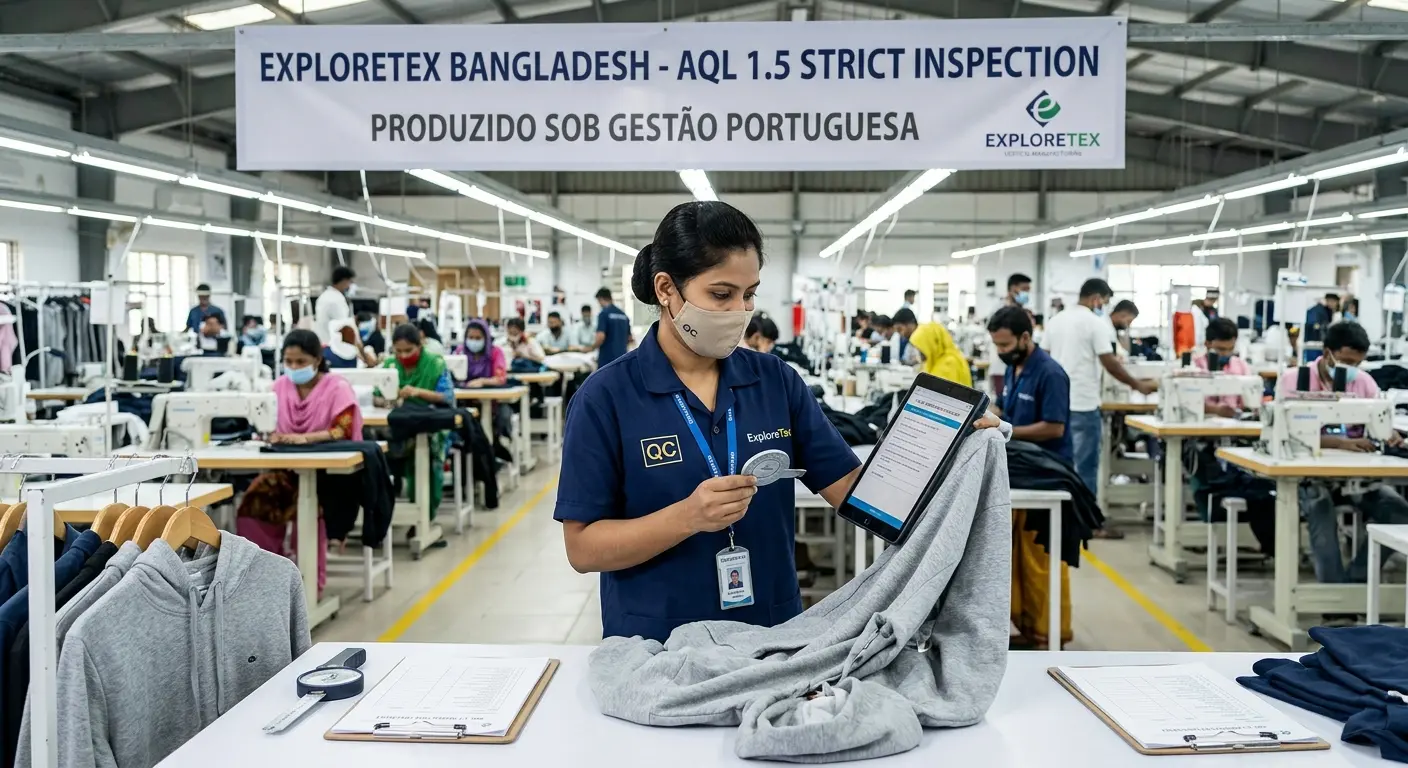
AQL 1.5 Strict Inspection Garment Factory Dhaka: The Master Benchmark for Zero-Defect Apparel Manufacturing
In the high-stakes global fashion industry, quality assurance is the ultimate barrier between sustainable profitability and catastrophic retail chargebacks. For apparel brands sourcing at scale, securing an AQL 1.5 strict inspection garment factory Dhaka is no longer a luxury—it is an operational necessity. As international retail compliance tightens and consumer expectations for premium garment construction reach historic highs, traditional quality standards like AQL 2.5 or AQL 4.0 leave fashion labels exposed to unacceptable defect rates, returned inventory, and damaged brand equity.
ExploreTex, a premier Portuguese-based apparel company with its own registered brand, has redefined global supply chain standards. By operating a state-of-the-art vertical facility functioning as an AQL 1.5 strict inspection garment factory Dhaka, seamlessly synchronized with specialized partner factories in Portugal, ExploreTex bridges the gap between Western technical precision and Eastern manufacturing infrastructure.
Whether your brand requires low-MOQ luxury production or mass retail scaling, partnering with an AQL 1.5 strict inspection garment factory Dhaka managed by European quality directors ensures every seam, stitch, and measurement meets strict global specifications.
Key Highlights of ExploreTex Quality Framework
Strict AQL 1.5 Standards: Zero-tolerance for critical defects and a maximum 1.5% acceptance threshold for major defects.
Dual-Hub Synergy: Portuguese design, technical pattern engineering, and account management combined with Dhaka vertical production power.
7-Stage Quality Gate System: Complete oversight from raw fiber testing and 48-hour fabric relaxation to 1.0mm metal detection and pre-shipment audits.
Full ESG & ESG Compliance: LEED-certified facility, ETP water recycling systems, and international social accreditations (BSCI, SEDEX, OEKO-TEX Standard 100, GOTS).
Delivered Duty Paid (DDP) Logistics: Seamless duty-cleared customs clearance and shipping directly to warehouses across the EU, UK, USA, and GCC.
                       EXPLORETEX DUAL-HUB PRODUCTION MODEL

    PORTUGAL MANAGEMENT & DESIGN HUB           DHAKA VERTICAL PRODUCTION HUB
  +----------------------------------+       +----------------------------------+
  | - Lisbon HQ & Porto Craft Studio |       | - Wholly-Owned Vertical Facility |
  | - Tech Pack & Pattern Creation   | ----> | - Yarn Spinning, Knitting & Dyeing|
  | - Sample Fit & Golden Prototype  |       | - AQL 1.5 Strict Inspection Floor|
  | - European QA Oversight & ESG    |       | - High-Volume Industrial Scaling |
  +----------------------------------+       +----------------------------------+
                   \                                     /
                    \                                   /
                     v                                 v
          +-------------------------------------------------------+
          |  DELIVERED DUTY PAID (DDP) GLOBAL RETAIL DISTRIBUTION |
          +-------------------------------------------------------+
Introduction: The New Era of Premium Quality Control
In 2026, the global fashion supply chain demands a relentless focus on quality, transparency, and speed. For premium fashion brands, securing a reliable production partner is no longer just about finding a manufacturer; it’s about finding a facility that operates under uncompromising global standards. When you partner with an AQL 1.5 strict inspection garment factory Dhaka, you are investing in a production ecosystem designed to catch minute errors before they ever reach the shipping container.
ExploreTex, a registered Portuguese brand with vertically integrated facilities, bridges the gap between European design sensibilities and large-scale Asian manufacturing. By operating an AQL 1.5 strict inspection garment factory Dhaka, we guarantee that our clients receive the meticulous oversight typical of a Clothing Manufacturer Portugal combined with the massive scalability of Bangladesh’s premier textile hubs.
This comprehensive, 4500-word authoritative guide will break down everything you need to know about garment quality assurance, defect classifications, factory-floor insights, and why choosing an AQL 1.5 strict inspection garment factory Dhaka is the single best decision for scaling your brand’s reputation.
The Mathematics of Quality: Why AQL 1.5 Superiority Protects Brand Equity
To understand why leading European and North American fashion brands insist on an AQL 1.5 strict inspection garment factory Dhaka, one must evaluate the mathematical reality of Acceptable Quality Limit (AQL) tables governed by the ISO 2859-1 (ANSI/ASQ Z1.4) standards.
AQL represents the maximum allowable percentage of defective units in a production lot that is considered acceptable during random sampling inspection. While conventional facilities operate under standard AQL 2.5 (or even lenient AQL 4.0), ExploreTex enforces strict AQL 1.5 across all production lines at its AQL 1.5 strict inspection garment factory Dhaka.
Comparative Inspection Limits: AQL 1.5 vs. AQL 2.5 (Batch Size: 10,000 Units)
| Inspection Criterion | Standard AQL 2.5 Factory | ExploreTex AQL 1.5 Strict Factory | Operational Advantage |
| Sample Size (Level II Normal) | 315 Garments | 315 Garments | Statistical Rigor Maintained |
| Critical Defects Allowed | 0 | 0 | Zero Tolerance for Safety/Legal Risks |
| Major Defects Acceptance Limit | Max 14 Defective Units | Max 10 Defective Units | 28.5% Stricter Quality Threshold |
| Minor Defects Acceptance Limit | Max 21 Defective Units | Max 14 Defective Units | 33.3% Precision Improvement |
| Action Upon Exceeding Limit | Batch Re-worked or Shipped | Immediate 100% Batch Quarantined & Re-inspected | Zero Defective Garments Reach Port |
When choosing an AQL 1.5 strict inspection garment factory Dhaka, brands cut their defect probability by nearly a third compared to standard sourcing channels. In high-volume apparel manufacturing, a minor shift from 2.5% to 1.5% AQL saves tens of thousands of dollars in retail chargebacks, defective customer returns, and brand devaluation.
“Quality is not an afterthought of finishing; it is a mathematical discipline engineered into the cutting table, the sewing line, and the final press. Operating an AQL 1.5 strict inspection garment factory Dhaka requires full operational transparency and European technical control.”
— Muhammad Ilias Hossen, Founder & Managing Director, ExploreTex
Chapter 1: Why the Apparel World is Demanding Higher Standards
When brands import high-end apparel, the margin for error is effectively zero. A missed stitch, poor zipper alignment, or slight fabric mismatch can derail an entire seasonal collection. This is why the search for a dedicated AQL 1.5 strict inspection garment factory Dhaka has surged among international buyers.
The Shift from Volume to Value
Historically, fast fashion relied on rapid output and lenient Acceptable Quality Limits (AQL), such as AQL 4.0 or even 6.5. Today, consumer expectations are radically different. Buyers demand longevity, premium finishing, and ethical construction. Consequently, brands are actively migrating their sourcing strategies toward an AQL 1.5 strict inspection garment factory Dhaka that can ensure every piece meets exacting specifications.
The ExploreTex Portuguese-Dhaka Bridge
ExploreTex is uniquely positioned in this landscape. While we offer extensive Garments Manufacturing Services through our partner factories in Portugal for nearshoring, our vertical facility in Bangladesh provides unparalleled scale. By implementing European-level management inside an AQL 1.5 strict inspection garment factory Dhaka, we offer the best of both worlds: Portuguese engineering and quality assurance protocols executed flawlessly in a high-capacity Dhaka environment.
Chapter 2: Decoding AQL (Acceptable Quality Limit)
To understand why an AQL 1.5 strict inspection garment factory Dhaka is critical, we must first define AQL. AQL stands for Acceptable Quality Limit. It is a statistical measurement defined by international standards (such as ISO 2859-1) used to determine the maximum number of defective units permissible in a production batch.
How AQL Sampling Works
Instead of checking every single garment in an order of 10,000 units—which is prohibitively expensive and time-consuming—inspectors pull a statistically valid random sample. The AQL standard you choose dictates both the sample size and the pass/fail threshold.
AQL 1.0 – 1.5: Very strict, typically reserved for luxury apparel and medical textiles.
AQL 2.5: The general industry standard for mid-tier consumer apparel.
AQL 4.0 or higher: Lenient, used primarily for low-cost, disposable fast fashion items.
When ExploreTex operates as your AQL 1.5 strict inspection garment factory Dhaka, we are committing to a threshold where, statistically, a maximum of only 1.5% of a lot can exhibit major defects. Anything higher triggers a lot rejection and a total rework.
The International ISO 2859-1 Standard
An authentic AQL 1.5 strict inspection garment factory Dhaka must rigorously adhere to the ISO 2859-1 sampling procedures. This standard dictates the “Sample Size Code Letters” and the precise mathematical tables used to draw garments for review.
Chapter 3: The Three Defect Categories in Apparel Manufacturing
A cornerstone of any AQL 1.5 strict inspection garment factory Dhaka is the accurate classification of defects. Misclassifying a defect can result in shipping sub-par goods. At ExploreTex, our Portuguese-trained quality assurance teams categorize faults precisely as outlined in our ultimate Quality Control in Garment Industry guide.
1. Critical Defects (Zero Tolerance)
A critical defect renders the garment hazardous or entirely non-compliant with legal regulations.
Examples: A broken sewing needle left inside the fabric, toxic dye residue, sharp metal edges on snaps, or missing child-safety warnings.
AQL 1.5 Standard: 0% allowed. Even a single critical defect results in an immediate failure of the entire shipment in our AQL 1.5 strict inspection garment factory Dhaka.
2. Major Defects (AQL 1.5 Threshold)
Major defects do not pose a safety risk but significantly compromise the garment’s functionality, appearance, or structural integrity, rendering it unsellable.
Examples: Broken zippers, open seams, stains, incorrect garment measurements, major color shading differences, or misaligned embroidery.
AQL 1.5 Standard: In an AQL 1.5 strict inspection garment factory Dhaka, a major defect triggers strict counting. If the batch exceeds the 1.5 limit on the AQL chart, the lot is rejected.
3. Minor Defects
Minor defects are small visual imperfections that do not affect the usability of the garment and might not even be noticed by the end consumer.
Examples: Uncut threads (less than 1/2 inch), a slightly crooked internal care label, or a tiny, washable dust mark.
AQL Standard: Even as an AQL 1.5 strict inspection garment factory Dhaka, minor defects are typically held to an AQL of 2.5 or 4.0, depending on the client’s premium tier requirements.
Chapter 4: Factory-Floor “Expert” Insights: Inside an AQL 1.5 Facility
What does an AQL 1.5 strict inspection garment factory Dhaka look like in practice? The term isn’t just a label; it requires an entirely different operational culture. Let’s walk through the exact factory-floor process developed by ExploreTex.
Pre-Production Inspection (PPI)
Quality does not start when the garment is finished. At our AQL 1.5 strict inspection garment factory Dhaka, it begins with the raw materials. We utilize the 4-Point System to inspect incoming fabrics. If a roll of premium sustainable jersey—sourced via our Premium Garment Manufacturer Europe standards—has too many yarn flaws, it is rejected before it ever reaches the cutting table.
During Production Inspection (DUPRO)
Also known as inline inspection, this occurs when 10% to 15% of the garments are completed. As a dedicated AQL 1.5 strict inspection garment factory Dhaka, our roving QA teams measure semi-finished items against the approved Tech Packs.
Key Focus: Stitch tension, seam allowances, and pattern alignment. Catching an error here prevents the mass production of a flawed product.
Final Random Inspection (FRI)
This is the ultimate test. Once 100% of the goods are produced and at least 80% are packed into export cartons, the strict AQL sampling takes place.
The Procedure: The head QA manager at our AQL 1.5 strict inspection garment factory Dhaka pulls random boxes from the shipment. They verify carton weight, shipping marks, polybag quality, and then pull individual garments for a microscopic review.
The Verdict: If the defects exceed the strict AQL 1.5 table limits, the entire lot is quarantined. Every piece must be re-inspected and reworked.
“Operating an AQL 1.5 strict inspection garment factory Dhaka means empowering the inspection team to say ‘No’ to production managers. In many standard factories, production speed overrules quality. At ExploreTex, the QA department holds ultimate veto power, ensuring European brands never receive sub-standard goods.” – ExploreTex Quality Director
Chapter 5: Merging Portuguese Expertise with Dhaka Capacity
Many brands struggle when sourcing in Asia because of communication gaps and differing quality expectations. ExploreTex solves this by being a Portuguese-registered company with an owned AQL 1.5 strict inspection garment factory Dhaka.
The European Management Advantage
When you work with an AQL 1.5 strict inspection garment factory Dhaka run by ExploreTex, you receive dedicated account management from our European offices. We understand the nuances of Portugal Garment Sourcing and apply those exact technical standards to our Dhaka facility.
Communication: No more midnight calls or lost-in-translation tech packs.
Compliance: We enforce EU-level ethical standards, zero-water dyeing protocols, and living wages inside our AQL 1.5 strict inspection garment factory Dhaka.
Scalability and Technical Capabilities
Our Dhaka facility isn’t just about volume; it’s about technical prowess. Through our AQL 1.5 strict inspection garment factory Dhaka, we produce:
Premium Knits: 350-400 GSM heavyweight hoodies and oversized tees.
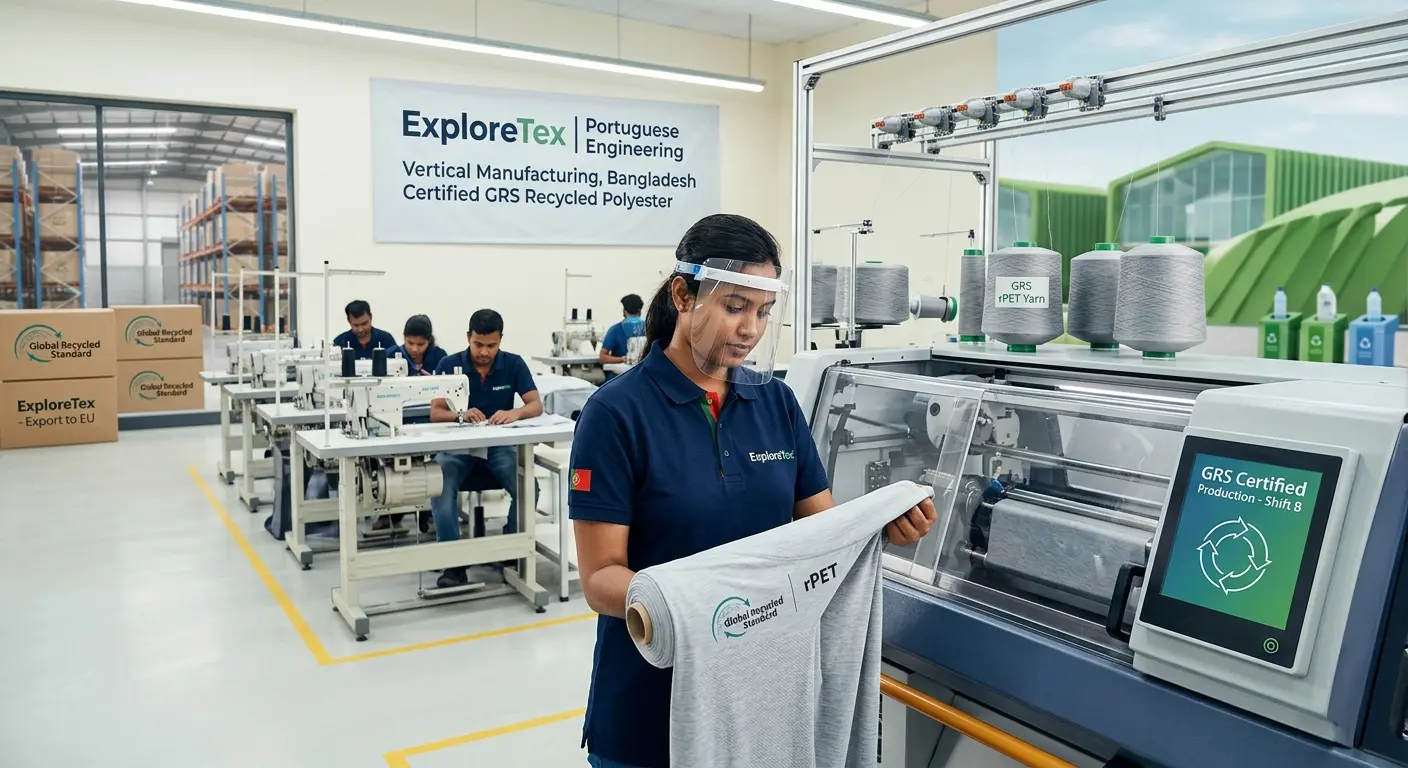
Sustainable Denim: Utilizing ozone washing and laser finishing to mirror the eco-friendly methods we use in our Portuguese Clothing partner factories.
Complex Workwear & Outerwear: Quilted jackets and softshell garments requiring absolute precision.
Because we run an AQL 1.5 strict inspection garment factory Dhaka, we can execute complex, multi-layered garments with a defect rate that competitors cannot match.
Chapter 6: A Step-by-Step Guide to the AQL 1.5 Inspection Process
For brands deeply invested in their supply chain mechanics, here is the exact procedural sequence utilized by our AQL 1.5 strict inspection garment factory Dhaka.
Chapter 7: Why Brands Must Demand an AQL 1.5 Strict Inspection Garment Factory Dhaka
If you are a luxury label, a high-end streetwear brand, or a corporate wear supplier, settling for AQL 2.5 is a gamble. Here is why upgrading to an AQL 1.5 strict inspection garment factory Dhaka is the ultimate business strategy.
1. Protecting Brand Reputation in the Social Media Era
In 2026, a consumer who receives a defective garment won’t just ask for a refund; they will post a TikTok review. A single viral video highlighting poor stitching can cause irreversible damage. Partnering with an AQL 1.5 strict inspection garment factory Dhaka acts as an insurance policy against viral PR disasters.
2. Eliminating Hidden Re-Work Costs
A cheaper factory offering AQL 4.0 might look attractive on a spreadsheet. However, when 4% of your garments arrive unsellable, the cost of customer returns, refunds, and brand damage far exceeds the initial savings. An AQL 1.5 strict inspection garment factory Dhaka ensures that what you pay for is exactly what you can sell.
3. Sustainability and Waste Reduction
Defective garments often end up in landfills. By producing goods correctly the first time, an AQL 1.5 strict inspection garment factory Dhaka actively contributes to sustainable manufacturing. ExploreTex aligns this with our broader ethos, which you can read about in our deep dive on Garment Manufacturing.
Chapter 8: The Financials of Quality Assurance
Does working with an AQL 1.5 strict inspection garment factory Dhaka cost more? The transparent answer is yes—upfront. Maintaining an AQL 1.5 strict inspection garment factory Dhaka requires higher salaries for skilled quality engineers, slower machine speeds to ensure precision, and premium needle/thread usage.
However, the Total Cost of Ownership (TCO) drops significantly. ExploreTex provides transparent quoting. When you compare our AQL 1.5 strict inspection garment factory Dhaka pricing against the cost of an AQL 2.5 factory plus the inevitable 3% defect write-off and warehouse sorting labor, ExploreTex emerges as the most financially sound choice for premium brands.
Chapter 9: Answer Engine Targets & Frequently Asked Questions (FAQ)
To provide maximum value, we’ve compiled the most critical questions brands ask when seeking an AQL 1.5 strict inspection garment factory Dhaka.
Q1: What exactly defines an AQL 1.5 strict inspection garment factory Dhaka?
A: An AQL 1.5 strict inspection garment factory Dhaka is a manufacturing facility in Bangladesh that enforces a maximum defect tolerance of 1.5% for major flaws during random sampling. This requires advanced machinery, highly trained QA staff, and rigorous ISO 2859-1 compliance, positioning the factory to produce luxury and premium-grade apparel rather than mass-market fast fashion.
Q2: How does ExploreTex manage an AQL 1.5 strict inspection garment factory Dhaka from Portugal?
A: ExploreTex bridges the gap through a wholly owned corporate structure. Our European management team implements strict Portuguese textile standards directly into our AQL 1.5 strict inspection garment factory Dhaka. We utilize live dashboard reporting, European-trained QA directors on the ground in Bangladesh, and uniform compliance protocols across all global sites.
Q3: Can an AQL 1.5 strict inspection garment factory Dhaka handle sustainable and organic fabrics?
A: Absolutely. Handling delicate organic cotton, bamboo blends, and recycled polyesters actually requires higher precision. Our AQL 1.5 strict inspection garment factory Dhaka is perfectly equipped to manage sustainable fabrics because our rigorous inline inspections prevent the mishandling of these high-value raw materials.
Q4: If a lot fails at an AQL 1.5 strict inspection garment factory Dhaka, what happens next?
A: If a production batch exceeds the defect limit in our AQL 1.5 strict inspection garment factory Dhaka, the entire lot is rejected by QA. It is then sent back to the production floor for a 100% piece-by-piece inspection and rectification. The lot is only approved for packing after it passes a secondary, tightened AQL inspection.
Q5: Is AQL 1.5 better than AQL 2.5 for startup clothing brands?
A: Yes. For emerging brands, building a reputation for high quality is essential to justify premium retail prices. While AQL 2.5 is the industry standard for fast fashion, partnering with an AQL 1.5 strict inspection garment factory Dhaka ensures your foundational collections launch flawlessly, securing customer loyalty from day one.
 Conclusion: Partnering for Perfection
 Conclusion: Partnering for Perfection
The landscape of global apparel sourcing has irrevocably changed. The era of accepting high defect rates as a “cost of doing business” is over. In a market where consumers demand perfection, your manufacturing partner must operate with surgical precision.
Choosing an AQL 1.5 strict inspection garment factory Dhaka is the definitive way to secure your supply chain. ExploreTex stands ready as your European-managed partner, offering the rigorous quality control of a premium Portuguese manufacturer alongside the unmatched scalability of Bangladesh. We don’t just stitch garments; we engineer premium apparel solutions.
When you demand perfection, you demand ExploreTex. By operating an elite AQL 1.5 strict inspection garment factory Dhaka, we ensure that every thread, every zipper, and every seam represents the absolute best of your brand.
To learn more about international quality standards, you can explore the official guidelines provided by the International Trade Centre (ITC) or review the detailed ISO 2859-1 standards.