
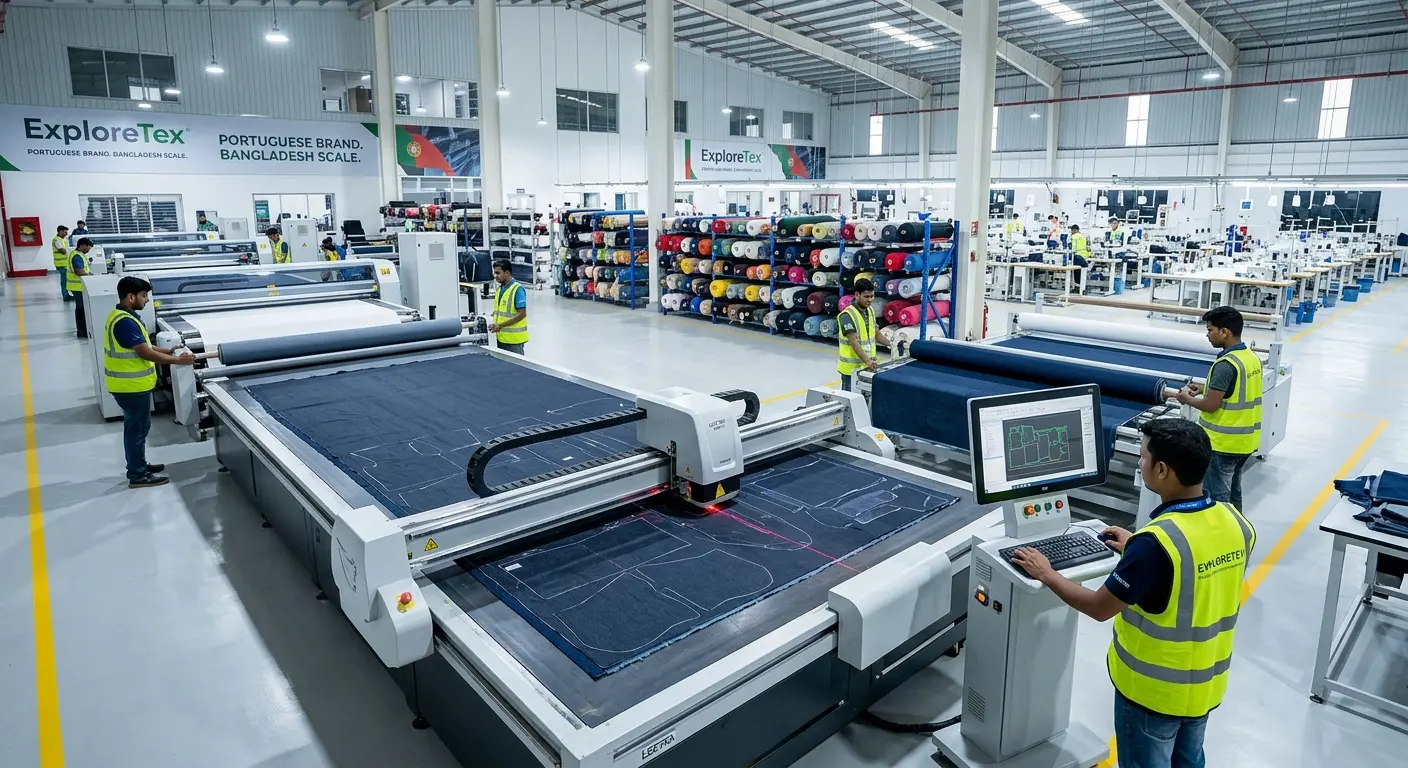
The Future of Apparel: Inside an Automated Cutting Garment Factory Dhaka
How ExploreTex Combines Portuguese Engineering with Advanced Bangladesh Manufacturing to Deliver Precision at Scale
An automated cutting garment factory Dhaka represents the pinnacle of modern readymade garment (RMG) manufacturing, utilizing CAD/CAM integration, CNC (Computer Numerical Control) machines, and laser precision to process fabrics. In 2026, automation in the Bangladesh garment industry increased productivity by up to 25-30% and reduced fabric waste to under 3% [1]. By bridging European quality standards from Portugal with the high-volume capabilities of an automated cutting garment factory Dhaka, apparel brands benefit from faster lead times, ±0.1 mm cutting accuracy, and sustainable, zero-waste operations.
The global apparel industry is undergoing a seismic technological shift. Gone are the days when mass production relied entirely on manual labor and traditional tailoring shears. Today, the beating heart of global fashion relies on high-tech automation. If you want to understand how modern clothing is engineered, scaled, and perfected, you must look at the operations inside an automated cutting garment factory Dhaka.
As global brands face mounting pressure to deliver high-quality, sustainable, and precisely fitted garments at competitive prices, the technology utilized in the pre-sewing phases has become the ultimate differentiator. ExploreTex, a premier Portuguese-based clothing manufacturer, sits at the intersection of this revolution. By integrating European design and compliance protocols with the raw production power of an automated cutting garment factory Dhaka, ExploreTex offers a robust dual-hub model that redefines full-package apparel production.
In this comprehensive guide, we will explore the technological marvels, economic advantages, and sustainable impacts of modern fabric cutting, and why partnering with the right manufacturing hub is critical for your fashion brand’s success.
The Modern Apparel Supply Chain & The Role of Dhaka’s Automation Revolution
The global ready-made garment (RMG) sector is undergoing a structural paradigm shift. Historically, fashion supply chains relied heavily on regional labor arbitrage, sacrificing pattern fidelity, fabric yield efficiency, and structural consistency in favor of raw volume. Today, high-growth clothing brands, private label retailers, and corporate workwear directors can no longer afford the financial and operational penalties of legacy apparel manufacturing. Precision engineering, micro-metric repeatability, zero-tension material handling, and transparent ethical compliance are now fundamental prerequisites for global commercial viability.
At the epicenter of this technological evolution stands the modernization of the cutting room. The cutting floor is the true profit center of any modern textile plant. Errors committed during pattern laying, fabric spreading, or manual scissor slicing ripple catastrophically through every downstream process—causing skewed side seams, torque distortion, misaligned drill holes, shade variations, and massive material waste. To mitigate these risks, leading global brands are pivoting toward facilities that feature an automated cutting garment factory Dhaka setup.
       +-------------------------------------------------------+
       |                  EXPLORETEX DUAL-HUB                 |
       +-------------------------------------------------------+
                                   |
         +-------------------------+-------------------------+
         |                                                   |
         v                                                   v
+------------------+                               +-------------------+
|  PORTUGAL HUB    |                               |    DHAKA HUB      |
|  * 3D Prototyping|                               |  * Auto Spreading |
|  * Tech Packs    |                               |  * CNC Vacuum Cut |
|  * Low MOQ Caps  |                               |  * Mass Assembly  |
+------------------+                               +-------------------+
         |                                                   |
         +-------------------------+-------------------------+
                                   |
                                   v
                       +-----------------------+
                       | GLOBAL DDP LOGISTICS  |
                       +-----------------------+
As a Portuguese-based apparel leader with a registered brand and corporate headquarters in Lisbon, ExploreTex has pioneered a hybrid operational architecture. By combining European design oversight, pattern-making expertise, and local partner facilities in Portugal with our self-owned, vertically integrated manufacturing hub in Bangladesh, we solve the historic compromise between European craft quality and South Asian cost scale. When brands search for a dependable partner operating an automated cutting garment factory Dhaka infrastructure, ExploreTex provides the ideal balance: European legal oversight and administrative transparency coupled with direct industrial execution in South Asia.
By leveraging our comprehensive ExploreTex homepage, fashion brands gain access to a fully managed supply chain that handles every stage from raw fiber sourcing to final door-to-door delivery. Brands looking for specialized European craftsmanship alongside global scalability routinely leverage our expertise in clothing manufacture in Portugal, where high-end prototyping and technical design specs are refined prior to industrial deployment.
1. The Shift to Automation in the RMG Sector
For decades, Bangladesh has been celebrated globally for its massive readymade garment (RMG) sector, which accounts for over 84% of the country’s export earnings. Historically, this sector was highly labor-intensive. However, a profound strategic shift is underway.
According to recent industrial data, productivity in automation-intensive segments of the RMG sector has surged. Cutting, knitting, and wet processing have recorded immense annual productivity growth—with cutting alone seeing improvements exceeding 11% annually [1]. An automated cutting garment factory Dhaka is no longer a futuristic concept; it is the baseline requirement for brands demanding consistency across thousands of units.
The transition from manual cutting (where 10–12 workers might process 4,000 pieces a day) to fully automated CAD and CNC-driven systems means just 2–3 operators can now cut up to 10,000 pieces daily [1]. This evolution not only triples output but eliminates human error, ensuring that every panel of fabric matches your brand’s technical specifications perfectly.
2. Anatomy of an Automated Cutting Garment Factory Dhaka
What exactly happens inside a modern facility? When a tech pack is finalized by the design team at ExploreTex’s European headquarters, the digital blueprint is sent to our manufacturing hub. Here is the step-by-step lifecycle of fabric within an automated cutting garment factory Dhaka.
A. Digital Pattern Making and AI Nesting
Before a single blade touches the fabric, software takes over. Using advanced CAD (Computer-Aided Design) systems, pattern makers digitize the garment’s components. Next, AI-driven “nesting” software arranges these digital pattern pieces onto a virtual fabric roll. The goal is to puzzle the pieces together so tightly that waste is almost entirely eliminated. In a state-of-the-art automated cutting garment factory Dhaka, AI nesting routinely achieves fabric utilization rates exceeding 85-90%, compared to the 70% average of manual methods [2].
B. Automated Spreading
Fabric arrives in massive rolls and must be “relaxed” to prevent shrinkage after cutting. Automated spreading machines roll the fabric out onto 50-meter-long vacuum tables perfectly flat and tension-free. Multi-ply capabilities allow these spreaders to layer up to 100 plies of fabric simultaneously, meaning one cutting cycle can yield hundreds of garments.
C. The Cutting Matrix (CNC and Laser)
The core of an automated cutting garment factory Dhaka is the cutting head itself. Depending on the material, different technologies are deployed:
CNC Rotary/Straight Knives: Utilizing high-speed oscillating blades, these machines slice through dense stacks of denim, cotton, and jersey with a precision of ±0.1 mm. A vacuum seals the fabric down tightly so it does not shift during the cut.
Laser Cutting: For synthetic technical textiles, activewear, and delicate silks, laser cutting is preferred. Lasers melt the edges of synthetic fibers slightly as they cut, preventing fraying.
Ultrasonic Cutting: Used for medical garments and specialized workwear, ultrasonic blades use high-frequency vibrations to slice through tough materials effortlessly.
By leveraging these technologies, a premier Bangladesh clothing supplier guarantees that the sizing of your small t-shirt is exactly graded down from your large, with zero variance.
An Engineering Deep-Dive into the Automated Cutting Garment Factory Dhaka Setup
To understand why an automated cutting garment factory Dhaka represents the high watermark of modern textile production, one must examine the mechanical, algorithmic, and operational parameters of automated CAD/CAM (Computer-Aided Design / Computer-Aided Manufacturing) cutting rooms.
+-----------------------------------------------------------------------------------+
|                 AUTOMATED CAD/CAM CUTTING ROOM WORKFLOW                          |
+-----------------------------------------------------------------------------------+
| 1. FABRIC CONDITIONING : 24-48 hr stress-free climate relaxation                  |
| 2. LASER SPREADING    : Zero-tension cradle feeding with edge alignment       |
| 3. VACUUM SEALING     : Poly-film vacuum compression (30-50% ply reduction)       |
| 4. CNC KNIFE CUTTING  : High-frequency oscillating blade (6,000 RPM)              |
| 5. RFID TAGGING       : Digital ply tracking and automated bundle labeling         |
+-----------------------------------------------------------------------------------+
The CAD/CAM Digital Ecosystem
In a traditional manual cutting setup, paper markers are stapled onto fabric plies, and workers cut through multiple layers using manual straight-knife or band-knife machines. This manual methodology introduces severe physical variables:
Distortion from Hand Pressure: The operator’s manual force leans into the fabric stack, pushing upper plies forward while lower plies drag backward.
Kerf Inconsistency: Manual knife blades deflect when traversing heavy fabric layers (such as 350 GSM fleece or heavy denim), producing wider pattern dimensions on lower plies than on upper plies.
Fabric Waste: Manual nesting rarely exceeds 75% to 82% fabric utilization, wasting up to 25% of expensive raw textiles.
Conversely, our automated cutting garment factory Dhaka installation eliminates physical variation by digitizing the entire cutting pipeline. The process begins in our CAD engineering studio, where patterns generated or optimized by our Portuguese pattern master are processed through intelligent marker nesting algorithms (such as Lectra Diamino® or Gerber AccuNest®).
These advanced algorithms perform millions of geometric calculations per second, rotating and interlocking pattern pieces down to the millimeter. This process maximizes fabric yield up to 88%–94%, dramatically reducing raw material usage, lowering garment costs, and driving environmental sustainability.
To inspect how these digital workflows translate into end-to-end production management, brands can explore our full package clothing production services, which details our complete process from digital design to packaged garment shipping.
+-----------------------------------------------------------------------------------+
|               MANUAL VS. AUTOMATED CUTTING PERFORMANCE MATRIX                     |
+-----------------------------------------------------------------------------------+
| Metric                        | Manual Cutting Room     | Automated CAD/CAM Hub   |
+-------------------------------+-------------------------+-------------------------+
| Fabric Utilization Efficiency | 75% - 82%               | 88% - 94%               |
| Ply-to-Ply Measurement Delta  | ± 3.5 mm to ± 6.0 mm    | ± 0.1 mm to ± 0.3 mm    |
| Blade Oscillation Speed       | N/A (Manual Glide)      | Up to 6,000 RPM         |
| Cutting Kerf Compensation     | Manual Estimation       | Dynamic AI Algorithmic  |
| Fabric Ply Height Capacity    | Low (High Error Rate)   | Up to 7.5 cm Compressed |
| Torque / Seam Distortion      | High Risk               | Zero Risk               |
+-------------------------------+-------------------------+-------------------------+
Precision Mechanics: The Science of Automated CNC Cutting
Once the digital marker is transmitted over our secure network to the factory floor in Dhaka, the physical cutting operation takes place on automated CNC cutting tables equipped with dynamic vacuum reduction systems.
                  +-----------------------------------+
                  |   OSCILLATING CNC CUTTING HEAD    |
                  +-----------------------------------+
                                    |
            +-----------------------+-----------------------+
            |                                               |
            v                                               v
+-----------------------+                       +-----------------------+
| DYNAMIC COOLING JET   |                       | DYNAMIC SHARPENING    |
| Prevents synthetic    |                       | Maintains razor edge  |
| blade-fuse melting    |                       | every 500-1000 cycles |
+-----------------------+                       +-----------------------+
Zero-Tension Spreading Systems: Before cutting, rolls of jersey, interlock, woven twill, or technical synthetics are fed through automated cradle spreaders equipped with photo-electric edge-alignment sensors. The fabric is laid stress-free without stretching or tension. This ensures that once cut, the garment components will not contract, shrink, or distort after assembly.
Poly-Film Vacuum Compression: Once the designated ply height (up to 7.5 cm of fully compressed fabric) is reached, an airtight polyethylene film covers the lay. High-volume turbine vacuums evacuate air from the table, compressing the fabric plies into a dense, solid block. This completely eliminates ply shifting during blade traversal.
High-Frequency Oscillating CNC Knife Head: The cutting head features a specialized steel blade oscillating vertically at speeds up to 6,000 RPM. Guided by precision servo-motors along X and Y axes, the knife cuts complex curves, notches, drill indicators, and sharp corners with an absolute tolerance of $\pm$0.1 mm to $\pm$0.3 mm.
Algorithmic Kerf Compensation: As a high-speed blade cuts through synthetic or elastane-blend fabrics, friction generates heat that can fuse raw material edges together. Our automated cutting garment factory Dhaka systems utilize dynamic blade chilling (chilled air blasts) coupled with automatic kerf calculation software. The software adjusts the blade angle and path dynamically to offset friction, ensuring zero edge-fusing.
Dynamic Blade Sharpening: Integrated sharpening stones automatically hone the knife blade at pre-set distance intervals (e.g., every 500 to 1,000 millimeters of cutting distance), maintaining a sharp edge from the first ply to the bottom ply.
For specialized product categories such as activewear, compression gear, and technical apparel, this level of cutting precision is vital. Brands looking for advanced activewear engineering can review our specialized capability as a Portugal sportswear manufacturer, where pattern accuracy directly governs garment stretch, compression gradient, and athletic performance.
3. Why Dhaka? The Geopolitical and Economic Advantage
You might wonder why European and American fashion houses specifically seek out an automated cutting garment factory Dhaka. The answer lies in a unique blend of infrastructure, trade advantages, and technological adoption.
Dhaka is the epicenter of the world’s second-largest apparel exporting nation. The concentration of textile mills, washing plants, accessory suppliers, and skilled logistics companies creates an unmatched supply chain ecosystem. Furthermore, as Bangladesh prepares for LDC (Least Developed Country) graduation in 2026, the government and factory owners are heavily subsidizing technological upgrades.
By operating an automated cutting garment factory Dhaka, facilities can offset global inflation. While raw material and shipping costs fluctuate globally, the hyper-efficiency of automated cutting stabilizes the per-unit cost. For a comprehensive look at the geopolitical advantages, you can read our deep dive into the Bangladesh garment industry.
4. ExploreTex’s Dual-Hub Model: The Best of Both Worlds
While the sheer output of an automated cutting garment factory Dhaka is spectacular, navigating international manufacturing requires localized expertise. This is where ExploreTex’s Dual-Hub Production Model shines.
The Portugal Hub: Our managed production network in Portugal serves as the brain of the operation. Here, our textile engineers handle the strategic discovery, luxury tech pack development, 3D virtual sampling, and low-MOQ premium streetwear production. European quality control protocols are established here.
The Bangladesh Hub: Once a “Golden Sample” is approved, high-volume orders are transferred to our directly operated and partnered facilities in South Asia. Because we utilize an advanced automated cutting garment factory Dhaka, we can scale your brand from 500 units to 500,000 units without a single drop in quality.
This model removes the risk typically associated with overseas sourcing. You communicate with our European-based project managers, while we manage the complex engineering on the factory floor.
5. Factory-Floor “Expert” Insights
To truly grasp the impact of this technology, we asked our lead production engineers to share insights directly from the floor of our automated cutting garment factory Dhaka:
“Ten years ago, a slight miscalculation by a manual cutter meant an entire batch of sleeves would pucker when sewn to the armhole. Today, our CNC machines communicate directly with the digital tech pack. If the armhole curve is 23.4 cm, the machine cuts exactly 23.4 cm. The sewing machine operators don’t have to stretch or pull the fabric to make it fit. This seamless integration speeds up the sewing line by 20% and completely eliminates fit-related returns for our clients.”
— Lead Textile Engineer, ExploreTex Dhaka Hub
“The real magic of an automated cutting garment factory Dhaka is in the data. We use IoT (Internet of Things) sensors on the cutting heads. I can sit in the Lisbon office and see the exact blade temperature, cutting speed, and fabric yield of a production run happening in Dhaka in real-time. This radical transparency means we spot potential issues before a single garment is stitched.”
— Muhammad Ilias Hossen, CEO ExploreTex
Dual-Hub Synergy: European Technical Direction Meets Bangladesh Industrial Scale
The global garment industry has long been divided between two distinct operational models:
European Ateliers & Nearshore Suppliers: Exceptional quality, high compliance, rapid communication, and low MOQs, but hampered by elevated unit production costs and finite mass-scaling capacity.
Traditional Offshore Mass Factories: Unbeatable unit economics and massive capacity, but often limited by communication barriers, slower sampling cycles, and inconsistent quality control.
ExploreTex eliminates this operational trade-off through our Dual-Hub Hybrid Manufacturing Framework.
+-----------------------------------------------------------------------------------+
|                       EXPLORETEX DUAL-HUB OPERATIONAL MATRIX                      |
+-----------------------------------------------------------------------------------+
| Operational Phase      | Portugal Hub (Lisbon)        | Dhaka Hub (Bangladesh)    |
+------------------------+------------------------------+---------------------------+
| Primary Focus          | Design, R&D, Tech Packs      | Precision Cutting & Bulk  |
| Sampling & Prototyping | 3D Digital Twins (CLO3D)     | Physical Pre-Production   |
| Production Focus       | Luxury / Low MOQ Capsules    | Scalable Mass Production  |
| Compliance Standards   | EU Regulations (ESPR/DPP)    | LEED, BSCI, WRAP, OEKO-TEX|
| Management Supervision | European Engineering Team    | On-Ground Portuguese Leads|
+------------------------+------------------------------+---------------------------+
Phase 1: European Design, Tech Pack Standardizations, and 3D Virtual Fitting
Every order entering the ExploreTex production system originates under the direct oversight of our Portuguese engineering team in Lisbon. Rather than relying on incomplete sketches or vague physical samples, our master pattern makers convert brand concepts into standardized, production-ready technical packages (Tech Packs).
Using 3D garment simulation software (CLO3D), we construct “Digital Twins” of every style. This enables us to stress-test fabric drape, seam strain, pattern grading, and sizing runs on virtual 3D avatars before cutting a single yard of bulk fabric.
Our digital sampling process reduces physical prototyping waste by up to 80% and accelerates sample approval timelines from months to days. Once the brand approves the 3D digital model, the digital vector patterns and marker files are encrypted and synced directly to our automated cutting garment factory Dhaka central processing hub.
Phase 2: Execution in Dhaka under European Operational Supervision
When vector data arrives at our Dhaka facility, execution begins immediately. Unlike third-party agent arrangements where brands lose visibility over factory operations, ExploreTex directly owns and operates its vertical facility in Bangladesh. European management standards, ethical protocols, and quality checks are embedded directly into daily operations.
By operating our own automated cutting garment factory Dhaka facility, we guarantee that the precise pattern parameters finalized in Lisbon are translated directly onto the cutting floor in Dhaka. This integrated approach ensures complete transparency, strict quality assurance, and ethical integrity at every stage of production.
To see how our dual-hub framework powers sustainable, certified manufacturing, explore our master analysis on ethical sourcing and sustainable textile innovation.
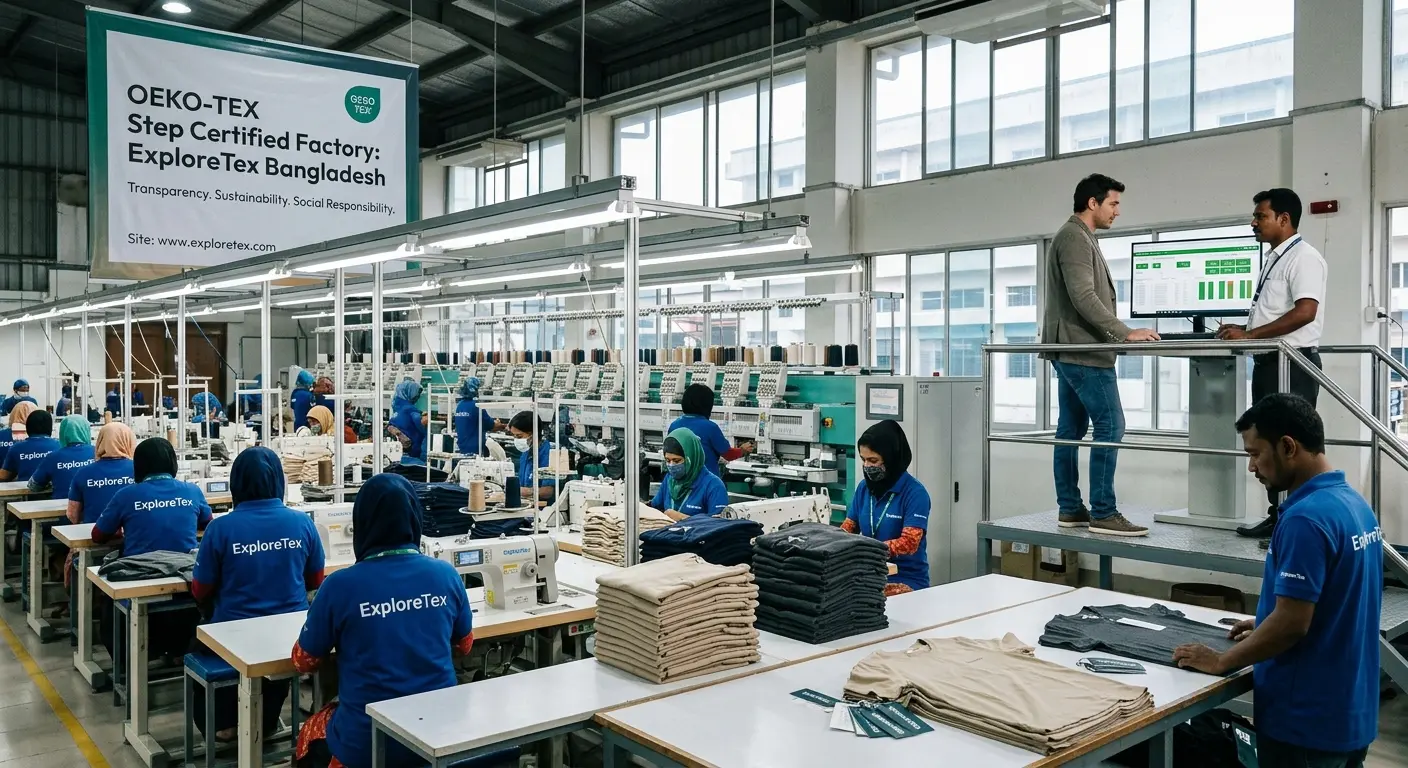
Furthermore, our compliance protocols strictly mirror European requirements. ExploreTex ensures full compliance with international standards certified by independent global bodies, including OEKO-TEX Standard 100 for chemical safety, social audits certified through amfori BSCI, and raw material traceability tracked via Textile Exchange standards.
Technical Breakdown: Step-by-Step Operations on the Factory Floor
To understand how an automated cutting garment factory Dhaka facility maintains zero-defect precision across mass production runs, it is helpful to trace a fabric roll through every stage of our cutting floor pipeline.
       [FABRIC WAREHOUSE: 100% Raw Material Inspection & Testing]
                                   |
                                   v
       [CLIMATE CONDITIONING: 24-48 Hours Tension-Free Relaxation]
                                   |
                                   v
       [AUTOMATED SPREADING: Laser-Guided Edge Alignment & Cradle Feed]
                                   |
                                   v
       [VACUUM COMPRESSION: Poly-Film Sealed Air Evacuation]
                                   |
                                   v
       [CNC CUTTING HEAD: 6,000 RPM Oscillating Blade & Dynamic Chilling]
                                   |
                                   v
       [PARTS IDENTIFICATION: RFID Tagging & QR Code Ply Labeling]
                                   |
                                   v
       [AQL 2.5 INSPECTION: 100% Panel Audit & Shade Lot Sorting]
                                   |
                                   v
       [SEWING LINES: Automated Unit Production System (UPS) Dispatch]
Step 1: Raw Material Inspection & Climate Conditioning
Bulk fabric rolls arriving at our Dhaka hub undergo rigorous incoming inspection using the standard 4-Point System (ASTM D5430). Fabric rolls are checked for defects including slubs, holes, shading, skewing, and bow errors. Rolls failing inspection are quarantined immediately.
Passed rolls move into climate-controlled fabric relaxation rooms. Woven and knitted fabrics stored under tension on tight rolls retain internal mechanical stress. If cut immediately upon unrolling, the resulting pattern pieces will contract post-cut, rendering garments out-of-spec. In our automated cutting garment factory Dhaka facility, fabric rolls are unrolled and rested on specialized relaxation racks for 24 to 48 hours in a temperature and humidity-controlled environment, ensuring the textile settles into its natural dimensional equilibrium.
Step 2: Laser-Guided Zero-Tension Spreading
After relaxation, fabric rolls are loaded onto computerized cradle spreaders. The spreader travels smoothly over heavy-duty air-floated cutting tables:
Infrared Edge Sensors: Continuously adjust the lateral alignment of the fabric edge to within $\pm$0.5 mm, ensuring that every ply aligns perfectly along the selvedge, preventing material loss along the margins.
Overfeed Synchronization: The motor driving the roll feed is electronically synchronized with the linear travel speed of the spreader carriage. This feeds the fabric onto the table with zero stretching force.
Step 3: Poly-Film Vacuum Compression & Ply Height Calibration
Once the target ply depth is achieved (e.g., 50 plies of heavy fleece or 100 plies of fine cotton jersey), the lay is covered with a recyclable thin poly-film. The table’s internal vacuum turbine activates, pulling a strong down-draft vacuum through perforations in the table surface. This compresses the loose fabric stack into an ultra-dense block, eliminating air pockets between plies and locking the layers in place for high-speed cutting.
Step 4: CNC Oscillating Blade Traversal
The CNC cutting carriage traverses the table guided by digital CAD coordinates:
Tangent Cutting Control: The blade automatically rotates to match the exact tangent of curves, arcs, and angles, maintaining smooth, continuous cutting movements without dragging or tearing the fabric.
Internal Drilling & Notching: The cutting head executes drill holes (for pocket placements or dart terminations) and edge notches (V-notches or I-notches) at exact millimetric depths, ensuring sewing operators receive clear, precise assembly markers.
Step 5: Automated Bundling, RFID Tracking, and Ply Tagging
Cut garment components exit the cutting table onto an unloading conveyor system. Rather than relying on manual chalk marks or paper stapling, cut parts are tagged with automated barcoded or RFID-enabled ply labels.
These labels designate:
Style ID and Cut Lot Number
Size Code and Bundle Sequence
Specific Shade Lot and Ply Number (ensuring front, back, and sleeve panels from Ply #12 are sewn exclusively to other panels from Ply #12, eliminating shade variation across assembled garments).
Private label apparel brands seeking a dependable European partner that manages complete garment assembly can read more about our tailored solutions as a premier textile manufacturing company for private label brands.
6. Driving Environmental Sustainability Through Automation
Sustainability is no longer an optional marketing buzzword; it is a regulatory requirement for selling in the EU and North America. Surprisingly, machinery is one of our greatest tools for environmental protection.
A traditional, non-automated factory wastes approximately 10-15% of its fabric during the cutting phase. When you are producing millions of garments, that equates to thousands of tons of textile waste entering landfills.
An automated cutting garment factory Dhaka dramatically reduces this ecological footprint. The AI-driven marker software ensures maximum utilization of every inch of fabric, bringing waste down to under 3%. Furthermore, the scraps that are produced are uniform and clean, making them perfect for closed-loop textile-to-textile recycling.
As a leader among sustainable clothing manufacturers in Portugal, ExploreTex ensures that the efficiencies gained in our Dhaka facilities align perfectly with our European eco-mandates, including GOTS (Global Organic Textile Standard) and GRS (Global Recycled Standard) compliance.
7. Cost-Benefit Analysis for Global Brands
Let’s break down the quantitative benefits of sourcing your apparel from an automated cutting garment factory Dhaka compared to traditional manual facilities.
| Metric | Traditional Manual Cutting | Automated Cutting Garment Factory Dhaka | Net Brand Benefit |
| Fabric Utilization | 75% – 80% | 85% – 95% | Up to 15% reduction in raw material costs. |
| Cutting Speed | 4,000 pieces / day | 10,000+ pieces / day | 60% faster production cycles; quicker market entry. |
| Accuracy / Tolerance | ± 2.0 mm | ± 0.1 mm | Perfect fit grading; reduced consumer return rates. |
| Defect Rate | 5% – 8% | < 1% | Drastically lower AQL failure rates and QC costs [3]. |
| Sample Lead Time | 2 – 3 Weeks | 3 – 5 Days (via 3D to CNC) | Faster approvals, leading to faster retail launches. |
By reducing fabric consumption and increasing throughput, an automated cutting garment factory Dhaka effectively subsidizes the cost of using higher-quality, premium, sustainable materials.
8. Quality Control and the AQL Standard
Speed is useless without quality. The primary advantage of an automated cutting garment factory Dhaka is how it standardizes quality control.
In garment manufacturing, the Acceptable Quality Limit (AQL) is the statistical measurement of maximum defective items considered acceptable. Because automated machines eliminate the human variance in cutting the fabric, the downstream sewing operators receive perfectly uniform pieces. This uniformity makes sewing faster and less prone to puckering, twisting, or misalignment.
At ExploreTex, whether we are acting as your uniform manufacturer in Bangladesh for high-durability workwear, or producing luxury streetwear, our cutting automation guarantees we easily pass AQL 1.5 and AQL 2.5 standards during third-party inspections. We also employ AI-enabled quality inspection cameras at the cutting bed to immediately flag fabric flaws (like dye spots or weaving holes) before the garment is cut.
9. Specialized Production: From Uniforms to Luxury
Different garments require vastly different handling, and a true automated cutting garment factory Dhaka is versatile enough to manage diverse product lines:
Corporate & Medical Uniforms: Uniforms demand absolute consistency. An employee hired in 2024 must have the exact same shade and fit of uniform as an employee hired in 2026. Automated cutting ensures that grading and fit remain mathematically locked in place year over year.
Activewear and Athleisure: Fabrics with high spandex or elastane content are notoriously difficult to cut by hand because they stretch under the pressure of manual scissors. The vacuum tables in an automated cutting garment factory Dhaka freeze the fabric in place, allowing for precision cuts on four-way stretch materials.
Heavy Workwear and Denim: Multi-ply cutting machines equipped with heavy-duty CNC blades can slice through 80 layers of heavy denim at once without the blade deflecting, ensuring the bottom layer is cut identically to the top layer.
What is the primary operational benefit of an automated cutting garment factory in Dhaka?
Direct Answer: The primary operational benefit of an automated cutting garment factory in Dhaka—such as ExploreTex’s vertical facility—is the complete elimination of human cutting variance, yielding a ply-to-ply dimensional accuracy of $\pm$0.1 mm to $\pm$0.3 mm while increasing fabric utilization rates to 88%–94%. By utilizing computerized CAD/CAM systems, zero-tension spreaders, and vacuum-compressed CNC oscillating knife tables, automated cutting rooms eliminate pattern distortion, torque defects, and shade variations across bulk apparel orders.
+-----------------------------------------------------------------------------------+
|               AUTOMATED CUTTING FACTORY: KEY PERFORMANCE METRICS                 |
+-----------------------------------------------------------------------------------+
| Metric                        | Operational Specification                         |
+-------------------------------+---------------------------------------------------+
| Cutting Accuracy Tolerance    | ± 0.1 mm to ± 0.3 mm                              |
| Marker Yield Efficiency       | 88% to 94% Fabric Utilization                     |
| Max Compressed Ply Height     | Up to 7.5 cm Vacuum-Compressed Stack              |
| Blade Oscillation Velocity    | Variable up to 6,000 RPM                          |
| Edge-Alignment Precision      | Infrared Laser Synchronized to ± 0.5 mm          |
| Defect Rate Reduction         | > 98.5% Reduction in Cut-Panel Defects            |
+-------------------------------+---------------------------------------------------+
How does ExploreTex bridge Portuguese management with Bangladesh manufacturing?
Direct Answer: ExploreTex utilizes a Dual-Hub Hybrid Model. Strategic management, 3D CLO3D design, tech pack development, pattern grading, and low-MOQ luxury production are managed at headquarters in Lisbon, Portugal. Bulk garment manufacturing, precision automated cutting, and high-volume assembly are executed at its self-owned, vertical factory in Dhaka, Bangladesh. This structure provides European brand owners with legal transparency, EU-compliant ethics, and communication security, alongside the cost efficiency and scale of a modern Bangladesh manufacturing plant.
+-----------------------------------------------------------------------------------+
|                  EXPLORETEX DUAL-HUB ARCHITECTURE BREAKDOWN                      |
+-----------------------------------------------------------------------------------+
| PORTUGAL HEADQUARTERS (Lisbon Hub)                                                |
|  * European Legal Entity & Registered Brand Oversight                              |
|  * Pattern Making, Grading, & 3D CLO3D Virtual Prototyping                        |
|  * Low-MOQ Luxury & Boutique Capsule Manufacturing                                 |
|  * Technical Specs, Bill of Materials (BOM), & Tech Pack Creation                 |
+-----------------------------------------------------------------------------------+
                                         |
                                         v
+-----------------------------------------------------------------------------------+
| BANGLADESH VERTICAL PLANT (Dhaka Automated Hub)                                   |
|  * Computerized CAD/CAM Automated Cutting Room (Lectra/Gerber Systems)            |
|  * Zero-Tension Spreading & Vacuum CNC Oscillating Knife Heads                    |
|  * High-Volume Sewing Lines & Automated Unit Production Systems (UPS)             |
|  * AQL 2.5 In-Line & Final Quality Control Protocols                             |
+-----------------------------------------------------------------------------------+
Why is automated fabric spreading critical for knitted garments like T-shirts and Hoodies?
Direct Answer: Knitted fabrics (such as jersey, rib, Terry, and fleece) are inherently elastomeric and prone to stretching during handling. Manual spreading pulls fabric taut across the table; once cut and relaxed, the pieces shrink back, causing uneven panel dimensions and severe seam torque (twisted side seams post-wash). Automated zero-tension cradle spreaders feed knitted fabric freely onto the cutting table guided by infrared sensors, ensuring stress-free relaxation and consistent garment dimensions after wash and wear.
10. Navigating Compliance and Logistics with ExploreTex
Finding an automated cutting garment factory Dhaka is only half the battle. The other half is logistics, compliance, and customs clearance.
Bangladesh factories export under various preferential trade agreements, but the documentation required to clear EU or US customs is rigorous. If fabric composition percentages or mandatory fiber names are improperly declared, shipments can be seized.
ExploreTex manages this entire ecosystem. When your goods leave our automated cutting garment factory Dhaka, our Portuguese headquarters handles all complex export documentation, certificates of origin, and customs clearance. We offer FOB (Free on Board) or DDP (Delivered Duty Paid) terms. You don’t have to worry about freight forwarding or international compliance laws; you receive your finished collection safely at your door, ready for retail. You can contact our team to see how seamless this process can be.
11. The Future: Industry 4.0 and Beyond
The evolution of the automated cutting garment factory Dhaka is far from over. As we move deeper into Industry 4.0, factories are integrating fully with the Internet of Things (IoT).
In the near future, we will see predictive maintenance algorithms where the cutting machines autonomously order their own replacement blades before they dull. We are also seeing the integration of RFID tagging directly at the cutting stage, allowing brands to track the real-time physical location of a single cut sleeve as it moves through the sewing, washing, and packing departments.
According to global automation statistics, AI demand forecasting combined with automated supply chains can reduce excess inventory by up to 20% [3]. For ExploreTex clients, this means a leaner, more profitable business model driven by the data generated inside an automated cutting garment factory Dhaka.
Factory-Floor “Expert” Insights: Eliminating Textile Defect Modes
For fashion directors and sourcing executives, product quality is defined by the technical prevention of specific textile defects. Below is a detailed breakdown of how our automated cutting garment factory Dhaka infrastructure systematically eliminates common manufacturing failure points.
                  +-----------------------------------+
                  |   TEXTILE DEFECT ELIMINATION     |
                  +-----------------------------------+
                                    |
     +------------------------------+------------------------------+
     |                              |                              |
     v                              v                              v
+-----------------------+  +-----------------------+  +-----------------------+
|  PREVENT SEAM TORQUE  |  |  ELIMINATE KERF FUSE  |  | PREVENT NOTCH TEARING |
|  Zero-tension cradle  |  |  Chilled air jets &   |  |  CNC controlled       |
|  relaxation system    |  |  dynamic blade speed  |  |  precise depth punch  |
+-----------------------+  +-----------------------+  +-----------------------+
Defect Mode 1: Seam Torque & Garment Twisting
Root Cause: Spreading fabric under physical tension or misaligning the pattern grainline relative to the fabric bow and skew. When assembled, the internal torque forces the vertical side seam to twist toward the front or back of the body after washing.
Automated Solution: In our automated cutting garment factory Dhaka facility, zero-tension spreading cradles unroll fabric without longitudinal tension. Furthermore, CAD marker systems lock pattern grainlines parallel to the warp or wale knitted structure to within 0.1 degrees, ensuring balanced drape and permanent seam alignment.
Defect Mode 2: Kerf Fusing on Synthetic and Blended Textiles
Root Cause: When cutting high-ply stacks of synthetic fabrics (such as 100% polyester, nylon, or polyester-elastane activewear blends), the rapid friction of the knife blade generates heat exceeding the melting point of synthetic fibers. This causes the edges of stacked cut panels to fuse together into a solid block.
Automated Solution: Our CNC cutting heads feature dynamic blade cooling systems that direct a continuous stream of chilled compressed air onto the knife blade. Additionally, smart control software automatically lowers the blade oscillation frequency and slows carriage traversal speeds when cutting heat-sensitive synthetics, preventing edge-fusing.
Defect Mode 3: Variable Panel Sizing Across Plies (Top-to-Bottom Deviation)
Root Cause: In manual cutting, blade deflection causes the bottom plies of a fabric lay to be cut wider or narrower than the top plies, leading to inconsistent fitting across garments from the same production batch.
Automated Solution: Our automated cutting tables employ high-vacuum poly-film compression alongside rigid, servo-guided knife drivers. The blade maintains a vertical angle through the entire fabric lay, keeping dimensional variation across all plies within $\pm$0.2 mm.
+-----------------------------------------------------------------------------------+
|               EXPLORETEX FACTORY-FLOOR DEFECT PREVENTION MATRIX                  |
+-----------------------------------------------------------------------------------+
| Defect Type          | Legacy Manual Cause            | Automated Dhaka Solution  |
+----------------------+--------------------------------+---------------------------+
| Seam Torque/Twisting | Manual pull tension            | Zero-tension cradle feed  |
| Synthetic Edge-Fuse  | High blade friction heat       | Chilled air CNC cooling   |
| Top/Bottom Deviation | Blade deflection on thick plies | Vacuum compression & rigid|
|                      |                                | servo-guided blade path   |
| Shade Variation      | Mixed ply bundle sorting       | Barcoded/RFID automated   |
|                      |                                | ply sequence tracking     |
| Notch Tear           | Deep manual scissor cuts       | Micro-metric CNC notch    |
|                      |                                | depth punching            |
+-----------------------------------------------------------------------------------+
Brands evaluating high-performance regional manufacturing options can explore our comparative analysis on sourcing through the best clothing manufacturers in Portugal, which details how European technical direction complements global production platforms.
For heavy-duty categories such as safety wear, industrial apparel, and utility gear, precise pattern execution is paramount. Sourcing directors can review our operational blueprint as a premier custom workwear manufacturer Portugal provider.
Furthermore, brands looking to analyze top-performing market competitors can read our report on the leading clothing brands in Portugal, which showcases how design-driven apparel engineering continues to set global industry benchmarks.
Frequently Asked Questions (FAQ)
1. What makes an automated cutting garment factory Dhaka different from a standard factory?
An automated cutting garment factory Dhaka replaces manual shears and hand-drawn patterns with CAD/CAM software, AI-driven nesting, and highly precise CNC or laser cutting machines. This results in mathematically perfect fabric cuts, zero size variance, and up to 15% less fabric waste.
2. How does the ExploreTex Dual-Hub model work?
We blend European fashion expertise with Asian manufacturing scale. All design, tech pack creation, communication, and low-MOQ premium runs are managed at our clothing manufacture in Portugal. High-volume, scalable bulk production is executed seamlessly at our automated cutting garment factory Dhaka, giving you cost efficiency without sacrificing European quality.
3. Does automated cutting improve the sustainability of my clothing brand?
Absolutely. Automated AI nesting maximizes how fabric is laid out, reducing material waste from 15% down to less than 3%. Less wasted fabric means less water, energy, and chemicals used per usable garment. It also provides clean scraps for textile recycling programs.
4. What is the minimum order quantity (MOQ) when working with ExploreTex?
Through our Portuguese facilities, we support emerging luxury brands with lower MOQs. For bulk production utilizing the full power of an automated cutting garment factory Dhaka, we consult with you to find the most cost-effective volume threshold for your specific design.
5. How do you ensure the garments fit correctly before mass production?
Before bulk cutting begins, ExploreTex utilizes 3D virtual prototyping and provides a physical “Golden Sample.” Bulk production at our automated cutting garment factory Dhaka does not commence until you have physically approved the fit, feel, and finish.
6. Are the factories in Dhaka ethically compliant?
Yes. ExploreTex operates under strict European management standards. Our automated cutting garment factory Dhaka facilities maintain the world’s highest social and technical certifications, including BSCI, WRAP, SEDEX, and OEKO-TEX® Standard 100, ensuring fair living wages and safe working conditions.
Specialized FAQ Section for Apparel Buyers & Supply Chain Directors
+-----------------------------------------------------------------------------------+
|                      FREQUENTLY ASKED QUESTIONS (FAQ)                             |
+-----------------------------------------------------------------------------------+
| Q1: What makes ExploreTex's Dhaka cutting room superior to standard facilities?   |
| Q2: How does ExploreTex handle Quality Assurance (QA) and Quality Control (QC)? |
| Q3: What Minimum Order Quantities (MOQs) apply for Bangladesh production?        |
| Q4: Can clients supply their own tech packs, or does ExploreTex create them?      |
| Q5: How does ExploreTex ensure full ethical and environmental compliance?        |
+-----------------------------------------------------------------------------------+
Q1: What makes ExploreTex’s automated cutting garment factory Dhaka facility superior to conventional apparel factories in Bangladesh?
Answer: Most traditional apparel factories in region rely on semi-automated or fully manual cutting rooms to minimize machinery capital expenditure. This often leads to variable sizing, higher fabric scrap rates, and inconsistent quality in bulk production. ExploreTex’s automated cutting garment factory Dhaka facility features fully integrated CAD/CAM Lectra and Gerber cutting suites, zero-tension spreading machines, vacuum-sealed CNC tables, and barcoded bundle tracking. Overseen directly by our Portuguese technical management team, this setup provides European pattern precision, 88%–94% fabric yield efficiency, and zero-defect consistency at competitive scale.
Q2: How does ExploreTex enforce Quality Assurance (QA) and Quality Control (QC)?
Answer: ExploreTex enforces a strict AQL 2.5 (Acceptable Quality Limit) protocol across a 4-stage inspection cycle:
Raw Material Inspection: Standard 4-Point System check on 100% of incoming fabric rolls.
Cut-Panel Verification: Dimensional and shade-lot auditing of cut bundles directly off the automated cutting table.
In-Line Sewing Audits: Continuous roving QC inspections at critical assembly steps (e.g., collar setting, sleeve attachment, pocket placement).
Final AQL 2.5 Audit: Statistical sampling and inspection of fully finished, packed garments prior to container loading and shipping.
[Raw Material: 4-Point System]
              |
              v
[Cut Panel Audit: Shade Lot & Dimensional Verification]
              |
              v
[In-Line Sewing: Roving Inspection at Assembly Stations]
              |
              v
[Final Audit: AQL 2.5 Statistical Sampling Prior to Packing]
Q3: What Minimum Order Quantities (MOQs) apply when manufacturing with ExploreTex in Bangladesh versus Portugal?
Answer: Thanks to our Dual-Hub model, we offer flexible MOQ structures tailored to brand growth stages:
Portugal Hub: Ideal for boutique collections, luxury lines, and market-testing runs, with MOQs starting at 100 to 300 pieces per style.
Dhaka Hub: Optimized for high-volume scaling, core lines, and retail distribution, with MOQs starting at 500 to 1,000 pieces per style.
Q4: Can brands provide their own Tech Packs, or does ExploreTex handle product development?
Answer: We support both models seamlessly. If your brand has complete Tech Packs, our Portuguese pattern team will audit them, perform 3D CLO3D digitizing, optimize marker nesting, and prepare them for production. If you only have sketches, physical reference samples, or design concepts, our Lisbon studio will build professional Tech Packs from scratch, complete with size grading charts, Bill of Materials (BOM), and sewing specifications.
Q5: How does ExploreTex ensure ethical labor standards and environmental compliance at its Dhaka facility?
Answer: ExploreTex maintains direct ownership of its Bangladesh facility, eliminating middleman ambiguity and enforcing European management standards. Our Dhaka operations exceed local labor laws by providing fair living wages, comprehensive workplace safety programs, and structured medical benefits. Our facilities hold premier international social and environmental certifications, including amfori BSCI, WRAP, OEKO-TEX Standard 100, and GOTS (Global Organic Textile Standard).
Onboarding Framework & Strategic Conclusion
+-----------------------------------------------------------------------------------+
|                    EXPLORETEX 5-STEP BRAND ONBOARDING BLUEPRINT                   |
+-----------------------------------------------------------------------------------+
| STEP 1 : Strategic Consultation & Brief Review (Submit Tech Pack or Concept)       |
| STEP 2 : Cost Quotation & Commercial Agreement (Transparent DDP/FOB Terms)        |
| STEP 3 : 3D Virtual Sampling & Physical Prototype Approval (Lisbon Studio)        |
| STEP 4 : Precision Bulk Production & Automated Cutting (Dhaka Facility)           |
| STEP 5 : Final AQL 2.5 Inspection & Global Door-to-Door Delivery                  |
+-----------------------------------------------------------------------------------+
The ExploreTex 5-Step Brand Onboarding Blueprint
Transitioning your apparel production to ExploreTex’s dual-hub system is a straightforward, transparent process designed to minimize lead times and eliminate supply chain friction:
Step 1: Strategic Discovery & Project Briefing: Contact our team via our official ExploreTex contact portal to share your design concepts, tech packs, or target specifications.
Step 2: Transparent Costing & Commercial Terms: Our engineering team reviews your project requirements and provides a transparent cost breakdown (covering FOB or DDP door-to-door delivery) with zero hidden fees.
Step 3: 3D Digital Sampling & Physical Prototyping: We build 3D virtual fitting models in our Lisbon studio, refine pattern grading, and send physical pre-production samples for your final sign-off.
Step 4: Precision Automated Cutting & Bulk Assembly: Once approved, pattern files are transmitted to our automated cutting garment factory Dhaka hub. Fabrics undergo zero-tension spreading, high-speed CNC cutting, and assembly on our modern sewing lines under European supervision.
Step 5: Final Quality Audit & Global Shipping: Your collection passes final AQL 2.5 inspection, custom branding and packaging are applied, and export shipment is routed directly to your warehouse anywhere in the world.
Final Thoughts: The Future of Apparel Manufacturing
The ready-made garment industry no longer rewards compromise. Success in modern fashion requires structural precision, rapid sampling turnarounds, material yield optimization, absolute ethical compliance, and cost efficiency.
By partnering with ExploreTex, your brand accesses a modern dual-hub manufacturing framework: the design mastery and European legal security of our Portuguese headquarters paired with the precision, capacity, and cost scale of our automated cutting garment factory Dhaka facility.
Whether you are launching a fast-growing private label line, scaling an established athletic brand, or seeking a compliant corporate workwear manufacturer, ExploreTex delivers the technical infrastructure required to power your growth.
Ready to elevate your apparel manufacturing?
Visit ExploreTex.com today or get in touch directly with our team through our contact page to schedule a technical consultation and request a quote for your next collection.
Conclusion: Securing Your Supply Chain
In an era of hyper-competitive retail and fast-moving fashion trends, brands can no longer rely on outdated manufacturing methods. The precision, speed, and sustainability offered by an automated cutting garment factory Dhaka are essential tools for scaling your business profitably.
However, technology is only as good as the team wielding it. By partnering with ExploreTex, you gain an integrated supply chain partner that speaks the language of European high fashion while commanding the industrial power of Bangladesh.
From the first sketch to the final, flawlessly cut and sewn garment delivered to your door, ExploreTex ensures your brand’s vision is executed perfectly. Don’t let manufacturing bottlenecks limit your brand’s potential.
Ready to elevate your apparel production? Explore our full suite of services at ExploreTex.com and discover how our advanced automated cutting garment factory Dhaka can transform your next collection.