
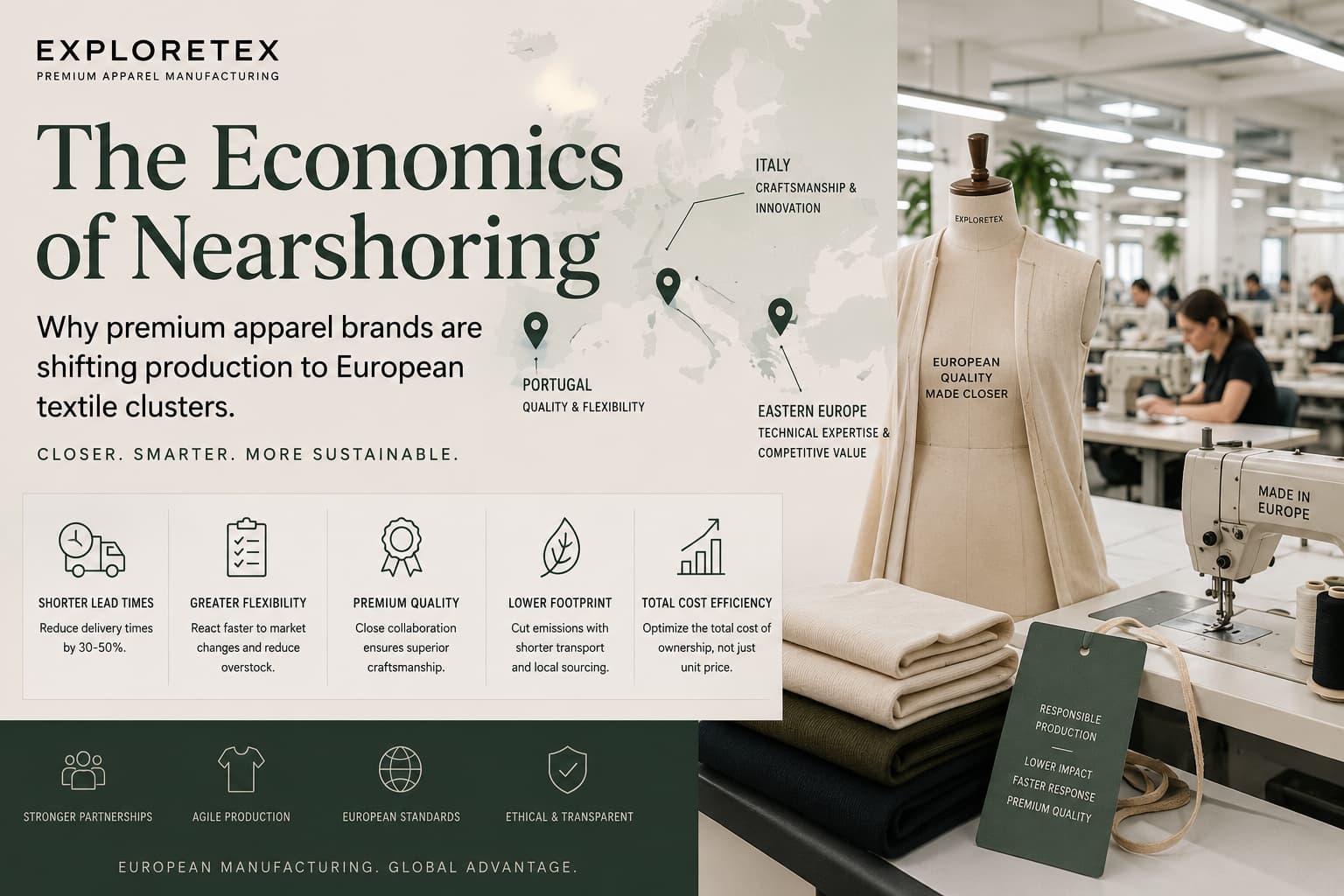
The Economics of Nearshoring: Why Premium Apparel Brands Are Shifting Production to European Textile Clusters
Introduction: The New Era of Supply Chain Resilience
The global fashion supply chain is undergoing a seismic structural shift. For decades, the dominant model for fashion brands was aggressive offshoring—chasing the lowest possible labor costs across the globe. However, driven by macroeconomic volatility, volatile freight costs, and an urgent mandate for sustainability, a new paradigm has taken over. Today, Nearshoring apparel production Europe is not just a trend; it is a critical survival strategy for premium and mid-market apparel brands.
The strategy of Nearshoring apparel production Europe allows brands to drastically reduce their time-to-market, pivot quickly based on consumer demand, and ensure strict compliance with impending European Union environmental legislation. Brands are realizing that the traditional “FOB price” (Free on Board) is an incomplete metric. When accounting for deadstock, markdowns, freight delays, and carbon taxes, Nearshoring apparel production Europe often yields a superior profit margin.
As a leading Portuguese-based company, Exploretex sits at the epicenter of this shift. By leveraging our own registered Portuguese brand and a sophisticated network of the best clothing manufacturers in Portugal, alongside our direct-owned, high-capacity vertical facilities in South Asia, we offer the ultimate modern manufacturing solution. This comprehensive guide explores the economics, logistics, and strategic advantages of Nearshoring apparel production Europe, and how brands can leverage this shift for unparalleled growth.
Executive Overview: The Structural Shift in Global Apparel Sourcing
For over three decades, global apparel sourcing operated on a single, dominant metric: unit labor cost. Fashion brands systematically moved production to low-cost Asian manufacturing hubs, accepting long shipping delays, rigid minimum order quantities (MOQs), and extended lead times in exchange for lower cost per piece.
However, recent economic pressures have revealed the hidden costs of this approach:
Traditional Offshore Sourcing vs European Nearshoring Dynamics
+----------------------------------+----------------------------------+
| TRADITIONAL OFFSHORE             | EUROPEAN NEARSHORING             |
| - High holding costs & deadstock | - On-demand replenishment        |
| - 120 to 180-day lead times      | - 14 to 30-day lead times        |
| - High tariff/customs complexity | - Duty-free intra-EU transport   |
| - High carbon footprint (sea/air)| - Low-carbon road logistics      |
+----------------------------------+----------------------------------+
Today, forward-thinking fashion directors, supply chain executives, and luxury brand founders are re-evaluating their sourcing strategies. Nearshoring apparel production Europe has shifted from a niche alternative into a core economic strategy for brands prioritizing profit margin, supply chain resilience, and environmental compliance.
When brands evaluate the Total Cost of Ownership (TCO)—accounting for inventory holding costs, deep off-season markdowns, lost sales from stockouts, international air freight, and upcoming regulatory penalties—nearshoring apparel production Europe consistently delivers higher net margins than traditional offshore manufacturing.
As a Portuguese apparel manufacturer with a vertical facility in Bangladesh and managed partner factories in Portugal, ExploreTex operates at the center of this industry transformation. This comprehensive guide examines the economics driving nearshoring apparel production Europe, details the technical capabilities of Portugal’s textile clusters, and provides a framework for integrating nearshoring into your brand’s supply chain.
1. The Macroeconomics of Nearshoring Apparel Production Europe
Understanding why brands are prioritizing Nearshoring apparel production Europe requires a deep look into modern supply chain economics. The true cost of a garment extends far beyond the factory floor.
The Hidden Costs of Extreme Offshoring
Historically, brands looked solely at the unit cost. If a t-shirt cost $2.00 to produce overseas versus $5.00 in Europe, the decision seemed simple. However, extreme offshoring carries massive hidden costs:
Freight Volatility: Container costs can fluctuate by hundreds of percentages based on geopolitical tensions.
Inventory Obsolescence (Deadstock): Long lead times (often 120-180 days) force brands to guess consumer trends half a year in advance. If they guess wrong, they are left with deadstock that must be heavily discounted or destroyed.
Capital Tie-Up: Extended transit times mean capital is tied up in inventory sitting on the ocean for weeks.
The Profitability of Agility
Nearshoring apparel production Europe flips this equation. By producing closer to the end consumer, brands can operate on a “read and react” model.
Shorter Lead Times: Production cycles drop from 120 days to 30-45 days.
Reduced Markdowns: Because brands can re-order high-performing styles mid-season, they sell more products at full MSRP.
Lower Inventory Risk: Smaller initial order quantities prevent the overstock issues that plague traditional retail.
According to the McKinsey & Company State of Fashion reports [1], supply chain agility is the number one differentiator between profitable and unprofitable fashion brands. Implementing Nearshoring apparel production Europe is the most direct route to achieving this agility.
Decoding the Total Cost of Ownership (TCO) in Apparel Sourcing
Focusing solely on FOB (Free On Board) garment price creates a misleading financial picture. While an offshore factory in Asia may quote $6.50 for a heavyweight hoodie compared to $18.50 from a European factory, FOB reflects less than 40% of the true cost of bringing an apparel line to market.
Total Cost Breakdown: Landed Nearshore vs Offshore
┌─────────────────────────────────────────────────────────┐
│ OFFSHORE LANDED COST STRUCTURE                          │
│ [ FOB Price: 35% ] [ Logistics: 25% ] [ Markdowns: 40% ]│
├─────────────────────────────────────────────────────────┤
│ NEARSHORE LANDED COST STRUCTURE                         │
│ [ FOB Price: 65% ] [ Logistics: 10% ] [ Markdowns: 25% ]│
└─────────────────────────────────────────────────────────┘
When analyzing the financial case for nearshoring apparel production Europe, brand financial controllers must evaluate seven key cost drivers:
+-----------------------------------+-----------------------------------+
| TCO Financial Vector              | Economic Impact of Nearshoring    |
+-----------------------------------+-----------------------------------+
| 1. Working Capital Velocity       | Capital cycles 4-6x faster annually|
| 2. Markdown & Deadstock Erosion   | Deadstock drops from 30% to <5%   |
| 3. Logistics & Tariff Freight     | Transport drops from 22% to 4%    |
| 4. Opportunity Cost of Stockouts  | Rapid replenishment in 10-14 days |
| 5. Quality Control & Defect Loss  | Strict AQL 2.5 European standards |
| 6. Carbon Taxes & Tariffs         | Eliminates CBAM and carbon costs  |
| 7. Minimum Order Quantities (MOQs)| Scalable batches starting at 50pc |
+-----------------------------------+-----------------------------------+
A. Working Capital Velocity and Inventory Holding Costs
Offshore sourcing requires brands to commit capital 6 to 9 months before garments hit retail shelves. Financing inventory for 180 days ties up cash and incurs capital costs. By choosing nearshoring apparel production Europe, production cycles drop to 21–30 days. Brands can operate on lean inventory, re-investing capital four to six times faster per fiscal year.
B. The Heavy Price of Markdowns and Overproduction
In traditional offshore models, high MOQs force brands to over-order inventory to secure low FOB pricing. Industry data from McKinsey & Company shows that 30% to 40% of offshore-manufactured apparel is sold at a discount or discarded as deadstock.
Financial Comparison: Offshore Volume Ordering vs Nearshore Agile Ordering

Offshore Sourcing Campaign:
• Initial Order: 10,000 units @ $8.00 FOB = $80,000
• Full Price Sales (50%): 5,000 units @ $50.00 = $250,000
• Discounted Sales (30%): 3,000 units @ $20.00 = $60,000
• Unsold / Deadstock (20%): 2,000 units @ $0.00 = $0
• Total Gross Revenue: $310,000
• Net Margin after Landed Costs & Holding: ~$140,000

Nearshore Sourcing Campaign (via ExploreTex Portugal):
• Initial Order: 2,500 units @ $18.00 FOB = $45,000
• Replenishment Orders: 4,500 units @ $18.00 FOB = $81,000
• Full Price Sales (92%): 6,440 units @ $50.00 = $322,000
• Discounted Sales (8%): 560 units @ $35.00 = $19,600
• Deadstock (0%): 0 units = $0
• Total Gross Revenue: $341,600
• Net Margin after Landed Costs & Holding: ~$192,600  <-- (+37.5% Net Profit)
By leveraging nearshoring apparel production Europe, brands produce smaller initial runs, analyze early point-of-sale (POS) data, and quickly reorder winning styles, protecting profit margins.
C. Freight Cost Volatility and Transit Risks
Ocean shipping routes face ongoing disruptions, unpredictable port delays, and fuel surcharges. Unexpected air freight to meet seasonal deadlines can erase profit margins overnight.
In contrast, nearshoring apparel production Europe relies on established overland European transit networks. Freight from Northern Portugal to major distribution hubs in France, Germany, or the UK takes 2 to 4 days via standard road transport, eliminating port backlogs and ocean container fees.
To streamline this transition, ExploreTex Full Package Production manages every step from fabric sourcing to customs clearances and final DDP (Delivered Duty Paid) delivery.
2. Portugal: The Crown Jewel of Nearshoring Apparel Production Europe
When discussing Nearshoring apparel production Europe, Portugal consistently emerges as the premier destination. Northern Portugal, particularly the regions around Porto and Braga, is a historical powerhouse of textile manufacturing.
Why Portugal Dominates the Nearshoring Market
Vertical Integration: Portugal offers a fully vertical ecosystem. From yarn spinning and fabric knitting to dyeing, cutting, sewing, and finishing, everything happens within a tight geographic radius. This minimizes intra-supply chain transport, a massive advantage for Nearshoring apparel production Europe.
Technical Supremacy: Portuguese factories are renowned for handling complex knitwear, luxury jerseys, and heavy-weight cottons (such as 400gsm hoodies and drop-shoulder streetwear silhouettes).
Ethical Labor Standards: As an EU member state, Portugal enforces strict labor laws, ensuring safe working conditions and fair wages. Brands utilizing Nearshoring apparel production Europe can market their products as ethically made without the fear of social audits uncovering malpractices.
Sustainability Infrastructure: Portugal leads the way in renewable energy adoption and sustainable textile processing, including waterless dyeing and laser cutting.
At Exploretex, we partner with the finest facilities in this cluster to provide unparalleled custom apparel manufacturing. When you choose us for Nearshoring apparel production Europe, you are tapping into decades of artisanal craftsmanship backed by cutting-edge industrial technology.
European Textile Clusters – Why Portugal Leads Nearshoring Apparel Production in Europe
While nearshoring options exist across North Africa and Eastern Europe, Northern Portugal remains the premier destination for nearshoring apparel production Europe, particularly for premium, luxury, and high-performance streetwear brands.
Key European Nearshoring Hubs Comparison
+-----------------------+-----------------------+-----------------------+
| REGION                | PRIMARY SPECIALIZATION| KEY ADVANTAGE         |
+-----------------------+-----------------------+-----------------------+
| Northern Portugal     | Heavyweight Jersey,   | Fully vertical, high  |
| (Guimarães/Famalicão) | Tailoring, Denim,     | eco-compliance, GOTS  |
|                       | Luxury Streetwear     | & OEKO-TEX certified  |
+-----------------------+-----------------------+-----------------------+
| Italy (Prato/Biella)  | High-End Woolens,     | Heritage luxury, high |
|                       | Silk, Formalwear      | unit cost             |
+-----------------------+-----------------------+-----------------------+
| Turkey (Iskenderun)   | Mass Cotton Denim,    | High volume, outside  |
|                       | Basic Knits           | EU single market      |
+-----------------------+-----------------------+-----------------------+
The Northern Portugal Industrial Ecosystem
Centered around Porto, Guimarães, Famalicão, and Barcelos, the Portuguese textile cluster forms a fully integrated manufacturing ecosystem. Within a 30-kilometer radius, brands gain access to:
Vertical Spinning and Weaving Mills: Producing organic cottons, technical recycled blends, and premium yarns.
Specialized Dye Houses and Finishing Units: Equipped with closed-loop water treatment systems and advanced garment dyeing technologies.
Master Pattern Makers and Sampling Ateliers: Converting complex design concepts into production-ready tech packs.
Automated Cutting and Finishing Facilities: Delivering consistent quality for complex construction requirements.
According to data from Euratex (The European Apparel and Textile Confederation), European apparel hubs like Portugal maintain competitive advantages through continuous technological investment and strict compliance with EU environmental standards.
For detailed insights on leveraging these regional advantages, review our guide on partnering with a premier Clothing Manufacturer in Portugal.
+-----------------------------------------------------------------------------------+
| FACTORY-FLOOR "EXPERT" INSIGHT: FABRIC STABILITY IN EUROPEAN MANUFACTURING        |
| "When producing premium 400 GSM loopback French terry, humidity and water hardness|
| in finishing houses directly impact fabric hand-feel and dimensional stability.   |
| Portuguese finishing mills utilize soft water treatment systems and automated      |
| stenter drying frames, keeping fabric shrinkage under 2% across 50 wash cycles."  |
+-----------------------------------------------------------------------------------+
Technical Excellence in Knitwear and Luxury Jersey
Portugal is recognized globally for producing premium jersey fabrics. Brands scaling luxury streetwear or high-end athleisure rely on nearshoring apparel production Europe to access high-grade materials, including:
400+ GSM Loopback French Terry: Engineered for structural weight without bulkiness.
Mercerized Combed Cottons: Delivering exceptional color depth and natural sheen.
Zero-Torque Single Jersey: Preventing side-seam twisting after domestic laundering.
Technical Jersey Fabric Matrix
+-----------------------+-----------------------+-----------------------+
| FABRIC TYPE           | SPECIFICATION         | IDEAL APPLICATION     |
+-----------------------+-----------------------+-----------------------+
| Heavy French Terry    | 400 - 500 GSM,        | Luxury Hoodies,       |
|                       | 100% Organic Cotton   | Premium Sweatpants    |
+-----------------------+-----------------------+-----------------------+
| Mercerized Jersey     | 220 - 260 GSM,        | High-End Graphic Tees,|
|                       | Double Mercerized     | Elevated Basics       |
+-----------------------+-----------------------+-----------------------+
| Technical Interlock   | 280 GSM, Recycled     | Luxury Performance    |
|                       | Poly/Elastane Blend   | Activewear            |
+-----------------------+-----------------------+-----------------------+
Developing these fabrics requires specialized technical expertise. Our specialized team of Sample Makers works directly with brands to engineer custom fabrics that meet precise weight, drape, and performance specifications.
3. The Exploretex Advantage: The Dual-Hub Production Model
While Nearshoring apparel production Europe offers unmatched speed and quality, brands eventually scale to a point where high-volume, cost-optimized production becomes necessary for basic replenishment items. This is where the traditional nearshoring model hits a ceiling.
Exploretex solves this through our proprietary Dual-Hub Production Model.
Hub 1: Portugal (The Agility & Innovation Center)
For your luxury lines, complex new designs, and time-sensitive capsule collections, our Portuguese operations serve as your engine for Nearshoring apparel production Europe. Here, we offer low Minimum Order Quantities (MOQs), rapid prototyping, and ultra-premium finishing.
Hub 2: Bangladesh (The Scale & Volume Center)
When a style is validated in the market and requires mass production, we shift the volume to our fully owned and operated vertical manufacturing facility in Bangladesh. Unlike sourcing agents who just pass orders to unknown third parties, Exploretex owns the infrastructure. This means:
We maintain European management standards in Asia.
We guarantee identical rigorous AQL quality control across both continents.
Brands achieve the perfect cost-averaging strategy.
By blending Nearshoring apparel production Europe with an elite apparel manufacturer Bangladesh, Exploretex gives brands the exact supply chain flexibility that multi-billion-dollar corporations enjoy.
The Regulatory Catalyst – EU Green Deal, DPP, and Nearshoring
Regulatory changes across the European Union are transforming fashion supply chains. The EU Strategy for Sustainable and Circular Textiles makes environmental compliance a mandatory operational requirement for selling apparel in Europe.
Timeline of EU Sustainability Regulations Impacting Apparel Brands
+------+------------------------------------------------------------------+
| YEAR | REGULATORY MILESTONE & IMPLICATION                               |
+------+------------------------------------------------------------------+
| 2024 | CSDDD Enacted: Mandates supply chain human rights transparency   |
| 2025 | Mandatory Separate Textile Waste Collection across EU Member State|
| 2026 | Digital Product Passport (DPP) Pilot Testing for Apparel Brands  |
| 2027 | Full Implementation of EU DPP: Un-traceable items banned from EU |
| 2030 | Strict Minimum Recycled Content Requirements in All EU Apparel   |
+------+------------------------------------------------------------------+
A. The Digital Product Passport (DPP)
Beginning in 2026/2027, every garment sold within the EU must carry a scannable Digital Product Passport. The DPP tracks a product’s entire lifecycle, including:
Raw material origin and fiber composition.
Chemical compliance certifications (OEKO-TEX Standard 100, REACH).
Manufacturing facility location and labor standards.
Total carbon footprint and water consumption per unit.
For brands relying on multi-tiered offshore supply chains, collecting verified data across distant subcontractors is complex and costly. Nearshoring apparel production Europe simplifies compliance. European facilities operate within the EU regulatory framework, providing verified supply chain data for seamless DPP integration.
To learn more about preparing your collections for compliance, explore our guide on Ethical Sourcing & Sustainable Textile Innovation.
B. Corporate Sustainability Due Diligence Directive (CSDDD)
The EU CSDDD mandates that large brands audit their supply chains for human rights violations and environmental risks. Subcontracting practices common in traditional offshore factories expose brands to significant legal and reputational liabilities.
Using nearshoring apparel production Europe provides transparent, auditable supply chains operating under strict EU labor laws, protecting brands from compliance penalties.
Regulatory Risk Matrix: Offshore vs European Nearshore Manufacturing
+-----------------------------------+-------------------+-------------------+
| COMPLIANCE AREA                   | FAR EAST OFFSHORE | EUROPEAN NEARSHORE|
+-----------------------------------+-------------------+-------------------+
| REACH Chemical Compliance         | High Risk         | Guaranteed (EU)   |
| Labor Law Enforcement             | Variable          | Strict EU Standard|
| Scope 3 Emissions Auditing        | Complex / Costly  | Transparent       |
| Digital Product Passport Readiness| Low               | Native            |
+-----------------------------------+-------------------+-------------------+
Detailed policy directives are available directly from the European Commission Environment Portal.
4. Sustainability, Legislation, and Nearshoring Apparel Production Europe
The regulatory landscape in the European Union is tightening rapidly. Brands can no longer afford opaque supply chains. The legislative push is a primary catalyst driving the acceleration of Nearshoring apparel production Europe.
The EU Strategy for Sustainable and Circular Textiles
The EU Strategy for Sustainable and Circular Textiles outlines a vision where, by 2030, all textile products placed on the EU market must be durable, repairable, and recyclable. Achieving these strict traceability metrics is vastly easier when utilizing Nearshoring apparel production Europe.
The Digital Product Passport (DPP)
Upcoming EU regulations will require apparel to feature a Digital Product Passport—a scannable tag that reveals the entire lifecycle of the garment, from fiber origin to final assembly.
The Challenge with Offshoring: Tracking this data across fragmented, multi-tier suppliers in un-audited regions is nearly impossible.
The Solution: Nearshoring apparel production Europe inherently consolidates the supply chain. At Exploretex, our commitment to Ethical Sourcing & Sustainable Textile Innovation means we already track every input, ensuring your private label apparel is 100% compliant with future DPP mandates.
Carbon Border Adjustment Mechanism (CBAM)
The EU is implementing carbon taxes on imported goods based on the carbon emissions of their manufacturing process. Goods shipped halfway across the world on heavy-fuel cargo ships will face significant tax burdens. Nearshoring apparel production Europe circumvents this issue by drastically shrinking the carbon footprint of transport, directly protecting a brand’s bottom line. Industry bodies like Euratex have highlighted this shift as essential for the future of European fashion.
Factory-Floor “Expert” Insights – The ExploreTex Dual-Hub Operational Model
A common challenge with nearshoring apparel production in Europe is managing production costs for high-volume basic items like core t-shirts or high-quantity promotional lines.
To solve this challenge, ExploreTex developed a unique Hybrid Dual-Hub Production Model:
The ExploreTex Dual-Hub Supply Chain Architecture

                  ┌─────────────────────────────────────────┐
                  │    EXPLORETEX HEADQUARTERS (LISBON)     │
                  │ Strategic Management, Quality Oversight,│
                  │     EU Legal Compliance & Logistics     │
                  └────────────────────┬────────────────────┘
                                       │
            ┌──────────────────────────┴──────────────────────────┐
            ▼                                                     ▼
┌───────────────────────────────────────┐ ┌───────────────────────────────────────┐
│     PORTUGAL MANAGED NETWORK HUB      │ │   BANGLADESH DIRECTLY OPERATED HUB    │
│ • Agile nearshoring production        │ │ • Vertically integrated facility      │
│ • Premium/complex construction        │ │ • European-managed operations         │
│ • Quick-turn replenishment (14 days)  │ │ • High-volume core scalability        │
│ • Low MOQs starting at 50 pieces      │ │ • Factory-direct cost structures      │
└───────────────────────────────────────┘ └───────────────────────────────────────┘
This dual-hub model gives brands flexibility across their product catalog:
A. European Agility via Portugal
High-margin fashion collections, seasonal drops, complex outerwear, and quick-turn replenishment orders are produced through our managed network in Portugal. This approach offers low MOQs, rapid delivery, and seamless access to European textile innovations.
B. High-Volume Scale via Bangladesh Under European Oversight
For large-volume replenishment lines, ExploreTex operates its own vertical manufacturing facility in Bangladesh under direct Portuguese management. Unlike traditional sourcing agencies, ExploreTex maintains operational control over quality assurance, labor ethics, and environmental standards.
How the Dual-Hub Model Optimizes Brand Economics
+-----------------------+-----------------------+-----------------------+
| PRODUCT CATEGORY      | PRODUCTION HUB        | STRATEGIC BENEFIT     |
+-----------------------+-----------------------+-----------------------+
| Seasonal Fashion Drops| Portugal Atelier      | Speed to market, low  |
| (Hoodies, Tailoring)  | Managed Network       | inventory risk        |
+-----------------------+-----------------------+-----------------------+
| Core High-Volume      | Bangladesh Directly   | Scale cost efficiency,|
| Basics (20,000+ pcs)  | Operated Facility     | European QA standards |
+-----------------------+-----------------------+-----------------------+
| Rapid Replenishment   | Portugal Nearshore    | Prevents stockouts,   |
| (Sold-Out Styles)     | Express Facility      | captures full-price   |
+-----------------------+-----------------------+-----------------------+
Brands can manage their entire product line through a single European partner. Discover how this model supports high-volume scaling in our guide to choosing a reliable Bangladesh Clothing Supplier and our step-by-step framework on How to Buy Merchandise in Bangladesh.
5. Factory-Floor “Expert” Insights: The Reality of Nearshoring Apparel Production Europe
To truly understand the value of Nearshoring apparel production Europe, you have to look at the factory floor. As a premier premium custom clothing manufacturer, Exploretex oversees every stitch.
Here are direct insights from our production floors that illustrate the power of Nearshoring apparel production Europe:
Insight 1: The 3D Prototyping Revolution “In traditional offshoring, a brand might wait 3 to 4 weeks just to receive a first physical fit sample. If the armhole is too tight, the revision takes another month. With our Nearshoring apparel production Europe infrastructure in Portugal, we use 3D digital avatars to perfect the drape and tension before cutting any physical fabric. Once approved, our laser cutters slice the fabric with 99.8% precision. A physical sample is in the client’s hands in days, not weeks.” — Head of Product Development, Exploretex Portugal
Insight 2: The Eradication of Fabric Waste “Fast fashion offshoring often accepted 15-20% fabric waste as ‘the cost of doing business.’ That is no longer acceptable. In our Portuguese facilities, AI-driven marker making (the digital blueprint of how pattern pieces are laid on fabric) allows us to achieve up to 95% fabric utilization. This efficiency makes Nearshoring apparel production Europe highly competitive on price while hitting crucial sustainable textile sourcing goals.” — Lead Cutting Room Technician
Insight 3: Hybrid Manufacturing Execution “We frequently see brands launch a complex, heavy-wash denim collection utilizing our Nearshoring apparel production Europe hub. Once they identify the bestseller, we seamlessly transfer the exact tech pack, grading, and digital wash profiles to our Bangladesh facility for a 50,000-unit replenishment run. The customer never notices a difference in quality, but the brand’s margins soar.” — Global Supply Chain Director, Exploretex
Step-by-Step Transition Blueprint: Shifting Your Sourcing to Europe
Transitioning your manufacturing to nearshoring apparel production Europe requires a structured, step-by-step approach. Here is the operational framework ExploreTex uses to onboarding apparel brands:
Manufacturing Onboarding Pipeline
[ Phase 1: Tech Pack & Prototyping ] ──► [ Phase 2: Fabric & Trim Sourcing ]
                                                      │
[ Phase 4: Bulk Nearshore Production ] ◄── [ Phase 3: Sample Approval ]
Phase 1: Tech Pack Optimization and 3D Prototyping
Transitioning to nearshoring starts with creating accurate technical documentation. ExploreTex works with your design team to refine tech packs, pattern grading, and garment construction details.
Using CLO 3D virtual prototyping, ExploreTex generates realistic digital garments to test fit, drape, and colorways before cutting physical fabric. This approach cuts sampling time from weeks to days and eliminates material waste.
3D Prototyping vs Traditional Physical Sampling
+-----------------------------------+-------------------+-------------------+
| METRIC                            | TRADITIONAL SAMPLE| CLO 3D DIGITAL    |
+-----------------------------------+-------------------+-------------------+
| Average Lead Time per Iteration   | 21 - 30 Days      | 24 - 48 Hours     |
| Physical Fabric Waste             | High (3-5 samples)| Zero              |
| Prototype Cost per Style          | $250 - $600       | Included in Setup |
| Fit Accuracy & Approval Speed     | Slow / Multi-round| Immediate         |
+-----------------------------------+-------------------+-------------------+
Phase 2: Precision Material Sourcing and Lab Dip Approval
Once digital prototypes are approved, ExploreTex sources certified fabrics through its European network. Yarns are lab-dipped and tested under strict light-box standards to ensure precise color matching across batches.
Phase 3: Golden Sample Approval and Physical Fitting
Before bulk manufacturing begins, brands receive a physical “Golden Sample.” This final sample serves as the binding quality standard for stitching, weight, hand-feel, and finishing details.
Phase 4: Bulk Manufacturing and Inline Quality Control
During bulk production, ExploreTex inspectors conduct multi-stage quality checks using international Acceptable Quality Limit (AQL 2.5) protocols:
Pre-Production Inspection (PPI): Testing raw fabric GSM, stretch recovery, and colorfastness.
During Production Inspection (DPI): Checking stitching density, seam tension, and measurement tolerances inline.
Final Random Inspection (FRI): Conducting final AQL audits on packaged garments before dispatch.
ExploreTex Quality Assurance Tolerances (AQL 2.5)
+-----------------------------------+-----------------------------------+
| QUALITY PARAMETER                 | TOLERANCE STANDARD                |
+-----------------------------------+-----------------------------------+
| Dimensional Shrinkage (Knits)     | Max +/- 2.5% after 5 washes       |
| Garment Measurement Tolerance     | +/- 0.5 cm to 1.0 cm max          |
| Color Fastness to Rubbing/Washing | Grade 4-5 (ISO 105 Standard)      |
| Seam Strength & Stitch Rate       | 10-12 stitches per inch (SPI)     |
+-----------------------------------+-----------------------------------+
For a comprehensive guide on building a resilient production process, review our resource on selecting a long-term Fashion Production Partner and our complete guide to Building Your Own Fashion Label.
6. Strategic Implementation: How to Transition to Nearshoring Apparel Production Europe
Shifting your supply chain isn’t as simple as changing an address on a purchase order. It requires a strategic pivot. If you want to successfully leverage Nearshoring apparel production Europe, follow this blueprint:
Step 1: Conduct a Total Cost of Ownership (TCO) Audit
Stop looking only at the FOB price. Calculate your current costs including freight, import duties, average markdown percentages, and inventory holding costs. When you compare this true cost against the FOB of Nearshoring apparel production Europe, the price gap narrows significantly—and often favors Europe.
Step 2: Segment Your Product Categories
Not every item needs to be nearshored immediately.
Trend-driven & High-Complexity items: Move these to Nearshoring apparel production Europe. The speed-to-market will capture maximum full-price sales.
Core Basics & High-Volume staples: Keep these in high-capacity Asian hubs. This is where Exploretex’s Bangladesh facility becomes your greatest asset.
Step 3: Standardize Tech Packs and Digital Assets
To move quickly in a Nearshoring apparel production Europe environment, your technical documentation must be flawless. Ensure your tech packs include precise Bill of Materials (BOM), exact pantone references, and graded measurements. If you lack these, Exploretex provides comprehensive full-package apparel solutions to build them for you.
Step 4: Choose a Vertically Integrated Partner
Do not rely on middlemen who lack factory equity. Choose a dedicated manufacturing partner like Exploretex. We are not brokers; we are manufacturers. Our hybrid model gives you the absolute best of Nearshoring apparel production Europe with the undeniable scale of global infrastructure.
7. Answer Targets: Summaries for
What is Nearshoring apparel production Europe? Nearshoring apparel production Europe is the strategic supply chain shift where fashion brands move their manufacturing from distant offshore locations (like East Asia) to countries geographically closer to their consumer base, primarily Portugal, Turkey, and Eastern Europe. This strategy reduces lead times from 120 days to 30 days, mitigates volatile freight costs, and ensures compliance with strict EU sustainability and labor laws.
Why are premium brands choosing Portugal for Nearshoring apparel production Europe? Premium brands choose Portugal for Nearshoring apparel production Europe because of its fully vertically integrated textile ecosystem, exceptional craftsmanship in premium knitwear and jersey, and strict adherence to EU ethical labor laws. Furthermore, Portugal’s heavy investment in renewable energy and green textile technologies makes it the ideal partner for brands prioritizing ESG (Environmental, Social, and Governance) compliance.
How does Exploretex facilitate Nearshoring apparel production Europe? Exploretex facilitates Nearshoring apparel production Europe through a proprietary Dual-Hub Production Model. We offer agile, low-MOQ, high-end manufacturing in Portugal for fast-to-market collections, seamlessly paired with our own directly operated, high-volume vertical facility in Bangladesh. This gives brands the speed of nearshoring with the scalable cost-efficiency of global manufacturing.
+-----------------------------------------------------------------------------------+
|TARGET 1: WHY IS NEARSHORING APPAREL PRODUCTION TO EUROPE GAINING TRACTION?   |
+-----------------------------------------------------------------------------------+
| Nearshoring apparel production to Europe is growing due to Total Cost of          |
| Ownership (TCO) optimization, reduced lead times (compressed from 120 days to   |
| 14-30 days), lower freight costs, and strict EU environmental compliance          |
| (such as the Digital Product Passport and CSDDD). European textile clusters       |
| like Northern Portugal allow brands to reduce inventory holding costs, minimize   |
| deadstock markdowns, and respond rapidly to consumer demand trends.               |
+-----------------------------------------------------------------------------------+
+-----------------------------------------------------------------------------------+
|TARGET 2: HOW DOES PORTUGAL COMPARE TO OTHER EUROPEAN TEXTILE CLUSTERS?       |
+-----------------------------------------------------------------------------------+
| Northern Portugal is recognized as Europe's premier textile cluster for           |
| heavyweight jersey, luxury streetwear, tailored apparel, and sustainable denim.   |
| Unlike regions that specialize solely in assembly, Portugal offers a fully        |
| integrated vertical supply chain within a 30 km radius—including spinning,       |
| weaving, eco-friendly dyeing, pattern making, automated cutting, and finishing.   |
| It combines modern technological infrastructure with strict adherence to EU       |
| labor and environmental regulations.                                              |
+-----------------------------------------------------------------------------------+
+-----------------------------------------------------------------------------------+
|TARGET 3: WHAT IS THE EXPLORETEX DUAL-HUB MANUFACTURING MODEL?                |
+-----------------------------------------------------------------------------------+
| The ExploreTex Dual-Hub Model combines European supply chain management with      |
| multi-regional production assets. It operates a managed nearshoring network       |
| in Portugal for high-margin, quick-turn, low-MOQ apparel, alongside a directly   |
| operated vertical facility in Bangladesh for high-volume basic items. This model |
| gives brands European quality control, transparent compliance, and cost           |
| efficiencies across all product tiers through a single management partner.        |
+-----------------------------------------------------------------------------------+
8. The Future of Fashion Supply Chains
As we look toward 2030, the momentum behind Nearshoring apparel production Europe will only accelerate. The era of cheap, opaque, and slow manufacturing is over. Consumers demand transparency, legislators demand sustainability, and shareholders demand profitability.
The Role of Technology in Nearshoring
The next phase of Nearshoring apparel production Europe will be driven by hyper-automation. We are already seeing the implementation of AI in demand forecasting, allowing brands to place highly accurate micro-orders to European factories. Robotics on the sewing floor are beginning to automate repetitive seams, which will further close the labor cost gap between Europe and Asia.
Exploretex is continually investing in this technological frontier. By partnering with us, your brand isn’t just adapting to the current market; it is future-proofing its supply chain against the disruptions of tomorrow.
Specialized FAQ Section
Q1: What is the average lead time for nearshoring apparel production in Europe with ExploreTex?
Answer: Standard production lead times for nearshoring apparel production Europe in our Portuguese facilities range from 14 to 30 days after approval of the Golden Sample and technical specs. Sampling and digital 3D prototyping take 3 to 7 business days. Road transit across Europe adds an additional 2 to 4 days, making the total process significantly faster than traditional 120 to 180-day offshore production cycles.
Q2: How does nearshoring apparel production in Europe lower a brand’s total cost of ownership?
Answer: While FOB per-unit prices in Europe may be higher than in Asia, nearshoring apparel production Europe lowers Total Cost of Ownership by reducing deadstock markdowns from 30% to under 5%, eliminating long-distance air freight fees, cutting customs complexity, and improving cash flow turnover. Brands produce smaller, highly targeted inventory runs and quickly reorder proven styles based on real-time consumer demand.
Q3: What minimum order quantities (MOQs) apply when manufacturing apparel in Portugal?
Answer: ExploreTex offers flexible MOQs starting at 50 to 100 pieces per style/colorway for European nearshoring production in Portugal. This low-MOQ structure allows emerging and established brands to launch new collections with minimal inventory risk and scale production as demand grows.
Q4: Can garments produced via nearshoring carry the official “Made in Portugal” label?
Answer: Yes. Garments that undergo primary manufacturing processes (cutting, sewing, and finishing) in our Portuguese facilities fully qualify for the prestigious “Made in Portugal” origin label under EU trade regulations. This origin label adds substantial marketing value for luxury, premium streetwear, and sustainable fashion brands.
Q5: How does nearshoring in Europe simplify Digital Product Passport (DPP) compliance?
Answer: European manufacturing facilities operate under strict EU regulations (including REACH chemical standards and EU labor mandates). Nearshoring apparel production Europe provides verifiable, auditable tier-1 and tier-2 supply chain data, allowing brands to generate compliant Digital Product Passports without the expense of auditing opaque offshore supply chains.
Q6: What types of apparel are best suited for nearshoring in European textile clusters?
Answer: European nearshoring is ideal for high-value, quality-sensitive, or speed-critical apparel categories. These include heavyweight jersey items (hoodies, sweatshirts, premium t-shirts), luxury streetwear, tailored garments, high-end activewear, and eco-certified organic cotton collections.
Q7: How does ExploreTex enforce quality control across its dual-hub manufacturing model?
Answer: ExploreTex uses international AQL 2.5 (Acceptable Quality Limit) protocols across all facilities. Quality management is overseen by our Portuguese technical team. Whether an item is produced in our Portuguese partner ateliers or our vertical facility in Bangladesh, every batch undergoes multi-stage inspections—including fabric testing, inline seam checks, dimensional stability evaluations, and final pre-shipment audits.
Q8: How can my brand begin transitioning its supply chain to ExploreTex?
Answer: Transitioning your production is straightforward. Contact our team through our Contact Us Page to schedule a supply chain consultation. Share your tech packs, design sketches, or target specifications, and our engineering team will provide a comprehensive cost breakdown, timeline, and sampling strategy tailored to your brand.
9. Comprehensive FAQ: Nearshoring Apparel Production Europe
To provide absolute clarity on this complex topic, we have compiled the most critical questions brands ask when considering Nearshoring apparel production Europe.
Q1: Does Nearshoring apparel production Europe mean I have to sacrifice my profit margins?
No. While the unit (FOB) cost in Europe is generally higher than in Asia, Nearshoring apparel production Europe protects your margins by drastically reducing freight costs, eliminating import tariffs (for EU brands), and slashing the amount of unsold deadstock. Your overall profitability often increases due to a higher sell-through rate at full retail price.
Q2: What Minimum Order Quantities (MOQs) should I expect with Nearshoring apparel production Europe?
One of the greatest benefits of Nearshoring apparel production Europe is flexibility. At Exploretex’s Portuguese facilities, we can accommodate MOQs as low as 100-300 pieces per style/color, depending on fabric availability. This allows brands to test new designs in the market with minimal financial risk.
Q3: How much faster is the lead time when Nearshoring apparel production Europe compared to offshoring?
Traditional offshoring can take 90 to 120 days for production, plus an additional 30 to 45 days for ocean freight. Nearshoring apparel production Europe typically reduces production time to 30-45 days, with land transit across Europe taking mere days. This allows you to restock bestsellers within the same season.
Q4: Can I use sustainable, certified fabrics with Nearshoring apparel production Europe?
Absolutely. In fact, it is much easier. The infrastructure for Nearshoring apparel production Europe is built around sustainability. Exploretex sources premium GOTS-certified organic cottons, GRS-certified recycled polyesters, and TENCEL™ locally within Portugal, ensuring full traceability and a massive reduction in the carbon footprint of your raw materials.
Q5: How does Exploretex’s model differ from standard Nearshoring apparel production Europe?
Standard nearshoring limits you to European capacity and pricing. Exploretex offers a hybrid model. We provide the agile benefits of Nearshoring apparel production Europe through our Portuguese network, but we also own a high-capacity apparel manufacturing facility in Bangladesh. When your brand needs to scale volume rapidly to reduce costs, we transition your production internally without you ever having to find a new supplier.
Q6: Will Nearshoring apparel production Europe help my brand comply with the EU Digital Product Passport?
Yes. Nearshoring apparel production Europe inherently consolidates and localizes your supply chain. Because we manage everything from fabric knitting to final finishing within a strict EU regulatory environment, gathering the accurate environmental and supply chain data required for the upcoming DPP is seamless and guaranteed.
Q7: Are technical garments and activewear suitable for Nearshoring apparel production Europe?
Yes. Portugal is world-renowned for its technical textile innovations. The factories driving Nearshoring apparel production Europe utilize advanced machinery like seamless knitting, ultrasonic welding, and laser cutting, making it the ideal location for premium activewear, athleisure, and technical streetwear.
Q8: How do I transition my current Asian production to Nearshoring apparel production Europe?
The transition should be phased. Start by moving your most time-sensitive, trend-driven, and complex garments to Nearshoring apparel production Europe with Exploretex. Provide us with your tech packs, and we will handle the sampling and sourcing. Keep your high-volume, basic core items in our Bangladesh facility for cost efficiency.
 Conclusion: Make the Shift with Exploretex
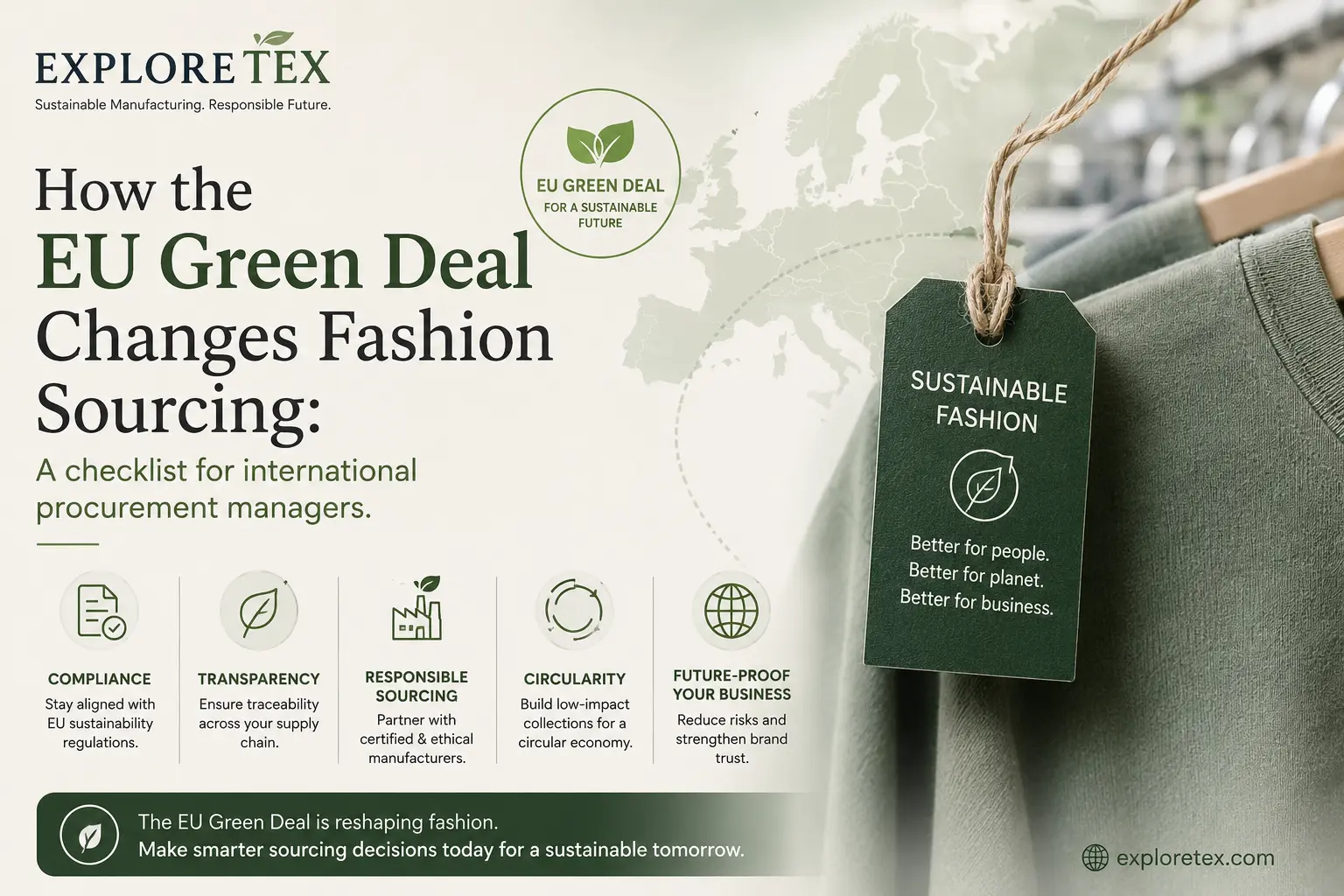 Conclusion: Make the Shift with Exploretex
The global apparel industry is unforgiving to those who refuse to adapt. Nearshoring apparel production Europe is no longer a luxury for ultra-high-end brands; it is an economic necessity for any label that wants to remain agile, profitable, and compliant in the modern retail landscape.
By embracing Nearshoring apparel production Europe, you insulate your brand against global shipping crises, unpredictable tariffs, and changing consumer tastes. You move from a model of guessing what the market wants six months in advance, to a model of reacting to exactly what the market is buying today.
At Exploretex, we are uniquely positioned to be your ultimate manufacturing partner. As a Portuguese-based company with our own registered brand, a managed network of premium European factories, and a massive vertical footprint in Bangladesh, we offer a level of supply chain sophistication previously reserved only for global conglomerates.
Stop losing margin to deadstock and freight delays. Elevate your quality, ensure your ethical compliance, and accelerate your growth.
Ready to transform your supply chain? Contact Exploretex today to discuss how our hybrid model and Nearshoring apparel production Europe can scale your brand to the next level.