
The Definitive Masterclass on Sourcing via a LEED Certified Garment Factory in Asia: Engineering Compliance, Carbon Neutrality, and Scale for Modern Apparel Brands
The global fashion landscape has passed a critical point of no return. Sourcing decisions are no longer guided solely by finding the lowest possible cut-make-trim (CMT) cost per unit. Today, international brands face shifting regulatory frameworks, rising eco-conscious consumer movements, and intense supply chain audits.
For fashion houses aiming to future-proof their operations, finding a world-class leed certified garment factory asia has changed from a optional marketing edge into a core survival strategy.
As an established European manufacturing partner, ExploreTex bridges the gap between strict Western design standards and clean, high-capacity industrial production. Operating a sophisticated dual-hub framework—headquartered with specialized partner factories inside Portugal and supported by a directly operated, high-capacity vertical production facility in Bangladesh—we provide the structural clarity required to navigate this green industrial shift.
In the modern fashion landscape, sustainability has shifted from a marketing buzzword to a measurable, data-driven mandate. With the European Union introducing the Digital Product Passport (DPP) and global consumers demanding absolute transparency, brands are fundamentally restructuring their supply chains. At the absolute forefront of this global shift is the decision to partner with a leed certified garment factory asia.
For fashion founders looking to how to start a clothing brand with an ethical backbone, understanding the operational mechanics of a leed certified garment factory asia is no longer optional—it is critical for long-term viability. ExploreTex, a Portuguese-based company with vertical manufacturing facilities in Bangladesh and a network of premium partner factories in Portugal, has engineered the perfect hybrid model. We bridge the gap between European design heritage and the immense, sustainable scale provided by a leed certified garment factory asia.
What Constitutes a LEED Certified Garment Factory Asia?
LEED (Leadership in Energy and Environmental Design), developed by the U.S. Green Building Council (USGBC), is the world’s most widely used green building rating system. When you source from a leed certified garment factory asia, you are utilizing a facility that has been rigorously audited for environmental performance across multiple vectors.
These facilities are not standard industrial sweatshops. A true leed certified garment factory asia is a marvel of modern engineering, designed from the ground up to reduce carbon footprints, minimize water consumption, and guarantee ethical labor conditions. In 2026, Bangladesh and surrounding regions host some of the highest-rated green facilities on the planet. By utilizing a leed certified garment factory asia, brands instantly elevate their Environmental, Social, and Governance (ESG) metrics.
Factory-Floor “Expert” Insights: The Anatomy of Green Production
What exactly happens inside a leed certified garment factory asia? As a manufacturer operating vertical facilities, ExploreTex ensures our operations exceed conventional standards. Here is the technical breakdown of what makes a leed certified garment factory asia vastly superior:
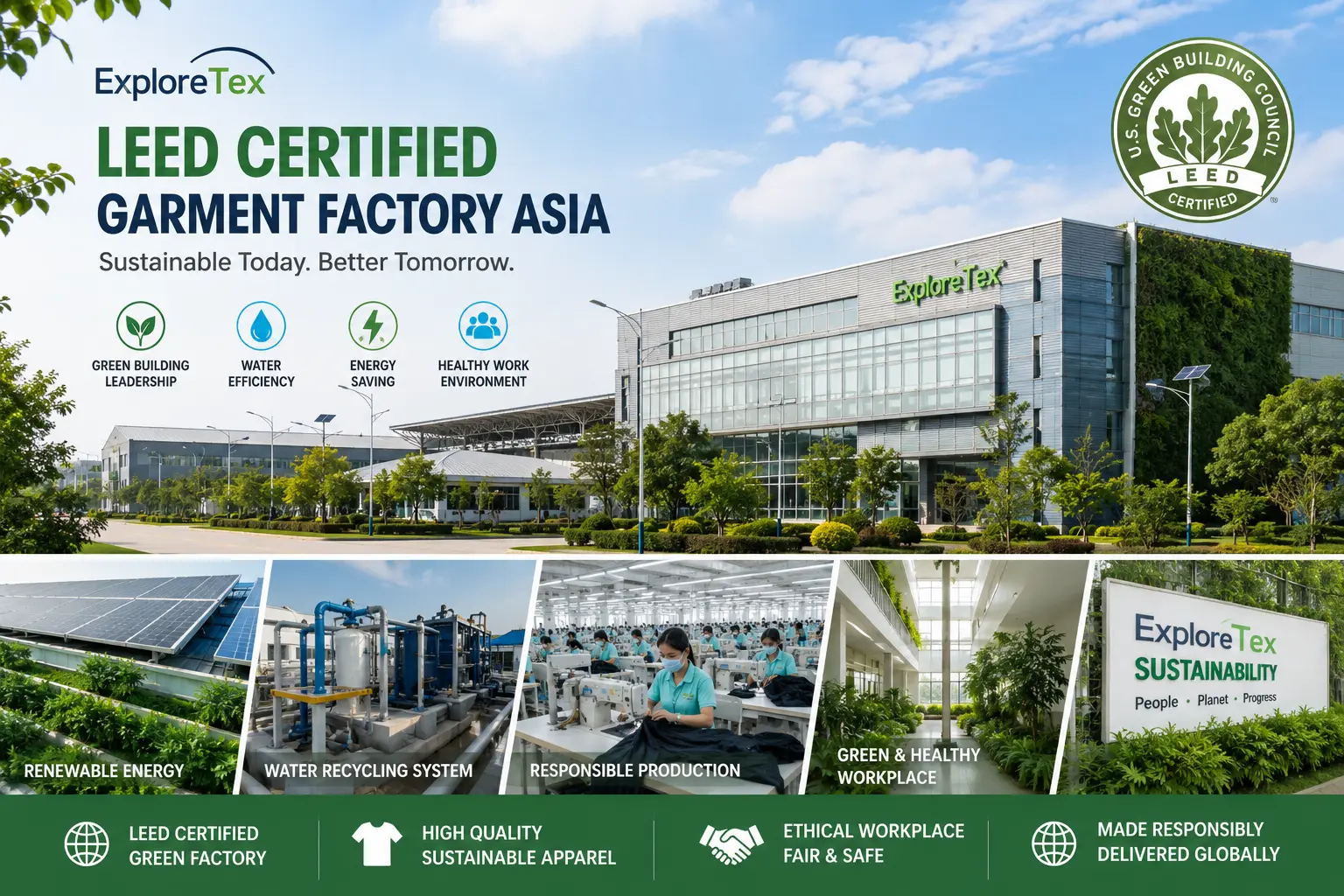
Renewable Energy Architecture: The roof of a leed certified garment factory asia is typically blanketed in industrial solar arrays. This allows the facility to generate up to 40% of its own operational power, drastically reducing reliance on fossil fuels.
Closed-Loop Water Management: In textile dyeing, water is the primary casualty. A top-tier leed certified garment factory asia utilizes Effluent Treatment Plants (ETP) and biological water purification to recycle up to 85% of wastewater.
Thermal Regulation without HVAC: A leed certified garment factory asia relies on passive cooling designs, high-efficiency insulation, and natural ventilation systems to keep the factory floor cool, reducing electricity use and prioritizing worker comfort.
When your brand utilizes turnkey clothing manufacturing services powered by a leed certified garment factory asia, these eco-efficiencies are directly woven into the story of your garments.
1. The Global Shift Toward Eco-Certified Sourcing Hubs
The international apparel supply chain is undergoing a structural redesign. For decades, brands accepted multi-tiered, non-transparent supply chains where energy usage was hidden and waste handling was overlooked. However, the introduction of strict legislative changes—such as the European Union’s Corporate Sustainability Due Diligence Directive (CSDDD) and the Ecodesign for Sustainable Products Regulation (ESPR)—has placed full legal responsibility for environmental impacts squarely onto apparel brands.
+-----------------------------------------------------------------+
|               THE TRADITIONAL vs. GREEN SUPPLY CHAIN            |
+-----------------------------------------------------------------+
|  Traditional Model:                                             |
|  [Raw Fiber] -> [High-Emission Mill] -> [Standard CMT Factory] |
|                     (High Carbon & Unregulated Water Waste)     |
|                                                                 |
|  ExploreTex Certified Eco-Model:                                |
|  [GOTS/GRS Fiber] -> [LEED Infrastructure] -> [Zero Waste Hub]  |
|                     (Solar Power & 40% Lower Resource Footprint)|
+-----------------------------------------------------------------+
When international sourcing teams evaluate options for a leed certified garment factory asia, they are looking for more than just a certificate on the wall. They are seeking factories engineered from the ground up to reduce energy consumption, maximize resource efficiency, and protect workers’ health.
Partnering with a globally verified infrastructure allows fashion labels to protect themselves against carbon taxes, secure high environmental, social, and governance (ESG) market valuations, and deliver genuine transparency to their customers.
2. Technical Breakdown: What LEED Certification Actually Demands from a Garment Factory
Leadership in Energy and Environmental Design (LEED), administered by the U.S. Green Building Council (USGBC), uses a rigorous point-based system across several performance categories to evaluate industrial facilities:
Sustainable Sites: Minimizing local ecosystem disruption, managing rainwater runoff, and mitigating urban heat island effects.
Water Efficiency: Requiring permanent, systemic drops in water consumption via advanced recycling loops and smart fixtures.
Energy and Atmosphere: Optimizing industrial HVAC systems, installing on-site renewable energy matrices, and eliminating ozone-depleting refrigerants.
Materials and Resources: Sourcing sustainable building components, diverting construction waste, and setting up ongoing recycling infrastructure on the factory floor.
Indoor Environmental Quality: Enhancing thermal control, ensuring high air filtration rates, and introducing abundant natural daylighting to protect worker health.
+-----------------------------------------------------------------------+
|                 LEED CERTIFICATION SCORECARD MATRIX                   |
+-----------------------------------------------------------------------+
|  LEED Certified   |  40–49 Points Baseline compliance systems         |
|  LEED Silver      |  50–59 Points Enhanced resource optimization      |
|  LEED Gold        |  60–79 Points Advanced systemic decarbonization   |
|  LEED Platinum    |  80+ Points   World-class clean production engineering |
+-----------------------------------------------------------------------+
To secure a top-tier green rank, a leed certified garment factory asia must change how it handles raw energy and daily waste. For example, our facility integrates high-efficiency manufacturing systems that lower carbon output right at the needle point, establishing a verifiable baseline for international environmental audits.
ExploreTex: The Bridge Between Portuguese Craftsmanship and Asian Scale
Many brands struggle when transitioning from small-batch production and startup incubation to mass retail distribution. Scaling up often forces brands to compromise on quality or ethics. ExploreTex eliminates this friction.
As a Portuguese-registered brand, we understand the luxury market. Our in-house technical teams work with the finest luxury textile suppliers in Portugal for high-end knitwear, bespoke tailoring, and low-MOQ premium drops. However, when volume is required, our infrastructure seamlessly shifts bulk production to our vertical leed certified garment factory asia in Bangladesh.
The Hybrid Sourcing Model Explained
This dual-hub approach means you get the best of both worlds. You benefit from the prestige of sustainable clothing manufacturers in Portugal for intricate design work, while achieving incredible margins and environmental compliance by executing the bulk run in a leed certified garment factory asia.
Whether you need full package clothing production or specific sourcing assistance, producing your collection in a leed certified garment factory asia ensures that your products align with global circular economy standards championed by organizations like the Ellen MacArthur Foundation.
3. Visualizing Sustainable Supply Chain Impact
The true value of an engineered eco-facility is found in its measurable environmental savings. To help supply chain directors, sourcing executives, and sustainability officers quantify these impacts, ExploreTex has developed an interactive performance calculator. This tool simulates the exact resource reductions achieved when moving volume from a standard, non-certified facility to our optimized operational infrastructure.
4. Factory-Floor “Expert” Insights: Inside the Engineering Ecosystem
To understand how an advanced apparel facility operates, we look directly at the factory floor. The operational systems of a premier leed certified garment factory asia combine structural design with automated production machinery.
On-Site Solar Arrays & Energy Microgrids
The roof of our facility acts as an active clean power plant. By installing high-efficiency photovoltaic panels across the entire building footprint, the facility generates up to 45% of its total operational energy independently. This grid integration protects production from local energy price spikes and helps client brands directly reduce their Scope 3 upstream manufacturing emissions.
Closed-Loop Hydro-Engineering & Rainwater Harvesting
Fabric processing and washing are notoriously water-intensive. To address this, a verified leed certified garment factory asia uses custom rainwater harvesting setups alongside a zero-discharge biological Effluent Treatment Plant (ETP). Rainwater is captured, filtered, and fed into production lines, while advanced processing loops clean and reuse up to 70% of the internal process water.
Thermodynamic Management & IAQ Optimization
Traditional apparel mills are often hot, dusty, and poorly ventilated, which can impact both worker health and fine fabric handling. Our facility features custom HVAC setups equipped with MERV-13 air filtration loops. These systems replace air continuously, maintaining stable humidity and comfortable temperatures without using excessive energy.
Mastering Eco-Friendly Textiles in a LEED Facility
You cannot build a sustainable brand without sustainable materials. A leed certified garment factory asia is specifically equipped to handle complex, eco-friendly textiles that traditional factories might destroy.
Working with a leed certified garment factory asia allows for precise handling of advanced fibers:
GOTS Certified Organic Cotton: Free from toxic pesticides, this fabric requires specialized handling. A leed certified garment factory asia guarantees farm-to-factory chain of custody, complying with the strict Global Organic Textile Standard (GOTS).
Recycled Polyester (rPET): Diverting plastic from oceans requires exact thermal calibrations during the cut-and-sew phase. A leed certified garment factory asia possesses the advanced machinery required to stitch these synthetic blends without micro-plastic shedding.
Tencel™ and Lyocell: These closed-loop wood-pulp fabrics require delicate tension control. The highly trained workforce in a leed certified garment factory asia ensures the drape and fit remain immaculate.
When you build your own fashion label utilizing a leed certified garment factory asia, your brand gains immediate credibility, allowing you to position your products in the premium market sector.
5. Financial Realities: The True ROI of Sustainable Sourcing
A common question among sourcing executives is whether choosing an eco-certified facility will hurt their margins. While building or upgrading to an eco-certified standard requires higher initial capital, the operational returns tell a completely different story.
| Operational Expense Category | Standard Factory Baseline | ExploreTex LEED Facility | Long-Term Strategic Margin Impact |
| Energy Consumption per Unit | Baseline Cost ($0.12–$0.15) | 40% Reduction ($0.07–$0.09) | Substantial insulation against volatile global fuel prices |
| Water Utility Costs | Standard Metered Rate | 60% Savings via Recycling Loop | High financial returns in regions with strict water pricing |
| Fabric Consumption Control | 3%–5% Average Cutting Waste | less than 1.5% via CAD-Opt Optimization | Immediate cost savings on raw materials per production run |
| Regulatory & Carbon Tariff Risks | High vulnerability to CBAM/CSRD penalties | Zero Penalty Status (Compliant) | Protects brands from unexpected compliance fines at port |
By reducing resource usage per needle point, a leed certified garment factory asia lowers long-term operational costs. This efficiency balance allows ExploreTex to offer stable, competitive pricing while maintaining the highest sustainability standards.
| Sustainability Metric | Conventional Factory | LEED Certified Garment Factory Asia | Brand Benefit |
| Water Recycling | < 10% | 85% – 95% via Closed-Loop ETP | Compliance with EU water-use regulations |
| Energy Source | 100% Fossil Fuels | Up to 40% On-Site Solar / Renewable | Reduced carbon tax liabilities |
| Worker Environment | Poor Ventilation | Passive Cooling, Abundant Daylight | Ethical labor transparency |
| Fabric Waste | 15% – 20% scrap | < 5% via Automated CAD Cutting | Higher fabric yield, lower unit costs |
| Certifications | Unverified | Platinum, Gold, or Silver LEED | Validated ESG marketing claims |
6. How ExploreTex Merges European Management with Advanced Asian Infrastructure
Choosing a global supply chain strategy shouldn’t force you to choose between high-volume cost efficiency and close proximity to your markets. ExploreTex solves this issue by using a unique Dual-Hub Production Model.
                   [EXPLORETEX LISBON HEADQUARTERS]
                     (EU-Binding Contracts & Tech Packs)
                                    |
            +-----------------------+-----------------------+
            |                                               |
            v                                               v
[NEARSHORE HUB: PORTUGAL]                     [OFFSHORE HUB: BANGLADESH]
- Low MOQ / Premium Luxury                    - High-Volume Scaling
- Quick-Turnaround Sampling                   - LEED Certified Infrastructure
- Specialized Partner Mills                   - Vertical Production Power
The Nearshore Hub: Precision Manufacturing in Portugal
For high-end fashion lines, fast seasonal adjustments, and low minimum order quantity (MOQ) collections, our network for clothing manufacture in Portugal provides exceptional speed and skill. Operating from our central offices in Lisbon, we create precise tech packs, manage local prototyping, and run agile production lines that get your products to European retail markets in record time.
The Offshore Hub: High-Capacity Sustainable Scaling in Bangladesh
When your brand is ready to scale up production to higher volume distributions, our directly managed vertical facility in Bangladesh provides the necessary capacity. Built to meet strict global certification criteria, this high-performance facility operates under European management standards to ensure fair living wages, safe working conditions, and complete transparency.
This dual-hub model gives your brand a single, trusted manufacturing partner capable of handling small, premium test launches in Europe as well as large-scale, sustainable production runs in Asia.
Maximizing Profitability with Sustainable Sourcing
A persistent myth in fashion is that utilizing a leed certified garment factory asia destroys profit margins. In reality, the opposite is true. While the initial setup of a leed certified garment factory asia requires massive capital expenditure from the manufacturer, the operational efficiency yields lower long-term costs.
Because a leed certified garment factory asia utilizes automated CAD software for zero-waste marker making, you pay for less wasted fabric. Because a leed certified garment factory asia relies on solar power, your production costs are insulated from fluctuating fossil fuel prices. Working with a leed certified garment factory asia through an experienced partner like ExploreTex means these savings are passed directly to your bottom line.
7. Step-by-Step Integration: Partnering with ExploreTex
Transitioning your brand’s production line to a sustainable framework requires careful planning and execution. To ensure a smooth transition, we guide our clients through an organized onboarding process.
8. Navigating International Apparel Compliance Matrices
To secure long-term success in the modern apparel industry, brands must ensure their products comply with a complex web of environmental, material, and social regulations.
                  GLOBAL APPAREL CERTIFICATION FRAMEWORK
  +-------------------------------------------------------------------+
  | MATERIAL INTEGRITY     | GOTS (Organic) / GRS (Recycled Standards) |
  +------------------------+------------------------------------------+
  | CHEMICAL SAFETY        | OEKO-TEX® Standard 100 / ZDHC Compliance |
  +------------------------+------------------------------------------+
  | SOCIAL ETHICS          | BSCI / SMETA / WRAP Operational Audits    |
  +------------------------+------------------------------------------+
  | STRUCTURAL PERFORMANCE | LEED Certified Building & Energy Grids   |
  +-------------------------------------------------------------------+
Our vertical manufacturing network is regularly audited and certified by leading global bodies, allowing your brand to easily demonstrate its compliance to investors, regulators, and consumers alike:
Social & Ethical Safeguards: Fully certified under BSCI, WRAP, and SMETA guidelines to ensure fair wages, workplace safety, and transparent operations.
Material Integrity Standards: Validated by the Global Organic Textile Standard (GOTS) and the Global Recycled Standard (GRS) to guarantee clear traceability from raw fiber to finished garment.
Chemical Safety Controls: Compliant with OEKO-TEX® Standard 100 and Zero Discharge of Hazardous Chemicals (ZDHC) frameworks to protect end consumers from harmful substances.
Specialized FAQ Section
Q1: What exactly makes a facility a leed certified garment factory asia? A: A leed certified garment factory asia has been independently audited by the USGBC and awarded a rating (Certified, Silver, Gold, or Platinum) based on strict criteria regarding energy use, water efficiency, indoor environmental quality, and sustainable building materials.
Q2: Why should a European or US brand use a leed certified garment factory asia instead of producing locally? A: A leed certified garment factory asia offers an unmatched combination of massive production scale and verified eco-efficiency. While ExploreTex provides Portuguese manufacturing for luxury small-batch items, utilizing a leed certified garment factory asia for bulk volume provides necessary cost efficiency without sacrificing environmental integrity.
Q3: Does sourcing from a leed certified garment factory asia help with EU Digital Product Passport compliance? A: Absolutely. A leed certified garment factory asia provides the transparent, traceable data (water usage, carbon offset, ethical labor metrics) required to satisfy upcoming EU transparency legislation.
Q4: How does ExploreTex manage quality control inside a leed certified garment factory asia? A: We deploy our own European-trained management teams directly to our vertical leed certified garment factory asia. We implement strict AQL 2.5 standards to ensure that every garment produced matches the premium quality established in our Portugal hubs.
9. Comprehensive FAQ Section
What makes a garment factory “LEED Certified” compared to standard apparel mills?
A factory earns this designation by meeting strict resource criteria set by the USGBC. Unlike standard facilities that focus only on production output, a verified green facility must achieve measurable performance targets in energy reduction, water recycling, building material sustainability, and indoor air quality.
Why should a clothing startup prioritize working with an ethical clothing manufacturer?
For new apparel brands, your supply chain represents your biggest operational risk. Partnering with an experienced ethical clothing manufacturer for startups ensures your products comply with international trade rules from day one, helping you avoid compliance penalties and build a strong reputation for sustainability.
How does ExploreTex manage quality control across its dual-hub production system?
We maintain consistent, high-quality standards across both our European partner mills and our Asian facilities by using unified management software. Our Lisbon offices handle the initial design files and tech packs, and our on-site quality teams use identical AQL testing protocols at every stage of production.
Can brands order small, low-MOQ test collections from your sustainable network?
Yes, our flexible production network is designed to support brands through every stage of growth. You can launch and test new designs using our low-MOQ capabilities for sportswear clothing and lifestyle collections in Portugal before scaling up to high-volume production runs in our major Asian manufacturing hub.
What advantages does an integrated custom sustainable fashion manufacturer offer?
Working with a fully integrated custom sustainable fashion manufacturer streamlines your entire development cycle. It combines material sourcing, custom fabric dye runs, advanced pattern engineering, and mass production under a single management system, which eliminates communication delays and reduces material waste.
How does your Asian facility reduce its total energy consumption?
Our facility minimizes energy use by combining smart building design with efficient production equipment. We use automated LED lighting arrays, variable-speed servo motors on our sewing lines, and an advanced HVAC system that maintains a comfortable working environment with minimal electricity consumption.
What documentation do you provide to verify a sustainable supply chain for EU customs?
We supply complete, audited documentation for every production run. This includes official GOTS and GRS transaction certificates, verified bills of lading, certificates of origin, and clear facility compliance statements to ensure your shipments pass smoothly through European customs ports.
Why is finding a reliable partner for finding a clothing manufacturer for a fashion brand so critical?
Your choice of production partner directly affects your profit margins, delivery schedules, and product quality. Working with a structured manufacturing partner like ExploreTex takes the guesswork out of the production process, allowing you to focus your energy on marketing and scaling your brand.
What types of apparel can be manufactured within your sustainable vertical facility?
Our high-capacity facility is equipped to produce a wide range of knit and woven apparel. We handle everything from standard t-shirts and hoodies to high-performance private label activewear collections, kids’ wear, and detailed workwear garments built to exact technical specifications.
How does your facility handle fabric waste during the cutting process?
We use advanced CAD pattern nesting software to lay out designs efficiently before a single piece of fabric is cut. This smart placement reduces raw material waste to less than 1.5%, and any remaining fabric scraps are collected and sent to certified regional facilities to be recycled into new yarn.
What are the real costs and steps involved when launching your own clothing line?
Launching a successful brand requires clear visibility into your development expenses. Our detailed guide on the actual cost breakdown for clothing production helps you plan your budget accurately, covering everything from initial pattern development to final bulk logistics.
How can international brands begin working with ExploreTex?
Getting started is simple. You can read through our comprehensive guide on launching your own clothing line to understand the development process, or reach out directly to our team in Lisbon for a personalized consultation and production quote.
10. Strategic Summary & Clean Sourcing Execution
The choice to build a more sustainable apparel brand requires choosing partners that value operational clarity, environmental responsibility, and scalable quality. ExploreTex removes the complexity from international sourcing by combining European design standards with highly efficient, eco-certified manufacturing facilities.
+-------------------------------------------------------------------+
|               EXPLORETEX PRODUCTION ENGINE SUMMARY                |
+-------------------------------------------------------------------+
|  Headquarters     : Lisbon, Portugal (EU Contracts & Tech Packs)  |
|  Nearshore Support: Agile Partner Mills across Portugal           |
|  Offshore Scale   : LEED Certified Vertical Infrastructure        |
|  Certifications   : GOTS, GRS, OEKO-TEX, BSCI, SMETA, WRAP        |
+-------------------------------------------------------------------+
Whether you are an established international retailer looking to optimize your carbon footprint or a growing brand searching for an experienced find a clothing manufacturer for fashion brand partner, our team provides the reliable, certified infrastructure you need to scale your business sustainably. Contact our Lisbon headquarters today to map out your production transition.
 Conclusion: Securing Your Supply Chain for the Future
 Conclusion: Securing Your Supply Chain for the Future
The fashion industry is undergoing a permanent correction. Brands that rely on opaque, environmentally destructive supply chains will be legislated out of existence or abandoned by consumers. Securing production space in a leed certified garment factory asia is the most strategic move a fashion founder can make today.
Through ExploreTex, you don’t just get a supplier; you gain an agile, global infrastructure. By fusing the luxury finishing of Portugal with the sustainable, high-volume output of a leed certified garment factory asia, your brand is positioned for limitless growth.
Ready to transition your production to a truly green supply chain? Contact our team today to discuss how we can integrate your brand with a world-class leed certified garment factory asia.