
The Ultimate Guide to Scaling with a Premium Denim Manufacturing Factory Bangladesh
When scaling a global apparel brand, finding the right production partner is the most critical decision a fashion label will make. In today’s highly competitive market, the search inevitably points toward a denim manufacturing factory bangladesh. As the undisputed global leader in ready-made garments (RMG), Bangladesh has evolved from a basic cut-and-sew hub into a highly sophisticated, technologically advanced center for sustainable and premium apparel production. If you are seeking a reliable denim manufacturing factory bangladesh, understanding the infrastructure, processes, and sustainability metrics behind these facilities is essential for maximizing your return on investment.
Exploretex, a premier Clothing Manufacturer Portugal, has revolutionized this supply chain. By integrating a Portuguese management framework with a directly operated, state-of-the-art denim manufacturing factory bangladesh, Exploretex offers brands an unparalleled advantage. This comprehensive guide will dissect every aspect of working with a top-tier denim manufacturing factory bangladesh, from raw material sourcing and weaving to laser washing and final export.
Technical Overview & Strategic Sourcing Metrics
Modern apparel sourcing directors faces a complex challenge: balancing shrinking margins against increasingly strict global compliance mandates. For premium fashion houses, high-volume retail chains, and private label brands, navigating the international denim ecosystem requires deep infrastructure visibility. Finding an elite denim manufacturing factory bangladesh is no longer just a quest for low labor costs; it is an optimization problem involving vertical capabilities, chemical transparency, and legal accountability.
+--------------------------------------------------------------------------+
|                        EXPLORETEX DUAL-HUB FRAMEWORK                      |
+--------------------------------------------------------------------------+
|  [LISBON, PORTUGAL HEADQUARTERS]                                         |
|  - European Contract Law & IP Protection                                  |
|  - R&D, Tech Pack Engineering & Master Pattern Grading                   |
|  - Managed Low-MOQ & Luxury Partner Network                              |
+--------------------------------------------------------------------------+
                                    |
                                    v
+--------------------------------------------------------------------------+
|  [VERTICALLY INTEGRATED PRODUCTION HUB — BANGLADESH]                      |
|  - Wholly-Owned/Directly Operated Denim Manufacturing Facility           |
|  - In-House Spinning, Rope Dyeing, Weaving & Advanced Laundering         |
|  - AQL 1.5 Strict Quality Gates & End-to-End DDP Logistics               |
+--------------------------------------------------------------------------+
When building high-volume denim programs, brands often struggle with traditional sourcing agencies that act as disconnected middlemen. These entities add layers of cost while obscuring the production floor, leading to quality drift and missed shipping windows. The solution lies in an integrated operational footprint.
By partnering with a Portuguese-based enterprise that operates its own vertical denim manufacturing factory bangladesh, your brand bridges the gap between European design precision and South Asian industrial capacity. This configuration provides a legally binding European contract structure while utilizing high-capacity manufacturing infrastructure overseas.
1. Why Choose a Denim Manufacturing Factory Bangladesh?
The global denim market is projected to reach unprecedented valuations over the next decade. To meet this demand without sacrificing quality or profit margins, brands must utilize a world-class denim manufacturing factory bangladesh.
The Evolution of the Industry
Historically, denim production was centered in Europe and the United States. However, the high cost of labor and stringent environmental restrictions drove a massive shift in the global supply chain. Today, a modern denim manufacturing factory bangladesh is not just a lower-cost alternative; it is an innovation center. Over the past decade, significant investments have been made in green building infrastructure, automated sewing machinery, and waterless dyeing techniques.
Scale, Speed, and Compliance
Partnering with a sophisticated denim manufacturing factory bangladesh provides access to massive economies of scale. Facilities operating in this region can handle minimum order quantities (MOQs) scaling from a few thousand to millions of units per month. Furthermore, the modern denim manufacturing factory bangladesh operates under the strict oversight of the RMG Sustainability Council (formerly the Accord on Fire and Building Safety), ensuring that ethical labor practices, structural integrity, and worker safety meet the highest international standards.
When you choose a Bangladesh Clothing Supplier like Exploretex, you are not merely outsourcing production; you are integrating your brand with a highly compliant, vertically integrated powerhouse.
The Global Denim Sourcing Landscape in 2026
The global textile landscape has shifted from fragmented assembly networks to highly integrated hubs. Historically, brands sourced denim by purchasing open-market fabric from one region, shipping it to a cutting facility in another, and executing laundered finishes via third-party wet-processing plants. This fragmented approach creates significant supply chain liabilities. Today, a premier denim manufacturing factory bangladesh relies on complete verticality to eliminate these systemic points of failure.
The Role of Bangladesh in Modern Denim Production
Bangladesh has evolved into a leading hub for specialized woven apparel, particularly premium denim. The country features some of the highest concentrations of LEED-certified industrial facilities globally. This evolution is driven by massive domestic capital investments in automated rope-dyeing ranges, advanced shuttleless air-jet looms, and modern ecological laundering systems.
When your brand sources through a vertically integrated denim manufacturing factory bangladesh, you are accessing an ecosystem optimized for high-volume efficiency, raw material security, and strict compliance alignment.
Fragmented Supply Chain (High Risk):
[Yarn Supplier] ---> [Weaving Mill] ---> [Sewing Facility] ---> [Laundry Plant]
       ^                     ^                    ^                    ^
       +---------------------+-----------+--------+--------------------+
                                         |
                            (Four Points of Interruption)

Vertical Supply Chain via ExploreTex (Low Risk):
+--------------------------------------------------------------------------+
|          EXPLORETEX VERTICAL DENIM MANUFACTURING FACTORY BANGLADESH       |
|  [Spinning] -> [Rope Dyeing] -> [Weaving] -> [Sewing] -> [Eco-Laundry]   |
+--------------------------------------------------------------------------+
Eliminating Sourcing Risk via European Corporate Governance
Operating through an independent broker presents clear structural risks: lack of accountability, unauthorized subcontracting, and IP vulnerabilities. ExploreTex mitigates these issues by maintaining its corporate headquarters and design R&D operations in Lisbon. This allows brands to secure their production contracts under European business regulations while accessing a directly operated denim manufacturing factory bangladesh.
This operational model ensures that your technical designs, master pattern blocks, and material requirements are executed precisely on the factory floor, backed by the legal security of an EU-registered entity.
To establish authentic foundational context for your sourcing portfolio, review our Clothing Manufacturer Portugal strategic overview, which explains how our European headquarters manages global product lifecycles.
2. The Anatomy of a World-Class Denim Manufacturing Factory Bangladesh
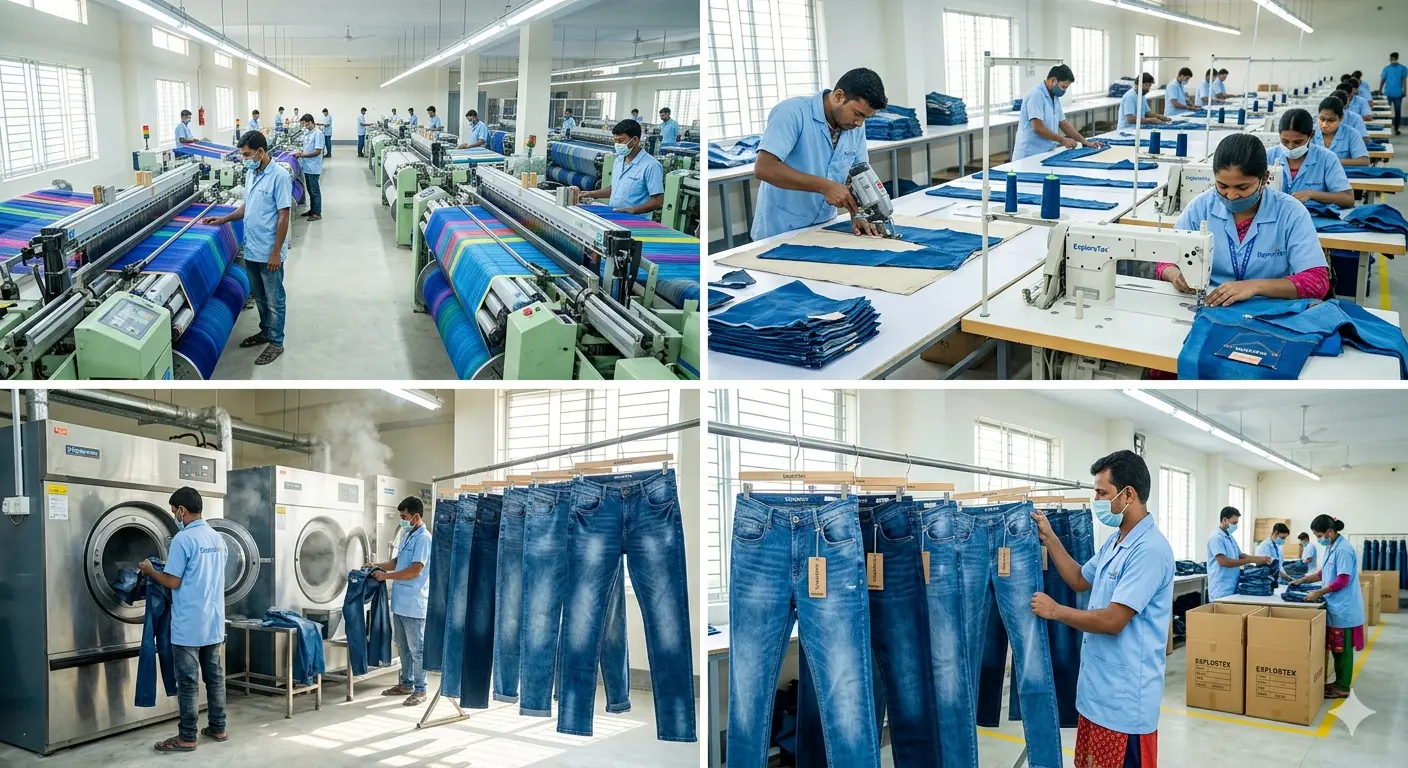
To truly understand the value generated by a leading denim manufacturing factory bangladesh, we must look inside the facility. Exploretex operates a high-capacity Full Package Clothing Production hub that manages the entire lifecycle of a pair of jeans.
Raw Material Sourcing
Every exceptional garment begins with premium fibers. A top-tier denim manufacturing factory bangladesh typically works with a variety of cotton blends, including conventional cotton, organic cotton, Better Cotton Initiative (BCI) cotton, and recycled post-consumer waste. Exploretex leverages its roots as a European company to integrate Luxury Textile Suppliers in Portugal into the supply chain. This means a brand can source ultra-premium, high-thread-count fabrics or custom linen blends from Europe and import them directly into the denim manufacturing factory bangladesh for cost-effective assembly.
Spinning and Weaving
Before fabric can be cut, it must be spun and woven. The weaving process in a comprehensive denim manufacturing factory bangladesh utilizes advanced shuttleless looms (such as air-jet and rapier looms) that can weave fabric at incredibly high speeds while minimizing defects.
A premium denim manufacturing factory bangladesh will offer various weave types:
Right-Hand Twill: The standard, traditional diagonal weave found in most jeans.
Left-Hand Twill: A softer weave that yields a more comfortable garment.
Broken Twill: A zigzag weave pattern designed to prevent the pant leg from twisting after washing.
Selvedge Denim: Woven on traditional shuttle looms, favored by heritage brands for its clean, finished edge.
The Dyeing Process (Indigo and Sulfur)
Dyeing is a hallmark of denim production. The best denim manufacturing factory bangladesh utilizes continuous rope dyeing or slasher dyeing machines. Because indigo dye does not naturally adhere well to cotton, the yarn must be repeatedly dipped and oxidized. A forward-thinking denim manufacturing factory bangladesh will utilize closed-loop water systems during this phase to recapture and reuse dye, significantly drastically reducing water consumption and chemical runoff.
Anatomy of a Vertical Denim Manufacturing Facility
True vertical integration means controlling every step of production, from raw cotton bale to retail-ready garment. For an elite denim manufacturing factory bangladesh, this end-to-end control is essential for maintaining consistent fabric cast, weight, and tensile strength across large manufacturing runs.
+-------------------------------------------------------------------+
|               VERTICAL DENIM PRODUCTION FLOW CHART                |
+-------------------------------------------------------------------+
|  1. RAW COTTON SOURCING   --> BCI & GOTS Certified Fiber Inputs   |
|  2. RING & OPEN-END SPINNING--> Controlled Slub & Twist Profiles  |
|  3. CONTINUOUS ROPE DYEing--> Automated Indigo Hydrosulfite Baths |
|  4. AIR-JET WEAVING       --> High-Efficiency Shuttleless Looms  |
|  5. SANFORIZATION         --> Controlled Shrinkage Stabilization  |
+-------------------------------------------------------------------+
Raw Material Sourcing and Spinning Precision
The manufacturing process starts with rigorous fiber selection. A world-class denim manufacturing factory bangladesh utilizes premium long-staple cotton sourced through verified channels like the Better Cotton Initiative (BCI) or the Global Organic Textile Standard (GOTS). These raw fibers are processed in advanced spinning facilities capable of producing both ring-spun and open-end yarns.
By adjusting twist factors and slub profiles during spinning, the factory can engineer custom warp yarns that provide targeted structural characteristics, such as authentic vintage textures or high-density modern weaves.
Continuous Indigo Rope Dyeing and Slashing
The distinctive character of premium denim depends on precise indigo penetration. In our vertical denim manufacturing factory bangladesh, warp yarns undergo continuous rope dyeing. Thousands of yarn ends are gathered into ropes, fed through consecutive vats of reduced indigo dye, and exposed to oxygen to build deep, consistent color profiles.
[Yarn Ropes] -> [Indigo Bath 1] -> [Oxidation Skying] -> [Indigo Bath 2-8] -> [Washing/Slashing]
This precise mechanical process ensures “ring dyeing,” where only the outer layers of the yarn absorb the pigment while the core remains white. This is critical for achieving high-contrast laser fades and authentic washes during final laundering.
High-Speed Weaving and Sanforization
Once dyed and coated with protective sizing agents, the yarns move to the weaving department. Utilizing modern, high-speed air-jet and rapier looms, a top-tier denim manufacturing factory bangladesh produces weights ranging from lightweight 4.5 oz shirting denim to heavy 14.5 oz rigid selvedge fabrics.
After weaving, the raw “greige” fabric undergoes sanforization—a process of controlled mechanical stretching and steaming. This stabilizes the fabric, reducing residual wash shrinkage from over 10% down to less than 2%, ensuring predictable garment sizing after manufacturing.
To see how these raw woven fabrics fit into a broader production ecosystem, review our comprehensive analysis of the Top Garments Manufacturers in Bangladesh, which highlights our facility’s capacity and operational standards.
3. Step-by-Step Production at a Denim Manufacturing Factory Bangladesh
Once the fabric is woven, the physical construction of the garment begins. The operational flow within an Exploretex-managed denim manufacturing factory bangladesh is a masterclass in efficiency and precision.
Step 1: CAD Pattern Making and Grading
Accuracy begins in the digital realm. A modern denim manufacturing factory bangladesh utilizes Computer-Aided Design (CAD) software to create patterns. Once the base size is perfected, the technical team performs mathematical size grading, ensuring the fit remains consistent whether the garment is an XS or a 5XL.
Step 2: Automated Spreading and Cutting
To minimize fabric waste, a denim manufacturing factory bangladesh relies on computerized markers that dictate exactly how pattern pieces should be laid out on the fabric roll. Automated spreading machines lay out hundreds of plies of heavy denim, which are then precisely cut using computer-guided laser or blade cutting systems. This automation ensures zero human error in the foundational shapes.
Step 3: Sewing and Assembly
The sewing floor is the heart of any denim manufacturing factory bangladesh. Denim requires specialized, heavy-duty machinery due to the fabric’s thickness.
An advanced denim manufacturing factory bangladesh will deploy specific machines for distinct tasks:
Feed-Off-The-Arm Machines: Used for creating the durable inseams and outseams.
Bartack Machines: Used to reinforce high-stress areas like belt loops and pocket corners.
Overlock Machines: Used to finish the raw edges of the fabric inside the garment.
Engineering Sustainable Wet and Dry Laundering Finishes
The modern denim consumer demands sophisticated visual finishes without the environmental footprint traditionally associated with wet processing. Meeting these expectations requires an advanced laundry department within the denim manufacturing factory bangladesh. This facility must combine precise dry craftsmanship with eco-friendly wet processing technologies.
+-------------------------------------------------------------------+
|             SUSTAINABLE LAUNDRY TECHNOLOGY MATRIX                 |
+-------------------------------------------------------------------+
|  TECHNOLOGY       | TRADITIONAL METHOD     | ECOLOGICAL REPLACEMENT|
+-------------------+------------------------+----------------------+
|  Visual Fading    | Potassium Permanganate | High-Precision Laser |
|  Abrasive Texture | Volcanic Pumice Stone  | Cellulase Bio-Enzymes|
|  Color Stripping  | Heavy Chlorine Bleach  | Gaseous Ozone Systems|
+-------------------------------------------------------------------+
Advanced Laser Micro-Structuring
Traditional dry finishing relied heavily on hand-scraping and potassium permanganate (PP) spraying to create worn characteristics. An environmentally compliant denim manufacturing factory bangladesh replaces these hazardous chemical processes with high-speed laser finishing systems.
These digital lasers execute precise design files directly onto the indigo-dyed cotton, burning away microscopic layers of dye with pixel-level accuracy. This approach allows brands to reproduce authentic whiskers, chevrons, and localized destruction consistently across thousands of units without weakening the underlying fabric structure.
Gaseous Ozone Stripping and Bio-Enzymatic Washing
To achieve bright, low-contrast vintage shades, a modern denim manufacturing factory bangladesh utilizes gaseous ozone technologies. Ozone systems convert ambient oxygen into an active gas that reacts with surface indigo molecules, neutralizing the color without degrading the cotton fiber. This process eliminates the need for harsh chlorine bleaching cycles, reduces rinsing steps, and leaves zero toxic residues in the process water.
Additionally, to replicate the look of stone-washed denim without the structural wear and sludge accumulation caused by volcanic pumice, our facility uses advanced bio-enzymatic laundering. Cellulase enzymes break down loose surface fibers naturally, yielding a soft, premium hand-feel and high visual contrast while preserving the physical integrity of the garment seams.
Ozone Laundering Phase:
[Ambient O2] ---> [Ozone Generator] ---> [Dry/Damp Garment Chamber] ---> [Indigo Reduction] ---> [Safe O2 Exhaust]
Closed-Loop Water Treatment Infrastructure
An elite denim manufacturing factory bangladesh operates with a focus on resource conservation. Our facility features a modern Effluent Treatment Plant (ETP) combined with a Reverse Osmosis (RO) recycling loop. This configuration allows the laundry department to reclaim, filter, and reuse up to 85% of its process water. By minimizing fresh water consumption and capturing chemical residues before discharge, the facility helps brands meet strict international environmental standards and verify their eco-claims.
For details on how our sustainable wet processing lines operate under European corporate oversight, explore our dedicated page for a premier Denim Manufacturer Bangladesh, which outlines our specialized capabilities.
The Dual-Hub Model: Strategic Sourcing Architecture
                       [ BRAND CLIENT ]
                              |
               (Secure Contract, Law & Compliance)
                              v
             [ EXPLORETEX LISBON HEADQUARTERS ]
               /                            \
      (Low-MOQ / Luxury)             (High-Volume Scaling)
             /                                \
            v                                  v
  [PORTUGAL PARTNER NETWORK]         [EXPLORETEX DENIM FACTORY BANGLADESH]
  - Luxury Premium Denim             - High-Volume Fabric Sourcing
  - Rapid Trend Prototyping          - Automated Rope Dyeing & Assembly
  - Quick-Turn Restocks              - Low Unit Cost at High Scale
Modern apparel brands must manage dual priorities: remaining agile enough to capture immediate market trends while securing the volume and margin benefits of long-term production runs. ExploreTex addresses this challenge through a hybrid operational structure that links our European headquarters with our vertical denim manufacturing factory bangladesh.
Balancing Specialized Production Across Geographic Hubs
Not every garment belongs in a high-capacity facility. Brands often face difficult decisions when allocating production between European artisanal workshops and large-scale overseas factories. Our infrastructure simplifies this process.
By operating a managed partner network in Portugal alongside our large-scale denim manufacturing factory bangladesh, we give sourcing teams the flexibility to allocate production dynamically based on volume, complexity, and margin targets.
| Sourcing Variable | Portugal Partner Factories | Bangladesh Vertical Factory |
| Primary Production Profile | Luxury Capsule Collections, Rapid Testing | High-Volume Core Programs, Scaled Denim |
| Minimum Order Quantities | 100 to 300 Units Per Style | 1,000 to 3,000+ Units Per Style |
| Average Production Lead Time | 4 to 6 Weeks (Ex-Factory) | 8 to 12 Weeks (Ocean Freight Included) |
| Logistics Integration | Intracontinental Trucking (Direct EU) | FOB Port of Chittagong or Integrated DDP |
| Finishing Strengths | Hand-Crafted Wash Effects, Custom Tailoring | Automated Laser Fading, Vertical Indigo Ranges |
To understand how to optimize your styles across these locations, consult our detailed analysis, Which Clothes Come From Bangladesh?, which offers a clear framework for balancing margin goals with production speed.
Streamlining Sourcing via Full Package Production
Managing separate fabric mills, trim suppliers, customs brokers, and assembly lines introduces complexity and risk. ExploreTex eliminates these friction points by providing full package apparel production. Our team coordinates the entire process: sourcing raw materials, executing pattern grading, managing bulk manufacturing at our denim manufacturing factory bangladesh, handling export documentation, and managing final delivery.
Full Package Sourcing Path:
[Tech Pack Intake] -> [Sourcing & Spinning] -> [Bulk Assembly] -> [Customs & Duty Clearance] -> [DDP Warehouse Delivery]
This integrated approach gives brands clear visibility over their supply chain through a single point of contact, protecting margins from unexpected import fees or logistics delays.
To see how this comprehensive management model protects your brand’s bottom line from technical prototype to final delivery, read about our Full Package apparel solutions.
Step 4: Washing, Fading, and Finishing
What truly distinguishes a standard facility from a high-end denim manufacturing factory bangladesh is the wash house. Raw denim is stiff and uniform; washing gives the garment its character, softness, and “lived-in” aesthetic. Historically, this required millions of gallons of water and harsh chemicals. Today, a sustainable denim manufacturing factory bangladesh uses ozone machines and laser fading.
Laser Whiskering: Instead of workers manually scrubbing jeans with sandpaper, a top denim manufacturing factory bangladesh uses precision lasers to burn the indigo dye off the fabric, creating whiskers and honeycombs in seconds with zero water.
Ozone Washing: By converting oxygen into ozone gas, a denim manufacturing factory bangladesh can bleach and fade garments with zero water and zero harsh chemicals, reverting the gas back to oxygen when finished.
Enzyme Washing: Using organic enzymes instead of pumice stones to soften the fabric, reducing sludge and water pollution.
If you want to experience this level of innovation, Contact Us at Exploretex to discuss how our denim manufacturing factory bangladesh can upgrade your brand’s finishings.
4. Sustainability and Compliance in a Denim Manufacturing Factory Bangladesh
The era of fast fashion without accountability is over. Consumers demand transparency, and a reputable denim manufacturing factory bangladesh must lead the charge in eco-friendly production. Bangladesh is currently home to the highest number of LEED certification (Leadership in Energy and Environmental Design) green garment factories in the world.
When sourcing from a denim manufacturing factory bangladesh, brands should expect:
Solar Power Integration: A leading denim manufacturing factory bangladesh will generate a significant portion of its energy through rooftop solar arrays.
Effluent Treatment Plants (ETP): It is mandatory for any legitimate denim manufacturing factory bangladesh to have a fully functional biological ETP to treat wastewater before it is released back into the environment.
Material Traceability: Through Exploretex, your denim manufacturing factory bangladesh production can utilize GOTS-certified organic cotton, ensuring that no toxic pesticides were used in the farming process.
By combining the regulatory strictness of Custom Apparel Manufacturing from Europe with the sustainable infrastructure of a denim manufacturing factory bangladesh, Exploretex ensures your brand remains highly competitive and ethically sound.
Technical Quality Assurance and AQL 1.5 Enforcement
A low unit price provides no benefit if the final shipment arrives with high defect rates, inconsistent sizing, or weak seams. To prevent these issues, our denim manufacturing factory bangladesh operates under an international quality assurance protocol managed directly by our European technical directors.
+--------------------------------------------------------------------------+
|                 EXPLORETEX AQL 1.5 QUALITY ASSURANCE GATE                 |
+--------------------------------------------------------------------------+
|  GATE 1: INCOMING RAW MATERIAL INSPECTION (4-Point Fabric Inspection System)|
|                                    |
|  GATE 2: INLINE PRODUCTION MONITORING (Sectional Seam Strength Testing)  |
|                                    |
|  GATE 3: POST-LAUNDRY SHADE SORTING (Spectrophotometer Color Grouping)   |
|                                    |
|  GATE 4: FINAL RANDOM AUDIT (Acceptable Quality Limit 1.5 Strict Release)|
+--------------------------------------------------------------------------+
The Four-Point Fabric Grading System
Before any fabric reaches the cutting tables, it undergoes automated inspection using the standard 4-Point System. This protocol identifies and scores material anomalies—such as warp skips, oil stains, or uneven slubs—per hundred square yards.
By identifying and isolating defective fabric rolls prior to processing, our denim manufacturing factory bangladesh ensures that only uniform, structurally sound textiles proceed to the cutting department. This approach reduces fabric waste and prevents structural failures in the finished garments.
Inline Stress Profiling and Assembly Inspections
Denim garments experience significant mechanical stress during multi-hour laundering, enzyme washing, and high-temperature drying cycles. Consequently, our denim manufacturing factory bangladesh implements strict inline inspection checkpoints at every stage of assembly.
Sewing Line Quality Gates:
[Front Panel Assembly] -> QC Gate -> [Back Pocket Stitching] -> QC Gate -> [Waistband Joining] -> QC Gate
Specialized technicians continuously monitor critical construction details:
Stitches Per Inch (SPI): Maintained at a consistent 8-10 SPI using high-tensile core-spun polyester threads to prevent seam splitting.
Tack Reinforcements: Applied at high-stress points like pocket corners, belt loops, and the base of the fly zipper to ensure long-term durability.
Seam Strength Audits: Regular pull-testing on sewing line samples to verify mechanical resistance before final laundering.
Post-Laundry Spectrophotometric Shade Sorting
Because denim is a living fabric that responds dynamically to wet processing, slight variations in shade can occur even within the same production lot. To ensure consistency for retail environments, our denim manufacturing factory bangladesh utilizes automated spectrophotometric analysis.
Finished garments are scanned under standardized D65 daylight conditions and sorted into precise, narrow shade categories (e.g., Shade A, B, and C). This ensures that every pallet delivered to your distribution center displays consistent color matching on the retail floor.
[Finished Jeans] ---> [D65 Light Chamber Scan] ---> [Spectrophotometer Analysis] ---> [Shade Category Sort]
Final Random Audits under AQL 1.5
The final checkpoint for every production run is a formal audit conducted under Acceptable Quality Limit (AQL) 1.5 standards. Independent quality inspectors pull statistically random samples from finished, packed boxes to inspect for critical, major, and minor defects.
The shipment is cleared for export only if the total defect count falls strictly below the AQL 1.5 threshold. This rigorous standard minimizes return rates and ensures your production consistently meets international retail requirements.
For brands navigating the logistical steps of importing these high-quality shipments into the European market, our detailed guide, How Can I Import Clothes From Bangladesh?, outlines the process from factory floor to distribution warehouse.
6. Supply Chain Logistics, Tariffs, and Compliance Architecture
A predictable global supply chain relies on efficient logistics and full compliance transparency. Managing international trade barriers, duty structures, and customs frameworks is a core focus for our denim manufacturing factory bangladesh.
+--------------------------------------------------------------------+
|               TRADE LOGISTICS & FREIGHT TIME FRAMES                |
+--------------------------------------------------------------------+
|  PORT OF ORIGIN: Chittagong (BD)  ---> DESTINATION: Lisbon (PT)    |
|  - OCEAN FREIGHT TIME FRAME:           32 to 38 Days Transit       |
|  - TRANS-CONTINENTAL AIR FREIGHT:      4 to 7 Days Express         |
|  - TARIFF STRUCTURE MATRIX:            EBA Everything But Arms     |
|  - APPLICABLE DUTY RATE:               0% Preferential Tariff      |
+--------------------------------------------------------------------+
Leveraging Preferential Trade Frameworks
Sourcing from our denim manufacturing factory bangladesh offers significant financial advantages through established trade agreements. European Union buyers benefit directly from the Everything But Arms (EBA) initiative, which provides duty-free, quota-free access for apparel manufactured in Bangladesh.
Our logistics team manages all necessary compliance documentation, including GSP Form A Certificates of Origin, to ensure your shipments clear EU customs at a 0% preferential tariff rate. This structural advantage protects your gross margins from standard import duties.
Managing Logistics on DDP Terms
Navigating ocean freight bookings, container consolidation, port handling, and domestic customs clearance can overwhelm internal brand logistics teams. ExploreTex addresses this by managing shipments under Delivered Duty Paid (DDP) terms.
Our logistics infrastructure coordinates ocean freight from the Port of Chittagong, manages import customs processing at European gateway ports, and handles final truck delivery directly to your distribution center. This model gives your brand a single, transparent per-unit landed cost, eliminating unexpected logistics surcharges.
ExploreTex Managed DDP Logistics Chain:
[Factory Dispatch] -> [Chittagong Port] -> [Ocean Transit] -> [EU Port Clearance] -> [Landed Warehouse Delivery]
Maintaining International Compliance Standards
Modern corporate social responsibility requires complete transparency across your supply chain. Our denim manufacturing factory bangladesh operates in strict compliance with major international workplace safety, environmental, and ethical standards.
> **Compliance Certification Status Matrix:**
> * **Social & Ethical Management:** Audited via the Business Social Compliance Initiative (BSCI) and SEDEX (SMETA), ensuring fair living wages, reasonable working hours, and safe labor conditions.
> * **Structural & Building Safety:** Fully aligned with Accord/RMG Sustainability Council (RSC) fire and building safety standards.
> * **Chemical Management Protocols:** Certified under OEKO-TEX® Standard 100, ensuring all component materials—including pocket linings, sewing threads, and metal rivets—are free from harmful substances.

To verify these eco-credentials on global platforms, see the [Oeko-Tex Standard 100 Certified Directory](https://www.oeko-tex.com/) and review independent tracking via the [Textile Exchange Material Summary](https://textileexchange.org/) to confirm our supply chain compliance.
To see how these environmental material standards align with premium input options, read our specialized resource on Top Luxury Textile Suppliers in Portugal, which demonstrates how we combine premium European raw materials with efficient South Asian assembly lines.
5. Factory-Floor “Expert” Insights
To provide a deeper understanding of operations, we spoke with senior production managers overseeing our denim manufacturing factory bangladesh:
“The shift toward digitalization has transformed our denim manufacturing factory bangladesh. Ten years ago, pattern making and cutting were highly manual, which led to high fabric wastage. Today, our AI-driven marker software allows us to achieve up to 90% fabric utilization. In a high-volume denim manufacturing factory bangladesh, saving even 2% of fabric equates to massive cost savings for our clients.”
— Head of Cutting Operations, Exploretex Bangladesh Hub
“Brands often ask me what makes our denim manufacturing factory bangladesh different. It’s the wash house. Water is the most precious resource on earth. By transitioning 70% of our fading processes to laser and ozone technologies, our denim manufacturing factory bangladesh has reduced water consumption per garment by over 60%. We are delivering the exact same vintage looks, but doing it responsibly.”
— Lead Wash Technician, Exploretex
“Quality control in a denim manufacturing factory bangladesh cannot be an afterthought. We implement AQL (Acceptable Quality Limit) 1.5 standards. This means inspections happen continuously—at the cutting table, inline during sewing, and after washing. A true premium denim manufacturing factory bangladesh catches a dropped stitch before the garment ever reaches the finishing department.”
— Quality Assurance Director, Exploretex
Factory-Floor “Expert” Insights
A Note From Our Production Director: “Apparel manufacturing is a complex, human-driven process where success depends on precise planning before a single yard of fabric is cut. In denim manufacturing, the biggest challenges usually stem from inaccurate tech packs or a failure to account for how fabric behaves during washing. Below are key technical principles our teams use on the factory floor every day to keep bulk production running smoothly.”
Technical Principle 1: Managing Wet Processing Shrinkage Allowances
Denim fabric behaves dynamically, changing dimensions significantly during aggressive wet laundering, enzyme washing, or ozone treatments. To ensure accurate sizing, our pattern makers develop a custom “shrinkage matrix” for every fabric batch.
[Base Design Dimensions] x [Fabric Batch Shrinkage Factor] = [Precision Industrial Pattern Geometry]
If a 12 oz rigid fabric shows a 4.5% warp shrinkage and 2.1% weft shrinkage during testing, the master cutting patterns are adjusted proportionally. This ensures that the finished jeans match your specified size charts exactly after final laundering.
+-------------------------------------------------------------------+
|               SHRINKAGE FACTOR OVERRIDE PROFILES                  |
+-------------------------------------------------------------------+
|  FABRIC CAPABILITY | RAW STATE DIMENSION | POST-LAUNDRY SPECIFICATION |
+--------------------+---------------------+----------------------------+
|  100% Cotton Rigid | Warp: 104.5 cm      | Target: 100.0 cm           |
|  Comfort Stretch   | Weft: 106.0 cm      | Target: 100.0 cm           |
+-------------------------------------------------------------------+
Technical Principle 2: Minimizing Fabric Waste Through Digital Marker Efficiency
Raw material costs represent a large portion of the total garment expense. To maximize fabric utilization, our engineering team uses advanced computer-aided design (CAD) marking software to optimize cutting layouts.
Optimized Marker Layout (87.5% Efficiency):
+-------------------------------------------------------------------+
| [Front Panel] [Back Panel] [Yoke] [Pocket] [Front Panel] [Yoke]   |
| [Back Panel]  [Front Panel] [Pocket] [Back Panel] [Pocket]        |
+-------------------------------------------------------------------+
By nesting pattern pieces tightly across the usable fabric width, we target an operational efficiency line of 85% or higher. This digital planning reduces textile waste, lowers your per-unit production cost, and supports your brand’s sustainability goals.
Technical Principle 3: Ensuring Consistency in Indigo Cast and Dye Lots
Because indigo dyeing is a continuous chemical process, subtle variations in shade can develop over long production runs due to changes in dye concentration, bath temperature, or oxidation times. To maintain color consistency across large orders, our facility implements strict control measures:
Automated Chemical Replenishment: Computerized dosing pumps continually adjust indigo and sodium hydrosulfite levels in the dye vats.
Controlled Batch Sizes: Large production programs are split into defined, manageable dye lots.
Continuous Fabric Audits: Technicians use calibrated digital colorimeters to verify fabric color consistency in real time as it leaves the drying ranges.
6. Quality Control in a Denim Manufacturing Factory Bangladesh
Producing a high volume of garments requires an ironclad quality assurance (QA) protocol. A trusted denim manufacturing factory bangladesh operates on a multi-tiered inspection system.
Inline and End-of-Line Inspections
During the sewing process, a dedicated QA team inside the denim manufacturing factory bangladesh inspects garments directly on the production line (inline inspection). This ensures that if a machine is miscalibrated, the error is corrected immediately. Once sewing is complete, an end-of-line inspection checks for symmetry, correct seam allowance, and proper hardware attachment (rivets, buttons, and zippers).
Laboratory Testing
A premier denim manufacturing factory bangladesh will have an in-house laboratory to test fabric integrity. Before bulk production begins, the denim manufacturing factory bangladesh tests for:
Dimensional Stability (Shrinkage): Denim naturally shrinks. The denim manufacturing factory bangladesh washes samples to ensure the garment will still fit the consumer after their first home wash.
Tear and Tensile Strength: Making sure the fabric can withstand high tension.
Color Fastness: Testing how well the indigo dye holds up to rubbing (crocking) and washing.
7. The Exploretex Advantage: The Portugal-Bangladesh Hybrid
Why simply hire a standard denim manufacturing factory bangladesh when you can have a global dual-hub system? Exploretex is uniquely positioned because it is a Portuguese company that owns and operates its own denim manufacturing factory bangladesh.
This model provides the best of both worlds:
European Management & Communication: You communicate with our Lisbon-based team for apparel development and fulfillment. We speak your language, understand Western market trends, and handle all technical design and tech pack creation.
Unmatched Scaling & Pricing: Once the design is perfected in Portugal, the tech packs are sent to our directly operated denim manufacturing factory bangladesh. Because we own the facility, we bypass agency fees and offer genuine factory-direct pricing. This makes us the ultimate high-volume retail distribution partner.
Premium Sourcing: If your brand requires luxury elements, our European office handles premium fabric sourcing from Italian and Portuguese mills, importing them directly to our denim manufacturing factory bangladesh for assembly.
This end-to-end production framework ensures that whether you are a boutique streetwear label or a global retailer, our denim manufacturing factory bangladesh has the infrastructure to support your growth.
Comprehensive FAQ Section for Sourcing Directors
Q1: How does ExploreTex protect European buyers from the financial and logistical risks of traditional offshore sourcing?
Our operations utilize a Dual-Hub corporate structure. When your brand partners with ExploreTex, all manufacturing agreements, intellectual property guarantees, and terms of service are executed through ExploreTex Unipessoal Lda, a legally registered Portuguese company operating under EU business laws. This structure eliminates the legal vulnerabilities of dealing with unverified overseas entities.
Your designs and proprietary patterns are protected by European IP frameworks, while bulk production is handled directly through our vertical denim manufacturing factory bangladesh. This model gives your brand clear, reliable pricing without the risk of unauthorized subcontracting.
Q2: What are the specific Minimum Order Quantities (MOQs) for custom denim programs?
Our manufacturing minimums are structured around the technical requirements of vertical fabric production:
Custom Fabric Fabrications: For completely custom fabric weights, unique slub yarn profiles, or specialized fiber blends (such as organic cotton mixed with Tencel), the minimum requirement is 3,000 meters of fabric. This yield translates to roughly 1,500 to 2,000 units of finished jeans per style, depending on the pattern geometry.
Standard Stock Fabrications: If your brand utilizes our ready-to-cut stock fabrics (such as our standard 12 oz rigid cotton denim or 11 oz comfort stretch weaves), we can support lower minimums starting at 1,000 units per style/wash. This allows brands to offer multiple aesthetic finishes across a single base fabric profile.
Q3: How does the facility handle fabric shade consistency across high-volume shipments?
Controlling shade variation is a core priority for our denim manufacturing factory bangladesh. We manage this through integrated testing protocols:
[Raw Cotton Blending] -> [Automated Chemical Dosing] -> [Digital Spectrophotometer Sorting]
First, we use large-batch raw cotton blending to ensure uniform dye absorption across the yarn lots. Second, our rope-dyeing lines feature automated chemical dosing systems that maintain constant indigo and reduction agent levels in the vats. Finally, after laundering, all finished jeans are analyzed with digital spectrophotometers under standardized light boxes.
The garments are grouped into narrow shade categories before packing, ensuring that the stock delivered to your stores or warehouses presents a clean, uniform look on the retail racks.
Q4: What are the exact lead times from initial tech pack submission to final delivery?
Production timelines are split into clear, predictable phases:
+-------------------------------------------------------------------+
|               PRODUCTION TIMELINE DEVELOPMENT PHASES              |
+-------------------------------------------------------------------+
|  PHASE 1: Tech Pack Review, Pattern Grading & Fit Prototyping     |
|           Time Frame: 2 Weeks                                     |
|  PHASE 2: Pre-Production (PP) Sample Approval & Fabric Sizing     |
|           Time Frame: 2 Weeks                                     |
|  PHASE 3: Bulk Cutting, Sewing Assembly & Eco-Laundering Finishes|
|           Time Frame: 4 to 6 Weeks                                |
|  PHASE 4: Ocean Freight Transit & Port-of-Entry Customs Clearing  |
|           Time Frame: 4 to 5 Weeks (Integrated DDP Route)         |
+-------------------------------------------------------------------+
This structured workflow yields an average end-to-end timeline of 12 to 15 weeks for a comprehensive DDP delivery directly to European distribution facilities.
Q5: Can ExploreTex import premium fabrics from European mills for assembly in Bangladesh?
Yes. Our hybrid operational model is well-suited for this approach. For premium capsule lines or luxury streetwear collections, our material science teams source high-end fabrics directly from specialized luxury textile suppliers in Portugal. These premium materials are shipped in bond directly to our high-capacity denim manufacturing factory bangladesh.
This method combines high-end European fabric engineering with the efficient assembly and advanced laser laundering capabilities of our South Asian facility, allowing brands to optimize production costs while maintaining premium material quality.
Q6: How does the factory manage environmental compliance and chemical tracing?
Our manufacturing facility operates under strict international environmental frameworks. All wet processing lines follow the Zero Discharge of Hazardous Chemicals (ZDHC) roadmap, ensuring that no harmful substances enter the local water system.
Our facility’s waste processing lines filter and treat all production effluents before discharge, and our material inputs are fully traceable. This clear documentation enables your compliance team to verify organic or recycled material claims under GOTS or GRS guidelines, helping your brand meet modern sustainability requirements with confidence.
8. Shipping, Logistics, and Global Export
Manufacturing the garment is only half the battle; the other half is getting it to your warehouse seamlessly. Navigating international customs can be complex, but a seasoned denim manufacturing factory bangladesh like Exploretex manages the entire export process.
We offer flexible shipping terms from our denim manufacturing factory bangladesh:
FOB (Free On Board): The denim manufacturing factory bangladesh is responsible for all costs and risks until the goods are loaded onto the shipping vessel in Chittagong port. From there, your designated freight forwarder takes over.
DDP (Delivered Duty Paid): The ultimate hands-off experience. Exploretex’s denim manufacturing factory bangladesh handles the manufacturing, sea or air freight, import duties, customs clearance, and final delivery directly to your warehouse doors in Europe or North America.
We ensure that every container leaving our denim manufacturing factory bangladesh is fully compliant with all international trade laws, complete with accurate packing lists, commercial invoices, and Certificates of Origin.
9. Frequently Asked Questions (FAQ)
Q: What is the typical minimum order quantity (MOQ) for a denim manufacturing factory bangladesh?
A: While massive conglomerate factories may require MOQs of 10,000+ units per style, an agile, managed denim manufacturing factory bangladesh like Exploretex offers highly competitive and scalable MOQs. We work with brands to optimize production runs, often starting lower to test the market while building a pathway for scale.
Q: How does a denim manufacturing factory bangladesh ensure consistent sizing?
A: Sizing consistency is maintained through digital CAD pattern making and strict size grading formulas. Furthermore, our denim manufacturing factory bangladesh washes samples in an in-house lab to calculate the exact shrinkage percentage, adjusting the initial cut so the final post-wash garment perfectly matches the tech pack measurements.
Q: Can a denim manufacturing factory bangladesh produce complex, heavily distressed vintage washes?
A: Absolutely. The modern denim manufacturing factory bangladesh is equipped with state-of-the-art Spanish and Italian wash machinery. From 3D whiskering and heavy hand-sanding to laser burning and enzyme stone washes, our denim manufacturing factory bangladesh can replicate any vintage archival piece with perfect consistency.
Q: How long does production take at a denim manufacturing factory bangladesh?
A: Once tech packs and samples are approved, bulk production at a highly efficient denim manufacturing factory bangladesh generally takes between 6 to 8 weeks, depending on the complexity of the wash and the availability of the specific denim fabric weight.
Q: Why should I choose Exploretex over going directly to an unknown denim manufacturing factory bangladesh?
A: Going direct can result in communication barriers, lack of quality control, and compliance risks. Exploretex bridges this gap. We are a Portuguese entity bound by European law, offering transparent communication, strategic planning, and design support, all while executing the manufacturing in our directly controlled denim manufacturing factory bangladesh.
B2B Sourcing Implementation Framework
[STEP 1: Technical Onboarding]
   |---> Submit Tech Packs, Graded Spec Sheets & Target Swatches
[STEP 2: Prototype Execution]
   |---> 14-Day Delivery of Master Fit Samples & Fabric Cast Swatches
[STEP 3: Material Allocation]
   |---> Finalize Sourcing Matrix via Vertical Bangladesh Supply Network
[STEP 4: Commercial Inception]
   |---> Sign EU-Governed Supply Contract with DDP Landed Price Guarantees
To integrate your current production lines with our managed manufacturing network, your sourcing team can follow this structured implementation path:
Technical Onboarding: Submit your current design portfolios, graded specification sheets, and target wash swatches to our project management team in Lisbon.
Prototype Development: Our sample room generates initial fit and wash prototypes within 14 days, allowing your team to verify fabric hand-feel, cast accuracy, and construction details before committing to bulk manufacturing.
Capacity Booking: Once your pre-production samples are approved, our teams secure yarn allocations and loom capacity within our vertical denim manufacturing factory bangladesh, establishing firm timelines for your seasonal delivery.
Logistics Setup: Our logistics coordinators finalize your delivery preferences, configuring your accounts for either FOB shipping or integrated DDP delivery directly to your regional fulfillment centers.
To coordinate an in-depth review of your technical denim portfolios, evaluate current fabric swatches, or request a detailed manufacturing quote for upcoming high-volume retail programs, connect directly with our global contract team at the official ExploreTex Contact Portal to schedule a consultation with our Lisbon-based project managers.
 Final Thoughts: Securing Your Supply Chain
 Final Thoughts: Securing Your Supply Chain
Building a globally recognized apparel brand requires a supply chain that is resilient, ethical, and highly scalable. By leveraging the immense production power of a denim manufacturing factory bangladesh alongside the sophisticated design and sourcing oversight of Exploretex in Portugal, brands can unlock unprecedented growth. The era of compromising between cost, quality, and ethics is over. Choose a denim manufacturing factory bangladesh that elevates your brand to the global stage.