
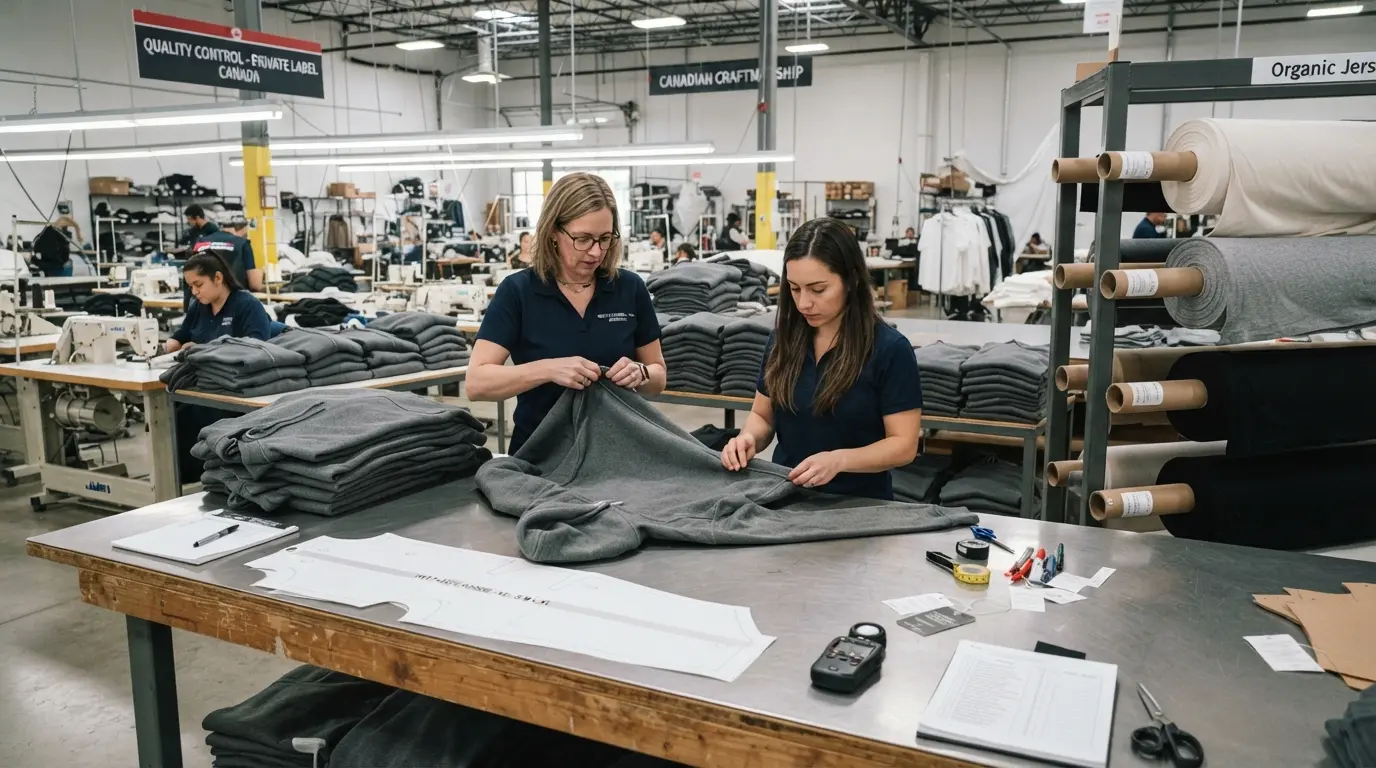
Private Label Apparel Canada: How Dual-Hub European Engineering and Vertical Manufacturing Scale Canadian Fashion Brands
Building a profitable fashion label in Toronto, Vancouver, Montreal, or Calgary requires far more than compelling aesthetic direction. Founders and retail buyers operating in the private label apparel Canada sector face an increasingly unforgiving operational landscape: rising domestic warehousing overhead, strict bilingual packaging laws, volatile trans-Pacific freight rates, and punishing import duties on garments sourced from non-preferential manufacturing hubs. When a Canadian brand relies on fragmented middlemen or single-region factories, hidden costs erode gross margins long before the first collection reaches a boutique rack or direct-to-consumer fulfillment center.
Succeeding in private label apparel Canada demands an architectural shift in how garments are engineered, financed, and shipped. Rather than choosing between expensive domestic workshops with limited technical capacity or opaque overseas trading agents who lack direct factory accountability, forward-thinking Canadian founders are adopting a dual-hub manufacturing framework. By partnering with ExploreTex, a registered Portuguese apparel manufacturer headquartered in Lisbon with vetted partner factories across Northern Portugal and wholly owned vertical manufacturing facilities in Dhaka, Bangladesh, Canadian brands gain European legal governance, PhD-led textile engineering, and 0% duty-free trade access into Canada under one unified contract.
Launching and scaling a profitable private label apparel Canada brand requires far more than compelling visual design; it demands a supply chain engineered for tariff efficiency, strict bilingual compliance, and factory-floor precision. Across Toronto, Vancouver, Montreal, and Calgary, founders and retail buyers entering the private label apparel Canada sector routinely confront steep operational obstacles.
Domestic sewing workshops face high labor overhead and limited fabric milling capacity, while conventional overseas sourcing hubs expose private label apparel Canada importers to punishing 16% to 18% Most-Favoured-Nation (MFN) customs duties, rigid minimum order quantities, and opaque middlemen. To win in today’s competitive private label apparel Canada landscape, clothing brands need a unified European-led manufacturing partner that eliminates border taxes while delivering uncompromising garment construction.
At ExploreTex, we bridge that exact gap for private label apparel Canada businesses through an integrated dual-hub manufacturing ecosystem. Headquartered in Lisbon as a registered Portuguese apparel company operating our own Portuguese fashion label, ExploreTex manages audited partner factories across Northern Portugal alongside wholly owned, zero-debt vertical manufacturing facilities in Dhaka, Bangladesh.
This architecture empowers private label apparel Canada founders to combine European textile engineering and rapid low-MOQ capsule launches in Portugal with high-volume, fibre-to-fashion vertical economics in Bangladesh—all under one legally binding European contract. Whether you are launching an emerging streetwear label or replenishing core seasonal SKUs for national retail distribution, our Full Package Production model protects your gross margins at every stage of growth.
Crucially, partnering with ExploreTex unlocks immediate 0% duty-free trade access for your private label apparel Canada shipments. Garments cut and sewn in our vertical Dhaka complex enter Canada completely free of customs tariffs under Canada’s Least Developed Country Tariff (LDCT) and GPT+ framework, while qualifying collections manufactured in our Portuguese partner factories enjoy 0% tariff entry under the Canada-European Union Comprehensive Economic and Trade Agreement (CETA). Eliminating up to 18% in border duties transforms unit economics for private label apparel Canada importers, freeing working capital for marketing, inventory expansion, and retail growth.
Beyond tariff arbitrage, every private label apparel Canada production run undergoes rigorous technical oversight led by textile engineers on our factory floors. From mandatory 24-to-48-hour fabric relaxation and automated Lectra CAD/CAM cutting to spectrophotometer color matching ($\Delta E < 1.0$) and statistical AQL 1.5–2.5 inspections, ExploreTex eliminates the shrinkage, twisting, and shade-banding defects that derail ordinary private label apparel Canada suppliers.
Our technical compliance specialists also verify every woven neck tag and care label against Canada’s Textile Labelling Act and Quebec’s bilingual French-English rules, ensuring your private label apparel Canada inventory arrives 100% retail-ready via seamless Delivered Duty Paid (DDP) logistics. Explore our specialized Private Label Clothing Canada capabilities, review our Quality & Ethical Standards, or connect directly with our Lisbon engineering team through the ExploreTex Contact Portal to turn your next private label apparel Canada collection into a market-leading success.
1. The 2026 Reality of Private Label Apparel Canada: Why Traditional Sourcing Models Break Down
The Canadian apparel market operates under unique geographic, climatic, and regulatory pressures that distinguish it sharply from the United States or mainland Europe. A brand developing private label apparel Canada collections must engineer garments capable of enduring harsh sub-zero winters in Edmonton and Winnipeg while delivering breathable, lightweight comfort during humid summers in Ontario and Quebec. Simultaneously, Canadian consumers exhibit high sensitivity toward ethical labor verification, verifiable organic fiber claims, and durable garment longevity.
Despite these clear market demands, most companies entering private label apparel Canada fall into one of three structural traps that stall growth:
The Domestic Canadian Production Bottleneck: While local sewing contractors in Toronto, Montreal, and Vancouver offer proximity, Canada’s domestic textile milling infrastructure has contracted over the past three decades. Domestic workshops frequently import raw jersey, fleece, and woven fabrics from Asia or Europe at marked-up wholesale rates, pass high North American labor costs onto the brand, and struggle to scale past small boutique runs. For private label apparel Canada startups aiming for healthy 65% to 75% retail gross margins, domestic unit costs often make wholesale distribution mathematically impossible.
The Tariff-Heavy Offshore Trap: Many new Canadian apparel buyers default to sourcing through general trading platforms in China or non-preferential Asian hubs. When those shipments arrive at the Port of Vancouver or Port of Montreal, the Canada Border Services Agency (CBSA) levies standard Most-Favoured-Nation (MFN) customs tariffs ranging from 16% to 18% on knitted and woven garments. Paying an immediate 18% border tax on top of factory FOB prices destroys working capital for private label apparel Canada businesses.
The Single-Factory Inflexibility Trap: Working directly with an isolated overseas factory forces a brand into rigid Minimum Order Quantities (MOQs) of 2,000 to 5,000 units per style, leaving founders exposed to dead inventory if a silhouette underperforms. Conversely, working with a tiny European atelier provides low MOQs but lacks the industrial capacity to scale a viral bestseller to 50,000 units without doubling retail prices.
Understanding how to overcome these structural friction points is the core mission of our About Us engineering philosophy at ExploreTex. Because ExploreTex owns and operates its own registered Portuguese fashion brand alongside its global production network, our leadership understands commercial retail math firsthand—from seasonal cash-flow cycles to post-wash shrinkage tolerances and sell-through margins.
2. Trade Arbitrage & Duty-Free Economics for Private Label Apparel Canada
One of the highest-leverage financial advantages available to any business scaling private label apparel Canada lies in international trade policy. Unlike American apparel importers—who face steep MFN tariffs and additional Section 301 duties across major Asian manufacturing hubs—Canadian importers enjoy legally codified 0% duty-free access from two premier global apparel manufacturing regions: Bangladesh and Portugal.
When you structure your private label apparel Canada supply chain through ExploreTex’s dual-hub network, every single garment you import benefits from preferential tariff elimination, provided rules-of-origin documentation is executed accurately at the factory level.
How 0% Duty-Free Access Works Under Canadian Customs Law
Bangladesh to Canada (0% Duty via LDCT & GPT+): Under Canada’s Least Developed Country Tariff (LDCT) and the modernized General Preferential Tariff Plus (GPT+) framework, ready-made garments cut and sewn in Bangladesh enter Canada completely free of customs duties (0% tariff), with Parliament extending duty-free market access through 2034. Under single-transformation origin rules, cutting and sewing the garment in ExploreTex’s Dhaka vertical facility confers Bangladeshi origin—meaning Canadian brands only pay the standard 5% federal Goods and Services Tax (GST) upon importation.
Portugal to Canada (0% Duty via CETA): Under the Canada-European Union Comprehensive Economic and Trade Agreement (CETA), apparel designed, milled, cut, and sewn in Portugal qualifies for 0% tariff entry into Canada when accompanied by a compliant CETA Origin Declaration on the commercial invoice. This allows private label apparel Canada luxury labels to market prestigious “Made in Portugal” provenance without paying punitive European import duties.
Landed Cost Comparison: Standard Offshore Sourcing vs. ExploreTex Dual-Hub Model
To illustrate the direct financial impact on a typical private label apparel Canada order of 2,000 heavyweight 460 GSM organic cotton hoodies, examine the landed cost math below:
By eliminating the 18% MFN border tariff and capturing vertical yarn-to-garment integration in Dhaka, private label apparel Canada brands save $9.59 CAD per hoodie compared to tariff-burdened offshore sourcing—generating $19,180 CAD in pure bottom-line profit on a single 2,000-unit production run.
3. Inside the ExploreTex Dual-Hub Architecture: Portugal Craftsmanship Meets Bangladesh Vertical Scale
Most sourcing agencies force private label apparel Canada founders into a false dichotomy: either pay high European prices for small batches or commit to massive overseas volumes before testing market demand. ExploreTex eliminates that compromise through an integrated two-continent manufacturing ecosystem governed by a single Portuguese corporate entity in Lisbon.
Hub 1: Northern Portugal Partner Factory Network (Porto, Braga & Barcelos)
Northern Portugal is globally recognized as Europe’s premier technical textile cluster. Through our curated network of audited partner factories across Porto, Braga, and Barcelos, ExploreTex serves private label apparel Canada brands seeking:
Low-MOQ Capsule Launches: Boutique runs starting at 150 to 300 pieces per style, enabling Canadian founders to validate new silhouettes, seasonal colorways, and luxury streetwear drops without tying up capital in excess stock.
Prestigious “Made in Portugal” Origin: Luxury jersey, heavyweight loopback French terry, garment-dyed fleece, and complex technical outerwear crafted to European luxury house standards.
Rapid 3-to-5-Week Bulk Turnaround: Ideal for mid-season replenishment ahead of peak Canadian retail windows such as Back-to-School, Black Friday, and Holiday gifting.
Hub 2: Wholly Owned Vertical Manufacturing Facilities in Dhaka, Bangladesh
When a private label apparel Canada collection proves retail velocity and requires aggressive unit economics to scale across national retail accounts or high-volume e-commerce, ExploreTex transitions your exact graded patterns into our wholly owned, zero-debt vertical manufacturing complex in Dhaka.
True Fibre-to-Fashion Vertical Integration: Our Dhaka infrastructure encompasses automated yarn knitting, reactive and disperse dyeing, continuous washing, Lectra CAD/CAM automated cutting, specialized category sewing lines, and biological Effluent Treatment Plants (ETP). Because we control the fabric mill and the sewing floor under one roof, there are zero third-party mill markups or fabric delivery delays.
Accessible Scaling MOQs: Standard full-package custom programs in Bangladesh start at just 500 pieces per style (1,000 pieces per order across styles) and scale effortlessly past 100,000+ units.
Cross-Hub Hybrid Execution: Many of our most successful private label apparel Canada clients source specialized European yarns or eco-certified textiles through our Portuguese mill network, prototype and fit-test in Lisbon, launch an initial capsule in Portugal, and transfer the approved digital blocks to our Bangladesh facility for high-margin restocks.
To explore how our end-to-end engineering team manages every milestone across both continents, review our Full Package Production workflow.
4. Mastering Canadian Apparel Compliance: Bilingual Labeling, CA Numbers & Fibre Laws
Launching private label apparel Canada without strict regulatory compliance at the factory floor can result in costly border seizures, CBSA administrative monetary penalties, or mandatory retail recalls. Unlike the United States, where English-only care and fiber tags satisfy federal law, Canada enforces rigorous bilingual and dealer-identification standards governed by the Competition Bureau Canada under the Textile Labelling Act and Textile Labelling and Advertising Regulations.
At ExploreTex, our technical compliance engineers audit every trim and label artwork file before bulk production begins, ensuring your private label apparel Canada garments arrive 100% retail-ready for distribution across all ten provinces and three territories—including Quebec.
The 4 Non-Negotiable Canadian Garment Labeling Mandates
Bilingual Fibre Content Disclosure (English & French): Every consumer textile article sold in Canada must carry a permanent label listing the generic name of each textile fiber present in an amount of 5% or more by mass, expressed as a percentage in descending order, in both English and French. For example: “80% Organic Cotton / 80% Coton biologique, 20% Recycled Polyester / 20% Polyester recyclé.” Under Quebec’s Charter of the French Language (Bill 96), French text on labels, hang tags, and packaging sold in Quebec must appear at least as prominently as any other language.
Dealer Identity or CA Identification Number: Canadian law requires the permanent disclosure label or hang tag to display either the full legal name and postal address of the Canadian dealer/importer OR a five-digit CA Identification Number registered with the Competition Bureau Canada. ExploreTex guides new private label apparel Canada founders through obtaining their CA number prior to woven label sampling so your brand avoids printing bulky street addresses inside delicate necklines.
Country of Origin Marking (CBSA Marking of Imported Goods Regulations): Under Canada Border Services Agency rules, imported wearing apparel must carry a permanent, legible Country of Origin mark (“Made in Portugal / Fabriqué au Portugal” or “Made in Bangladesh / Fabriqué au Bangladesh”) located in close proximity to the size or brand mark inside the collar or waistband.
Permanent Label Durability & Care Symbols: Permanent disclosure labels must remain securely affixed and legible through at least 10 commercial or domestic cleanings. While care instructions are technically voluntary under federal law, providing inaccurate care symbols triggers liability under deceptive marketing provisions. ExploreTex applies standardized Canadian/ASTM/ISO wash-care iconography verified against our laboratory shrinkage and colorfastness tests.
Our in-house branding division produces custom high-density damask woven labels, satin printed care tags, recycled-board hang tags, and FSC-certified packaging tailored specifically for private label apparel Canada brands. Learn more about our bespoke trim engineering on our Custom Clothing Labels & Branding page.
5. Factory-Floor “Expert” Insights: Engineering Secrets That Prevent Costly Production Failures
Over nearly two decades on factory floors in Porto and Dhaka, ExploreTex’s textile engineers—led by founder Muhammad Ilias Hossen (M.Sc. and B.Sc. in Textile Engineering)—have diagnosed hundreds of failed production runs brought to us by brands switching away from inexperienced vendors. In the private label apparel Canada market, where heavy fleece, structured outerwear, and technical performance knits dominate seasonal revenue, minor shortcuts in the cutting or dyeing room translate into massive customer return rates.
Here are six mandatory factory-floor engineering protocols institutionalized across ExploreTex’s Portuguese and Bangladeshi lines to protect your brand:
1. Mandatory 24-to-48-Hour Climate-Controlled Fabric Relaxation
Knitted fabrics such as organic cotton jersey, loopback French terry, and rib trims exit circular knitting machines and dye house compactors under longitudinal mechanical tension. If a factory unrolls fresh fabric and cuts it immediately—a widespread shortcut among budget suppliers—the cut panels recoil inside the sewing room and twist violently after the customer’s first domestic wash (known as spirality or torque). At ExploreTex, every single roll of fabric for private label apparel Canada orders is unrolled, layered loosely on tension-free relaxation tables in a humidity-controlled cutting room, and rested for 24 to 48 hours before a single blade touches the cloth.
2. Automated Lectra CAD/CAM Cutting & Zero-Waste Marker Nesting
Manual hand-shearing introduces human variance of 3mm to 8mm across stacked fabric plies, causing collar ribs to pucker and side seams to misalign between sizes S and XXL. ExploreTex utilizes computer-guided Lectra CAD/CAM automated cutting systems paired with algorithmic marker nesting. This engineering achieves 88% to 92% fabric utilization (cutting raw material waste and lowering your per-unit fabric cost) while guaranteeing sub-millimeter precision across every graded size block.
3. Spectrophotometer Lab-Dip & Shade Banding Control (ΔE<1.0\Delta E < 1.0)
Matching a dyed 1×1 cotton-elastane rib cuff to a heavyweight 480 GSM brushed fleece body across different dye batches is one of the hardest challenges in private label apparel Canada manufacturing. Relying on the human eye under fluorescent office bulbs leads to mismatched sleeves and bodies in natural daylight. ExploreTex enforces digital spectrophotometer lab-dip verification under calibrated D65 daylight and TL84 retail lighting booths, rejecting any dye lot exceeding a color tolerance of ΔE<1.0\Delta E < 1.0 and conducting strict roll-to-roll shade banding before cutting.
4. Titanium Ballpoint Needle Calibration & Core-Spun Thread Engineering
High-speed lockstitch and coverstitch machines generate intense needle friction that can sever microscopic elastane filaments or punch pinholes in fine combed cotton—defects that only appear as runs after two or three washes. Our line mechanics calibrate SES (light ballpoint) and SUK (medium ballpoint) titanium-coated needles precisely to fabric GSM, paired with silicone-lubricated core-spun polyester threads and calibrated Stitches Per Inch (SPI) specifications.
5. Four-Point Fabric Inspection System (ASTM D5430)
Before bulk fabric enters the cutting room, ExploreTex’s textile technicians inspect incoming greige and finished rolls on illuminated inspection frames using the ASTM D5430 Four-Point Inspection System. Every yarn slub, knitting needle line, oil stain, or dye streak is flagged, scored, and mapped out of the cutting marker so defective yardage never reaches a finished garment.
6. Multi-Stage AQL 1.5–2.5 Quality Audits & Live Video Technical Fittings
Rather than waiting until boxes are sealed to discover a grading error, ExploreTex executes continuous in-line quality checks every 50 garments, followed by a statistical Final Random Inspection (FRI) governed by strict AQL 1.5 to 2.5 standards. During prototyping, our Lisbon pattern masters conduct live high-definition video technical fittings with your team using professional fit models, catching shoulder slope, armhole pitch, and drape adjustments in real time before bulk cutting begins.
Review our complete testing frameworks and international compliance portfolio on our Quality & Ethical Standards hub.
6. Core Product Verticals Engineered for the Canadian Apparel Market
Because Canadian retail calendars revolve around distinct seasonal transitions—from crisp autumn layering in British Columbia to deep winter insulation in Quebec and active outdoor performance across the Rockies—brands building private label apparel Canada require a manufacturer capable of handling diverse fabric constructions under one unified technical team.
ExploreTex organizes dedicated, category-specific production lines across both Portugal and Bangladesh:
Heavyweight Streetwear & Luxury Knitwear: 380 GSM to 550 GSM combed organic cotton French terry, double-knit interlock, brushed fleece hoodies, boxy drop-shoulder tees, garment-dyed pigment washes, and enzyme-washed vintage finishes engineered for Toronto and Vancouver contemporary streetwear labels.
Technical Activewear, Athleisure & Seamless Performance: GRS-certified recycled nylon-spandex compression leggings, moisture-wicking brushed jersey tops, four-way stretch woven training shorts, and flatlock-seamed performance layers engineered to rival Canada’s premier athletic retailers.
Cold-Weather Outerwear & Puffer Jackets: Windproof and DWR-coated recycled polyester shells, RDS-certified down and high-clo synthetic thermal fills, seam-sealed technical parkas, and quilted overshirts engineered for Canadian winter performance.
Heritage Denim & Rugged Workwear: 11 oz to 16 oz selvedge and ring-spun organic cotton denim, reinforced triple-needle canvas utility pants, chore jackets, and waterless ozone/laser-washed finishes.
Contemporary Wovens, Tailored Shirting & Kidswear: Crisp poplin button-downs, Belgian/European flax linen resort wear, Tencel™ Lyocell dresses, and OEKO-TEX® Standard 100 certified infant and children’s apparel.
Explore our full spectrum of custom textile development on our Our Services overview.
7. Sustainable & Traceable Textiles: Meeting Canadian Consumer & ESG Standards
Canadian shoppers and institutional retail buyers scrutinize sustainability claims closely. Under Canada’s Competition Act greenwashing enforcement rules (Bill C-59), brands making environmental claims about organic fibers, recycled content, or carbon reduction must substantiate those claims with internationally recognized third-party verification.
At ExploreTex, sustainability is backed by verifiable chain-of-custody documentation across every private label apparel Canada order:
GOTS (Global Organic Textile Standard): Verifies farm-to-factory organic cotton integrity, non-toxic dye chemistry, and strict social labor protections.
GRS (Global Recycled Standard) & RCS: Certifies post-consumer recycled polyester and regenerated nylon content with full transaction certificates (TCs) for your brand’s compliance records.
OEKO-TEX® Standard 100 & EU REACH Compliance: Guarantees every yarn, button, zipper, interlining, and screen-print ink is tested free from over 1,000 harmful substances, heavy metals, phthalates, and azo dyes.
Social & Structural Safety Audits: Our facilities operate under strict ISO 9001 quality management alongside amfori BSCI, WRAP, and SEDEX SMETA ethical labor audits, powered by rooftop solar arrays and closed-loop biological wastewater filtration.
Discover how we engineer verifiable eco-collections on our Private Label Sustainable Clothing Manufacturer guide.
8. Step-by-Step Workflow: Launching Your Private Label Apparel Canada Collection with ExploreTex
Whether you are an emerging founder launching your first capsule or an established Canadian retail director transitioning an existing supply chain, ExploreTex guides your private label apparel Canada program through a transparent, six-stage milestone workflow:
Stage 1: Strategic Discovery & Technical Tech Pack Engineering (Days 1–7): Share your existing Tech Packs, flat sketches, mood boards, or physical reference garments. If you do not have production blueprints, our Lisbon technical designers build complete production-ready Tech Packs from scratch—defining fabric GSM, stitch callouts, Bill of Materials (BOM), artwork placement, and graded North American size charts (XS–3XL).
Stage 2: Transparent Line-Item Costing & Hub Allocation (Days 5–10): You receive an itemized quotation breaking down fabric, trims, CMT labor, washing/printing, packaging, and DDP freight to your Canadian warehouse—with zero hidden markups. We recommend whether Portugal, Bangladesh, or a Hybrid split optimizes your target margin and launch calendar.
Stage 3: Raw Material Sourcing, Lab Dips & 3D Virtual Prototyping (Weeks 2–3): Our mill network develops custom fabric swatches and spectrophotometer-verified lab dips while our 3D CAD team builds digital drape twins to validate proportions before cutting physical yardage.
Stage 4: Physical Fit Samples & Pre-Production Sample (PPS) Approval (Weeks 3–5): We construct physical Proto/Fit samples in your exact fabric and colorway, conduct live video technical fittings with our master pattern maker, and deliver a final Pre-Production Sample (PPS) complete with your bilingual Canadian woven labels and hang tags. Bulk manufacturing never begins until you sign off on the PPS.
Stage 5: Bulk Production & Multi-Stage AQL Quality Control (Weeks 6–11): Bulk production runs 3 to 5 weeks in Portugal or 5 to 8 weeks in our vertical Bangladesh facility. You receive weekly factory-floor photo and video progress reports alongside inline and final AQL 1.5–2.5 inspection certificates.
Stage 6: CETA / LDCT Customs Clearance & Door-to-Door DDP Delivery to Canada: ExploreTex prepares your commercial invoice, packing list, CETA Origin Declaration or Bangladeshi Certificate of Origin (Form A / Statement on Origin), and manages international air freight (4–7 days) or ocean freight (25–35 days) straight to your door in Toronto, Vancouver, Montreal, or Calgary under Delivered Duty Paid (DDP) terms.
For additional insights on structuring your brand launch roadmap, explore our guides on How to Start a Clothing Line and Private Label Clothing Factory engineering, or browse our latest supply chain briefings on the ExploreTex Blog.
9. Specialized FAQ: Expert Answers on Private Label Apparel Canada
1. Do Canadian brands pay import duties when manufacturing private label apparel in Bangladesh or Portugal with ExploreTex?
No. When your private label apparel Canada order is cut and sewn in ExploreTex’s vertical manufacturing facility in Dhaka, Bangladesh, it qualifies for 0% customs duty upon entry into Canada under Canada’s Least Developed Country Tariff (LDCT) and GPT+ trade framework (extended by the Canadian Parliament through 2034). Similarly, qualifying garments produced in our Northern Portugal partner factories enter Canada at 0% customs duty under the Canada-European Union Comprehensive Economic and Trade Agreement (CETA). In both cases, Canadian importers only pay the standard 5% federal GST (which is recoverable as an Input Tax Credit for GST-registered businesses).
2. Can ExploreTex manufacture compliant bilingual English and French labels for private label apparel Canada?
Yes. Every private label apparel Canada program managed by ExploreTex includes full Canadian labeling compliance review. Our trim engineering division produces permanent woven neck labels, printed care labels, and custom hang tags displaying generic fiber percentages in both English and French as mandated by the Competition Bureau Canada’s Textile Labelling Act, alongside your registered CA Identification Number and permanent Country of Origin disclosure.
3. What are ExploreTex’s Minimum Order Quantities (MOQs) for Canadian fashion startups versus established retailers?
ExploreTex structures flexible MOQs tailored to your brand’s growth stage. For boutique luxury capsules produced in our Northern Portugal partner factories, MOQs start at 150 to 300 pieces per style. For full-package custom programs in our wholly owned vertical manufacturing facility in Bangladesh, MOQs start at 500 pieces per style (1,000 pieces per order across styles) and scale smoothly past 100,000+ units.
4. How does DDP (Delivered Duty Paid) shipping work from ExploreTex to Toronto, Vancouver, or Montreal?
Under Delivered Duty Paid (DDP) terms, ExploreTex handles the entire international logistics chain—export customs clearance in Portugal or Bangladesh, air or ocean freight booking, Canadian customs brokerage, preferential CETA or LDCT duty-free filing, and final-mile palletized delivery straight to your Canadian warehouse or 3PL fulfillment center. You receive one predictable landed price per garment with zero surprise border brokerage bills.
5. Do I need a finished Tech Pack before requesting a quote for private label apparel Canada?
No. While our Lisbon engineering team happily works from existing Tech Packs, many private label apparel Canada founders approach us with design sketches, reference garments, or mood boards. Our in-house pattern makers and technical designers will develop your complete production Tech Pack, graded North American size spec sheet, and Bill of Materials before sampling begins.
6. Can I combine Made-in-Portugal sampling with high-volume Bangladesh production?
Yes—this is our signature Cross-Hub Hybrid Model. Because your digital CAD patterns, fit blocks, and spectrophotometer color standards are centrally archived at our Lisbon headquarters, you can develop prototypes and launch a low-MOQ test batch in Portugal, then seamlessly transfer the exact approved specifications to our vertical Bangladesh facility for high-margin bulk replenishment without re-engineering your fit.
 10. Ready to Launch or Scale Your Private Label Apparel Canada Brand?
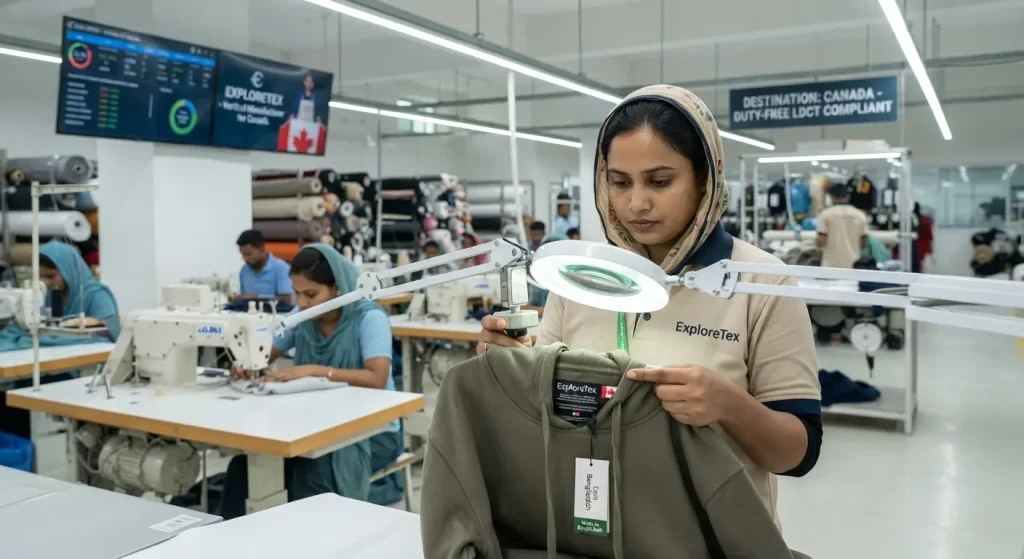 10. Ready to Launch or Scale Your Private Label Apparel Canada Brand?
Your clothing brand deserves a manufacturing partner engineered for commercial precision, zero-tariff trade efficiency, and uncompromising quality. By uniting a registered Portuguese company in Lisbon with specialized partner factories in Northern Portugal and wholly owned vertical manufacturing facilities in Bangladesh, ExploreTex gives private label apparel Canada founders and retail buyers a resilient, future-proof production backbone built for long-term profitability.
Building a resilient, profitable private label apparel Canada enterprise requires far more than seasonal mood boards; it requires a manufacturing architecture engineered to protect gross margins, satisfy federal bilingual regulations, and eliminate cross-border tariff friction. Throughout this guide, we have examined why traditional sourcing models—whether high-cost domestic workshops or tariff-burdened offshore brokers—consistently stall growth for private label apparel Canada founders in Toronto, Vancouver, Montreal, and Calgary. By adopting a unified dual-hub production strategy, your private label apparel Canada brand gains the commercial agility needed to compete against established North American retailers while preserving independent brand equity.
At ExploreTex, we empower private label apparel Canada startups and established retail directors to capture the best of two manufacturing worlds under a single Portuguese corporate contract. Headquartered in Lisbon with our own registered Portuguese brand, ExploreTex integrates specialized partner factories across Northern Portugal’s historic textile cluster with wholly owned, zero-debt vertical manufacturing facilities in Dhaka, Bangladesh.
This dual-continent infrastructure allows private label apparel Canada labels to launch low-MOQ boutique capsules in Portugal starting at 150 to 300 pieces per style, and seamlessly scale bestsellers in Bangladesh starting at 500 pieces per style. Every private label apparel Canada order benefits from 0% duty-free entry into Canada—via CETA for qualifying Portuguese garments and via Canada’s LDCT/GPT+ trade framework for garments cut and sewn in Bangladesh—eliminating up to 18% in border customs tariffs.
Equally critical to long-term retail success in private label apparel Canada is uncompromising factory-floor quality control and regulatory accuracy. Our textile engineering team enforces mandatory 24-to-48-hour fabric relaxation, automated Lectra CAD/CAM cutting, spectrophotometer shade verification (ΔE<1.0\Delta E < 1.0), and statistical AQL 1.5–2.5 audits across every private label apparel Canada production run. Simultaneously, our compliance specialists audit your woven neck labels, printed care tags, and packaging to guarantee 100% adherence to Competition Bureau Canada’s bilingual English-French Textile Labelling Act and CA Identification Number rules, delivering your private label apparel Canada inventory door-to-door under hassle-free Delivered Duty Paid (DDP) terms.
As consumer demand in private label apparel Canada shifts toward verifiable GOTS organic cotton, GRS recycled synthetics, and OEKO-TEX® certified craftsmanship, choosing the right technical partner defines your brand’s ceiling. Explore our dedicated Private Label Clothing Canada capabilities, compare regional benchmarks on our Apparel Manufacturers Canada guide, review our end-to-end Full Package Production workflow, and inspect our Quality & Ethical Standards framework to see how we safeguard every stitch.
If you are ready to transform your private label apparel Canada supply chain into a high-margin competitive advantage, submit your Tech Pack, design sketches, or fabric specifications through the ExploreTex Contact & Quote Portal today. Our Lisbon engineering team will deliver a transparent, line-item quotation within 24 hours so you can launch and scale your private label apparel Canada collection with absolute confidence.
Submit your Tech Pack, design sketches, target quantities, or fabric inquiries directly through the ExploreTex Contact & Quote Portal today. Our Lisbon textile engineering team will review your project specifications and deliver a transparent, line-item production quotation within 24 hours.