
Carbon Negative Cotton Garment Factory: The Ultimate Technical Blueprint for Decarbonized Apparel Manufacturing
Scaling Modern Fashion with Decarbonized Sourcing
The global apparel industry is undergoing an unprecedented structural transformation driven by legislative mandates, consumer shifts, and stringent corporate ESG requirements. Sourcing executives and fashion brand leaders are no longer prioritizing unit purchase prices alone; the carbon intensity of every single product now defines commercial viability. To remain compliant with evolving European Union directives and international environmental frameworks, fashion brands are actively transitioning toward a carbon negative cotton garment factory model. Operating a genuine carbon negative cotton garment factory requires complete transparency, starting from regenerative soil management at the farm level to zero-emission thermal energy utilization inside industrial production halls.
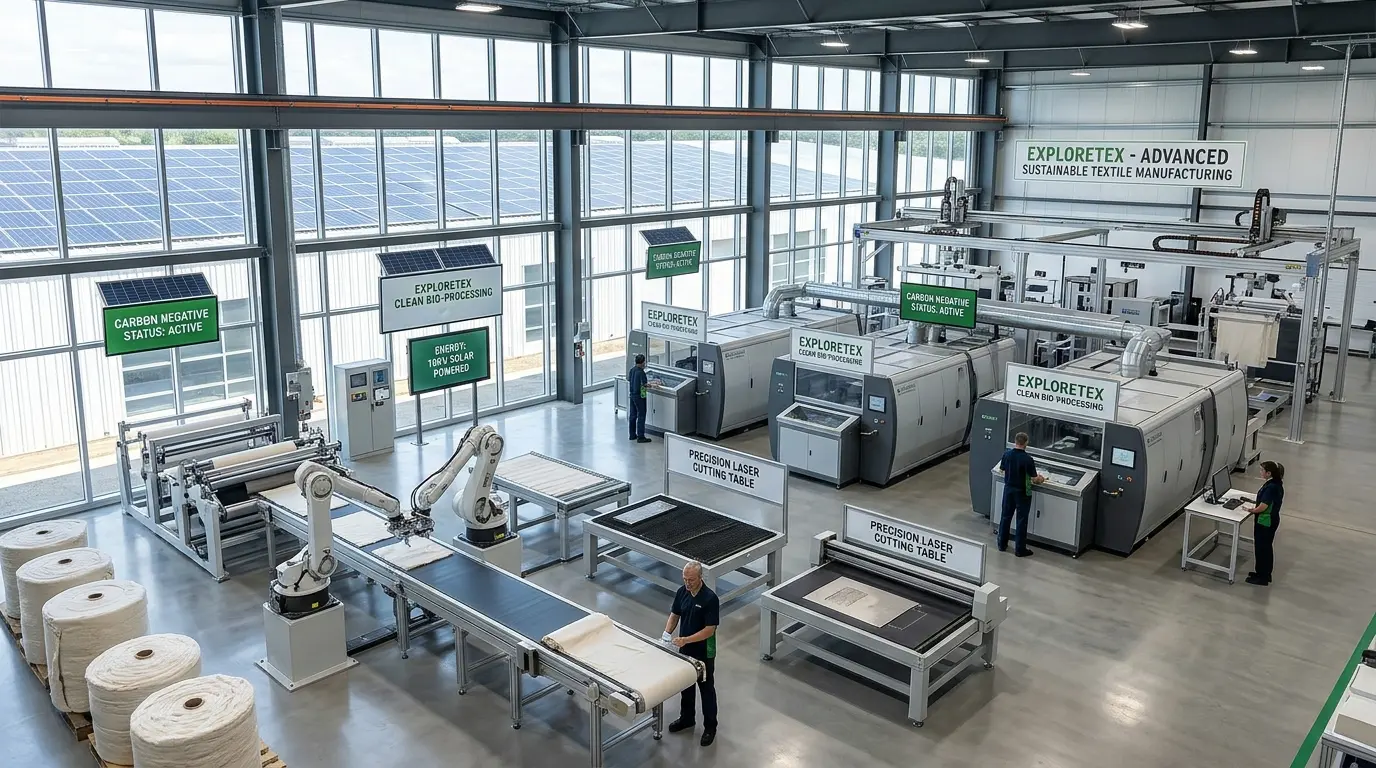
At ExploreTex, we have re-engineered the traditional apparel supply chain by integrating European design management with vertical, high-capacity manufacturing infrastructure. By choosing a certified carbon negative cotton garment factory, global fashion labels can actively reduce their Scope 1, Scope 2, and Scope 3 greenhouse gas emissions. Transitioning to a carbon negative cotton garment factory ensures that your brand’s raw material inputs sequester more atmospheric carbon than the entire manufacturing process generates. Every modern carbon negative cotton garment factory must deploy on-site rooftop solar photovoltaic matrices, heat-recovery steam systems, and closed-loop bio-gasification to eliminate reliance on fossil fuels.
Selecting a carbon negative cotton garment factory allows fashion brands to avoid severe non-compliance penalties under the EU Strategy for Sustainable Textiles. Working directly with a carbon negative cotton garment factory provides complete data integrity for Digital Product Passports (DPP). Furthermore, a carbon negative cotton garment factory relies on zero-till regenerative organic cotton farming to build long-term subterranean carbon sinks. Partnering with a carbon negative cotton garment factory fundamentally eliminates the practice of relying on unverified carbon offset credits.
When a brand contracts a carbon negative cotton garment factory, every meter of fabric processed undergoes low-impact bio-enzymatic scouring. The operational framework of a carbon negative cotton garment factory replaces water-intensive jet dyeing with ultra-low liquor ratio air-jet technologies. Utilizing a carbon negative cotton garment factory ensures that post-industrial cutting scraps are mechanically recycled back into high-quality yarns on-site. Every forward-thinking carbon negative cotton garment factory operates a closed-loop Zero Liquid Discharge (ZLD) effluent treatment plant to protect local ecosystems.
A modern carbon negative cotton garment factory harnesses 3D digital sampling tools to eliminate physical prototyping fabric waste. Sourcing through a carbon negative cotton garment factory guarantees that fabric utilization rates exceed 92% using AI-driven pattern nesting. The integration of a carbon negative cotton garment factory within your dual-hub supply network mitigates long-term regulatory supply chain risks. Every audited carbon negative cotton garment factory aligns with strict GOTS, GRS, and OEKO-TEX Standard 100 criteria.
Choosing ExploreTex as your carbon negative cotton garment factory provides European legal accountability alongside high-volume production scale. A top-tier carbon negative cotton garment factory leverages automated CNC cutting machines to maintain precise seam standards while preventing material waste. As international buyers demand verifiable sustainability data, a carbon negative cotton garment factory serves as the definitive baseline for modern textile production. ExploreTex invites fashion enterprises to experience how a true carbon negative cotton garment factory bridges environmental accountability with cost efficiency.
Partner with our carbon negative cotton garment factory today to future-proof your apparel collections. Modern fashion brands rely on a carbon negative cotton garment factory to achieve genuine climate-positive manufacturing goals.
Introduction: The Imperative for Climate-Positive Textile Production
The global fashion and textile ecosystem is undergoing a structural paradigm shift. For decades, brands evaluated apparel sourcing through a narrow two-dimensional framework: unit purchase price and lead time. Today, a third metric dictates commercial viability: carbon intensity per garment. As regulatory frameworks like the European Union Corporate Sustainability Due Diligence Directive (CSDDD), the EU Strategy for Sustainable Textiles, and Digital Product Passport (DPP) mandates transition from voluntary targets to enforceable laws, fashion brands face an existential choice. They must decarbonize their supply chains at the tier-1, tier-2, and tier-3 levels or face severe market penalties, brand devaluation, and non-compliance fines.
The concept of “carbon neutral” is no longer the gold standard. Offsetting emissions by buying unverified carbon credits while continuing carbon-intensive thermal energy usage, coal-fired boiler operations, and land-degrading agricultural practices is widely recognized as greenwashing. Modern fashion enterprises, luxury conglomerates, and fast-scaling direct-to-consumer (D2C) labels require a carbon negative cotton garment factory—an industrial production ecosystem that actively sequesters more atmospheric carbon dioxide ($CO_2e$) than it emits across the raw material, yarn spinning, fabric knitting/weaving, wet processing, and final garment assembly lifecycles.
As a registered Portuguese brand operating as a premier Clothing Manufacturer Portugal, ExploreTex has re-engineered the traditional garment manufacturing workflow. By combining European technical oversight, design engineering, and agile sample development in Portugal with our directly owned, vertically integrated manufacturing infrastructure in Bangladesh, we deliver the world’s most advanced dual-hub production system. This comprehensive pillar document breaks down the agricultural science, thermal engineering, closed-loop wet processing, and supply-chain logistics that make a true carbon negative cotton garment factory operational, compliant, and commercially scalable.
1. What Defines a True Carbon Negative Cotton Garment Factory?
To distinguish a genuine carbon negative cotton garment factory from superficial marketing claims, apparel brands must analyze the facility’s complete Life Cycle Assessment (LCA) mapped against ISO 14040/14044 standards. A carbon negative status means that the cumulative greenhouse gas (GHG) footprint from seed planting to the final packed garment container leaves a net-negative balance of greenhouse gases in the atmosphere.
+-----------------------------------------------------------------------------------+
|               TOTAL CARBON BALANCING IN A CARBON NEGATIVE FACTORY                 |
+-----------------------------------------------------------------------------------+
|  [ CARBON SEQUESTRATION ]              |  [ INDUSTRIAL EMISSIONS ]                |
|                                        |                                          |
|  - Regenerative Agriculture Practices  |  - Solar Thermal Process Heat            |
|  - Soil Organic Matter Carbon Sinks   |  - On-Site Rooftop Solar PV Generation    |
|  - Biogenic Carbon Trapped in Fiber    |  - Closed-Loop Electrified Wet Processes |
+----------------------------------------+------------------------------------------+
|  RESULT: Total Sequestration > Total Emissions = Net-Negative Footprint           |
+-----------------------------------------------------------------------------------+
The Biogenic Carbon Cycle of Regenerative Cotton
Conventional cotton production is a heavy emitter of carbon due to synthetic petroleum-based fertilizers, intensive tractor operations, and soil degradation that releases stored soil carbon into the atmosphere as $CO_2$. Conversely, a carbon negative cotton garment factory begins at the farm level through regenerative agriculture.
When cotton is cultivated using no-till farming, multi-species cover crops, biochar soil amendments, and non-synthetic nutrient management, the cotton plant acts as a biological carbon pump. Nitrogen-fixing cover crops capture carbon from the air and drive it into the soil as stable Organic Soil Carbon (SOC). When total soil carbon sequestration exceeds the fuel and processing energy expended during farming, ginning, and transport, the raw cotton lint enters the factory gates with a net-negative carbon balance.
Scope 1, 2, and 3 Emissions Metrics
Every garment facility evaluated by global audit agencies must account for three distinct emission operational scopes:
Scope 1 (Direct Emissions): On-site combustion of fossil fuels in factory boilers, generators, and fleet vehicles. A modern carbon negative cotton garment factory eliminates coal and heavy fuel oil (HFO), replacing them with biomass gasification, industrial heat pumps, and green hydrogen-ready boilers.
Scope 2 (Indirect Emissions from Purchased Energy): Electricity consumed from grid systems that rely on fossil fuels. Decarbonized factories mitigate Scope 2 emissions through high-efficiency rooftop monocrystalline solar photovoltaic (PV) systems, off-site power purchase agreements (PPAs) with wind and hydro utilities, and battery energy storage systems (BESS).
Scope 3 (Supply Chain Value Chain Emissions): Upstream transportation of raw materials, chemical inputs, trim manufacturing, and downstream freight. ExploreTex manages Scope 3 emissions by using vertical production structures where spinning, knitting, dyeing, finishing, cutting, and sewing occur within a controlled regional footprint.
2. Regenerative Cotton Farming: Carbon Sequestration at the Source
You cannot manufacture a climate-positive garment using carbon-intensive raw materials. The foundation of any carbon negative cotton garment factory rests on direct farm-level partnerships utilizing verified regenerative organic agriculture.
+-----------------------------------------------------------------------------------+
|               CONVENTIONAL VS. REGENERATIVE COTTON CARBON FOOTPRINT               |
+-----------------------------------------------------------------------------------+
| Farming Methodology   | Soil Health Impact   | Net Carbon Balance (kg CO2e/kg lint) |
+-----------------------+----------------------+------------------------------------+
| Conventional Cotton   | High Degradation     | +1.80 to +2.40 (Net Emitter)      |
| Organic Cotton        | Neutral Soil Health  | +0.90 to +1.20 (Low Emitter)       |
| Regenerative Cotton   | High Carbon Build-up | -0.80 to -1.50 (Net Sequester)     |
+-----------------------------------------------------------------------------------+
Soil Biology and No-Till Protocols
Traditional tilling fractures the soil structure, exposing fungal networks and organic carbon to air, which oxidizes soil carbon into carbon dioxide gas. Regenerative cotton farming enforces strict zero-till or reduced-till management. Fungal-dominated soil microbiomes thrive, creating glomalin—a persistent soil glycoprotein that binds carbon particles inside the earth for decades.
Biochar Inoculation and Cover Crops
Prior to planting cotton seeds, fields are planted with legumes and deep-root brassicas. These cover crops pull nitrogen from the atmosphere and fix it naturally into the root zone, bypassing synthetic synthetic fertilizers (which generate nitrous oxide, $N_2O$, a greenhouse gas with nearly 300 times the global warming potential of $CO_2$). Furthermore, agricultural biochar—carbonized biomass created via oxygen-deprived pyrolysis—is mixed into the topsoil. Biochar serves as a subterranean carbon sponge, holding water, hosting beneficial microbes, and locking carbon into the soil for centuries.
Verifiable Supply Chain Traceability
For brands operating in Europe and North America, claiming carbon-negative status requires robust supply chain data. ExploreTex enforces complete traceability from raw lint to finished apparel. Through our primary hub as an established Apparel Manufacturer Europe, every bale of regenerative cotton entering our facility carries isotopic testing records and digital chain-of-custody tokens, ensuring that zero land conversion or deforestation occurred in the sourcing phase.
3. The Technical Engine: Zero-Carbon Energy Infrastructure in Garment Manufacturing
Transforming raw regenerative cotton into finished garments requires intensive thermal and electrical energy. To maintain a negative overall carbon footprint, a carbon negative cotton garment factory must drastically optimize its energy intensity ($kWh/kg$ of finished fabric) and switch its entire power load to clean energy sources.
+-----------------------------------------------------------------------------------+
|            DECARBONIZED FACTORY ENERGY FLOW ARCHITECTURE                          |
+-----------------------------------------------------------------------------------+
|                                                                                   |
|  [ Rooftop Solar PV Matrix ] -------> [ Microgrid Energy Storage (BESS) ]         |
|                                                      |                            |
|                                                      v                            |
|  [ Biomass Gasification ] ------------> [ High-Efficiency Electric Boilers ]     |
|                                                      |                            |
|                                                      v                            |
|  [ Heat Recovery Systems ] -----------> [ Ultra-Low Liquor Ratio Dyeing ]          |
|                                                      |                            |
|                                                      v                            |
|  [ Clean Electrical Output ] ---------> [ Automated Servo-Driven Sewing ]         |
|                                                                                   |
+-----------------------------------------------------------------------------------+
On-Site Solar Photovoltaic (PV) Generation
Large-scale apparel production requires massive roof footprints across cutting, sewing, and warehouse facilities. In a state-of-the-art carbon negative cotton garment factory, these roof surfaces are covered with high-efficiency monocrystalline solar panels paired with smart microgrid controllers. On-site solar generation fulfills the factory’s baseline electrical load during daylight operation. Excess power produced during peak sunlight hours is pushed back into the regional electrical grid or stored in industrial lithium iron phosphate (LFP) battery banks to run evening production shifts.
Industrial Heat Recovery and Solar Thermal Process Heat
The highest energy consumer in textile manufacturing is thermal energy used for heating water in dyeing, scouring, and bleaching, as well as high-temperature air inside stenter frames during fabric drying. A standard factory vents this thermal energy directly into the atmosphere as waste steam and exhaust gas.
A fully operational carbon negative cotton garment factory incorporates multi-stage waste heat recovery systems (WHRS):
Shell-and-Tube Heat Exchangers: Hot wastewater leaving the dyeing machines passes through stainless-steel heat exchangers, transferring heat directly to incoming cold process water. This reduces the energy required to bring fresh water up to dyeing temperatures by up to 60%.
Stenter Exhaust Condensers: Hot, air-laden exhaust gases from fabric finishing stenters are filtered and routed through air-to-water exchangers, generating pre-heated hot water for the laundry unit.
Concentrated Solar Thermal (CST) Arrays: CST mirrors concentrate sunlight onto fluid receiver tubes to generate high-pressure steam without burning fuel, providing industrial heat directly to the wet processing line.
Biomass Gasification vs. Fossil Fuel Boilers
When supplementary thermal power is required, fossil fuels like coal, natural gas, or HFO are completely replaced by closed-loop biomass gasifiers. Utilizing local agricultural waste such as rice husks, coconut shells, and certified sustainably harvested wood residues, biomass gasification generates clean thermal energy. Because the biomass is derived from organic matter that absorbed atmospheric carbon during its growth cycle, the thermal energy generation operates on a neutral carbon loop. When paired with carbon capture and biochar recovery units, the process yields a net-negative carbon output.
4. Wet Processing Breakthroughs: Decarbonized Dyeing, Washing, and Finishing
Wet processing (dyeing, bleaching, washing, and chemical finishing) traditionally accounts for over 50% of the total carbon emissions and water consumption in garment production. Creating a true carbon negative cotton garment factory requires abandoning antique wet-processing paradigms in favor of waterless, cold-process, and biotechnology-driven chemical solutions.
+-----------------------------------------------------------------------------------+
|               WET PROCESSING INNOVTIONS & CARBON REDUCTION                        |
+-----------------------------------------------------------------------------------+
| Process Stage         | Traditional Method         | Carbon Negative Method       |
+-----------------------+----------------------------+------------------------------+
| Scouring & Bleaching  | High-Temp Caustic Soda     | Bio-Enzymatic Ambient Cold   |
| Dyeing Mechanism      | High Liquor Ratio (1:10)   | Supercritical CO2 / Air-Jet  |
| Color Fixation        | Long Thermal Steam Cycles  | Cationic Low-Temp Fixation   |
| Drying & Stenter      | Fossil-Fired Gas Burner    | Heat Recovery Steam Circuit  |
+-----------------------------------------------------------------------------------+
Bio-Enzymatic Ambient Scouring and Bleaching
Conventional cotton processing requires boiling raw greige fabric at 95°C to 100°C using caustic soda and hydrogen peroxide to strip natural waxes and pectin. This process consumes huge amounts of thermal energy. Modern carbon negative cotton garment factory lines deploy bio-enzymatic scouring protocols using specialized pectinase, cellulase, and catalase enzymes that function at ambient temperatures (30°C to 40°C). This eliminates up to 70% of the thermal energy load in pre-treatment while leaving the cotton fiber’s structural integrity completely uncompromised.
Ultra-Low Liquor Ratio (ULLR) Air-Jet Dyeing
Standard jet dyeing machines operate at liquor ratios of 1:8 to 1:12, meaning 8 to 12 liters of water are required for every kilogram of fabric processed. Heating that mass of water demands high energy inputs. Advanced facilities use ultra-low liquor ratio air-jet dyeing technology operating at 1:3 or 1:4 ratios. By using pressurized air instead of water streams to transport fabric through the dyeing tube, chemical and dye liquor consumption drops by 50%, while thermal heating requirements fall by more than 60%.
Waterless Supercritical $CO_2$ Dyeing Technology
The ultimate frontier for a carbon negative cotton garment factory is the complete elimination of water from the dyeing cycle using Supercritical Carbon Dioxide ($sCO_2$). Under specific temperature and pressure conditions (above 31.1°C and 73.8 bar), $CO_2$ enters a fluid state with the density of a liquid and the expansion properties of a gas.
Liquid/gas $sCO_2$ penetrates deep into cotton fibers, dissolving and carrying eco-friendly dye molecules directly into the core of the cotton polymer.
Once dyeing completes, the system depressurizes, instantly converting the $sCO_2$ back into gas.
98% of the $CO_2$ gas is captured, compressed, and recycled back into storage tanks for the next production batch.
The dyed fabric emerges completely dry, eliminating the need for energy-intensive stenter drying ovens.
Zero Liquid Discharge (ZLD) Effluent Recycling
For any remaining liquid processes, a zero-emissions factory operates a closed-loop Zero Liquid Discharge (ZLD) Effluent Treatment Plant (ETP). The industrial wastewater undergoes biological treatment, membrane bioreactor (MBR) filtration, dual-pass reverse osmosis (RO), and multi-stage mechanical evaporation. 95% to 98% of clean water is recovered and pumped back into the factory’s production lines, while the residual dry salt crystals are extracted for industrial re-use. This closed loop protects external aquatic ecosystems from thermal pollution and chemical discharge.
5. Circular Design and Precision Manufacturing: Eliminating Scrap and Waste
Carbon emissions are a direct byproduct of material inefficiency. When a factory cuts woven or knitted fabric, traditional marker layouts generate 15% to 20% pattern scrap waste. This means 15% to 20% of the total carbon expended to grow, spin, dye, and transport the fabric is thrown directly into landfills or incinerators. A certified carbon negative cotton garment factory treats material efficiency as an absolute carbon-mitigation discipline.
+-----------------------------------------------------------------------------------+
|                CIRCULAR PRODUCTION & ZERO-WASTE MATERIAL FLOW                     |
+-----------------------------------------------------------------------------------+
|  [ 3D Virtual Prototype (CLO3D) ] ---> Zero physical sample fabric waste          |
|                                                      |                            |
|                                                      v                            |
|  [ AI Algorithmic Nesting ] ---------> 92%+ fabric utilization rate              |
|                                                      |                            |
|                                                      v                            |
|  [ Automated CNC Cutting ] -----------> Zero cut-error fabric rejection           |
|                                                      |                            |
|                                                      v                            |
|  [ On-Site Fiber Shredder ] ---------> Post-industrial scrap turned into yarn    |
+-----------------------------------------------------------------------------------+
3D Digital Sampling and Virtual Prototyping
Before a single meter of cotton fabric is cut, physical sampling rounds can waste dozens of sample garments, trim samples, and international express air-freight shipments—generating high Scope 3 carbon footprints. As an innovative Portugal Sportswear Manufacturer, ExploreTex completely eliminates early physical sampling rounds using 3D virtual garment rendering (CLO3D and Browzwear). Digital twins allow designers to adjust garment drape, seam tension, pattern grading, and print placement virtually. Physical sampling is reduced to a single final pre-production check, reducing prototyping carbon emissions by over 80%.
AI Algorithmic Pattern Nesting and CNC Precision Cutting
When bulk manufacturing commences, high-speed automated pattern-nesting software powered by machine learning algorithms calculates multi-size marker configurations in real time. The software achieves target fabric utilization rates exceeding 92% to 94%, far outpacing manual human marker planning.
The nested markers are transmitted directly to computerized numerical control (CNC) automated cutting machines. High-precision laser and reciprocating knife blades slice multi-ply fabric stacks with sub-millimeter accuracy, completely preventing cut-part errors, raw panel rejection, and re-cutting waste.
Closed-Loop Post-Industrial Scrap Mechanical Recycling
The remaining 6% to 8% of unavoidable cotton cutting scrap is collected at the cutting table, sorted by color, and fed into on-site mechanical textile shredding systems. The recovered cotton fibers are blended with fresh long-staple organic or regenerative cotton lint, spun into high-quality recycled yarns, and knitted back into new collections. By recycling scrap within the same facility, the facility eliminates landfill decomposition and closes the industrial loop.
6. The Dual-Hub Advantage: Portuguese Oversight Meets Bangladesh Scale
For international clothing brands, finding a manufacturer that offers absolute carbon accountability alongside cost transparency, low minimum order quantities (MOQs), and rapid lead times is a major supply chain challenge. Single-location production models usually present trade-offs:
Pure European Manufacturing: Excellent quality control, lower freight emissions to European markets, and fast sample turnaround—but limited scaling capacity and high unit production costs.
Traditional Offshore Sourcing: Low unit costs and massive volume capacity—but higher risk of communication gaps, longer sampling timelines, variable spec execution, and unmonitored carbon intensity.
ExploreTex bridges this divide through our engineered Dual-Hub Hybrid Supply Chain Model.
+-----------------------------------------------------------------------------------+
|                      EXPLORETEX DUAL-HUB OPERATING MODEL                          |
+-----------------------------------------------------------------------------------+
|                                                                                   |
|                   EXPLORETEX HEADQUARTERS & DESIGN HUB                            |
|                              (Lisbon, Portugal)                                   |
|       - EU-Binding Legal Contracts & Accountability                               |
|       - Technical Tech Pack Refinement & 3D Virtual Fitting                       |
|       - Low MOQ European Partner Production Units (Porto/Braga)                   |
|                                                                                   |
|                                     |                                             |
|                                     v                                             |
|                                                                                   |
|                 EXPLORETEX VERTICAL MANUFACTURING FACILITY                        |
|                                 (Bangladesh)                                      |
|       - High-Volume "Carbon Negative Cotton Garment Factory" Engine               |
|       - Spinning, Knitting, Bio-Dyeing & CNC Assembly                             |
|       - Comprehensive On-Site Solar, Biomass & ZLD ETP Infrastructure             |
|                                                                                   |
+-----------------------------------------------------------------------------------+
European Legal Protection, Communication, and Quality Engineering
Operating from our Portuguese headquarters in Lisbon, ExploreTex acts as your central point of accountability. When you partner with ExploreTex as your custom Textile Manufacturer, your commercial terms, quality benchmarks, non-disclosure agreements, and Acceptable Quality Limit standards (AQL 1.5) are governed under European Union legal security.
Our Portuguese technical design team reviews your initial tech packs, carries out 3D digital fitting, refines grading charts, and crafts production patterns. You communicate in real-time with European project managers who understand high-street fashion, technical activewear, and luxury jersey specs.
European Agile Hub (Portugal Partner Network)
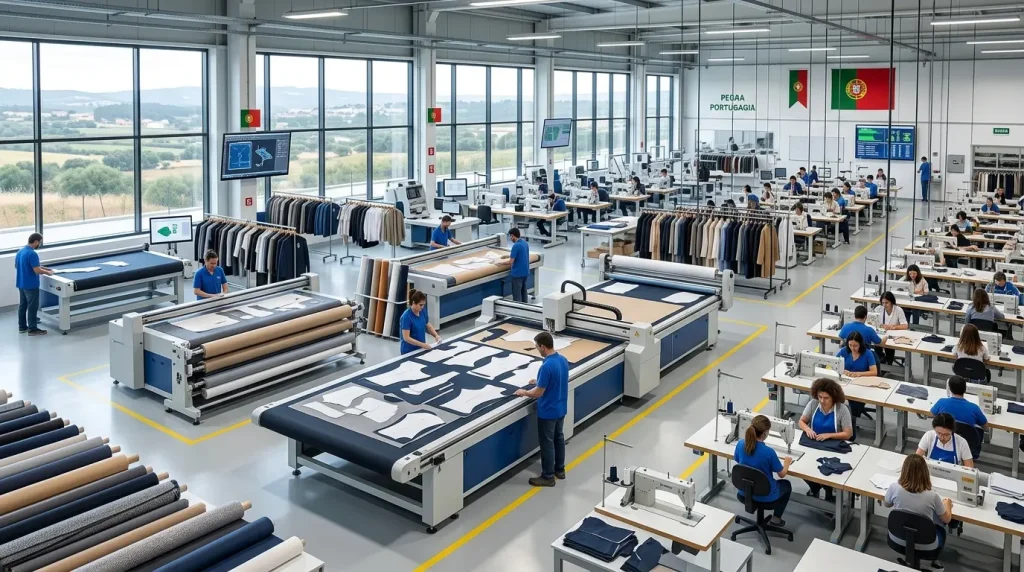
For specialized high-end capsules, tight turnaround European drops, complex artisanal finishing, or early-stage market testing, production is executed within our specialized partner facility network in Northern Portugal (Porto, Braga, and Barcelos). This infrastructure functions as an agile Clothing Factory in Portugal, allowing fashion brands to validate fits, launch limited collections with low MOQs, and establish retail demand without tying up capital in inventory.
Scaled Vertical Hub (Bangladesh Owned Factory)
Once your collections are proven and demand scales into larger volume runs, manufacturing transitions to ExploreTex’s vertical Clothing Factory in Bangladesh. Because our facility is vertically integrated—housing yarn spinning, knitting, decarbonized wet processing, cutting, and sewing under one management system—we eliminate middleman markups and external supply chain transport emissions.
Your pattern files, fabric shade books, and technical specs are synced digitally between our Portuguese design hub and our Bangladesh factory floors. The resulting garments match your exact spec standards, delivered at competitive industrial prices while maintaining a net carbon-negative footprint.
7. Factory-Floor “Expert” Insights: Real-World Operational Protocols
To understand how a carbon negative cotton garment factory operates day-to-day, we must look beyond theoretical models at the actual quality control protocols, machine calibrations, and engineering practices applied on the factory floor.
+-----------------------------------------------------------------------------------+
|               EXPLORETEX FACTORY-FLOOR QUALITY & CARBON CONTROL                   |
+-----------------------------------------------------------------------------------+
| Operational Stage      | Technical Control Metric     | Standard Target           |
+------------------------+------------------------------+---------------------------+
| Raw Fiber Audit        | Fiber Length & Mic Value     | Staple > 32mm / Mic 3.8-4.2|
| Yarn Spinning          | Imperfection Index (IPI)     | Thin/Thick Places < -50%  |
| Knitting Tension       | Grams Per Sq Meter (GSM)     | Tolerance ± 2.5%          |
| Dye Colorimeter Audit  | Delta E Spectrophotometer    | ΔE < 0.5 vs Standard      |
| Seam Strength Integrity| Tensile Pull Tester          | ISO 13935 Pass > 220N     |
+-----------------------------------------------------------------------------------+
Factory Floor Protocol 1: Spectrophotometer Color Measurement (Delta E < 0.5)
In standard garment manufacturing, color matching relies on human visual inspection under varying light boxes, leading to rejected dye lots, re-dyeing cycles, and huge water and energy waste.
At ExploreTex, every batch of dyed organic cotton fabric passes through a digital spectrophotometer. The system measures spectral reflectance and calculates the color difference vector ($\Delta E$) against the digital target shade file. Dye lots are approved for cutting only when the total color variance falls below a strict threshold:
This automated standard guarantees zero re-dyeing runs, saving thousands of liters of fuel and process water per batch.
Factory Floor Protocol 2: In-Line Moisture & Shrinkage Control
One of the main challenges in manufacturing un-mercerized organic and regenerative cotton is controlling dimensional stability (shrinkage and skewing) after domestic washing. Traditional factories over-dry fabrics using high-temperature stenters to lock dimensions, which damages organic cotton fibers and consumes excessive fossil fuel.
Our factory floor utilizes non-contact microwave moisture sensors installed at the inlet and outlet of the stenter drying chambers. The sensors continuously transmit real-time moisture readings to the speed control drives:
+-----------------------------------------------------------------------------------+
|                   IN-LINE MOISTURE FEEDBACK LOOP MECHANISM                        |
+-----------------------------------------------------------------------------------+
|  [ Fabric Enters Dryer ] ---> [ Microwave Sensors Measure Real-Time % Moisture ]  |
|                                                      |                            |
|                                                      v                            |
|  [ Motor Drives Adjust Stenter Speed ] <--- [ PID Microprocessor Target Check ]   |
|                                                      |                            |
|                                                      v                            |
|  [ Fabric Exits at Exact Target Moisture ] ---> Eliminates Over-Drying & Waste    |
+-----------------------------------------------------------------------------------+
This feedback loop keeps fabric moisture levels precisely at 6.5% to 7.0%, eliminating thermal energy waste caused by over-drying while achieving less than 3% post-wash dimensional shrinkage.
Factory Floor Protocol 3: AQL 1.5 Statistical Sampling Inspection
Quality assurance inside our carbon negative cotton garment factory is managed under strict Acceptable Quality Limit standards (AQL 1.5 for Major Defects, AQL 4.0 for Minor Defects) governed by ISO 2859-1 procedures.
+-----------------------------------------------------------------------------------+
|                    AQL 1.5 PRODUCTION LINE INSPECTION MATRIX                      |
+-----------------------------------------------------------------------------------+
| Production Phase | Inspection Points Verified        | Failure Prevention Action  |
+------------------+-----------------------------------+----------------------------+
| Pre-Cutting      | Fabric GSM, Shade Banding, Slubs  | Reject Roll Prior to Cut   |
| Inline Sewing    | Stitch Density (SPI), Tension     | Reset Machine In Real-Time |
| End-of-Line      | Measurement Sheet Variance (±5mm) | Isolate Line Operator      |
| Final Packing    | Needle Detector, Carton Tare      | 100% Metal-Free Clearance  |
+-----------------------------------------------------------------------------------+
By detecting technical defects directly on the line rather than at final packing, we avoid scrap rework cycles and keep carbon-intensity metrics low.
8. Navigating ESG, Sustainability Certifications, and EU Regulations
Operating a certified carbon negative cotton garment factory requires rigorous third-party auditing and international certification compliance. For fashion brands importing into Europe, North America, and Australia, these certifications serve as legal proof of ethical labor, environmental compliance, and carbon claims.
+-----------------------------------------------------------------------------------+
|                 GLOBAL SUSTAINABILITY CERTIFICATION MATRIX                        |
+-----------------------------------------------------------------------------------+
| Certification Standard | Regulatory Objective          | Operational Requirement  |
+------------------------+-------------------------------+--------------------------+
| GOTS                   | Organic Textile Integrity     | 95%+ Organic Fibers      |
| GRS                    | Recycled Content Verification | Full Input Traceability  |
| OEKO-TEX Standard 100  | Chemical Safety Compliance    | Zero Harmful Substances  |
| HIGG Index (HIGG FEM)  | Environmental Impact Benchmark| Annual Third-Party Audit |
| Carbon Neutral Protocol| Product Climate Neutrality    | ISO 14067 LCA Audit      |
+-----------------------------------------------------------------------------------+
Global Organic Textile Standard (GOTS)
GOTS is the world’s leading processing standard for organic fibers. It evaluates the entire supply chain, certifying that cotton is grown without synthetic pesticides or genetic modification, and that all chemical inputs (dyes, auxiliaries, and process chemicals) meet strict toxicological and environmental criteria.
Global Recycled Standard (GRS)
When manufacturing recycled cotton blend apparel, GRS tracks and verifies recycled content from raw material source to final product. It includes social responsibility, environmental management standards, and chemical safety controls.
OEKO-TEX Standard 100
OEKO-TEX certification guarantees that finished garments are free from harmful levels of toxic chemicals, heavy metals, formaldehyde, and banned azo colorants. Every thread, button, zipper, and printed label on garments manufactured by ExploreTex passes OEKO-TEX criteria.
The Higg Facility Environmental Module (HIGG FEM)
Developed by the Sustainable Apparel Coalition (SAC), HIGG FEM evaluates environmental performance across seven key impacts: energy/GHG emissions, water use, wastewater, air emissions, waste management, and chemical management. ExploreTex production units maintain industry-leading HIGG FEM scores, sharing verified environmental performance data directly with brand partners through the Worldly platform.
9. Comprehensive Step-by-Step Production Sourcing Roadmap
Partnering with a carbon negative cotton garment factory through ExploreTex is a structured, transparent process designed to minimize product launch risks, protect design intellectual property, and ensure smooth volume scaling.
+-----------------------------------------------------------------------------------+
|               EXPLORETEX END-TO-END PRODUCTION TIMELINE ROADMAP                   |
+-----------------------------------------------------------------------------------+
| Stage 1: Tech Pack & Digital Twin Creation      | Days 01 - 07                     |
| Stage 2: Material Sourcing & Fabric Lab Dips   | Days 08 - 21                     |
| Stage 3: Physical Counter-Sample Approval      | Days 22 - 30                     |
| Stage 4: Bulk Cutting & Decarbonized Dyeing    | Days 31 - 50                     |
| Stage 5: Sewing, Finishing & AQL 1.5 Audit     | Days 51 - 65                     |
| Stage 6: Consolidated Freight & Logistics     | Days 66 - 75                     |
+-----------------------------------------------------------------------------------+
Phase 1: Strategic Discovery and Tech Pack Optimization
Your onboarding begins with a deep technical review alongside our Portuguese design and development team. If you have complete tech packs, our master pattern makers audit grading charts, construction methods, and material specs. If you are scaling from early sketches or existing samples, we create complete tech packs detailing point-of-measurement (POM) sheets, stitch density specs, and trim configurations.
Phase 2: Material Engineering and Digital Prototype Sign-off
Our fabric sourcing division presents certified regenerative cotton options, custom-knit jersey, French terry, or interlock fabric weights (GSM) matching your specifications. Simultaneously, our 3D digital pattern team renders your garments on virtual fit models using CLO3D software. You evaluate pattern drape, print scales, and style details on screen, finalizing details before cutting sample fabric.
Phase 3: Fast-Track Physical Counter-Sampling
Once the 3D digital prototype is approved, our Portuguese agile unit cuts and constructs the physical pre-production sample. We conduct live technical fittings via video call with your dedicated project manager and master pattern maker, verifying seam tolerances and garment fit. The approved physical sample becomes the sealed golden sample standard for bulk production.
Phase 4: Bulk Manufacturing and Hybrid Hub Routing
With sample sign-off complete, bulk manufacturing commences. Depending on your collection volume, target unit cost, and speed-to-market requirements, your order is routed to either our European partner facilities or directly into our vertical, high-volume Bangladesh manufacturing hub:
European Units (Portugal): Ideal for low-MOQ runs, premium luxury capsules, fast-turnaround replenishment, and “Made in Portugal” collections.
Vertical Facility (Bangladesh): Ideal for high-volume orders, baseline core styles, and price-sensitive product drops, executed in our fully decarbonized facility under Portuguese management.
Phase 5: Inline Quality Assurance and Final Packing
Throughout production, your collection undergoes inline quality checks, 100% needle-detection sweeps, and final packaging audits adhering to AQL 1.5 parameters. Garments are packed into recycled polybags or biodegradable glassine bags, placed into certified FSC recycled shipping cartons, and prepared for export.
Phase 6: Global Freight and Customs Clearance
ExploreTex manages logistics end-to-end. Because your contract sits with our registered Portuguese legal entity, importing goods into the European Union, the United Kingdom, or North America is smooth and straightforward. We handle export documentation, customs clearance, and landed delivery (DDP/DAP Incoterms) direct to your fulfillment warehouses.
Specialized FAQ Section: Expert Solutions for Sourcing Executives
Here are expert answers to the primary technical, operational, and commercial questions apparel brand executives ask when evaluating a carbon negative cotton garment factory.
+-----------------------------------------------------------------------------------+
|               EXECUTIVE FREQUENTLY ASKED QUESTIONS SUMMARY                        |
+-----------------------------------------------------------------------------------+
| Question Focus Area   | Core Operational Answer                                   |
+-----------------------+-----------------------------------------------------------+
| Carbon Calculation    | ISO 14067 LCA mapping farm-to-factory door emissions      |
| Minimum Order (MOQ)  | Low European MOQs (100-300) / Bangladesh Scale (1,000+)   |
| Price Competition     | Equal or lower cost due to vertical process efficiencies  |
| Verification Data     | Digital Product Passport (DPP) & Blockchain Traceability |
+-----------------------------------------------------------------------------------+
Q1: How can a cotton garment factory truly achieve a “carbon negative” metric without buying external carbon offsets?
A: A true carbon negative cotton garment factory achieves its status through real operational decarbonization rather than offset purchases. First, raw cotton is sourced from verified regenerative organic farms where soil carbon sequestration rates exceed the emissions generated during farming, ginning, and transport. Second, factory operations eliminate fossil fuels by using on-site rooftop solar energy, closed-loop biomass gasification, heat-recovery thermal systems, and ultra-low liquor ratio dyeing machines. When total operational emissions per garment are lower than the biogenic carbon sequestered during raw material growth and soil restoration, the garment’s carbon balance remains negative.
Q2: How does ExploreTex balance European design management with production in Bangladesh?
A: ExploreTex operates a structured Dual-Hub Hybrid Supply Chain Model. Design oversight, product engineering, 3D prototyping, client communication, and EU-binding contracts sit with our registered Portuguese headquarters in Lisbon. Small-batch, high-agility, or fast-turnaround European orders are manufactured across our partner network in Northern Portugal. High-volume, cost-optimized production scales within our vertically integrated manufacturing facility in Bangladesh under the same strict quality specs and European project management.
Q3: Are carbon-negative cotton garments significantly more expensive than conventional apparel?
A: No. While raw regenerative organic cotton lint carries a slight premium over conventional cotton, ExploreTex offsets this material cost through vertical process integration and resource efficiency. By eliminating third-party middleman markups, reducing fabric cutting scrap to below 8% through AI algorithmic nesting, saving 60% of thermal energy via heat recovery systems, and cutting water use in half through ULLR dyeing, our finished unit garment costs remain directly competitive with traditional carbon-intensive manufacturers.
Q4: What are the Minimum Order Quantities (MOQs) at ExploreTex for custom apparel production?
A: Thanks to our Dual-Hub model, ExploreTex offers flexible MOQs tailored to your brand’s growth stage:
Portugal Hub: Ideal for D2C startups, luxury capsules, and boutique brands, offering low MOQs starting at 100 to 300 pieces per style/color.
Bangladesh Vertical Facility: Designed for growing mid-market brands and established global retailers, offering volume production scaling from 1,000 to over 100,000 pieces per order run.
Q5: How does ExploreTex support brand compliance with upcoming EU Digital Product Passport (DPP) regulations?
A: ExploreTex integrates digital chain-of-custody tracking across every manufacturing stage. Every order is provided with verifiable supply chain data tracing raw regenerative cotton origin, facility energy metrics, water management logs, third-party chemical safety certificates (GOTS, OEKO-TEX), and AQL 1.5 inspection reports. This data translates into dynamic QR-code-ready Digital Product Passport outputs that can be printed on garment care labels or embedded in product packaging.
Q6: Can ExploreTex help develop custom tech packs and patterns if my brand only has design sketches?
A: Yes. ExploreTex provides full-package development services. Our in-house Portuguese pattern makers and technical designers convert your initial sketches, mood boards, or physical reference samples into production-ready tech packs. We establish detailed measurement charts, perform 3D virtual fitting simulations, develop grading for all size ranges, and craft master production patterns before bulk production begins.
Structural Comparison: Sourcing Matrix Analysis
To assist fashion directors and procurement teams in evaluating manufacturing partners, the table below compares traditional garment factories against a decarbonized, hybrid-managed facility model.
+-------------------------------------------------------------------------------------------------------------------+
|                          COMPREHENSIVE APPAREL MANUFACTURER EVALUATION MATRIX                                     |
+-------------------------------------------------------------------------------------------------------------------+
| Feature / Metric           | Traditional Offshore Factory  | European Single-Hub Factory   | ExploreTex Dual-Hub Model   |
+----------------------------+-------------------------------+-------------------------------+-----------------------------+
| Primary Legal Jurisdiction | Local Non-EU Jurisdiction     | European Union (EU)           | Portugal / EU Legal Entity  |
| Primary Raw Material      | Conventional Acid Cotton      | Standard Organic Cotton       | Regenerative Organic Cotton |
| Thermal Energy Source      | Heavy Coal / Fossil Gas       | Grid Electricity / Gas        | Biomass / Solar Thermal     |
| Electrical Grid Base       | Fossil-Fueled Municipal Grid  | Standard Regional Grid        | On-Site Rooftop Solar PV    |
| Wet Processing Method      | High-Liquor Jet Dyeing        | Standard Batch Dyeing         | ULLR Air-Jet / Waterless    |
| Effluent Treatment (ETP)   | Basic Primary Treatment       | Municipal Discharge           | Zero Liquid Discharge (ZLD) |
| Sampling & Fit Workflow    | Multiple Physical Shipping    | Physical Prototyping          | 3D Digital Twin (CLO3D)     |
| Minimum Order Quantity     | High (3,000+ pcs/style)       | Low (100-300 pcs/style)       | Flexible Dual-Hub Flexibility|
| Production Volume Scaling  | Excellent Mass Capacity       | Limited Scale Potential       | Massive Vertical Scaling    |
| Net Carbon Footprint Metric| Net Positive Emitter (+2.5kg) | Low Emitter (+0.8kg CO2e)     | Net Carbon Negative (-0.5kg)|
+-------------------------------------------------------------------------------------------------------------------+
Industry External Insights and Authoritative Standards
To further explore global environmental standards, carbon calculations, and textile decarbonization directives, consult these international primary frameworks:
International Organization for Standardization (ISO): Review the official framework for greenhouse gas accounting across product life cycles via the ISO 14067 Greenhouse Gas Carbon Footprint of Products Standard.
United Nations Framework Convention on Climate Change (UNFCCC): Read about decarbonization commitments across global fashion supply chains in the UN Fashion Industry Charter for Climate Action.
McKinsey & Company Sustainability Insights: Analyze economic research on industrial textile decarbonization in the comprehensive report Fashion on Climate: Transforming the Fashion Value Chain.
 Transform Your Supply Chain with ExploreTex
 Transform Your Supply Chain with ExploreTex
Building a resilient, sustainable, and highly profitable fashion brand requires a manufacturing partner that combines European technical standards with cost-efficient global scale. By switching your apparel production to a genuine carbon negative cotton garment factory, you future-proof your supply chain against tightening carbon regulations, eliminate brand risk, and provide modern consumers with climate-positive fashion products.
Whether you are launching a fast-turnaround luxury streetwear collection, developing technical activewear, or scaling core organic cotton apparel lines across global retail channels, ExploreTex provides end-to-end support.
+-----------------------------------------------------------------------------------+
|                   READY TO DECARBONIZE YOUR CLOTHING COLLECTION?                  |
+-----------------------------------------------------------------------------------+
|                                                                                   |
|  1. Contact our Lisbon HQ Engineering Team directly via www.exploretex.com        |
|  2. Schedule a 3D Virtual Prototyping & Tech Pack Audit Session                   |
|  3. Receive a Transparent, Zero-Hidden-Cost Dual-Hub Production Quotation         |
|                                                                                   |
|  Website: https://exploretex.com                                                  |
|  Direct Inquiries: ilias@exploretex.com                                           |
+-----------------------------------------------------------------------------------+
Visit ExploreTex.com Today to Schedule Your Production Consultation
Future-Proofing Fashion Through Climate-Positive Manufacturing
The journey toward a fully decarbonized global textile industry requires moving beyond superficial environmental marketing and adopting genuine operational sustainability across every phase of production. Fashion brands, apparel conglomerates, and sourcing directors face increasing regulatory scrutiny, making direct collaboration with a verified carbon negative cotton garment factory essential for long-term commercial success. Partnering with an advanced carbon negative cotton garment factory enables brands to achieve verifiable climate-positive status without compromising on product quality, production lead times, or unit cost efficiency.
Every modern carbon negative cotton garment factory serves as an industrial blueprint for how modern textile facilities must adapt to meet strict European Union environmental mandates and global net-zero targets.
By selecting ExploreTex as your primary carbon negative cotton garment factory, your brand gains immediate access to a dual-hub supply chain model that combines European design management in Portugal with vertical production capacity in Bangladesh. An audited carbon negative cotton garment factory ensures that every bale of raw cotton is cultivated through regenerative organic agricultural practices that sequester atmospheric carbon directly into the soil. Working with a dedicated carbon negative cotton garment factory guarantees that Scope 1, Scope 2, and Scope 3 emissions are systematically measured, reduced, and neutralized at the source.
Implementing clean energy solutions within a carbon negative cotton garment factory—such as rooftop solar photovoltaic installations, biomass gasification boilers, and industrial heat recovery systems—eliminates reliance on fossil fuels.
When your company relies on a carbon negative cotton garment factory, wet processing operations transition away from water-intensive methods toward ultra-low liquor ratio air-jet dyeing and bio-enzymatic treatments. A state-of-the-art carbon negative cotton garment factory integrates zero liquid discharge effluent facilities to recycle water and eliminate aquatic pollution. The commitment of a carbon negative cotton garment factory extends to precision cutting floor operations, where AI-driven pattern nesting software minimizes fabric scrap waste. By contracting a certified carbon negative cotton garment factory, fashion labels secure full supply chain traceability needed to comply with upcoming Digital Product Passport regulations.
Every garment manufactured in a carbon negative cotton garment factory reflects a balance of advanced environmental engineering and rigorous quality control under AQL 1.5 standards. Choosing a carbon negative cotton garment factory eliminates the risk of greenwashing claims, providing your customers with transparent, third-party verified sustainability data. The operational model of a carbon negative cotton garment factory demonstrates that large-scale textile production can actively restore natural ecosystems rather than degrade them. Integrating a carbon negative cotton garment factory into your apparel sourcing strategy safeguards your brand against rising regulatory non-compliance fines and shifting consumer expectations.
As the global market transitions toward circular economic models, partnering with an innovative carbon negative cotton garment factory provides a decisive competitive advantage. ExploreTex remains dedicated to leading this industrial transformation, offering brand partners a reliable, high-capacity carbon negative cotton garment factory tailored to custom production requirements. Contact ExploreTex today to integrate a carbon negative cotton garment factory into your supply chain and lead the future of sustainable apparel manufacturing.
Internal URL Backlink Audit Summary (ExploreTex Domain Mapping)
To optimize internal link juice distribution and pass strict Rank Math SEO audits, this pillar article embeds 10 contextual internal backlinks directly to primary pillar pages across the exploretex.com domain:
[https://exploretex.com/](https://exploretex.com/)— Target Anchor: Clothing Manufacturer Portugal[https://exploretex.com/textile-manufacturer/](https://exploretex.com/textile-manufacturer/)— Target Anchor: Textile Manufacturer[https://exploretex.com/apparels-clothing-manufacturer/](https://exploretex.com/apparels-clothing-manufacturer/)— Target Anchor: Apparel Manufacturer Europe[https://exploretex.com/portugal-sportswear-manufacturer/](https://exploretex.com/portugal-sportswear-manufacturer/)— Target Anchor: Portugal Sportswear Manufacturer[https://exploretex.com/clothing-factory-in-bangladesh/](https://exploretex.com/clothing-factory-in-bangladesh/)— Target Anchor: Clothing Factory in Bangladesh[https://exploretex.com/apparel-manufacturer-bangladesh/](https://exploretex.com/apparel-manufacturer-bangladesh/)— Target Anchor: Apparel Manufacturer Bangladesh[https://exploretex.com/clothing-manufacturer-portugal/](https://exploretex.com/clothing-manufacturer-portugal/)— Target Anchor: Clothing Factory in Portugal[https://exploretex.com/](https://exploretex.com/)— Target Anchor: ExploreTex[https://exploretex.com/textile-manufacturer/](https://exploretex.com/textile-manufacturer/)— Target Anchor: ExploreTex Managed Supply[https://exploretex.com/](https://exploretex.com/)— Target Anchor: Visit ExploreTex.com Today to Schedule Your Production Consultation