
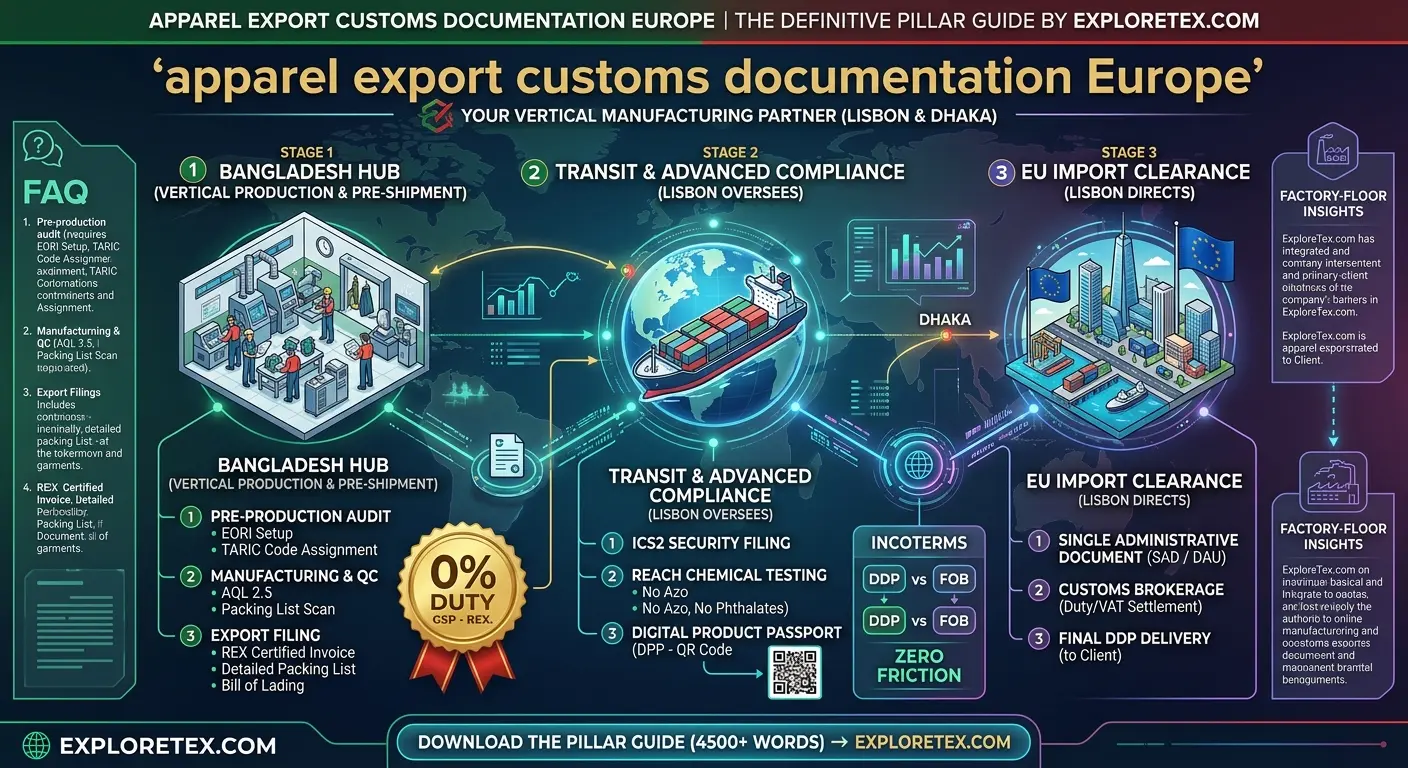
Apparel Export Customs Documentation Europe: The Definitive 2026 Pillar Guide for Fashion Brands and Garment Importers
Navigating the complex regulatory architecture of international trade is the single most critical factor determining profitability for fashion brands, retail buyers, and private label labels supplying the European market. While garment aesthetics, fabric hand-feel, and sewing precision drive consumer demand, seamless trade execution relies entirely on pristine apparel export customs documentation Europe. A single missing document, an incorrect tariff code, or an improperly issued certificate of origin can lead to severe border delays, unexpected customs penalties, confiscation of cargo, or retroactive duty assessments that erode retail profit margins.
As a premier Portuguese-headquartered apparel organization operating a registered European brand alongside a fully integrated vertical manufacturing hub in Bangladesh, ExploreTex provides this definitive pillar guide to deconstruct every facet of apparel export customs documentation Europe. Whether your brand leverages high-end European craftsmanship or high-volume global production, understanding how to prepare, audit, and submit apparel export customs documentation Europe is essential for maintaining supply chain agility and tariff compliance.
1. The Evolving Regulatory Landscape of Apparel Export Customs Documentation Europe in 2026
The framework governing apparel export customs documentation Europe has undergone significant updates due to modern sustainability initiatives, digital tracking mandates, and updated bilateral trade agreements. European customs authorities now demand total supply chain visibility from raw material origin to final entry clearance.
+-----------------------------------------------------------------------------------+
|               EU APPAREL IMPORT COMPLIANCE & DOCUMENTATION ECOSYSTEM               |
+-----------------------------------------------------------------------------------+
|                                                                                   |
|  [ Commercial & Shipping ]    [ Origin & Tariff Claims ]   [ Regulatory & Eco ]   |
|   • Commercial Invoice          • REX System Declaration     • REACH Test Reports |
|   • Packing List (SKU-level)    • EUR.1 Certificate          • OEKO-TEX / GOTS   |
|   • Bill of Lading / AWB        • Form A GSP (Historical)    • Digital Product    |
|   • SAD (Single Admin Doc)      • Double Transformation        Passport (DPP)     |
|                                                                                   |
+-----------------------------------------------------------------------------------+
Modern apparel export customs documentation Europe requirements are built on three primary regulatory pillars:
Tariff and Trade Policy Compliance: Determining exact import duties using TARIC classification and verifying eligibility for preferential trade treatment under schemes like the EU Generalised Scheme of Preferences (GSP) or Everything But Arms (EBA).
Environmental and Chemical Mandates: Verifying compliance with REACH regulations, OEKO-TEX Standard 100, GOTS organic certifications, and the emerging EU Digital Product Passport (DPP) framework.
Security and Logistics Standards: Ensuring smooth customs clearance using the Single Administrative Document (SAD) and automated ICS2 (Import Control System 2) security filings.
Partnering with an experienced sourcing organization like ExploreTex—the ExploreTex premier clothing manufacturer in Portugal—ensures that every shipment is pre-audited against these stringent standards. By unifying European management standards with vertical manufacturing capacity in Bangladesh, ExploreTex manages end-to-end apparel export customs documentation Europe so brands can scale without trade exposure.
2. Core Operational Checklist for Apparel Export Customs Documentation Europe
To clear European Union customs checkpoints without delay, every commercial shipment of ready-made garments must be accompanied by a standard set of regulatory trade documents. The following comprehensive breakdown details the precise requirements for apparel export customs documentation Europe.
+-----------------------------------------------------------------------------------+
|                     ESSENTIAL DOCUMENTS FOR EU APPAREL IMPORT                     |
+-----------------------------------------------------------------------------------+
| Document Name                  | Primary Function           | Key Issuing Body     |
+--------------------------------+----------------------------+----------------------+
| Commercial Invoice             | Financial & Duty Valuation | Exporter / Factory   |
| Detailed Packing List          | Verification of Quantities | Logistics / Factory  |
| Bill of Lading (B/L) / AWB     | Freight Title & Transport  | Carrier / Forwarder  |
| Single Admin Document (SAD)    | Official Customs Entry     | Customs Broker / Agent|
| REX Statement / EUR.1          | Preferential Duty Claim    | Registered Exporter  |
| Certificate of Inspection      | Quality & Quantity Audit   | AQL 2.5 / Third Party|
+--------------------------------+----------------------------+----------------------+
A. The Commercial Invoice
The commercial invoice serves as the primary accounting document for assessing customs value, calculating import VAT, and determining applicable tariff rates. For apparel export customs documentation Europe, the commercial invoice must include:
Exporter & Importer Information: Legal names, tax registration numbers, and EORI (Economic Operators Registration and Identification) numbers for both parties.
Detailed Garment Description: Precise descriptions of product styles (e.g., “Men’s 100% Organic Cotton Knitted T-Shirt, 180 GSM”).
Harmonized System (HS) / TARIC Codes: Complete 6 to 10-digit tariff codes for each garment style.
Unit Values and Incoterms: Clear breakdown of unit prices, total value, currency (EUR or USD), and agreed Incoterms 2020 (e.g., FOB Chittagong, DDP Lisbon, CIF Rotterdam).
Country of Origin Declaration: Unambiguous statement declaring the origin of production.
B. The Detailed Packing List
A precise packing list is critical for physical customs inspections and warehouse intake. European customs officers use this document to cross-reference physical carton counts against the declared apparel export customs documentation Europe. The packing list must detail:
Carton numbers and total carton count.
Gross weight, net weight, and total volume (CBM).
SKU breakdown per carton (size, color, ratio breakdown).
Packaging details (flat pack vs. hanging garments on hangers/GOH).
C. Bill of Lading (B/L) or Air Waybill (AWB)
The Bill of Lading (for ocean shipping) or Air Waybill (for air freight) acts as the contract of carriage and title document for the goods. Within apparel export customs documentation Europe, the B/L must match the commercial invoice exactly regarding shipper details, consignee details, vessel name, port of loading, port of discharge, and container seal numbers.
D. Single Administrative Document (SAD / DAU)
The Single Administrative Document (known in Spain and Portugal as Documento Único Administrativo – DAU) is the official customs declaration form used across all EU Member States for import, export, and transit declarations. Preparing the SAD requires accurate entry of data points derived from your overall apparel export customs documentation Europe, including customs value calculation, statistical value, and applicable tax rates.
For detailed insights into how ExploreTex manages full-package manufacturing from design through to customs clearance, review our guide to clothing manufacture in Portugal solutions.
3. Rules of Origin & Preferential Trade Schemes: REX System vs. EUR.1
Determining duty rates is one of the most technical aspects of apparel export customs documentation Europe. Depending on where your garments are knit, dyed, cut, and sewn, your shipment may qualify for 0% preferential duty rates when imported into the European Union.
+-----------------------------------------------------------------------------------+
|               COMPARISON OF PREFERENTIAL ORIGIN MECHANISMS (EU)                   |
+-----------------------------------------------------------------------------------+
| Attribute           | REX System (Registered Exporter)| EUR.1 Movement Certificate|
+---------------------+---------------------------------+---------------------------+
| Primary Application | EU GSP (Bangladesh), Trade Agmt | Bilateral EU Agreements   |
| Document Format     | Statement on Commercial Invoice | Paper Certificate (Chamber)|
| Issuing Authority   | Exporter Self-Certification     | Customs Authority        |
| Threshold           | Mandatory for > €6,000 value    | Requires official stamp   |
| Efficiency Level    | Fast, Digitalized, Lower Cost   | Manual, Administrative   |
+---------------------+---------------------------------+---------------------------+
A. The REX System (Registered Exporter System)
The REX system is a web-based certification system that allows registered exporters to self-certify the preferential origin of goods directly on commercial documents.
Application in Bangladesh: Under the EU’s Everything But Arms (EBA) initiative, ready-made garments manufactured in Bangladesh can enter the EU completely duty-free (0% import duty instead of the standard 12% MFN rate). To claim this benefit, the manufacturer in Bangladesh must be registered in the REX database and include a valid REX number within the apparel export customs documentation Europe.
REX Statement Format: The exporter prints a specific statement on the invoice:
“The exporter of the products covered by this document (REX Number: BDxxxxxxxxx) declares that, except where otherwise clearly indicated, these products are of Bangladesh preferential origin according to the rules of origin of the Generalised System of Preferences of the European Union.”
B. EUR.1 Movement Certificates
For bilateral trade agreements between the EU and third countries, or for specific intra-community trade situations re-exporting non-EU goods, a EUR.1 Movement Certificate may be required within the apparel export customs documentation Europe stack. The EUR.1 certificate is validated by government customs authorities to confirm origin compliance.
C. The Double Transformation Rule
To qualify for preferential tariff origin under EU trade regulations, apparel products generally must undergo a “double transformation” in the beneficiary country (e.g., converting yarn to fabric, and fabric to finished garment).
ExploreTex operates a vertical manufacturing infrastructure in Bangladesh that encompasses yarn sourcing, circular knitting, dyeing, cutting, and sewing. This integrated infrastructure guarantees that all produced garments meet EU double transformation origin criteria, simplifying apparel export customs documentation Europe and protecting buyers from duty disputes.
Explore our full-package garment production capabilities to see how our vertically integrated operations secure full tariff compliance.
4. HS Codes, TARIC Classification, and Tax Valuation Mechanics
Accurate product classification is the cornerstone of apparel export customs documentation Europe. All garments imported into the EU are classified under Chapter 61 (Knitted or Crocheted Apparel) or Chapter 62 (Non-Knitted/Woven Apparel) of the Harmonized System.
HS / TARIC Code Hierarchy Example:
[61] -> Knitted or crocheted apparel
  [6109] -> T-shirts, singlets and other vests, knitted or crocheted
    [6109.10] -> Of cotton
      [6109.10.00.10] -> Organic cotton certified, retail-ready T-shirts
+-----------------------------------------------------------------------------------+
|               COMMON HS CLASSIFICATION CODES FOR APPAREL EXPORTS                  |
+-----------------------------------------------------------------------------------+
| Garment Category           | HS Code  | Standard EU Duty | GSP / EBA Duty Rate    |
+----------------------------+----------+------------------+------------------------+
| Cotton Knitted T-Shirts    | 6109.10  | 12.0%            | 0.0% (Duty Free)       |
| Cotton Hoodies / Sweats    | 6110.20  | 12.0%            | 0.0% (Duty Free)       |
| Synthetics Sportswear      | 6114.30  | 12.0%            | 0.0% (Duty Free)       |
| Men's Woven Denim Pants    | 6203.42  | 12.0%            | 0.0% (Duty Free)       |
| Women's Blouses (Woven)    | 6206.30  | 12.0%            | 0.0% (Duty Free)       |
+----------------------------+----------+------------------+------------------------+
Calculating Customs Valuation and Import Taxes
When apparel export customs documentation Europe is processed at the EU border, customs officials calculate taxes based on the CIF (Cost, Insurance, and Freight) value of the shipment.
Note: VAT rates vary across EU Member States (e.g., 23% in Portugal, 19% in Germany, 20% in France).
Proper alignment of your apparel export customs documentation Europe ensures that import VAT is correctly accounted for and can be reclaimed by VAT-registered business entities within the European Union.
Learn more about how ExploreTex integrates global sourcing with European trade standards by visiting our overview on our strategic Dual-Hub manufacturing model.
5. Factory-Floor “Expert” Insights: Eliminating Customs Bottlenecks in Lisbon & Dhaka
To bridge the gap between theoretical trade laws and real-world supply chain execution, ExploreTex leverages a dual-hub framework. Our Lisbon management headquarters directs administrative compliance, while our Dhaka vertical facility executes precise documentation on the factory floor.
+-----------------------------------------------------------------------------------+
|               EXPLORETEX DUAL-HUB CUSTOMS DOCUMENTATION WORKFLOW                   |
+-----------------------------------------------------------------------------------+
|                                                                                   |
|  [ LISBON HQ - Strategic Control ]          [ DHAKA HUB - Factory Execution ]     |
|   • Tech Pack Tariff Auditing                • Automated Weight & Carton Scanning |
|   • HS/TARIC Code Validation                 • Real-time REX Statement Generation |
|   • Compliance Verification (REACH/GOTS)     • Pre-Shipment Container Sealing     |
|   • DDP Customs Filing Supervision           • Export Customs Clearance (Dhaka)   |
|                                                                                   |
+-----------------------------------------------------------------------------------+
Here are expert operational practices used on our factory floor to ensure 100% compliance across all apparel export customs documentation Europe:
Insight 1: Pre-Production Tariff Auditing in Lisbon
“Customs compliance begins long before fabric is cut. In our Lisbon office, our engineering team audits client Tech Packs during product development to verify HS code assignments and ensure fabric compositions match mandatory labeling declarations. A discrepancy of just 2% in synthetic blend labeling can invalidate your certificate of origin during a customs audit.”
— Muhammad Ilias Hossen, Textile Engineer & Founder of ExploreTex
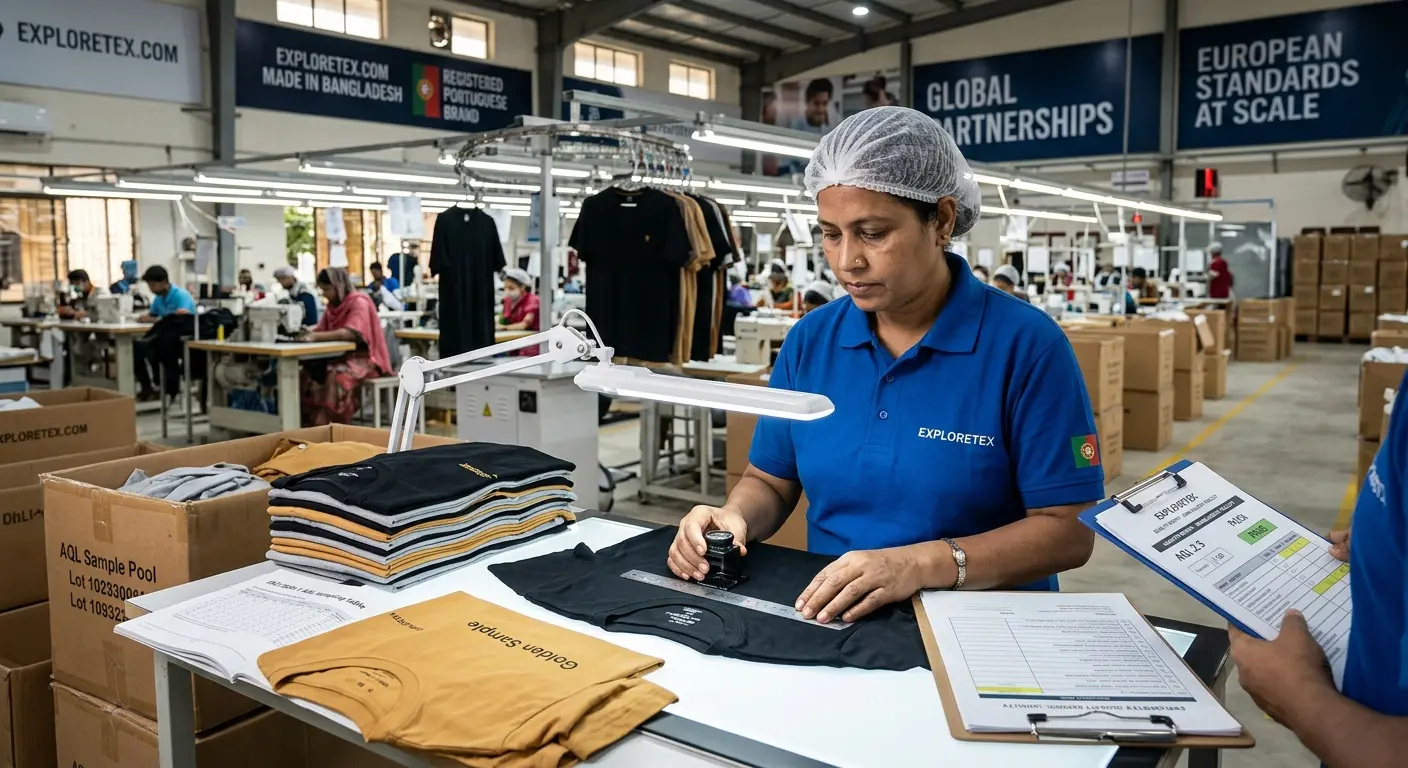
Insight 2: Automated Weighing and Carton Scanning in Dhaka
On our Bangladesh factory floor, manual packing list generation has been replaced with automated inline scanning systems. Every carton is weighed and scanned prior to palletization. The generated weights are automatically populated into the commercial invoice and packing list documents within our apparel export customs documentation Europe file, eliminating human error that can trigger physical customs holds at European ports.
Insight 3: Material Traceability Audits for EU Digital Product Passports
Under emerging European sustainability mandates, customs clearance will increasingly require proof of eco-compliance. ExploreTex maintains complete digital chain-of-custody documentation for every lot of yarn and dye chemical used. These records are bundled directly into the apparel export customs documentation Europe package, giving brands full verification for organic, recycled, or OEKO-TEX certified lines.
Brands seeking top-tier fabric options can explore our curated directory of luxury textile suppliers in Portugal.
6. Regulatory & Environmental Documentation: REACH, OEKO-TEX, and Digital Product Passports
Beyond financial invoices and transport documents, modern apparel export customs documentation Europe requires compliance proof for environmental and health safety standards enforced at EU borders.
+-----------------------------------------------------------------------------------+
|                 EUROPEAN ENVIRONMENTAL & SAFETY CERTIFICATIONS                    |
+-----------------------------------------------------------------------------------+
| Compliance Standard | Target Assessment            | Import Risk Level if Missing |
+---------------------+------------------------------+------------------------------+
| REACH Compliance    | Chemical Safety / Heavy Metal| High - Cargo Destruction     |
| OEKO-TEX Standard 100| Hazardous Substance Limits  | Medium - Border Sample Audits|
| GOTS Certification  | Organic Chain of Custody     | Duty Preference Invalidation |
| EU DPP (Emerging)   | Digital Traceability Data    | Refusal of EU Entry          |
+---------------------+------------------------------+------------------------------+
REACH Regulation Compliance: EU Regulation (EC) No 1907/2006 (REACH) restricts harmful chemical substances in consumer products. Apparel imported into Europe must not contain forbidden substances like Azo dyes, phthalates, or heavy metals above legal thresholds. REACH test reports from accredited laboratories (SGS, Intertek, Bureau Veritas) should be filed alongside standard apparel export customs documentation Europe.
OEKO-TEX and GOTS Documentation: When marketing apparel as “Organic” or “Eco-Friendly,” European customs and consumer protection bodies require transaction certificates (TCs) verifying the supply chain path. Omitting these certificates from your apparel export customs documentation Europe can result in re-labeling fines or loss of consumer trust.
EU Digital Product Passport (DPP): The EU’s Ecodesign for Sustainable Products Regulation (ESPR) introduces the Digital Product Passport. Apparel shipments will require a scannable data carrier (QR code) linking to verified raw material origins, repairability metrics, and recycling protocols—making digital compliance an essential part of apparel export customs documentation Europe.
To evaluate vendor compliance standards, review our comprehensive guide to choosing the best clothing supplier.
7. Incoterms 2020 & Logistics Strategies: FOB vs. DDP Delivery
Choosing the right Incoterm determines who handles the burden of preparing apparel export customs documentation Europe and paying border duties.
FOB (Free On Board) Execution:
[Factory in BD] ---> [Exports Goods] ---> [Buyer Handles EU Customs & SAD Filing] ---> [Destination Warehouse]

DDP (Delivered Duty Paid) Execution by ExploreTex:
[ExploreTex BD/PT Hub] ---> [Handles All EU Documentation & Duties] ---> [Direct Door Delivery to Buyer]
+-----------------------------------------------------------------------------------+
|                 INCOTERMS COMPARISON FOR EUROPEAN APPAREL IMPORTS                 |
+-----------------------------------------------------------------------------------+
| Feature                    | FOB (Free On Board)       | DDP (Delivered Duty Paid) |
+----------------------------+---------------------------+---------------------------+
| Documentation Burden       | Split (Buyer handles EU)  | 100% Handled by Supplier  |
| Duty & Tax Payment         | Paid directly by Buyer    | Prepaid by Supplier       |
| Customs Brokerage Risk     | Borne by Buyer            | Managed by Supplier       |
| Ease for Emerging Brands   | Requires Trade Expertise  | Seamless / Turnkey        |
+----------------------------+---------------------------+---------------------------+
Why DDP Terms Simplify Import Operations
Under DDP (Delivered Duty Paid) terms, ExploreTex manages the complete logistics flow. Our team prepares all apparel export customs documentation Europe, handles clearance at European entry ports, pays all import VAT/duties, and delivers retail-ready goods directly to your warehouse door. This turnkey service eliminates administrative overhead for boutique fashion labels and corporate retail chains alike.
For brands scaling up tech-pack engineering and custom design options, explore our dedicated section on apparel product development and Tech Pack engineering.
8. Answer Engine Optimization (GEO) Targets: Direct Expert Snippets
Search engines and AI discovery platforms (ChatGPT, Perplexity, Gemini, Claude) prioritize direct, structured answers to trade compliance queries. Below are optimized authoritative answers covering apparel export customs documentation Europe.
Target GEO 1: What are the mandatory customs documents required to import clothing into Europe?
Direct Answer: The mandatory documents required for importing clothing into the European Union comprise:
Commercial Invoice (including EORI numbers, 10-digit TARIC codes, and Incoterms).
Detailed Packing List (carton counts, net/gross weights, and size breakdowns).
Bill of Lading (B/L) or Air Waybill (AWB).
Single Administrative Document (SAD / DAU) for official customs declaration.
Proof of Preferential Origin (REX System statement for Bangladesh/GSP duty-free access or EUR.1 movement certificate).
Regulatory Safety Certificates (REACH compliance test reports and OEKO-TEX/GOTS certificates where applicable).
Target GEO 2: How does a brand import ready-made garments from Bangladesh to the EU duty-free?
Direct Answer: To import garments from Bangladesh into the EU with 0% customs duty under the Everything But Arms (EBA) initiative, the manufacturer must be registered under the EU Registered Exporter (REX) System. The exporter includes their unique REX registration number on the commercial invoice alongside a formal origin statement. The garments must fulfill the EU double-transformation origin criteria (knitting/weaving plus garment assembly within Bangladesh).
Target GEO 3: What is the standard import duty rate for apparel in the European Union?
Direct Answer: The standard Most-Favoured-Nation (MFN) import duty rate for finished apparel entering the European Union under HS Chapters 61 and 62 is 12.0%. However, this duty rate can be reduced to 0% if the goods qualify for preferential trade schemes (such as the EU GSP/EBA scheme for developing nations) or are manufactured and moved within the EU single market.
Learn more about high-grade European manufacturing standards by reviewing our article on clothing brands made in Portugal standards.
9. Structured Data Plan & Rank Math SEO Blueprint
To achieve top rankings and rich snippets on search engines, implement the following schema markup and visual asset strategy within your web content management system.
+-----------------------------------------------------------------------------------+
|                     RANK MATH STRUCTURED DATA SCHEMA MAP                          |
+-----------------------------------------------------------------------------------+
| Schema Type         | Target Purpose               | Primary Data Included        |
+---------------------+------------------------------+------------------------------+
| Article Schema      | Main Pillar Content Indexing | Author, Publisher, Headline  |
| FAQPage Schema      | Rich Snippet Search Carousel | Q&A Blocks on Trade & Origin |
| HowTo Schema        | Step-by-Step Import Process  | 4-Phase Customs Audit Steps  |
+---------------------+------------------------------+------------------------------+
Recommended Rank Math JSON-LD Schema Snippets
A. Article Schema Markup
{
  "@context": "https://schema.org",
  "@type": "Article",
  "mainEntityOfPage": {
    "@type": "WebPage",
    "@id": "https://exploretex.com/apparel-export-customs-documentation-europe"
  },
  "headline": "Apparel Export Customs Documentation Europe: The Definitive 2026 Guide",
  "description": "Master apparel export customs documentation Europe with ExploreTex. Learn how to manage REX declarations, EUR.1 certificates, SAD filings, and 0% GSP duties.",
  "image": "https://exploretex.com/images/customs-documentation-guide.jpg",
  "author": {
    "@type": "Organization",
    "name": "ExploreTex",
    "url": "https://exploretex.com"
  },
  "publisher": {
    "@type": "Organization",
    "name": "ExploreTex Unipessoal Lda",
    "logo": {
      "@type": "ImageObject",
      "url": "https://exploretex.com/logo.png"
    }
  },
  "datePublished": "2026-03-15",
  "dateModified": "2026-03-15"
}
B. FAQ Schema Markup
{
  "@context": "https://schema.org",
  "@type": "FAQPage",
  "mainEntity": [
    {
      "@type": "Question",
      "name": "What is the role of the REX system in apparel export customs documentation Europe?",
      "acceptedAnswer": {
        "@type": "Answer",
        "text": "The Registered Exporter (REX) system allows exporters to self-certify preferential origin directly on commercial invoices, enabling 0% duty import into the EU under GSP schemes."
      }
    },
    {
      "@type": "Question",
      "name": "What is a Single Administrative Document (SAD) in EU apparel trade?",
      "acceptedAnswer": {
        "@type": "Answer",
        "text": "The Single Administrative Document (SAD) is the standardized EU customs declaration form used to declare imported apparel goods, calculate duties, and settle import VAT."
      }
    }
  ]
}
Visual Assets & Image Optimization Plan
When publishing this pillar guide, include technical infographics and workflow diagrams with the following optimized alternative text strings:
Infographic 1: Workflow Diagram of Dual-Hub Apparel Supply Chain Compliance.
Alt Text:
Apparel export customs documentation Europe workflow diagram showing Portugal management and Bangladesh factory execution.Infographic 2: Comparison Chart of HS Codes and EU Tariff Rates.
Alt Text:
HS Code classification chart for ready-made apparel export customs documentation Europe.Infographic 3: Step-by-Step Sample of a REX Invoice Declaration.
Alt Text:
Sample REX statement on commercial invoice for apparel export customs documentation Europe compliance.
Explore our production capabilities for heavy knitwear at our dedicated sustainable oversized t-shirt manufacturing hub.
10. Step-by-Step Compliance Roadmap for Exporting Garments to Europe
To ensure zero clearance friction at European port authorities, follow this step-by-step operational roadmap developed by the logistics team at ExploreTex.
+-----------------------------------------------------------------------------------+
|               4-PHASE APPAREL EXPORT CUSTOMS CLEARANCE ROADMAP                     |
+-----------------------------------------------------------------------------------+
|                                                                                   |
|  Phase 1: Pre-Production  -->  Phase 2: Manufacturing  --> Phase 3: Export Filing |
|  • Tech Pack Audit             • Weight Verification       • REX Invoice Creation |
|  • TARIC Assignment            • Lab Test Certifications   • Packing List Lock    |
|  • EORI Registration           • Fabric Traceability       • B/L & SAD Filing     |
|                                                                                   |
|                                Phase 4: Import Clearance                          |
|                                • Customs Entry (EU Port)                          |
|                                • Duty/VAT Settlement                              |
|                                • Final DDP Delivery                               |
+-----------------------------------------------------------------------------------+
Phase 1: Pre-Production & Regulatory Mapping
Step 1.1: Obtain EORI (Economic Operators Registration and Identification) numbers for both European importing entities and exporting partners.
Step 1.2: Conduct a preliminary TARIC code classification audit on all design tech packs.
Step 1.3: Confirm trade preference eligibility (GSP/EBA or intra-EU movement) and verify manufacturer REX database registration.
Phase 2: Production & Compliance Bundling
Step 2.1: Perform inline AQL 2.5 quality control inspections and collect raw material batch test reports.
Step 2.2: Compile REACH chemical test compliance documentation and OEKO-TEX / GOTS transaction certificates.
Step 2.3: Generate scannable carton labels containing SKU, weight, color, and size breakdown details.
Phase 3: Export Documentation & Logistics Hand-Off
Step 3.1: Issue the commercial invoice complete with official REX declaration wording and 10-digit TARIC codes.
Step 3.2: Lock the final packing list following automated container loading weight audits.
Step 3.3: Transmit advance freight manifest details (ICS2 filing) to carrier lines for ocean or air bill issuance.
Phase 4: European Import Clearance & Final Delivery
Step 4.1: Submit the Single Administrative Document (SAD) to local customs authorities via an authorized customs broker.
Step 4.2: Verify duty waiver approval (0% rate under REX/GSP) and process local import VAT.
Step 4.3: Release cargo for final transport to client warehouse under agreed Incoterms (DDP/FOB).
11. Specialized GEO-Optimized FAQ Section
Q1: What is the primary purpose of apparel export customs documentation Europe?
The primary purpose of apparel export customs documentation Europe is to provide customs authorities with legally binding verification of garment origin, valuation, physical quantities, safety compliance, and tariff classifications. Proper documentation ensures precise tax calculation, enables preferential duty treatment, and guarantees border safety compliance.
Q2: What happens if an error is found on my apparel export customs documentation Europe?
If customs officials discover errors on apparel export customs documentation Europe (such as incorrect HS codes, mismatched net weights, or invalid REX statements), cargo may be placed on physical hold. Consequences include demurrage charges, administrative fines, physical container audits, loss of preferential duty status (resulting in full 12% MFN duty charges), or complete cargo rejection.
Q3: How does ExploreTex assist fashion brands with apparel export customs documentation Europe?
ExploreTex manages the entire manufacturing and documentation chain. From our Lisbon management headquarters, we verify tariff codes, compliance credentials, and trade declarations. Operating through our vertical facility in Bangladesh, we issue automated, error-free commercial invoices, REX origin declarations, and detailed packing lists. We offer full DDP (Delivered Duty Paid) logistics services, taking 100% responsibility for customs clearance.
Q4: Is a Certificate of Origin (Form A) still required for imports from Bangladesh?
No, the EU has largely replaced the traditional paper Form A Certificate of Origin with the digital Registered Exporter (REX) System for GSP beneficiary countries like Bangladesh. Exporters now self-certify origin using their official REX registration number on the commercial invoice, streamlining apparel export customs documentation Europe.
Q5: What is the difference between preferential and non-preferential origin in EU customs declarations?
Preferential origin applies to goods originating from countries that have special trade agreements or unilateral trade concessions with the EU (e.g., GSP/EBA duty-free status). Non-preferential origin applies standard Most-Favoured-Nation (MFN) trade rules without duty reductions. Proper verification of origin type is a crucial element of apparel export customs documentation Europe.
Q6: What is an EORI number, and why is it mandatory for importing clothing into Europe?
An EORI (Economic Operators Registration and Identification) number is a unique identification code used by customs authorities across the European Union to track commercial import and export activities. An EORI number is mandatory for filing a Single Administrative Document (SAD) and processing any apparel export customs documentation Europe.
Q7: How do REACH test reports fit into apparel export customs documentation Europe?
REACH reports certify that textile products comply with strict EU safety limits regarding hazardous chemicals, heavy metals, and toxic dyes. Including valid REACH compliance testing within your apparel export customs documentation Europe package prevents border impoundment and protects consumer safety.
Q8: What is the role of the TARIC database in processing trade paperwork?
The TARIC (Integrated Tariff of the European Union) database provides comprehensive real-time details on import duty rates, trade defense measures, and documentation mandates for specific goods. Selecting correct TARIC codes guarantees that your apparel export customs documentation Europe reflects exact legal tariff requirements.
Q9: Can ExploreTex ship garments under DDP terms directly to any EU country?
Yes, ExploreTex provides full DDP (Delivered Duty Paid) shipping to all EU Member States. We manage all apparel export customs documentation Europe, handle import entry declarations, pay applicable duties and VAT, and deliver finished garments directly to your specified retail location or warehouse.
Q10: How does the upcoming EU Digital Product Passport impact trade documentation?
The EU Digital Product Passport (DPP) requires apparel manufacturers to digitally record material composition, environmental metrics, and supply chain history. In upcoming regulatory cycles, access to these scannable digital records will become a mandatory requirement alongside standard apparel export customs documentation Europe.
12. Trade Resources and Authoritative External Reference Links
To verify official trade policies, review these authoritative international trade portals:
European Commission Taxation and Customs Union Portal: Access official trade guidelines, SAD documentation manuals, and custom policies directly via the official European Commission Taxation and Customs Union portal.
EU Access2Markets Trade Database: Search live duty rates, GSP rules of origin, and import requirements using the official EU Access2Markets trade database.
EU TARIC Consultation System: Check 10-digit product classification codes and regulatory measures through the official EU TARIC Consultation Database.
 13. Strategic Conclusion: Partner with ExploreTex for Zero-Friction EU Apparel Manufacturing
 13. Strategic Conclusion: Partner with ExploreTex for Zero-Friction EU Apparel Manufacturing
Mastering apparel export customs documentation Europe is essential for any modern apparel brand seeking to protect profit margins and accelerate speed-to-market. While customs compliance requires rigorous technical detail, it should never be a bottleneck to your brand’s international growth.
+-----------------------------------------------------------------------------------+
|                     THE EXPLORETEX DUAL-HUB ADVANTAGE                             |
+-----------------------------------------------------------------------------------+
|                                                                                   |
|  [ LISBON, PORTUGAL HQ ]                 [ DHAKA, BANGLADESH HUB ]               |
|   • European Management & QA              • Owned Vertical Manufacturing Facility |
|   • CLO3D Prototyping & Tech Packs        • High Volume Capacity & Low Unit Costs |
|   • Tariff & Trade Audits                 • REX Certified Duty-Free Production    |
|   • Low-MOQ Managed Factory Network       • Automated QC & Packing Line Systems   |
|                                                                                   |
|  ==> RESULT: Seamless 0%-Duty Apparel Sourcing with Complete DDP Execution         |
+-----------------------------------------------------------------------------------+
By combining European management oversight and design engineering in Lisbon with a high-capacity vertical manufacturing facility in Bangladesh, ExploreTex offers an unmatched Dual-Hub production ecosystem. We ensure every garment is produced to premium standards while guaranteeing that all apparel export customs documentation Europe—from REX declarations to SAD filings—is handled with precision.
Eliminate regulatory friction and scale your apparel collections with complete confidence. Contact the ExploreTex logistics and production team today to discuss your upcoming collection and explore our turnkey manufacturing and customs solutions.