
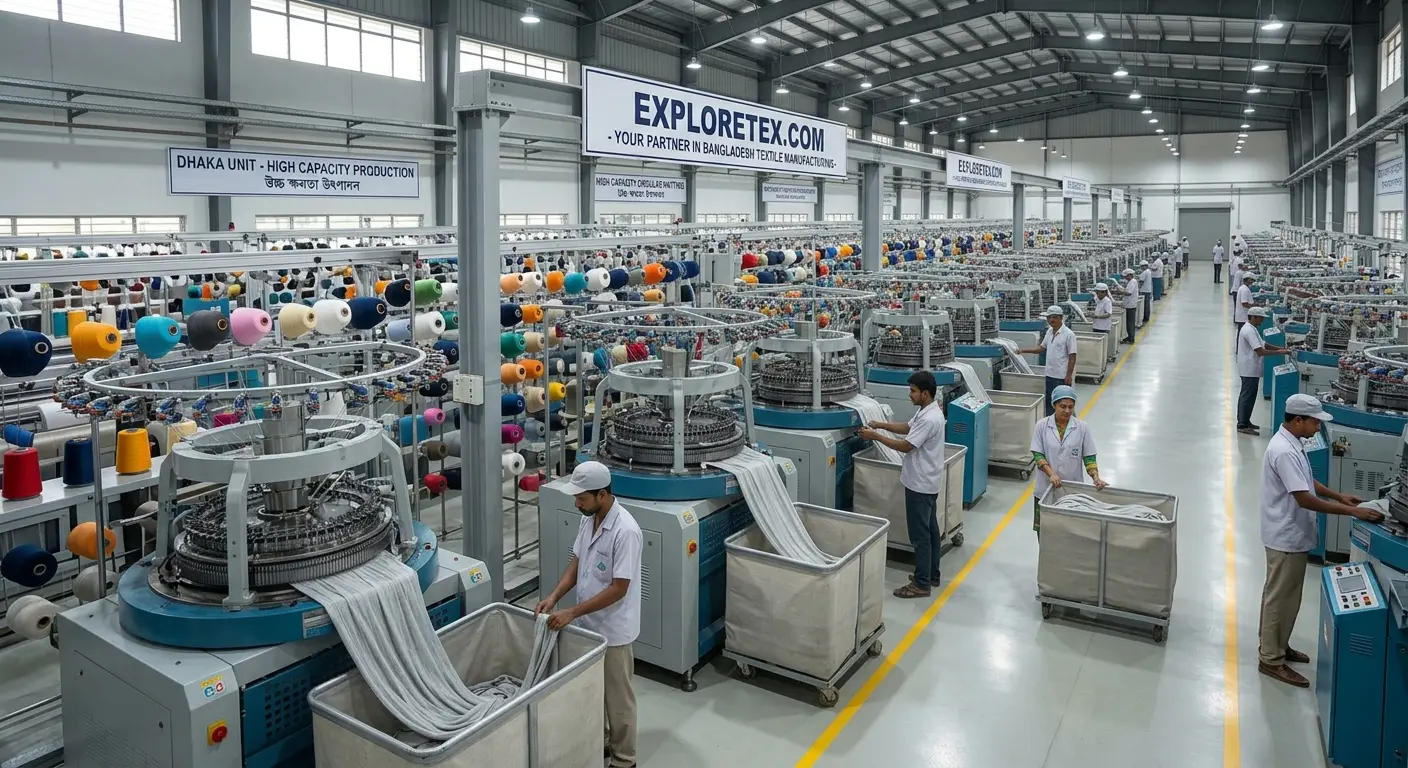
High Capacity Circular Knitting Factory Bangladesh: Inside ExploreTex’s Vertical Production Hub
High Capacity Circular Knitting Factory Bangladesh — Introduction
If you are searching for a high capacity circular knitting factory Bangladesh buyers can genuinely scale with, you already know the real problem isn’t finding capacity — Bangladesh has plenty of it. The real problem is finding a high capacity circular knitting factory in Bangladesh that also gives you accurate tech packs, transparent pricing, and someone who actually answers the phone when a shipment is delayed.
That is exactly the gap ExploreTex was built to close. ExploreTex operates a high capacity circular knitting factory Bangladesh clients rely on for everything from single jersey T-shirts to heavyweight fleece hoodies — but unlike a standalone Bangladesh factory or a faceless sourcing agent, this high capacity circular knitting factory in Bangladesh is directly operated (not subcontracted) and managed end-to-end by a Lisbon, Portugal headquarters. You get EU-based contracts, real-time communication, and full legal accountability, paired with the industrial-scale output of a genuine high capacity circular knitting factory Bangladesh production floor.
This dual-hub structure means your fabric is knitted, dyed, cut, and sewn under one coordinated roof in Dhaka, while your tech packs, sampling approvals, and account management happen through ExploreTex’s Portugal team. The result is a high capacity circular knitting factory Bangladesh partnership that behaves less like an offshore gamble and more like an extension of your own brand team.
Whether you’re placing your first 1,000-piece private label order or scaling an existing knitwear program into full retail distribution, this high capacity circular knitting factory Bangladesh facility is built to grow with you — not force you to switch suppliers the moment your volume outgrows a small workshop. In the sections below, we’ll walk through exactly how the factory works, what certifications back it up, and how to evaluate it against any other supplier you’re considering.
If you have typed “high capacity circular knitting factory Bangladesh” into Google, you are almost certainly one of three people: a fashion brand founder who has outgrown a small domestic supplier, a sourcing manager comparing vertical manufacturing hubs before a factory audit, or a private label buyer who needs consistent GSM, consistent hand-feel, and consistent delivery dates at real retail volume. This article is written for all three.
We are going to walk you through exactly what “high capacity” and “circular knitting” actually mean on a factory floor, why Bangladesh has become the world’s most strategically important country for knit fabric production, and how ExploreTex, a Portugal-headquartered manufacturer with a directly operated, high capacity circular knitting factory in Bangladesh, structures its production to serve both boutique private label brands and high-volume retail programs from a single point of contact in Lisbon.
By the end, you will understand the machinery, the quality systems, the certifications, and the realistic timelines involved — plus you will get a factory-floor view most sourcing articles never show you.
What Does “High Capacity Circular Knitting Factory” Actually Mean?
The phrase gets thrown around loosely in sourcing directories, so let’s define it properly before we go further.
Circular knitting refers to fabric produced on a circular knitting machine — a cylindrical machine with needles arranged around its circumference that continuously knits a tube of fabric (single jersey, rib, interlock, fleece, pique, terry) rather than the flat-bed weaving used for woven fabrics. Circular knit fabric is what almost every T-shirt, polo shirt, hoodie, sweatshirt, and piece of activewear is made from.
A high capacity circular knitting factory is a facility that has:
- Machine density — a large fleet of circular knitting machines (often 24–34 inch diameter, multiple gauges from 18 to 28 GG) capable of running several fabric constructions in parallel.
- Vertical integration — knitting, dyeing/finishing, cutting, sewing, and printing under coordinated management, reducing lead time between fabric and finished garment.
- Daily/monthly tonnage capacity — the ability to knit, dye, and finish tens of thousands of kilograms of fabric per month without bottlenecking downstream sewing lines.
- Consistent quality systems — AQL inspection protocols, lab-tested GSM tolerance, and shrinkage/shade consistency across large repeat orders.
A factory can call itself “high capacity,” but the real test is whether it can hold GSM tolerance, shade consistency, and delivery dates across a 10,000-piece reorder the same way it did on a 500-piece sample run. This is the exact question every sourcing manager should be asking when evaluating a high capacity circular knitting factory Bangladesh buyers are considering for a private label program.
Why Bangladesh Is the World’s Center of Gravity for Circular Knit Manufacturing
Bangladesh is now the world’s second-largest apparel exporter, and knitwear — T-shirts, polos, sweatshirts, hoodies, and jersey basics — makes up the majority of that export volume. According to the Bangladesh Garment Manufacturers and Exporters Association (BGMEA), the country’s ready-made garment sector has built one of the most concentrated knit and dyeing infrastructures anywhere in the world, with entire industrial zones dedicated to circular knitting, dyeing, and vertical garment finishing.
There are four structural reasons brands keep searching for a high capacity circular knitting factory in Bangladesh rather than sourcing from other regions:
- Vertical infrastructure at scale — knitting mills, dye houses, and sewing units are often co-located or under shared ownership, cutting weeks off lead time compared to fragmented supply chains.
- Deep fabric expertise — decades of specialization in single jersey, pique, rib, fleece, and terry knits mean technicians can hit tight GSM and shrinkage tolerances consistently.
- Competitive, transparent pricing — yarn access, labor cost structure, and duty advantages (including EU GSP/EBA preferences) make Bangladesh price-competitive without sacrificing quality when the factory is properly managed.
- Export-ready compliance infrastructure — internationally audited factories with BSCI, WRAP, SEDEX, and OEKO-TEX-aligned dye houses are now standard among top-tier producers.
The challenge for international brands has never really been finding capacity — Bangladesh has plenty of it. The challenge is finding a high capacity circular knitting factory Bangladesh partner that also gives you European-level communication, tech pack accuracy, and legal accountability. That is precisely the gap ExploreTex’s dual-hub model was built to close.
Inside ExploreTex’s High Capacity Circular Knitting Factory in Bangladesh
ExploreTex operates under a structure it calls the Dual-Hub Production Model: a Lisbon-headquartered design, tech pack, and client-management team in Portugal, paired with a directly operated (not subcontracted) high capacity circular knitting factory in Bangladesh that handles knitting, dyeing, cutting, sewing, and finishing at industrial scale.
This distinction matters more than most buyers realize. Many “Bangladesh sourcing agents” are simply brokers placing orders with third-party factories they don’t control — meaning quality, capacity, and compliance can shift from order to order. ExploreTex’s Bangladesh facility, based in the Dhaka production hub, is directly operated with equity ownership, which gives the company direct control over machine scheduling, labor standards, and factory-direct pricing rather than passing through a middleman markup.
You can read more about how the two hubs work together on ExploreTex’s Production Process page, but here is the short version of what “high capacity” looks like in practice at this facility:
- Multi-gauge circular knitting lines producing single jersey, 1×1 and 2×2 rib, interlock, pique, French terry, and fleece constructions.
- Parallel dyeing and finishing capacity that allows the factory to hold shade-matching tolerance across large repeat cuttings — critical for private label programs that reorder the same style every season.
- Integrated cutting and sewing lines immediately downstream from the knitting and finishing floor, which is what makes the facility genuinely vertical rather than just a fabric mill selling greige goods to a separate garment factory.
- Scalable monthly output, giving brands room to grow from an initial 1,000-piece order into a multi-container annual program without switching factories.
This is the operational backbone that lets ExploreTex position itself as a genuine high capacity circular knitting factory Bangladesh clients can scale with — from a first small-batch order through to full retail distribution volume.
Factory-Floor Insights: What Actually Happens Between Yarn and Fabric
Sourcing articles often stay theoretical. Here is what the process actually looks like on the knitting floor of a high capacity circular knitting factory in Bangladesh, based on how ExploreTex structures its production.
“The single biggest quality risk in circular knitting isn’t the machine — it’s yarn consistency. If the yarn count or twist varies between lots, your GSM and hand-feel will drift across a bulk order even if every machine setting stays identical. We lock yarn specifications at the tech pack stage precisely so the fabric a client approves in sampling is the fabric they receive in bulk.” — ExploreTex Bangladesh Knitting Floor Production Team
Step 1 — Yarn Selection and Testing. Cotton, cotton-poly blends, viscose, modal, Tencel™, bamboo, and recycled polyester yarns are tested for count, twist, and strength before they ever reach a knitting machine. This is where ExploreTex’s Product Development team coordinates directly with the Bangladesh floor to lock the fabric spec against the client’s tech pack.
Step 2 — Circular Knitting. Yarn is fed into circular knitting machines set to the required gauge and stitch length to hit the target GSM (grams per square meter) — typically 140–180 GSM for T-shirts, 220–320 GSM for fleece and hoodie fabric, and 180–220 GSM for polo pique.
“Stitch length is the lever most people forget about. Two fabrics can use the exact same yarn and gauge, but if the stitch length is off by even half a millimeter, the finished GSM after dyeing and finishing can be 10–15 grams away from spec. We recheck stitch length on every changeover, not just at the start of a run.” — ExploreTex Bangladesh Knitting Floor Production Team
Step 3 — Dyeing and Finishing. Greige (unfinished) fabric is scoured, bleached where needed, dyed to a lab-approved shade standard, and then compacted and calendered to control shrinkage. This is the stage where a high capacity circular knitting factory Bangladesh buyers are vetting either proves or fails to prove its shrinkage control — reputable facilities target under 5% shrinkage on cotton jersey after home laundering, tested and documented before bulk cutting begins.
Step 4 — Fabric Inspection. Every roll is inspected under a four-point fabric inspection system for holes, oil stains, dye streaks, and knitting faults before it is released to the cutting floor.
Step 5 — Cutting, Sewing, and Finishing. Approved fabric moves directly into cutting and sewing lines, kept under the same roof to protect lead time — the core advantage of vertical, high capacity circular knitting factory Bangladesh operations over fragmented, multi-vendor supply chains.
Machinery and Technology: What Powers a High Capacity Circular Knitting Factory
Understanding the machinery behind a high capacity circular knitting factory in Bangladesh helps buyers ask sharper questions during a factory audit. Industry-standard circular knitting lines generally fall into a few categories, each suited to different fabric outcomes:
- Single jersey machines (typically 24–34 inch cylinder diameter, 18–28 gauge) — used for basic T-shirt and vest jersey, the highest-volume fabric category in any knitwear program.
- Rib and interlock machines — used for collars, cuffs, waistbands, and full-body rib or interlock fabric for polo shirts and premium T-shirts.
- Terry and fleece machines — equipped with additional feeder systems to lay in a heavier loop yarn, producing the base fabric for hoodies and sweatshirts before brushing and napping.
- Jacquard and pattern knitting machines — for textured or patterned knit fabric beyond plain jersey.
A genuinely high capacity circular knitting factory in Bangladesh runs multiple machine types in parallel across dedicated production floors, with a planning team sequencing machine changeovers against confirmed order volume so gauge and construction changes don’t create bottlenecks between the knitting floor and the downstream dyeing lab.
Gauge selection matters more than buyers often realize. A 24-gauge single jersey machine produces a noticeably different hand-feel than a 28-gauge machine using the same yarn count — finer gauges generally produce a smoother, lighter fabric surface, while coarser gauges are often chosen for heavier, more textured basics. When ExploreTex’s Product Development team builds a tech pack, gauge selection is locked at the fabric approval stage specifically so the bulk order matches the approved handle, drape, and weight of the sealed sample — a step that separates a professionally managed high capacity circular knitting factory Bangladesh operation from a factory that treats gauge as a rough estimate rather than a locked specification.
Digital knitting technology and monitoring systems are increasingly standard on modern circular knitting floors, allowing production planners to track machine output, stitch density, and downtime in real time. This is part of why vertically integrated facilities can hold tighter tolerances across a bulk run than fragmented, multi-vendor supply chains where fabric changes hands between unrelated companies.
Comparing Bangladesh to Other Sourcing Regions for Circular Knit Production
Brands evaluating a high capacity circular knitting factory in Bangladesh often want to know how it stacks up against alternatives like China, Vietnam, Turkey, or domestic European production. Here is a realistic, practical comparison:
| Factor | Bangladesh (Circular Knit) | China | Turkey | Portugal (Domestic) |
|---|---|---|---|---|
| Knit fabric specialization | Very high — dedicated jersey/fleece hubs | High, broad category range | High, strong for premium jersey | Strong, smaller-scale artisanal |
| Typical MOQ | Moderate (500–1,000 pcs/style) | Often high at factory-direct level | Moderate to high | Low, ideal for premium/low-volume |
| Cost efficiency at volume | Very strong | Strong | Moderate | Lower (higher labor cost) |
| EU trade preference | GSP/EBA duty advantages | Standard duty | EU customs union advantages | Duty-free within EU |
| Best fit | High-volume retail knitwear | Broad-category bulk sourcing | Fast-fashion, nearshoring to EU | Luxury, “Made in Portugal,” low MOQ |
This is exactly why ExploreTex’s dual-hub model pairs a directly operated, high capacity circular knitting factory in Bangladesh for volume production with a managed Portuguese network for brands that also want premium, low-MOQ, “Made in Portugal” pieces — rather than forcing every client into a single regional trade-off.
A Realistic Scaling Path: From First Order to Full Retail Volume
To make the numbers concrete, here is an illustrative example of how a private label brand typically scales through a high capacity circular knitting factory in Bangladesh:
- Initial order (Month 1–2): A 1,000-piece order across two T-shirt styles, produced to test market fit, fabric hand-feel, and fit approval using the factory’s standard 500-piece-per-style minimum.
- First reorder (Month 4–6): Volume increases to 3,000–5,000 pieces as the brand adds a hoodie and a polo shirt style, drawing on the same circular knitting floor and shared fabric base to control cost and lead time.
- Seasonal program (Month 9–12): The brand moves to a structured seasonal calendar — spring/summer and autumn/winter drops — with fabric and shade standards locked from prior orders, reducing sampling time on repeat constructions.
- Retail-scale production (Year 2+): Multi-container orders across a full knitwear range, with the factory’s AQL inspection protocol and dyeing capacity supporting consistent shade-matching across tens of thousands of units per style.
This progression is only realistic when the underlying factory genuinely has spare capacity to scale into — which is the practical reason brand founders search specifically for a high capacity circular knitting factory Bangladesh partner rather than a small workshop that will hit a ceiling at exactly the volume where the brand needs to grow.
Product Range Built on Circular Knit Fabric
Because circular knitting is the foundation of most casualwear and activewear, a genuinely high capacity circular knitting factory in Bangladesh needs to support a wide product range from the same fabric base. ExploreTex’s Bangladesh facility, combined with its Portugal-managed finishing network, produces:
- T-shirts in single jersey and combed cotton jersey
- Polo shirts in pique and interlock knit
- Hoodies in brushed fleece and French terry
- Sweatshirts and crewnecks in mid-weight fleece
- Sportswear in performance interlock and moisture-wicking blends
- Vest tops, underwear, swimwear, and scarves in lighter jersey and rib constructions
Every one of these categories starts on the same circular knitting floor, which is exactly why brands consolidating multiple SKUs — a T-shirt line, a hoodie line, and a polo line — under one factory relationship find real efficiency working with a single high capacity circular knitting factory Bangladesh partner instead of splitting production across three unrelated vendors.
Quality Control and Certifications: What “High Capacity” Should Never Sacrifice
Capacity without quality control is just risk at scale. This is the part of factory evaluation buyers should never skip, and it’s worth reviewing in detail on ExploreTex’s Why Choose Us page.
A properly managed high capacity circular knitting factory in Bangladesh should be able to show documentation for:
Social and Ethical Compliance
- BSCI (Business Social Compliance Initiative)
- WRAP (Worldwide Responsible Accredited Production)
- SEDEX and SMETA audits
Environmental and Material Standards
- OEKO-TEX® Standard 100 — certifying that textiles are tested for harmful substances
- GOTS (Global Organic Textile Standard) — for certified organic cotton programs
- GRS (Global Recycled Standard) and RCS (Recycled Claim Standard) for recycled fiber traceability
Quality Management
- ISO 9001 quality management systems
- AQL 2.5/4.0 inspection standards applied at pre-production, mid-line, and final stages
ExploreTex applies these standards across its directly operated Bangladesh facility and its managed Portuguese production units, meaning the same AQL discipline governs both a “Made in Portugal” luxury jersey run and a high-volume knitwear order from the Bangladesh hub. You can see the full production workflow, including how tech packs, 3D sampling, and pre-production inspections connect the two hubs, on the Full-Package production page.
Branding, Printing, and Finishing on Circular Knit Garments
A high capacity circular knitting factory in Bangladesh is only half the equation for a private label brand — the other half is how the fabric gets branded and finished into a retail-ready product. ExploreTex integrates this directly into the same production pipeline through:
- Print, Heat Transfer & Embroidery services for logo placement, all-over prints, and technical embroidery on knit fabric
- Label branding for main labels, neck prints, care labels, and custom hangtags that meet EU, US, UK, and GCC regulatory labeling requirements
Keeping branding and finishing under the same coordinated production umbrella as the knitting and sewing floor avoids the classic sourcing failure point: fabric produced at one factory, branded at another, and quality-checked nowhere — a fragmentation problem that a genuinely vertical high capacity circular knitting factory Bangladesh setup is specifically designed to eliminate.
From Bangladesh Factory to Your Warehouse: Shipping and Logistics
Capacity on the factory floor only matters if the product actually arrives on time. ExploreTex manages export logistics directly from the Bangladesh facility, detailed on its Shipping page, offering:
- Express Air Freight (DHL, FedEx, UPS) for fast market launches, typically 5–10 days transit
- Sea Freight for cost-efficient bulk shipping on high-volume orders, typically 20–35 days transit
- FOB or DDP terms, with the factory handling customs documentation, certificates of origin, and customs clearance
Bulk production timelines after final sample approval generally run 30–45 days, depending on fabric availability and garment complexity — a realistic benchmark to compare against any factory quoting significantly faster turnaround, which is often a red flag for corners being cut on quality control.
How to Choose the Right High Capacity Circular Knitting Factory in Bangladesh
If you are actively comparing suppliers, use this checklist during factory evaluation or a video/in-person audit:
- Ask for machine count and gauge range, not just “capacity” as a vague number.
- Request lab dip and shrinkage test reports from a previous bulk order, not just the sample.
- Confirm vertical integration — is dyeing/finishing in-house, or subcontracted to a third party you can’t audit directly?
- Verify certifications directly with the certifying body (BSCI, OEKO-TEX, GOTS) rather than trusting a PDF alone.
- Clarify who owns the factory relationship — a broker placing orders on your behalf, or a directly operated facility like ExploreTex’s Bangladesh hub, where the company managing your account also controls the production floor.
- Check MOQ flexibility — ExploreTex, for example, works with a 500-pieces-per-style / 1,000-pieces-per-order minimum, which is accessible for growing private label brands without being so low that it signals a factory unequipped for real volume.
Why Brands Choose ExploreTex Over a Standalone Bangladesh Factory or Sourcing Agent
Going direct to a Bangladesh factory without local representation often means communication delays, limited legal recourse, and no design/tech pack support. Going through a generic sourcing agent means paying a markup with no real operational control over the factory floor. ExploreTex’s model is different specifically because it combines both sides:
- A Lisbon-based headquarters providing EU-governed contracts, real-time communication, tech pack development, and design support
- A directly operated, high capacity circular knitting factory in Bangladesh giving factory-direct pricing, full compliance oversight, and industrial-scale output
- A managed Portuguese production network in Porto, Braga, and Lisbon for brands that also want “Made in Portugal” labeled pieces alongside their Bangladesh-manufactured volume styles
This dual structure is why ExploreTex describes itself as more than a sourcing agent — it is a manufacturing partner. You can read the full company background on the About Us / Clothing Manufacturer Portugal page, and browse recent production insights on the ExploreTex Blog.
Sustainability Inside a High Capacity Circular Knitting Factory
Scale and sustainability are often assumed to be in tension, but a well-managed high capacity circular knitting factory in Bangladesh can actually improve sustainability outcomes compared to smaller, less-monitored producers, simply because larger, audited facilities have the resources to invest in water treatment, energy monitoring, and certified fiber sourcing.
Areas worth asking about during any factory evaluation:
- Effluent treatment plants (ETPs) — dyeing and finishing at volume requires proper wastewater treatment before discharge; ask for ETP documentation and third-party water testing.
- Certified fiber sourcing — GOTS-certified organic cotton and GRS-certified recycled polyester require chain-of-custody documentation at every transformation stage, from yarn spinning through to the finished circular knit fabric.
- Energy and water efficiency — modern circular knitting and dyeing equipment consumes meaningfully less water and energy per kilogram of fabric than older machinery, another reason machine-fleet age and maintenance records are worth asking about directly.
- Waste fabric reuse — offcuts from cutting floors can be recycled into regenerated fiber programs when a factory has the right downstream partnerships in place.
ExploreTex sources GOTS-certified organic cotton, GRS-certified recycled polyester, bamboo, Tencel™, and hemp blends through its global fabric network, and applies the same OEKO-TEX® Standard 100 and ISO 9001 quality framework across both its directly operated Bangladesh facility and its managed Portuguese production units — so sustainability documentation isn’t limited to one hub of the business.
Cost Factors to Understand Before You Get a Quote
Pricing from any high capacity circular knitting factory in Bangladesh depends on several variables that are worth understanding before you request a quote, so you can compare apples to apples across suppliers:
- Fabric composition and GSM — 100% cotton jersey, cotton-poly blends, and specialty fibers (organic cotton, Tencel™, recycled polyester) all carry different yarn costs, and heavier GSM fleece naturally costs more per kilogram than lightweight jersey.
- Order volume and MOQ tier — per-unit cost typically decreases as volume increases past the factory’s minimum, since dyeing and finishing runs achieve better cost efficiency at scale.
- Complexity of construction — plain single jersey is the most cost-efficient base fabric; jacquard, engineered stripes, and multi-color yarn-dyed constructions add cost.
- Branding and finishing — embroidery, all-over prints, and premium trims (woven labels, metal hardware) are quoted separately from the base garment cost.
- Shipping method — air freight carries a significant cost premium over sea freight, which is why most brands reserve air shipping for launch orders or replenishment, and use sea freight for planned seasonal bulk.
Because ExploreTex operates a directly operated, high capacity circular knitting factory in Bangladesh rather than routing orders through a third-party agent, pricing reflects factory-direct cost structure rather than an added brokerage markup — one of the clearest financial advantages of working with a dual-hub manufacturer instead of a pure sourcing agency.
Frequently Asked Questions
What makes a circular knitting factory “high capacity”? A high capacity circular knitting factory typically runs a large fleet of circular knitting machines across multiple gauges, integrates in-house dyeing and finishing, and can hold consistent GSM, shrinkage, and shade tolerance across large repeat orders — not just on a single sample run.
Where is ExploreTex’s circular knitting factory located in Bangladesh? ExploreTex operates its directly operated, high capacity circular knitting factory in the Dhaka production hub in Bangladesh, working alongside its Lisbon, Portugal headquarters and managed production units in Porto and Braga.
What is the minimum order quantity (MOQ) at ExploreTex’s Bangladesh factory? ExploreTex’s standard MOQ is 500 pieces per style and 1,000 pieces per order, designed to give growing private label brands access to genuine factory-level production without an unrealistically low minimum.
What fabrics can a high capacity circular knitting factory in Bangladesh produce? Typical outputs include single jersey, rib, interlock, pique, French terry, and fleece — used for T-shirts, polo shirts, hoodies, sweatshirts, sportswear, and underwear, in cotton, cotton-poly blends, organic cotton, modal, bamboo, and recycled polyester.
How long does bulk production take after sample approval? At ExploreTex, bulk production generally takes 30 to 45 days after final sample approval, with air freight shipping in 5–10 days or sea freight in 20–35 days depending on order volume and destination.
Is Bangladesh knitwear production ethical and compliant? Reputable, high capacity circular knitting factories in Bangladesh, including ExploreTex’s facility, operate under internationally recognized standards such as BSCI, WRAP, SEDEX, SMETA, OEKO-TEX® Standard 100, GOTS, and ISO 9001, with AQL-based quality inspections at every production stage.
Can I get organic or recycled circular knit fabric from a Bangladesh factory? Yes. GOTS-certified organic cotton, GRS-certified recycled polyester, and blends like Tencel™, modal, and bamboo are available through ExploreTex’s sourcing network for brands prioritizing sustainable circular knit fabric.
What’s the difference between working directly with a Bangladesh factory and working with ExploreTex? Going direct to a Bangladesh factory often means limited legal protection and communication gaps. ExploreTex combines a Lisbon-based, EU-contracted management team with a directly operated (not subcontracted) high capacity circular knitting factory in Bangladesh, giving brands both accountability and industrial-scale production capacity.
- “What is a high capacity circular knitting factory in Bangladesh?”
- “Best high capacity circular knitting factory Bangladesh for private label”
- “Bangladesh knitwear manufacturer with EU management”
- “Vertical circular knitting factory Bangladesh MOQ”
- “Portugal-based clothing manufacturer with Bangladesh factory”
- “How long does bulk knitwear production take in Bangladesh”
- “Certified sustainable circular knit fabric manufacturer Bangladesh”
 Ready to Work With a High Capacity Circular Knitting Factory in Bangladesh?
 Ready to Work With a High Capacity Circular Knitting Factory in Bangladesh?
In the global apparel ecosystem, choosing a high capacity circular knitting factory Bangladesh offers unmatched production efficiency for modern textile sourcing. Partnering with a high capacity circular knitting factory Bangladesh ensures large-scale knit fabric output without sacrificing quality standards. Today, every top-tier high capacity circular knitting factory Bangladesh utilizes advanced machinery to meet rapid market demands. The integration of modern technology in a high capacity circular knitting factory Bangladesh drastically reduces lead times for international buyers. Furthermore, relying on a high capacity circular knitting factory Bangladesh helps brands maintain seamless bulk supply chain management.
When expanding apparel lines, selecting a high capacity circular knitting factory Bangladesh delivers superior cost efficiency alongside high-volume output. A certified high capacity circular knitting factory Bangladesh strictly adheres to international compliance, sustainability, and safety benchmarks. Investing in relationships with a high capacity circular knitting factory Bangladesh empowers global fashion retailers to scale their seasonal collections effortlessly. From jersey to rib knits, a specialized high capacity circular knitting factory Bangladesh processes diverse yarn types with pinpoint precision. Consequently, modern brands recognize that a high capacity circular knitting factory Bangladesh is central to sustainable textile growth.
Moreover, operational excellence in a high capacity circular knitting factory Bangladesh minimizes waste and optimizes energy consumption. Sourcing directly from a high capacity circular knitting factory Bangladesh guarantees consistent fabric weight, texture, and color fastness. As market competition accelerates, a high capacity circular knitting factory Bangladesh gives companies the agility needed to respond to changing fashion trends. The infrastructure of a reliable high capacity circular knitting factory Bangladesh incorporates continuous monitoring and rigorous quality control protocols. Working with a high capacity circular knitting factory Bangladesh ultimately strengthens market competitiveness for global fashion labels.
The decision to engage a high capacity circular knitting factory Bangladesh transforms knitwear supply chain dynamics. Leveraging a prominent high capacity circular knitting factory Bangladesh drives long-term profitability and consistent volume delivery. Buyers seeking reliable manufacturing find that a high capacity circular knitting factory Bangladesh meets all technical specifications smoothly. Through ExploreTex.com, discovering the ideal high capacity circular knitting factory Bangladesh becomes a streamlined process. Ultimately, establishing connections with a leading high capacity circular knitting factory Bangladesh secures your position at the forefront of the global garment industry.
Whether you’re launching your first 1,000-piece T-shirt collection or scaling an existing knitwear program into full retail distribution, ExploreTex’s dual-hub model gives you EU-based accountability in Lisbon and industrial-scale production from a directly operated, high capacity circular knitting factory in Bangladesh — under one contract, one point of contact, and one quality standard.
Contact ExploreTex today for a free consultation and production quote, or explore the full production process to see exactly how your collection moves from tech pack to finished, shipped garment.