
DDP Door to Door Shipping Garment Factory Bangladesh: The Complete 2026 Buyer’s Guide
If you have ever imported clothing before, you already know the real cost of a garment order is rarely the price on the factory invoice. It is the customs broker who goes silent for a week. It is the demurrage fee that appears out of nowhere at the port. It is the “who is supposed to pay this duty” phone call that nobody wants to have. This is exactly why so many fashion brands, retailers, and startups are now searching specifically for DDP door to door shipping garment factory Bangladesh solutions instead of settling for the old FOB-and-hope-for-the-best model.
This guide was written for exactly that buyer. Whether you run a streetwear label in Los Angeles, a private label fashion brand in London, a boutique chain in Dubai, or a startup collection in Toronto, you want one number, one invoice, and one delivery date — not a five-party relay race between a factory, a freight forwarder, a customs agent, and a trucking company that never talk to each other.
Below, we break down what DDP actually means, why Bangladesh remains one of the smartest sourcing countries on earth for apparel, how the door to door process really works, what it costs, and how ExploreTex, a Portugal-headquartered manufacturer with a directly operated production hub in Bangladesh, structures this entire journey so your finished garments simply show up — cleared, taxed, and ready to sell.
Table of Contents
- What Does DDP Door to Door Shipping From a Bangladesh Garment Factory Actually Mean?
- Why Buyers Are Actively Searching for DDP Terms Right Now
- DDP vs. FOB vs. EXW vs. CIF: A Clear-Eyed Comparison for Apparel Buyers
- Why Bangladesh Remains a Top Sourcing Destination for Garment Manufacturing
- Inside ExploreTex’s Dual-Hub Model: Portugal Management, Bangladesh Production
- The ExploreTex DDP Door to Door Shipping Process, Step by Step
- Factory-Floor Insights: What Our Bangladesh Production Team Wants Buyers to Know
- What Actually Sits Inside a DDP Landed Cost
- Common Mistakes Buyers Make When Choosing a DDP Shipping Partner
- Sustainability, Ethics, and Compliance Inside the DDP Model
- How to Prepare Your Business Before Placing a DDP Order
- Frequently Asked Questions
- Final Thoughts: Choosing the Right DDP Door to Door Shipping Garment Factory in Bangladesh
1. What Does DDP Door to Door Shipping From a Bangladesh Garment Factory Actually Mean?
DDP stands for Delivered Duty Paid, one of the eleven official Incoterms® rules published by the International Chamber of Commerce that define who is responsible for costs, risks, and paperwork at every stage of an international shipment. Under DDP terms, the seller — in this case, the garment factory or manufacturing partner — takes on nearly the entire logistics burden. That includes export packing, inland transport to the port or airport in Bangladesh, ocean or air freight, import customs clearance at destination, and payment of all applicable import duties and taxes, all the way until the goods are physically unloaded at the buyer’s chosen address.
Put simply, DDP door to door shipping garment factory Bangladesh means the manufacturer is responsible for your apparel from the moment it leaves the cutting table in Dhaka until the moment a pallet of finished, folded, and polybagged garments is sitting inside your own warehouse or 3PL facility — with nothing left for you to arrange, clear, or pay at the border. You are not calling a customs broker. You are not tracking three separate shipment legs across three separate portals. You are simply watching a single tracking number move from “in production” to “delivered.”
This is different from the more commonly quoted FOB (Free on Board) arrangement, where the factory’s responsibility ends once the container is loaded onto the vessel at the Bangladesh port, and everything from that point forward — ocean freight booking, destination customs entry, duty payment, and last-mile trucking — becomes the buyer’s job. For an experienced import team with an in-house logistics department, FOB can be cheaper on paper. For a growing brand, a startup, or a company entering a new import market for the first time, DDP removes almost all of that operational risk.
2. Why Buyers Are Actively Searching for DDP Terms Right Now
Search interest around DDP shipping, landed-cost clarity, and “who pays the duty” questions has climbed steadily as more independent fashion brands and DTC retailers began sourcing internationally without a dedicated logistics team. A few forces are driving this shift:
- Tariff volatility. Import duty rates on apparel have changed multiple times across major markets in recent years, and buyers increasingly want a manufacturer who tracks and absorbs that complexity rather than leaving them exposed to a sudden customs bill.
- E-commerce speed expectations. Brands selling through Shopify, Amazon FBA, or their own retail stores cannot afford unpredictable customs delays that leave inventory stuck at a port during a launch window.
- First-time importers. A growing share of apparel buyers are founders launching their very first collection. They do not have an in-house customs broker, and they do not want to become one.
- Cost predictability for budgeting. A single, all-in landed price per unit is far easier to build a retail margin around than a fluctuating FOB price plus an unknown freight and duty variable.
This is exactly the gap ExploreTex was built to close. As a manufacturer that runs both the factory relationship and the shipping arrangement, we can quote a true door to door number upfront, rather than asking you to assemble the final landed cost yourself from three different vendors.
3. DDP vs. FOB vs. EXW vs. CIF: A Clear-Eyed Comparison for Apparel Buyers
| Incoterm | Where Seller’s Responsibility Ends | Who Pays Import Duty | Who Arranges Customs Clearance | Best Suited For |
|---|---|---|---|---|
| EXW (Ex Works) | Factory gate in Bangladesh | Buyer | Buyer | Experienced importers with their own freight network |
| FOB (Free on Board) | Once loaded on the vessel at the origin port | Buyer | Buyer | Buyers with an established customs broker |
| CIF (Cost, Insurance, Freight) | Goods arrive at destination port (before clearance) | Buyer | Buyer | Buyers who want freight/insurance handled but will clear goods themselves |
| DDP (Delivered Duty Paid) | Buyer’s named address, duty and taxes paid | Seller | Seller | Startups, DTC brands, first-time importers, buyers who want zero customs exposure |
When a client asks us for a DDP door to door shipping garment factory Bangladesh quotation, what they are really asking for is the right-hand column of that table: no import broker to hire, no duty invoice arriving weeks later, and no risk of a shipment being held at a bonded warehouse because a customs form was filed incorrectly. ExploreTex’s shipping services are structured to make that single, transparent quote possible for every order, regardless of destination country.
4. Why Bangladesh Remains a Top Sourcing Destination for Garment Manufacturing
Bangladesh is the world’s second-largest apparel exporter, and it did not earn that position by accident. A few structural advantages keep global brands sourcing there year after year:
- Deep, vertically integrated supply chains. Yarn spinning, knitting, dyeing, printing, and sewing capacity exist within the same industrial clusters around Dhaka, Chattogram, and Gazipur, shortening lead times and simplifying fabric sourcing.
- Massive production scale. Bangladesh factories are built for volume, which is exactly why a DDP door to door shipping garment factory Bangladesh partnership makes economic sense for brands placing four-figure and five-figure unit orders — the base manufacturing cost is already highly competitive before freight and duty are added.
- Skilled, specialized labor. Decades of export-garment experience have produced a workforce and management layer that understands international quality standards, AQL inspection protocols, and compliance documentation.
- Improving compliance infrastructure. Following major reforms over the past decade, a large share of export-oriented factories now operate under recognized social and safety certification programs, and buyers increasingly expect proof of this before placing an order.
The trade-off historically has been distance from Western buyers and the complexity of navigating customs in unfamiliar markets — precisely the friction that a genuine door to door DDP shipping model is designed to remove.
It is also worth understanding why Bangladesh continues to out-compete several other sourcing regions on pure unit economics. Labor cost per minute in Bangladeshi garment factories remains meaningfully lower than in China, Vietnam, or Turkey, while the country’s export infrastructure — including the Chattogram seaport and Hazrat Shahjalal International Airport in Dhaka — has expanded capacity significantly over the past decade to support growing container and air cargo volumes. Fabric mills sitting inside the same industrial zones as cut-and-sew factories mean that raw material can move from knitting to dyeing to sewing within days rather than weeks, which shortens the total production window before a shipment is even ready to leave the country.
For buyers evaluating a DDP door to door shipping garment factory Bangladesh option specifically, this local efficiency matters just as much as the international freight leg, because a slow, fragmented domestic supply chain adds hidden days to your total timeline long before a container reaches the port. A factory that controls fabric sourcing, cutting, sewing, and finishing under one roof — rather than subcontracting each stage to a different vendor — removes several of those hidden delays entirely.
5. Inside ExploreTex’s Dual-Hub Model: Portugal Management, Bangladesh Production
ExploreTex is a Portuguese-registered brand — ExploreTex Unipessoal Lda, headquartered in Lisbon — operating what we call a Dual-Hub Production Model. This structure is the backbone of how we can responsibly offer DDP door to door shipping in the first place.
The Portugal Hub (Management, Design, and EU-Standard Oversight): Our Lisbon office manages client relationships, tech pack development and product development, fabric sourcing, quality benchmarking, and legal contracting under EU business standards. For brands who want the “Made in Portugal” label specifically, we also coordinate with managed production units in the Porto, Braga, and Lisbon textile cluster for premium, low-MOQ, and luxury-tier categories.
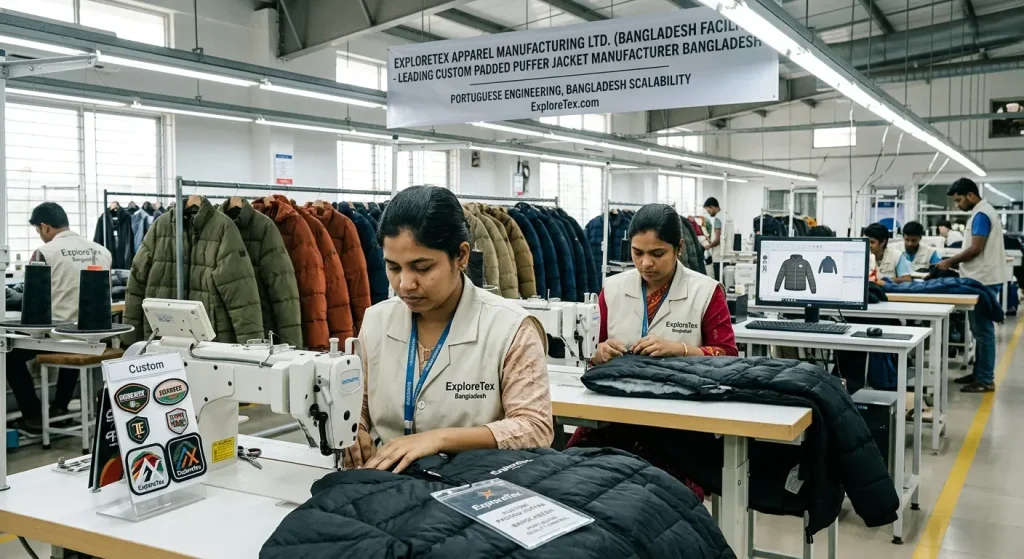
The Bangladesh Hub (Directly Operated Manufacturing at Scale): For high-volume, cost-efficient production, our directly operated facility in Dhaka handles cutting, sewing, finishing, and packing. Because this is a factory we operate directly — not a broker relationship with an unknown third-party subcontractor — we control quality, ethics, and shipping logistics from the same roof where the garments are actually made. You can review our end-to-end capabilities on our full-package manufacturing page and see how our production process is structured from tech pack to final AQL inspection.
This combination is what allows ExploreTex to legitimately offer a DDP door to door shipping garment factory Bangladesh arrangement rather than simply reselling freight forwarder quotes: the factory, the quality control team, and the export documentation team are coordinated under one company, with one Lisbon-based point of contact managing the entire order on your behalf.
6. The ExploreTex DDP Door to Door Shipping Process, Step by Step
Here is what actually happens, order by order, when a client chooses our door to door DDP shipping option instead of FOB.
Step 1 — Quotation With Landed Cost Included. During costing, we calculate not just the FOB unit price but the full landed cost to your destination address, including freight, insurance, customs duty, VAT/GST where applicable, and last-mile delivery. You receive one number per unit, delivered.
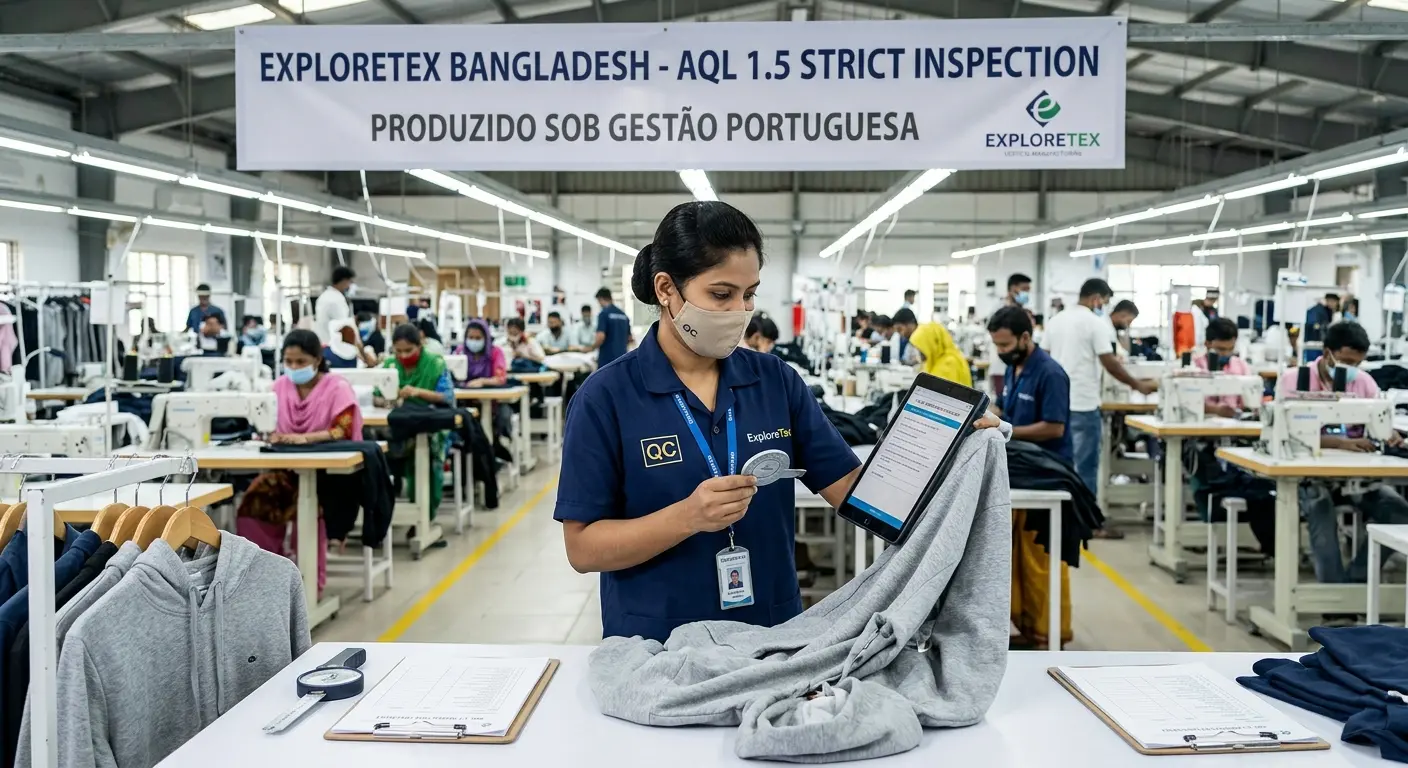
Step 2 — Production and In-House AQL Inspection. Once the sample is approved, bulk production runs through our Bangladesh facility with pre-production, mid-line, and final AQL 2.5/4.0 inspections before a single carton is packed for export.
Step 3 — Export Documentation and Compliance Prep. Our logistics team prepares the commercial invoice, packing list, certificate of origin, and any product-specific compliance documents required by your destination country (labeling, fiber content declarations, wash-care symbols, and more).
Step 4 — Freight Booking (Air or Sea). Depending on your timeline and order volume, we book express air freight through partners such as DHL, FedEx, or UPS for fast market launches, or consolidated sea freight for larger, cost-efficient bulk orders. Full lead-time expectations by region are published on our shipping page.
Step 5 — Destination Customs Clearance and Duty Payment. This is the step that separates true DDP from a “we’ll help you find a broker” arrangement. Under our DDP terms, ExploreTex arranges and pays the import duties and clearance fees at destination before the shipment ever reaches your door — you are not contacted by customs, and you do not receive a surprise invoice.
Step 6 — Final Mile Delivery. The cleared shipment is trucked directly to your specified warehouse, 3PL, or retail distribution center, with tracking provided throughout.
Step 7 — Delivery Confirmation and After-Sales Support. Once received, our team confirms delivery and remains available for any quality concerns, in line with our standard returns and quality policy.
To make this concrete: imagine a private label activewear brand placing its first 1,500-unit order of leggings and sports bras. Under a standard FOB arrangement, that brand would need to independently research freight forwarders, compare ocean versus air rates, hire a licensed customs broker in their own country, calculate the applicable duty rate for the correct HS code, and coordinate final trucking once the container clears the port — all while the factory’s involvement effectively ends the moment the goods are loaded.
Under ExploreTex’s door to door process, the same brand receives one quotation covering every one of those steps, one point of contact in Lisbon coordinating the entire journey, and one delivery date for the finished units to arrive at their fulfillment center, with duties and taxes already settled before the truck ever reaches their loading dock.
For brands who also need branding elements finished before shipment — woven labels, printed neck tags, heat-transfer branding, or embroidery — these are completed in-house prior to packing, which you can review on our label branding and print, heat transfer, and embroidery service pages.
7. Factory-Floor Insights: What Our Bangladesh Production Team Wants Buyers to Know
We asked members of our Bangladesh production and logistics team what buyers most often misunderstand about DDP shipping. Their answers are worth sharing directly, because they come from people who load the containers, not from a sales brochure.
“Buyers think DDP just means ‘you handle shipping.’ It actually starts at the cutting table.” — one of our senior line supervisors explains that DDP planning affects packing decisions from day one. Cartons are weighed, measured, and labeled for the destination country’s customs classification before production is even finished, not afterward. A mismatch between the declared HS code and the actual product description is one of the most common causes of customs delays — so it has to be correct from the very first carton.
“AQL inspection isn’t just for quality — it protects the shipping timeline too.” Our in-house quality control lead notes that a failed mid-line inspection caught early saves weeks compared to a shipment rejected at the destination port. Every DDP order goes through the same three-stage AQL checkpoints as our standard production, precisely because a delay caused by rework is far cheaper than a delay caused by a held container.
“Sea freight documentation has to be perfect before the vessel sails — there’s no fixing it mid-ocean.” Our export documentation coordinator points out that certificates of origin, commercial invoices, and packing lists are triple-checked against the actual carton contents before the bill of lading is finalized, because once a sea shipment departs, any paperwork error can only be corrected at destination — at the buyer’s expense of time, if not handled properly by the DDP seller.
“Buyers underestimate how much smoother communication makes everything.” Because ExploreTex is headquartered in Lisbon but operates the Bangladesh facility directly, our production floor team and logistics coordinators sit inside the same reporting chain. That means a scheduling question from a client in New York gets answered by someone who can walk over to the sewing line and check in person — not relayed through three separate agencies.
These are the operational realities that sit underneath the words “DDP door to door shipping garment factory Bangladesh” on a website. It is not a shipping label — it is a coordinated handoff between cutting, sewing, quality control, documentation, freight, and customs, all managed by people who talk to each other in the same building.
8. What Actually Sits Inside a DDP Landed Cost
Buyers new to DDP terms sometimes assume the “all-in” price is simply padded. In reality, it is built from clearly identifiable components:
- Base garment manufacturing cost — fabric, trims, labor, and factory overhead.
- Export packing — cartons, poly bags, barcoding, and carton marking to destination-country standards.
- Inland freight in Bangladesh — trucking from the factory to the port or airport of departure.
- International freight — ocean or air freight to the destination country.
- Marine or air cargo insurance — protecting the shipment value in transit.
- Import duty and applicable taxes — calculated against the destination country’s tariff schedule for the specific HS code of the garment category.
- Destination customs clearance fees — brokerage and port handling charges at arrival.
- Last-mile delivery — trucking from the port or bonded warehouse to your specified address.
Because every one of these line items is quoted upfront under a DDP door to door shipping garment factory Bangladesh arrangement, brands can build accurate retail pricing and margin models before committing to a purchase order — something that is far harder to do when freight and duty are unknown variables under FOB terms.
Consider a simplified example. A brand ordering 2,000 units of a mid-weight cotton hoodie might see a factory manufacturing cost of a few dollars per unit under FOB terms, which looks attractive in isolation. Once that same order is shipped, the buyer then needs to separately budget for ocean or air freight, marine insurance, a customs broker’s clearance fee, the destination country’s import duty percentage applied against the customs value, and a trucking company for the final leg to their warehouse — each invoiced by a different vendor, on a different timeline, often in a different currency.
Under a DDP quotation, every one of those components is already folded into a single per-unit landed price before the purchase order is even signed, which is precisely why so many growing brands now request DDP terms by name rather than negotiating each shipping component separately after the goods are already in production.
This also changes how a brand can plan cash flow. Under FOB or EXW terms, unexpected costs tend to appear at the worst possible moment — after the goods have already left the factory and the buyer has limited leverage to negotiate. Under DDP, because the manufacturer is financially responsible for freight and duty until delivery, the incentive to keep the shipment moving smoothly through customs sits with the seller, not the buyer.
9. Common Mistakes Buyers Make When Choosing a DDP Shipping Partner
Mistake 1: Assuming “DDP” always means the same thing. Not every factory that advertises DDP actually pays duty in advance — some simply mean “we will help arrange a broker.” Always ask your manufacturer to confirm, in writing, that duty and clearance fees are included in the quoted unit price.
Mistake 2: Ignoring HS code accuracy. Garments are classified differently depending on fiber content, construction, and intended use. An incorrect HS classification can trigger a higher duty rate or a customs hold, regardless of which Incoterm is used.
Mistake 3: Choosing the cheapest freight option without checking lead times. Sea freight is cost-efficient but can take 25–50 days depending on destination, while express air freight typically arrives in 3–9 business days. Align your freight method with your actual launch date, not just your budget.
Mistake 4: Skipping factory-side quality control because “shipping is handled.” DDP shipping manages logistics, not garment quality. Always confirm your manufacturer runs independent AQL inspections before goods are packed for export — our production process outlines exactly how this works for every order.
Mistake 5: Not confirming insurance coverage. Ask explicitly whether cargo insurance is included in your DDP quote, and what happens in the rare case of transit damage or loss.
Mistake 6: Treating the cheapest quote as the safest quote. A dramatically low DDP price relative to competitors is often a sign that duty, insurance, or brokerage fees have been quietly excluded and will resurface later as an unexpected charge. Ask for an itemized breakdown of the landed cost rather than accepting a single lump-sum figure at face value, so you can see exactly what is and is not included before you commit to a purchase order.
10. Sustainability, Ethics, and Compliance Inside the DDP Model
A door to door shipping arrangement is only as trustworthy as the factory behind it. ExploreTex’s directly operated Bangladesh facility and managed Portuguese production network are held to recognized social, environmental, and quality certifications, including BSCI, WRAP, SEDEX, and SMETA for social compliance; GOTS, OEKO-TEX® Standard 100, GRS, and RCS for sustainable and recycled materials; and ISO 9001 with AQL 2.5/4.0 inspection standards for quality management. This matters directly to DDP buyers because import compliance increasingly extends beyond customs duty — many destination markets now require documented proof of ethical sourcing and material traceability as part of import clearance itself, not just as a marketing claim.
Retailers in the EU, UK, and North America are also facing tightening due-diligence expectations around supply chain transparency, meaning buyers are increasingly asked by their own customers, investors, or marketplace platforms to prove where and how a garment was produced. A manufacturer that can hand over audit reports, certification numbers, and factory documentation alongside a shipment — rather than a vague assurance — makes it significantly easier for a brand to satisfy those downstream compliance checks. This is part of why we treat certification documentation as a standard deliverable with every order, not an optional add-on reserved for larger clients.
11. How to Prepare Your Business Before Placing a DDP Order
Before requesting a DDP door to door shipping quote from any Bangladesh garment factory, gather the following so your first quotation is accurate:
- Exact delivery address, including whether it is a residential, commercial, or 3PL/FBA warehouse location (this affects last-mile delivery access and scheduling).
- Product specifications or tech pack, or at minimum a clear reference garment, fabric preference, and target price point.
- Order quantity and size breakdown, since MOQ and per-unit landed cost both shift with volume.
- Preferred freight method — express air for speed, sea freight for cost efficiency on larger orders.
- Any destination-market compliance requirements, such as specific labeling laws, flammability standards, or retailer-specific packaging guidelines.
- Your target launch date, worked backward from sampling, bulk production (typically 30–45 days after sample approval), and transit time.
Once you have these details ready, you can request a detailed, itemized quote through our contact page, and our Lisbon-based team will prepare a full landed-cost breakdown rather than a partial FOB estimate.
12. Frequently Asked Questions
What does “DDP door to door shipping garment factory Bangladesh” actually mean for my order?
It means your chosen Bangladesh-based manufacturer takes full responsibility for your garments from the factory floor all the way to your warehouse door, including freight, customs clearance, and payment of import duties and taxes. You receive one all-in price and one delivery date, with nothing left for you to arrange at the border.
Is DDP more expensive than FOB shipping?
The unit price under DDP terms is typically higher on paper than an FOB price, but that is because freight, insurance, customs clearance, and duty are already built into the number. When you add those same costs to an FOB quote yourself, the true landed cost is often very similar — DDP simply removes the uncertainty and the operational workload from your side.
How long does DDP door to door shipping from Bangladesh take?
Timelines depend on the freight method and destination. Express air freight generally arrives within 3–9 business days once the shipment departs, while sea freight ranges from roughly 15–60 days depending on the destination region. Full country-by-country transit estimates are listed on our shipping page.
Who is responsible if my shipment is delayed at customs under DDP terms?
Under a genuine DDP arrangement, the seller — your manufacturer — is responsible for managing customs clearance and resolving any delays at the border, since duty payment and clearance documentation are part of their obligation, not yours.
Can I get DDP shipping for a small, low-MOQ order?
Yes. ExploreTex’s minimum order quantity starts at 500 pieces per style and 1,000 pieces per order, and DDP door to door shipping can be arranged for orders at this scale, particularly for startup and private label brands launching their first collection.
Does DDP shipping include import duty for every country?
Yes, by definition — DDP means Delivered Duty Paid, so applicable import duties and standard import taxes for your destination country are calculated and paid by the manufacturer before the shipment reaches you. It is important to confirm this explicitly with any factory before signing a purchase order, since not every “DDP” quote in the market is fully inclusive.
What happens if my garments are damaged or lost in transit under DDP terms?
This depends on whether cargo insurance is included in your agreement. Always confirm insurance coverage in writing as part of your DDP door to door shipping quote so you know exactly what protection applies before goods leave the factory.
Why choose a Bangladesh factory with a Portugal-based headquarters instead of sourcing directly in Asia?
A dual-hub structure like ExploreTex’s gives you EU-based legal security, real-time communication in your business hours, and a single accountable point of contact in Lisbon, while still benefiting from Bangladesh’s high-volume, cost-competitive manufacturing capacity — without the communication barriers that can come from sourcing directly through an unfamiliar overseas agent.
 13. Final Thoughts: Choosing the Right DDP Door to Door Shipping Garment Factory in Bangladesh
 13. Final Thoughts: Choosing the Right DDP Door to Door Shipping Garment Factory in Bangladesh
Choosing a DDP door to door shipping garment factory Bangladesh partner is ultimately a decision about how much operational risk you want to carry yourself versus hand over to a manufacturer who is equipped to manage it end-to-end. For brands without an in-house logistics or customs team, DDP terms convert an unpredictable, multi-vendor shipping process into a single, transparent, all-in delivery — one invoice, one tracking number, and one accountable partner.
ExploreTex was built specifically to offer that accountability: Portuguese-registered, Lisbon-headquartered, with a directly operated manufacturing hub in Bangladesh and a managed production network in Portugal for brands who need both cost-efficient scale and premium European finishing. Whether you are planning your first 1,000-unit private label run or scaling an established retail line, our team can prepare a full landed-cost DDP quotation tailored to your product, your quantity, and your destination address.
Ready to see what a true door to door DDP quote looks like for your next collection? Get in touch with our team or explore our full-package manufacturing services to get started.