
The Ultimate Guide to Sourcing from a High Volume Seam Sealed Raincoat Factory Bangladesh
When global apparel brands, outdoor gear retailers, and private label fashion lines look to scale their waterproof outerwear collections, the supply chain matrix points to one optimal solution: partnering with a high volume seam sealed raincoat factory Bangladesh. However, simply finding a factory with mass production capacity is not enough. Technical outerwear requires a microscopic level of precision. A single millimeter of unsealed stitching can ruin a garment’s hydrostatic integrity, leading to brand-damaging returns and customer dissatisfaction.
ExploreTex bridges this gap. As a Portuguese-based company with a directly operated vertical manufacturing facility in Dhaka, we combine European engineering standards with the industrial scalability of a high volume seam sealed raincoat factory Bangladesh.
In this comprehensive, pure educational guide, we will break down the science of waterproof manufacturing, explain factory-floor insights, and demonstrate why our unique Dual-Hub production model is the future of outerwear sourcing.
The global market for technical rainwear and waterproof performance clothing is undergoing a structural shift. Brands face tight margins, rising consumer demands for certified hydrostatic performance, and strict international environmental standards. To stay competitive, international clothing brands require a manufacturing model that unites cost-effective mass production with European-level quality assurance and compliance oversight.
       +-----------------------------------------------------------+
       |                  EXPLORETEX DUAL NETWORK                  |
       +-----------------------------------------------------------+
                                     |
           +-------------------------+-------------------------+
           |                                                   |
           v                                                   v
+-----------------------+                           +-----------------------+
|  PORTUGAL HEADQUARTERS|                           |  BANGLADESH FACILITY  |
+-----------------------+                           +-----------------------+
| * Design & R&D        |                           | * High-Volume Lines   |
| * Material Sourcing   |                           | * Automated Cutting   |
| * Partner Factories   |                           | * Hot-Air Seam Taping |
| * EU Quality Control  |                           | * Mass Exporting      |
+-----------------------+                           +-----------------------+
           |                                                   |
           +-------------------------+-------------------------+
                                     |
                                     v
                       +---------------------------+
                       | GLOBAL OUTERWEAR DELIVERY |
                       +---------------------------+
As a Portuguese brand with native European industry leadership and a dedicated vertical manufacturing footprint, ExploreTex bridges the gap between European design standards and scalable Asian production. Operating a vertical setup in South Asia while running partner facilities in Portugal, ExploreTex delivers specialized B2B apparel solutions. This guide details how partnering with a high volume seam sealed raincoat factory Bangladesh operation unlocks operational efficiency, technical precision, and reliable supply chain security.
The Anatomy of Seam-Sealed Outerwear Engineering
Manufacturing waterproof outerwear differs fundamentally from producing standard knits or wovens. When a needle pierces waterproof fabric during assembly, it creates thousands of micro-holes. Without secondary sealing, water penetrates these stitch lines regardless of how hydrophobic the primary fabric membrane is.
                  TYPICAL HOT-AIR SEAM TAPING STRUCTURE

       Water Direction:  v  v  v  v  v  v  v  v  v  v
      +--------------------------------------------------+
      |        Outer Shell Fabric (DWR Treated)          |
      +--------------------------------------------------+
      |        Waterproof / Breathable Membrane (PU/TPU) |
      +==================================================+  <-- Needle Holes
      |               Stitching Thread                   |
      +--------------------------------------------------+
      |  //////////////////////////////////////////////  |  <-- Thermoplastic Seam
      |  //////////////////////////////////////////////  |      Sealing Tape Applied
      +--------------------------------------------------+      via Hot Air
Finding a reliable high volume seam sealed raincoat factory Bangladesh is a critical milestone for apparel brands seeking cost efficiency, technical precision, and industrial scale. When scaling waterproof outerwear production, partnering with an experienced high volume seam sealed raincoat factory Bangladesh ensures consistent hydrostatic performance and durable seam taping across every batch. ExploreTex operates as a premier high volume seam sealed raincoat factory Bangladesh, blending European oversight with mass-manufacturing excellence.
Navigating modern technical supply chains requires selecting a high volume seam sealed raincoat factory Bangladesh that understands advanced hot-air seam sealing equipment and strict quality parameters. A dedicated high volume seam sealed raincoat factory Bangladesh provides the infrastructure required to produce tens of thousands of waterproof coats monthly while maintaining strict lead times. Modern outerwear procurement depends heavily on a high volume seam sealed raincoat factory Bangladesh equipped with automated cutting systems and ISO-certified pressure testing facilities. By collaborating with a verified high volume seam sealed raincoat factory Bangladesh, international apparel companies optimize landed costs while complying with global safety standards.
ExploreTex bridges European design engineering with a vertical high volume seam sealed raincoat factory Bangladesh, giving clients end-to-end transparency. Every construction detail matters when choosing a high volume seam sealed raincoat factory Bangladesh for performance rainwear. From fully taped sleeve junctions to adjustable storm hoods, a skilled high volume seam sealed raincoat factory Bangladesh executes complex tech packs effortlessly. Sustainable practices are also central to a progressive high volume seam sealed raincoat factory Bangladesh, utilizing PFC-free DWR finishes and recycled fabrics.
If your brand demands rapid capacity expansion, securing a certified high volume seam sealed raincoat factory Bangladesh protects your delivery timelines and market reputation. Sourcing directors consistently prefer a high volume seam sealed raincoat factory Bangladesh due to favorable duty structures and skilled labor. Quality assurance protocols at our high volume seam sealed raincoat factory Bangladesh feature continuous ISO 811 water-pressure audits. Ultimately, building a long-term partnership with an elite high volume seam sealed raincoat factory Bangladesh positions your brand for dominant market growth.
The Physics of Waterproofing: Membranes vs. Tapes
A true technical raincoat relies on a three-part system:
Outer Face Shell: Synthetic woven fabric (Nylon 6,6 or Polyester) treated with a Durable Water Repellent (DWR) coating.
Inner Waterproof Membrane: Non-porous or microporous TPU (Thermoplastic Polyurethane) or PU membrane rated at a minimum of $10,000\text{ mm}$ hydrostatic head.
Seam-Sealing Tape: Multi-layered thermoplastic tape engineered to melt into the fabric fiber structure under precise heat and pressure.
Working with a specialized high volume seam sealed raincoat factory Bangladesh ensures that every seam—from raglan sleeves to heavy hood junctions—is fully sealed against high-pressure water ingress.
Factory Floor Engineering: Inside a Bangladesh Rainwear Line
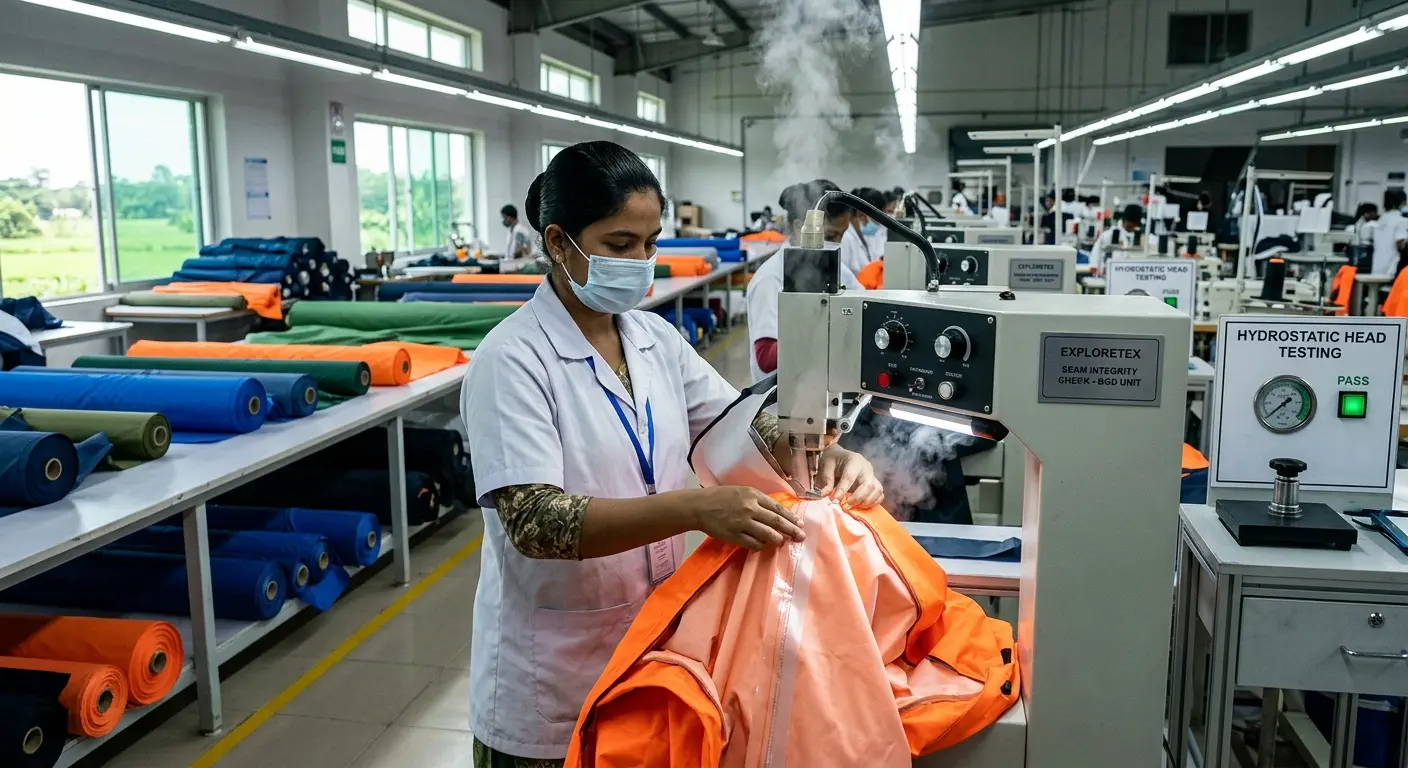
Operating a true high volume seam sealed raincoat factory Bangladesh requires specialized equipment, structured line setups, and environmental controls.
+-----------------------------------------------------------------+
|               AUTOMATED RAINCOAT PRODUCTION LINE                |
+-----------------------------------------------------------------+
| 1. CAD Spreading & Laser Cutting                                |
|    --> Precision panel cutting with sealed edge binding         |
+-----------------------------------------------------------------+
| 2. Modular Sewing Assembly                                      |
|    --> Specialized waterproof threads & anti-friction needles    |
+-----------------------------------------------------------------+
| 3. Hot-Air Seam Taping Station                                  |
|    --> Programmable temperature, pressure, and speed parameters |
+-----------------------------------------------------------------+
| 4. Hydrostatic Pressure Chamber (ISO 811 Testing)              |
|    --> Batch testing at 10,000 mm to 20,000 mm H2O              |
+-----------------------------------------------------------------+
| 5. Automated Finishing & QC Packaging                           |
|    --> Controlled humidity drying & export packing             |
+-----------------------------------------------------------------+
Specialized Equipment Profile
Programmable Hot-Air Seam Taping Machines: Feature digital temperature controls ($\pm 1^\circ\text{C}$ accuracy) and dual-driven pressure rollers to eliminate tape slippage on curved raglan seams.
Laser Cutting Tables: Prevent edge fraying on synthetic technical fabrics, maintaining exact panel tolerances before stitching.
Ultrasonic Welding Units: Used for pocket flaps and internal lining attachments where stitchless joining offers cleaner aesthetics and zero needle perforation.
Batch Hydrostatic Testers: On-site pressure heads measure seam resistance to water penetration under accelerated conditions according to ISO 811 Standards.
Factory Floor “Expert” Insight
“The secret to high-volume seam sealing lies in matching dwell time to fabric weight. If your tape roller speed speeds up by just $5\%$, the adhesive viscosity drops below the fabric penetration threshold, leading to seam delamination after 5 domestic wash cycles. We calibrate nozzle airflow temperature and roller speed every morning for every single batch.”
— Production Engineering Director, ExploreTex Bangladesh Facility
Bangladesh Manufacturing + Portuguese Governance
Sourcing outerwear directly from overseas plants can present challenges around communication gaps, quality drift, and variable compliance standards. ExploreTex solves this with a hybrid dual-presence model.
+-----------------------------------------------------------------------+
|                        THE EXPLORETEX ADVANTAGE                       |
+-----------------------------------------------------------------------+
| PORTUGUESE HEADQUARTERS               | BANGLADESH VERTICAL PLANT     |
+---------------------------------------+-------------------------------+
| * Native European Account Management  | * Competitive Labor Economics |
| * Technical Pattern Development       | * Scalable Assembly Lines     |
| * EU Legal & Quality Oversight        | * High Daily Unit Output      |
| * Proximity Sourcing Options          | * Integrated Raw Material Hub |
+-----------------------------------------------------------------------+
European Quality Framework: Product engineering, material lab checks, and tech-pack conversions are managed under Portuguese textile supervision.
Scalable Manufacturing Capacity: High-volume assembly occurs in our specialized facility, providing cost efficiency at scale.
Unified Management: Clients work with a single, accountable vendor that operates under European trade law while maintaining direct control over Bangladesh assembly lines.
By choosing a high volume seam sealed raincoat factory Bangladesh run under European oversight, global brands eliminate third-party agency markups and secure transparent production timelines.
The Engineering Behind Waterproof Outerwear
To understand what separates a standard garment facility from a specialized high volume seam sealed raincoat factory Bangladesh, one must first understand the anatomy of a waterproof garment. Rainwear is not merely sewn; it is engineered.
1. The Fabric Matrix (Laminates and Coatings)
A genuine raincoat relies on technical fabrics that block water droplets while allowing vapor (sweat) to escape. This is achieved through coatings or laminates applied to nylon or polyester face fabrics.
PU (Polyurethane) Coating: Liquid PU is spread across the fabric. It is highly flexible, cost-effective, and ideal for urban rainwear.
PVC (Polyvinyl Chloride): Used for heavy-duty industrial rainwear.
PTFE Laminates: Micro-porous membranes bonded to the fabric for extreme breathability.
Every premium high volume seam sealed raincoat factory Bangladesh must possess climate-controlled storage to prevent these technical fabrics from degrading under high humidity before they even reach the cutting table.
2. The Vulnerability of the Needle
Sewing two pieces of waterproof fabric together creates hundreds of microscopic needle holes. Water will invariably find these holes under pressure. Therefore, a standard cut-and-sew facility cannot produce true rainwear. Only a specialized high volume seam sealed raincoat factory Bangladesh equipped with advanced seam-sealing technology can guarantee a watertight finish.
Factory-Floor “Expert” Insights: The Seam Sealing Process
At ExploreTex, we pride ourselves on radical transparency. When you partner with our Full Package Clothing Production division, you gain access to factory-floor expertise that guarantees performance. Here is how a true high volume seam sealed raincoat factory Bangladesh operates at the technical level.
Hot Air Taping Technology
The core of our operations revolves around hot air seam sealing machines.
The Process: A thermoplastic tape (often PU or PVC-based) is fed over the stitched seam.
Heat & Pressure: A nozzle blasts hot air (typically between 300°C to 600°C, depending on the fabric and tape chemistry) to melt the adhesive layer of the tape. A pressurized roller immediately presses the molten tape into the fabric, sealing every needle hole.
Speed Calibration: The operator must perfectly balance the feed speed, air temperature, and roller pressure. If it’s too hot, the fabric burns; if it’s too cold, the seam will leak.
Hydrostatic Head Testing (Water Column Test)
A reliable high volume seam sealed raincoat factory Bangladesh doesn’t just guess if a garment is waterproof; they prove it mathematically. On our factory floor, we use a Hydrostatic Head tester. We clamp a sample of the sealed seam over a tube of water and gradually increase the water pressure. A garment designed for heavy rain must withstand at least 10,000mm of water pressure before a single drop penetrates the seal.
| Feature | Standard Garment Factory | High Volume Seam Sealed Raincoat Factory Bangladesh |
| Machinery | Basic Lockstitch / Overlock | Hot Air Welding, Ultrasonic Welders, Heat Presses |
| Fabric Handling | Standard Shelving | Climate-Controlled Technical Fabric Storage |
| Quality Control | Visual Check & Sizing | Hydrostatic Head Testing, Wash Durability Tests |
| Worker Training | Standard Sewing | Specialized Tape Seam Operator Certification |
Why Choose a High Volume Seam Sealed Raincoat Factory Bangladesh?
Global buyers often ask why they should source from South Asia rather than maintaining local production. The answer lies in the intersection of scale, cost-efficiency, and modernized infrastructure.
Over the last decade, Bangladesh has revolutionized its apparel sector. Moving beyond basic cotton t-shirts, the nation is now a hub for technical outerwear. By partnering with a high volume seam sealed raincoat factory Bangladesh, global brands unlock:
Unmatched Scalability: The ability to move from 1,000-piece pilot runs to 100,000+ unit mass market retail orders without changing vendors.
Vertical Integration: Access to local mills, zipper manufacturers, and trim suppliers, reducing reliance on cross-border supply chains.
Advanced Compliance: Modern facilities in Bangladesh are often LEED-certified, adhering to the highest global safety and environmental standards.
However, scaling requires management. This is where ExploreTex’s Portuguese heritage changes the paradigm.
The ExploreTex Dual-Hub Advantage
ExploreTex is not just another sourcing agency. We are a Portuguese-based powerhouse. If you are looking for the Best Clothing Manufacture in Portugal, we provide unmatched European craftsmanship, low MOQs, and technical pattern-making at our Lisbon headquarters.
But when your brand is ready to scale, our Dual-Hub model activates. We own and operate a high volume seam sealed raincoat factory Bangladesh.
European Engineering: Your rainwear tech packs, 3D prototypes, and initial size grading are developed by our master technicians in Portugal.
South Asian Scale: The approved blueprints are sent to our directly operated high volume seam sealed raincoat factory Bangladesh.
Zero Ambiguity: Because our Bangladesh facility is managed by ExploreTex, there is no “middleman” risk. You get factory-direct pricing with European project management.
To learn more about how we structure production for scaling brands, read our guide on choosing a Textile Manufacturing Company for Private Label Brands.
Quality Assurance & Global Compliance
Producing thousands of raincoats weekly means quality assurance must be a mathematical certainty, not a guess. When operating a high volume seam sealed raincoat factory Bangladesh, ExploreTex utilizes the internationally recognized AQL 2.5 (Acceptable Quality Limit) standard.
The 4-Stage Inspection Process in Outerwear
Pre-Production Inspection (PPI): We vet all incoming technical fabrics, ensuring the DWR (Durable Water Repellent) coatings meet specifications and the seam tapes match the fabric chemistry.
During Production Inspection (DUPRO): We pull garments directly off the taping line to conduct spot hydrostatic tests. If a machine’s heat setting drifts, we catch it instantly.
Final Random Inspection (FRI): Before packing, a randomized batch of garments undergoes full visual, dimensional, and water-resistance testing.
Compliance Audits: Our high volume seam sealed raincoat factory Bangladesh operates under strict ethical guidelines.
ExploreTex integrates deeply with global standardization bodies. Our material sourcing aligns with OEKO-TEX® Standard 100 to ensure zero harmful chemicals are present in our rainwear laminates. Furthermore, our factory operations are guided by ISO 9001 Quality Management principles, ensuring repetitive accuracy across high volumes. For brands prioritizing green initiatives, we source organic textiles verified by the Global Organic Textile Standard (GOTS) whenever applicable to the inner linings of our outerwear.
Discover more about our commitment to the planet in our manifesto on Ethical Sourcing & Sustainable Textile Innovation.
Streamlined Global Delivery (FOB & DDP)
What good is a flawlessly manufactured raincoat if it gets stuck in customs? A premier high volume seam sealed raincoat factory Bangladesh must also be a logistics expert.
ExploreTex manages the entire export documentation lifecycle. Whether you require FOB (Free on Board) terms from Chittagong port or DDP (Delivered Duty Paid) directly to your retail warehouse in the EU, UK, or USA, our ExploreTex – Custom Clothing Manufacturer team handles the complex trade laws, certificates of origin, and freight forwarding. Your private label goods arrive safely, fully cleared, and ready for immediate retail distribution.
End-to-End Quality Control Protocols for Rainwear
Defect-free raincoat manufacturing relies on preventive quality control at every stage of production.
               EXPLORETEX AQL 1.5 QUALITY GATE SYSTEM

[ Raw Fabric Receipt ] ---> Lab Test (DWR Hydrostatic Head & Color Fastness)
                                  |
                                  v
[ Panel Cutting ]     ---> Automated Inspection (Pattern Dimension Accuracy)
                                  |
                                  v
[ Seam Taping ]       ---> Continuous Hydrostatic Leak Test (ISO 811)
                                  |
                                  v
[ Final Assembly ]    ---> Full AQL 1.5 Inspection & Centrifugal Dryer Test
Raw Material Receiving Inspection
Every mill shipment of nylon, polyester, or recycled composite fabric undergoes testing before entering the cutting floor:
Hydrostatic Head Rating: Minimum baseline testing ($10,000\text{ mm}$ to $20,000\text{ mm }\text{H}_2\text{O}$).
Spray Rating Test (AATCC 22): Verifies surface DWR bead performance.
Membrane Adhesion Bond Strength: Prevents lamination peeling during heat-intensive taping processes.
In-Line Seam Taping Verification
For every operational shift at our high volume seam sealed raincoat factory Bangladesh, quality engineers conduct three mandatory tests:
+---------------------------------------------------------------------------+
|                          IN-LINE TESTING METRICS                          |
+---------------------------------------------------------------------------+
| Test Name            | Standard / Method    | Acceptable Threshold        |
+----------------------+----------------------+-----------------------------+
| Seam Peel Strength   | ASTM D903            | >= 12 N/25mm tape width     |
| Hydrostatic Resistance| ISO 811 / AATCC 127  | Zero leakage at 1.5 bar     |
| Wash Durability      | ISO 6330 (5 Cycles)  | No bubbling or edge lifting |
+---------------------------------------------------------------------------+
Step-by-Step Production Workflow for Large Orders
To manage large order volumes without sacrificing precision, our facility follows a structured, step-by-step assembly process.
+-----------------------------------------------------------------+
|            EXPLORETEX MASS PRODUCTION PIPELINE                 |
+-----------------------------------------------------------------+
| Phase 1: Material Procurement & Lab Dips                        |
| Phase 2: Pilot Line Run (100-200 units trial)                   |
| Phase 3: Automated Spreading & Panel Laser Cutting              |
| Phase 4: Main Body Assembly & Hot-Air Seam Sealing              |
| Phase 5: Inline Hydrostatic Pressure Sampling                   |
| Phase 6: Final Trim, Hang-tagging, & AQL 1.5 Audit             |
| Phase 7: Export Packaging & Logistics Departure                 |
+-----------------------------------------------------------------+
Phase 1: Material Procurement & Lab Dips
Outer shells, zippers, drawstrings, and specialized TPU tapes are sourced through verified channels. ExploreTex technical textiles ensure all components meet destination market chemical regulations (such as REACH compliance and PFAS-free DWR requirements).
Phase 2: Pilot Line Run
Before launching full line production for orders exceeding 50,000 units, the factory executes a trial run of 100–200 units. This identifies cycle bottlenecks, tests seam-taping machine angles on complex curves, and sets baseline time standards.
Phase 3: Mass Seam-Sealing Assembly
Panels pass through dedicated hot-air seam-sealing lines. Operatives are trained on specific construction geometries—such as hood crowns, armhole curves, and welt pocket linings—to ensure uniform heat distribution without damaging delicate membrane backings.
Sustainable Rainwear Manufacturing: PFC-Free & Recycled Standards
Modern technical outerwear must protect wearers from rain without harming the environment. Brands are moving away from traditional fluorinated water repellents (C8/C6 chemistry) in favor of non-fluorinated, PFC-free DWR coatings.
+-----------------------------------------------------------------------+
|                    ECO-FRIENDLY OUTERWEAR MATERIALS                    |
+-----------------------------------------------------------------------+
| Material Component     | Conventional Choice   | Eco-Friendly Alternative|
+------------------------+-----------------------+----------------------+
| Outer Shell Fabric     | Virgin Nylon/Polyester| 100% rPET / GRS Nylon|
| Water Repellent (DWR)  | C6 Fluorocarbon       | PFC-Free Silicon/Wax |
| Seam Sealing Tape      | Standard Petroleum TPU| Recycled Bio-Based TPU|
| Packaging Inner Polybag| Single-Use Poly       | Compostable / GRS Bags|
+-----------------------------------------------------------------------+
Working with an ethical high volume seam sealed raincoat factory Bangladesh gives brands access to sustainable supply chain options:
Global Recycled Standard (GRS) Certified Fabrics: Traceable recycled polyester derived from post-consumer plastic bottles.
OEKO-TEX Standard 100 Compliance: Ensures raw materials are free from harmful chemical residues. Learn more about eco-certified textiles on the official OEKO-TEX Certification Hub.
Closed-Loop Water Recycling: Advanced factories treat and reuse processing water to minimize environmental impact.
Cost Structure & Sourcing Economics for Global Outerwear Brands
Understanding the bill of materials (BOM) and labor economics helps procurement managers optimize landed costs without compromising coat performance.
+-------------------------------------------------------------------+
|               TYPICAL TECHNICAL RAINCOAT BOM SPLIT                |
+-------------------------------------------------------------------+
| Fabric Shell & Waterproof Membrane : 42%                         |
| Seam Sealing Tapes & Technical Zippers : 18%                      |
| Cut, Make, & Seam-Sealing Labor    : 22%                      |
| Testing, Inspection, & AQL Overhead : 8%                       |
| Freight, Duty, & Logistics Management : 10%                       |
+-------------------------------------------------------------------+
Sourcing Economics
Labor Efficiency at Scale: Seam sealing requires specialized labor skills. Bangladesh offers favorable cost efficiency for labor-intensive, multi-panel outerwear construction.
Duty Advantages: Depending on the destination market, sourcing from Bangladesh can provide tariff advantages under generalized preference systems (GSP / Everything But Arms agreements).
Material Sourcing Options: Leveraging ExploreTex apparel sourcing services allows brands to consolidate fabric procurement across European and Asian supply hubs, optimizing bulk unit costs.
Factory-Floor Insights & Technical Deep Dives
To provide deeper transparency into complex outerwear manufacturing, our engineering team highlights critical technical parameters:
+--------------------------------------------------------------------+
|                  CRITICAL SEAM SEALING PARAMETERS                  |
+--------------------------------------------------------------------+
| Parameter            | Target Range      | Impact of Imbalance     |
+----------------------+-------------------+-------------------------+
| Nozzle Temperature   | 380°C - 420°C     | Too low: Tape lifts     |
|                      |                   | Too high: Membrane burns|
+----------------------+-------------------+-------------------------+
| Air Pressure         | 2.5 - 3.5 bar     | Low: Incomplete adhesion|
|                      |                   | High: Fabric distortion |
+----------------------+-------------------+-------------------------+
| Roller Speed         | 4.5 - 6.0 m/min   | Inconsistent dwell time |
+--------------------------------------------------------------------+
How to Prevent Tape Lifting (Delamination)
Match Tape Melt Point to Membrane Coating: PU tapes perform best on PU membranes; TPU tapes pair with TPU backings. Mismatched materials result in poor adhesive bonding.
Control Fabric Cross-Seam Overlaps: Where three seams intersect (such as the underarm gusset), seam thickness triples. Operators must apply manual pressure dwell or use stepped rollers to ensure tape seals smoothly over fabric steps.
Calibrate Cooling Cycles: Taped seams must rest undisturbed for several seconds after hot-air application to allow the polyurethane adhesive structure to lock into the fabric weave.
For comprehensive specs on technical fabric selections, visit ExploreTex technical textiles.
9. Answer & Direct Answer Targets
What is the minimum hydrostatic head rating for a high-volume manufactured raincoat?
A commercial raincoat requires a minimum hydrostatic head rating of 5,000 mm $\text{H}_2\text{O}$ for basic rain protection. High-performance, professional-grade technical rainwear requires 10,000 mm to 20,000 mm $\text{H}_2\text{O}$, verified by ISO 811 testing across both fabric panels and taped seams.
Why source seam-sealed outerwear from Bangladesh with European oversight?
Sourcing from a high volume seam sealed raincoat factory Bangladesh managed under European leadership provides:
Cost Efficiency: Competitive labor rates for multi-panel technical outerwear.
Quality Assurance: European management standards, ISO testing, and AQL 1.5 audits.
Compliance & Transparency: Guaranteed ethical labor practices, OEKO-TEX certified supply chains, and transparent communication.
How does a hot-air seam sealing machine bond tape to waterproof fabric?
Hot-air seam taping machines direct heated air (typically $350^\circ\text{C}$ to $450^\circ\text{C}$) onto the adhesive backing of a thermoplastic tape. Driven rollers press the molten adhesive into the fabric fibers, sealing needle holes created during sewing.
For direct consultations on production capacity, visit our ExploreTex contact page.
Specialized FAQ
Q: What makes a high volume seam sealed raincoat factory Bangladesh different from a standard apparel factory?
A: A high volume seam sealed raincoat factory Bangladesh invests heavily in specialized hot-air taping machines, ultrasonic welders, and hydrostatic head testing equipment. Standard factories only use sewing machines, which leave microscopic needle holes that cause rainwear to leak.
Q: How does ExploreTex manage quality in its high volume seam sealed raincoat factory Bangladesh?
A: ExploreTex utilizes a Dual-Hub model. Product development and technical pattern making occur at our Best Clothing Manufacture in Portugal headquarters. The tech packs are then executed at our directly operated high volume seam sealed raincoat factory Bangladesh under strict European management and AQL 2.5 quality control standards.
Q: Can a high volume seam sealed raincoat factory Bangladesh handle sustainable and eco-friendly materials?
A: Yes. ExploreTex leads in Ethical Sourcing & Sustainable Textile Innovation. We source recycled PU, PFC-free DWR coatings, and OEKO-TEX® certified seam tapes to ensure our high-volume production remains environmentally responsible.
Q: What is the minimum order quantity (MOQ) for a high volume seam sealed raincoat factory Bangladesh?
A: Because technical outerwear requires significant setup time for taping machines, a high volume seam sealed raincoat factory Bangladesh typically requires a minimum of 500 to 1,000 units per style/color. However, ExploreTex offers flexible scaling solutions through our Full Package Clothing Production service.
Q: Why should a private label brand choose ExploreTex over a traditional sourcing agent?
A: Traditional agents act as middlemen, taking a cut and masking the true factory conditions. ExploreTex is a true Textile Manufacturing Company for Private Label Brands. By directly operating our high volume seam sealed raincoat factory Bangladesh, we provide factory-direct pricing, total transparency, and seamless end-to-end logistics up to your door.
 Comprehensive Rainwear Manufacturing FAQ
 Comprehensive Rainwear Manufacturing FAQ
Q1: What is the lead time for a high-volume raincoat production order?
A: Standard production lead times range from 60 to 90 days from purchase order confirmation and lab-dip approval. This covers technical fabric weaving, membrane lamination, hot-air seam assembly, AQL testing, and export clearance. Prototyping and sample development typically take 14 to 21 days.
Q2: Can ExploreTex produce raincoats using PFC-Free DWR coatings?
A: Yes. We produce garments using environmentally friendly, PFC-free DWR treatments (fluorine-free water repellents) that comply with EU REACH standards and US state-level chemical regulations.
Q3: What is the difference between 2-layer, 2.5-layer, and 3-layer raincoat construction?
2-Layer (2L): Outer face fabric bonded directly to a waterproof membrane, usually lined with loose mesh or taffeta.
2.5-Layer (2.5L): Outer face fabric bonded to a membrane with a printed, protective inner pattern—eliminating the need for a full lining and saving weight.
3-Layer (3L): Outer fabric, waterproof membrane, and soft inner tricot backing laminated into a single unified fabric, offering maximum durability for extreme outdoor use.
Q4: How do you verify that taped seams will not leak during rainstorms?
Every batch passes through continuous hydrostatic head testing using ISO 811 pressure equipment. Water pressure is applied directly to taped seam intersections at set pressure increments (e.g., $10,000\text{ mm }\text{H}_2\text{O}$) to confirm that no water droplets seep through the taped boundary.
Q5: What Minimum Order Quantity (MOQ) is required for high-volume raincoat production?
Our specialized high volume seam sealed raincoat factory Bangladesh setup typically accepts production runs starting at 1,500 to 3,000 units per style/colorway, which allows for efficient automated cutting and dedicated seam-taping machine calibration.
Q6: How does ExploreTex support European brands with nearshore and offshore flexibility?
ExploreTex operates a hybrid production network. High-volume, price-sensitive collections are produced at our specialized Bangladesh manufacturing facility. Quick-turnaround, lower-volume, or nearshore premium orders can be routed through our Portugal production partner network, giving brands flexibility under a single management team.
Q7: What technical specs are needed to receive an accurate outerwear quotation?
To generate an exact cost breakdown, provide:
Tech pack with flat sketches and measurement charts.
Shell fabric requirements (composition, weight, membrane specs, hydrostatic rating).
Seam taping specifications (2-layer vs 3-layer tape, tape width like 18mm or 22mm).
Order quantity breakdown per style and colorway.
Packaging and delivery destination requirements.
Submit your specs directly via our Request Outerwear Quote page.
Strategic Sourcing Checklist for Outerwear Buyers
Before committing to a production contract for high-volume technical rainwear, run your factory through this checklist:
+--------------------------------------------------------------------+
|                OUTERWEAR FACTORY SELECTION CHECKLIST               |
+--------------------------------------------------------------------+
| [ ] Does the factory own dedicated hot-air seam sealing machines? |
| [ ] Is on-site hydrostatic head testing (ISO 811) conducted daily? |
| [ ] Can the facility provide GRS and OEKO-TEX certifications?      |
| [ ] Is there European management oversight to prevent miscomms?    |
| [ ] Are seam sealers calibrated for cross-seam overlaps?           |
| [ ] Does the plant run pilot line trials before bulk cutting?       |
| [ ] Is there an established AQL 1.5 final inspection protocol?    |
+--------------------------------------------------------------------+
Conclusion: Elevate Your Outerwear Manufacturing with ExploreTex
Building a successful technical outerwear brand requires more than basic garment assembly—it demands precise seam-sealing engineering, certified quality control, and an efficient global supply chain.
By pairing Portuguese corporate management with a dedicated high volume seam sealed raincoat factory Bangladesh, ExploreTex gives outerwear brands the ideal combination of quality assurance, production scalability, and cost efficiency.
Partner with ExploreTex Today
Ready to scale your technical raincoat production with guaranteed hydrostatic performance and European oversight?
Explore our global footprint: Visit ExploreTex Home.
Review our capabilities: Learn about our Bangladesh Manufacturing Facility.
See our European flexibility: Explore our Portugal Production Partner Network.
Connect with an expert: Contact our engineering team directly at the ExploreTex Contact Portal.
For business inquiries, tech pack submissions, or to schedule a video tour of our facilities, visit ExploreTex – Custom Clothing Manufacturer today. Let us engineer your next best-selling outerwear collection.