
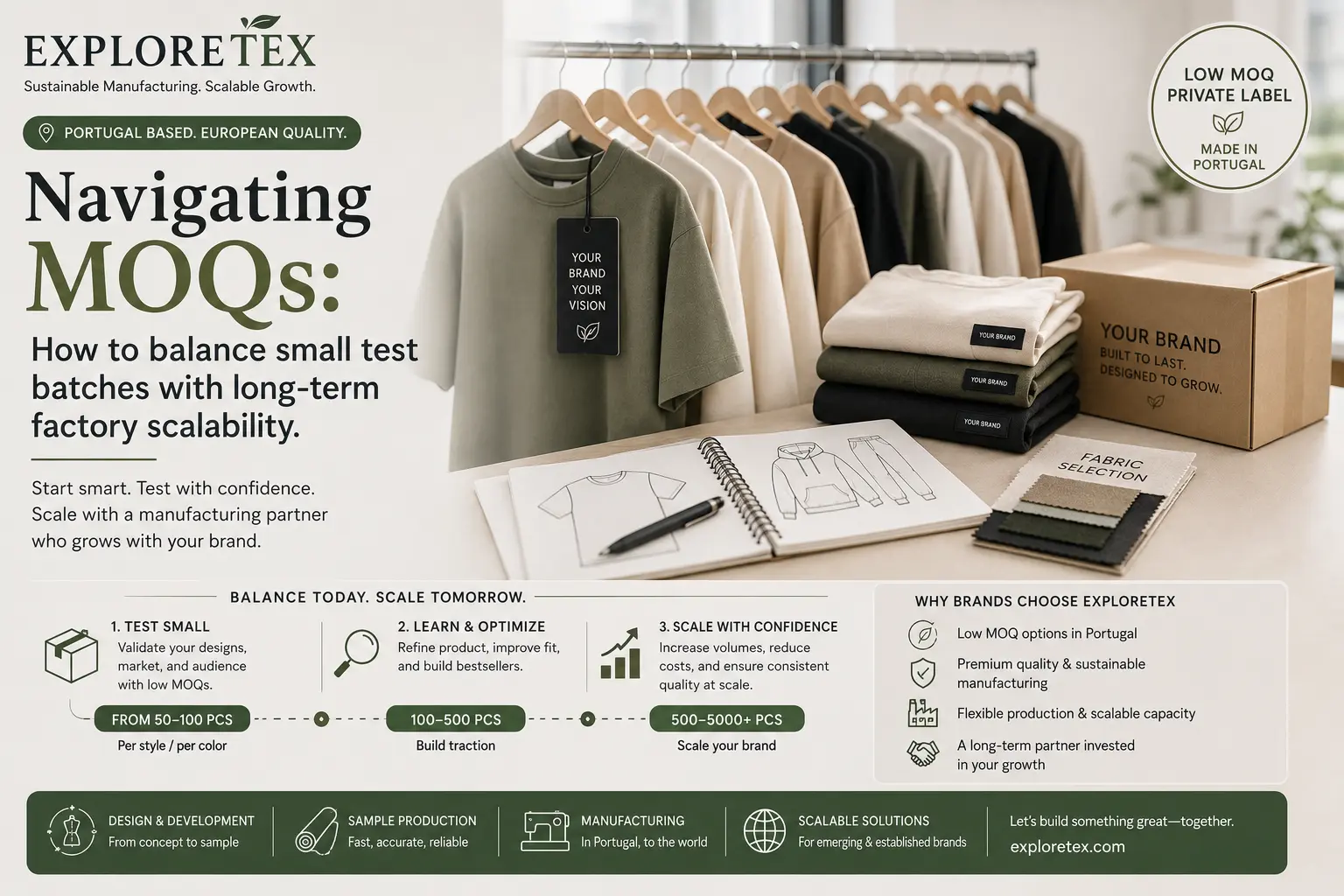
Navigating Minimum Order Quantities (MOQs): How to Balance Small Test Batches with Long-Term Factory Scalability
The Strategic Guide for Fashion Founders, Emerging Labels, and Scaling Brands Sourcing Premium Apparel in Europe and Beyond
Executive Summary
What is low MOQ private label clothing Portugal production, and how does it allow fashion brands to scale without inventory risk?
Low MOQ private label clothing Portugal manufacturing refers to custom garment production in Portuguese facilities that accept small initial production runs—typically between 50 and 300 units per style—allowing fashion brands to test market demand, refine fit, and minimize financial risk. Modern supply chain leaders like ExploreTex combine this low MOQ agility with a dual-hub production model: initial development, prototyping, and small luxury drops are produced in Portugal, while high-volume reorders can seamlessly transition to direct vertical facilities in Bangladesh. This hybrid framework eliminates the traditional trade-off between flexible low-volume entry and high-margin global scalability.
Table of Contents
The Financial & Operational Reality of MOQs in Garment Manufacturing
Why Portugal is the World Leader for Low MOQ Private Label Apparel
The ExploreTex Dual-Hub Model: From 50-Unit Test Drops to Volume Scaling
Factory-Floor “Expert” Insights: The Technical Science of Low MOQs
Step-by-Step Blueprint: Building a Low MOQ Private Label Collection
Financial Strategy: Unit Economics, Cash Flow, and Margin Optimization
1. The Financial & Operational Reality of MOQs in Garment Manufacturing
For emerging apparel brands, independent designers, and established labels expanding into new product categories, navigating Minimum Order Quantities (MOQs) is the single greatest obstacle to profitability. Choosing low MOQ private label clothing Portugal production allows brands to validate designs without tying up working capital in unsold inventory.
┌─────────────────────────────────────────────────────────────────────────────┐
│                       TRADITIONAL MOQs VS. LOW MOQ HYBRID                    │
├──────────────────────────────────────┬──────────────────────────────────────┤
│ Traditional High MOQ Factory         │ ExploreTex Low MOQ Portugal Model     │
├──────────────────────────────────────┼──────────────────────────────────────┤
│ • 1,000 - 5,000 units per colorway   │ • 50 - 300 units per style/colorway  │
│ • Heavy upfront capital commitment   │ • Preserved working capital & cash   │
│ • High deadstock & markdown risk     │ • Rapid market testing & agility     │
│ • Rigid fabric & trim minimums       │ • Pre-milled stock & custom options  │
└──────────────────────────────────────┴──────────────────────────────────────┘
Why Do Garment Factories Enforce High MOQs?
Garment manufacturing is a game of precision, efficiency, and industrial setup. When a factory accepts a production order, several fixed operational costs are incurred regardless of whether they sew 50 garments or 50,000 garments:
Fabric Mill Dye Vat Minimums: Textile mills operate industrial dyeing vats that require minimum liquid volume and fabric weight (often 300 kg to 500 kg per colorway) to ensure consistent color shades across the entire batch.
Cutting Room Marker Efficiency: Cutting machines require heavy roll setups and multi-layer fabric lays. Preparing a cutting table for 50 pieces incurs almost the same labor cost as setting up for 500 pieces.
Machine Calibration & Threading: Industrial sewing lines must be re-tooled, re-threaded, and calibrated for specific seam types (e.g., flatlock, overlock, double-needle coverstitch) for each garment design.
Administrative & Pattern Development Overhead: Creating technical blueprints, grading digital patterns across size runs (XS to 5XL), and managing bill of materials (BOM) require identical engineering time regardless of order size.
Understanding these operational hurdles explains why standard overseas factories reject small orders. Achieving success with low MOQ private label clothing Portugal manufacturing requires working with a specialized partner capable of engineering around these physical constraints.
The Danger of High MOQs for Growing Fashion Brands
Committing to high initial production runs exposes a brand to structural financial risks:
Capital Lockup: Tying up 70% to 80% of operating capital in inventory leaves insufficient funds for digital marketing, influencer campaigns, and customer acquisition.
Deadstock & Discount Spiral: Unsold stock forces heavy discounting, damaging brand perception and eroding retail gross margins.
Inability to Adapt to Market Feedback: If a fit is slightly off or a specific colorway underperforms, a high-volume commitment prevents immediate design iteration.
By partnering with an experienced clothing manufacture in Portugal provider, fashion founders can execute controlled market launches, gather real-time consumer data, and reorder only top-performing SKUs.
For modern fashion founders, supply chain directors, and apparel directors, few operational decisions carry as much financial weight as managing Minimum Order Quantities (MOQs). Setting an inventory order too high before validating consumer demand leads to trapped capital, deadstock, and cash-flow strain. Conversely, setting order volumes too low with an unequipped facility results in exorbitant unit costs, inconsistent quality control, and an inability to fulfill reorders when demand spikes.
The key to overcoming this challenge lies in a hybrid manufacturing strategy: starting with low MOQ private label clothing Portugal production to test market reception, and then transitioning into scalable vertical facilities once demand is proven.
       ┌──────────────────────────────────────────────────────────┐
       │                   BRAND GROWTH ROADMAP                   │
       └────────────────────────────┬─────────────────────────────┘
                                    │
            ┌───────────────────────┴───────────────────────┐
            ▼                                               ▼
┌───────────────────────┐                       ┌───────────────────────┐
│       PHASE 1         │                       │        PHASE 2        │
│ Small Batch Testing   │                       │ Vertical Scaling      │
├───────────────────────┤                       ├───────────────────────┤
│ • Portugal Hub        │ ──[ Demand Met? ]──►  │ • High-Volume Facility│
│ • 500 pcs / style     │      (Validate)       │ • 1,000+ pcs / order  │
│ • Speed & Agility     │                       │ • Optimized Unit Cost │
└───────────────────────┘                       └───────────────────────┘
This comprehensive pillar guide breaks down the mechanics of MOQs, the physics of garment factory floors, and how to structure your supply chain for sustainable, long-term brand growth.
2. Why Portugal is the World Leader for Low MOQ Private Label Apparel
Portugal, specifically the northern industrial corridor surrounding Porto, Guimarães, Barcelos, and Braga, has earned an unmatched global reputation for high-end garment craftsmanship, ethical working conditions, and flexible manufacturing.
                   ┌─────────────────────────────────────────┐
                   │    THE PORTUGUESE TEXTILE ECOSYSTEM     │
                   └────────────────────┬────────────────────┘
                                        │
        ┌───────────────────────────────┼───────────────────────────────┐
        │                               │                               │
┌───────▼────────┐             ┌────────▼────────┐             ┌────────▼────────┐
│ Northern Cluster│             │ EU Sustainability│             │   Nearshoring   │
│ Porto & Braga   │             │ Strict Directives│             │ Speed & Logistics│
│ Luxury Jersey,  │             │ GOTS & OEKO-TEX  │             │ 3-5 Day EU Truck│
│ Tailoring & Knit│             │ Fair Living Wage │             │ Air/DDP to USA  │
└────────────────┘             └─────────────────┘             └─────────────────┘
Key Advantages of Sourcing Low MOQ Private Label Clothing in Portugal
Unrivaled Fabric Sourcing Capabilities: Portugal houses some of Europe’s finest fabric mills, specializing in heavyweight organic cottons, French terry, loopback fleece, luxury modal blends, and technical performance textiles. Access to curated fabric stock allows brands to manufacture low MOQ private label clothing Portugal collections without ordering thousands of meters of custom-milled fabric.
Flexible, High-Skill Workforces: Portuguese textile artisans excel at complex cut-and-sew operations, precision embellishments, flatlock stitching, and garment finishing. This craftsmanship makes low MOQ private label clothing Portugal runs viable even for intricate luxury streetwear, premium activewear, and tailored garments.
Rapid Nearshoring Lead Times: Shipping from Northern Portugal to major European fashion capitals takes just 3 to 5 business days via road freight, while express air shipments to North America take 2 to 4 days. This shortens lead times dramatically compared to Asia-based supply chains, enabling quick-turn replenishment drops.
Strict EU Environmental & Ethical Compliance: Manufacturing within the European Union guarantees adherence to strict labor regulations, living wages, safe working environments, and EU REACH chemical standards. Brands producing low MOQ private label clothing Portugal lines can market 100% ethical compliance and sustainability to discerning global consumers.
For a deep dive into sourcing options, consult our comprehensive sourcing guide for best clothing manufacturers in Portugal.
The Economics of Minimum Order Quantities (MOQs)
Understanding why apparel factories enforce MOQs is crucial for negotiating better production terms and maintaining healthy margins. Factories do not impose order minimums arbitrarily; MOQs are driven by fixed operational overheads and raw material constraints on the factory floor.
┌─────────────────────────────────────────────────────────────────────────┐
│                        FACTORY MOQs DIRECT DRIVERS                      │
├─────────────────────────────────────────────────────────────────────────┤
│ 1. Fabric Mill Minimums   ──► Dye vats require minimum liquid volume    │
│ 2. Production Line Setup  ──► Machine recalibration & thread changeover │
│ 3. Pattern & Marker Yield ──► Marker nesting efficiency (<85% = waste)  │
│ 4. Administrative Fixed   ──► Tech pack intake, CAD, sampling, export   │
└─────────────────────────────────────────────────────────────────────────┘
1. Fabric Mill Minimum Vats
Knitting and weaving mills operate industrial dyeing vats that require a minimum volume of liquid and fabric to maintain consistent color saturation across a batch. If a brand orders a custom-dyed fabric below the mill’s minimum capacity (often 300 kg to 500 kg per colorway), the mill must either charge a “small-batch surcharge” or turn down the order.
For instance, a standard 240 GSM 100% combed cotton jersey fabric yields roughly 3 to 3.5 t-shirts per kilogram. A 300 kg mill minimum translates to roughly 900–1,000 t-shirts. When brands seek low MOQ private label clothing Portugal solutions, manufacturers offset mill minimums by sourcing high-grade stock fabrics, using continuous-run yarns, or combining dye lots across non-competing lines.
2. Line Balancing and Setup Friction
Industrial sewing facilities operate through progressive bundle systems or modular assembly lines. Transitioning a production line from a heavy fleece hoodie to a light jersey tee requires re-tooling machines, changing needle types, adjusting thread tension, and re-training operators on line adjustments.
[ Line Changeover ] ──► [ Machine Setup & Tension ] ──► [ Operator Calibration ]
        │
        └─► Fixed setup costs spread over 100 pcs = HIGH Cost Per Unit
        └─► Fixed setup costs spread over 1,000 pcs = LOW Cost Per Unit
If a line setup takes 4 hours and yields only 100 garments, the labor cost of line changeover dominates the per-unit price. Spread across 1,000 garments, that setup friction dilutes to pennies.
3. Marker Efficiency and Material Waste
Before fabric is cut, Computer-Aided Design (CAD) software nests pattern pieces onto a digital layout called a “marker.” Higher order quantities allow pattern makers to mix sizes (e.g., S, M, L, XL) across a longer fabric lay, achieving marker efficiency ratings above 88%. Small orders restrict sizing variation on the marker, lowering yield efficiency and generating higher textile scrap waste.
To explore how full-package production balances these operational overheads, visit the ExploreTex Full Package Manufacturing Service.
3. The ExploreTex Dual-Hub Model: From 50-Unit Test Drops to Volume Scaling
While low MOQ private label clothing Portugal manufacturing provides exceptional flexibility and luxury quality, growing brands eventually face a secondary challenge: cost-effective scaling. When order volumes scale from 300 units to 5,000 or 50,000 units, pure European manufacturing costs can strain mass-market retail price points.
To solve this scaling bottleneck, ExploreTex developed a proprietary Dual-Hub Production Model.
┌─────────────────────────────────────────────────────────────────────────────┐
│                      EXPLORETEX DUAL-HUB PRODUCTION MODEL                    │
├──────────────────────────────────────┬──────────────────────────────────────┤
│ HUB A: PORTUGAL (Lisbon / Porto Hub) │ HUB B: BANGLADESH (Directly Operated)│
├──────────────────────────────────────┼──────────────────────────────────────┤
│ • Focus: R&D, Prototyping, Low MOQ   │ • Focus: High-Volume Mass Production │
│ • Order Volume: 50 - 300 units/style │ • Order Volume: 1,000 - 50,000+ units│
│ • Speed: Rapid sampling & fast drops │ • Cost Structure: Maximize margins   │
│ • Target: Premium drops & new launches│ • Target: Scaled core collections    │
└──────────────────────────────────────┴──────────────────────────────────────┘
How the Dual-Hub Supply Chain Works for Your Brand
Phase 1: Research, Sampling, & Low MOQ Launch in Portugal
Designers collaborate with the ExploreTex Lisbon headquarters for collection planning, pattern engineering, and 3D virtual prototyping.
Initial test batches (50 to 300 pieces per colorway) are produced through our managed Portuguese facility network.
The brand launches its low MOQ private label clothing Portugal collection, testing product-market fit, audience engagement, and price point resistance with minimal capital risk.
Phase 2: Seamless Technical & Pattern Transfer
Because ExploreTex manages both European and Asian operations under a single standardized technical management system, all tech packs, digital patterns, fabric specifications, and size grading parameters are archived at our European headquarters.
When a core product line proves successful and demands high-volume retail reorders, production can be transferred directly to our vertical facility in Bangladesh.
Phase 3: High-Volume Cost Optimization in Bangladesh
By utilizing our directly operated Bangladesh facility for volume reorders, brands achieve unit cost reductions of up to 40% to 50% while maintaining the exact same fit, tech pack specifications, and AQL 2.5 quality control standards established during the European sampling phase.
This hybrid approach allows brands to market their luxury drops as low MOQ private label clothing Portugal productions while maintaining the structural infrastructure required to scale into a multi-million-dollar fashion enterprise.
To learn more about our end-to-end management capabilities, explore our full package clothing production Portugal framework.
The Portugal Advantage for Small Batch & Premium Apparel
Portugal—specifically the Northern Portuguese textile corridor surrounding Porto and Guimarães—has established itself as Europe’s premier hub for high-end garment creation. Working with a partner focused on low MOQ private label clothing Portugal offers clear strategic advantages for modern fashion labels.
| Strategic Advantage | Portugal Production Network | Traditional Offshore Sourcing |
| Typical Initial MOQ | 500 pcs / style (Flexible) | 2,000 – 5,000 pcs / style |
| Transit Lead Time to Europe/US | 2 to 7 days (Road/Air Freight) | 30 to 45 days (Ocean Freight) |
| Fabric Specialization | Premium Jersey, Organic Cotton, Luxury French Terry | Basic Synthetics, Heavy Blends |
| Labor Standards | 100% EU Labor Laws & Living Wage Compliance | Variable Third-Party Auditing |
| Proto Sampling Speed | 2 to 3 weeks | 6 to 10 weeks |
| Environmental Compliance | EU REACH, Closed-Loop Dyeing, OEKO-TEX | Regional Environmental Variance |
Ethical Labor and Environmental Rigor
Portugal operates under stringent European Union labor frameworks, guaranteeing fair wages, safe working conditions, and complete supply chain transparency. European mills also comply with EU REACH regulations, restricting harmful chemicals and azo dyes in fabric processing.
For brands looking to build an ethical narrative, leveraging low MOQ private label clothing Portugal production provides instant credibility and verifiable compliance. You can review our corporate ethics and European operational framework on the ExploreTex Corporate Homepage.
EU Environmental & Labor Standards
  ├── REACH Regulation (Zero Harmful Chemicals)
  ├── Fair Living Wage & Safe Working Conditions
  └── OEKO-TEX / GOTS Certified Dyeing Processes
Unmatched Workmanship in Jersey and Heavyweights
Portuguese garment facilities are globally recognized for luxury streetwear, heavy French terry fleece (e.g., 450 GSM to 600 GSM), fine gauge t-shirts, and tailored luxury items. The tactile feel and structural integrity of Portuguese-knitted fabrics give private label collections a distinct hand-feel that elevates market positioning.
To read more about European industry benchmarks, consult the official guidelines from the European Apparel and Textile Confederation (EURATEX).
4. Factory-Floor “Expert” Insights: The Technical Science of Low MOQs
Technical Commentary
By Muhammad Ilias Hossen — Founder & Chief Executive Officer, ExploreTex
M.Sc. in Textile Engineering, B.Sc. in Textile Engineering, PhD Candidate in Fashion Design
“Most fashion founders believe that getting a low MOQ is simply a matter of finding a factory willing to take a smaller order. In physical reality, achieving a sustainable low MOQ private label clothing Portugal production run requires advanced textile engineering and smart marker geometry.
If you do not engineer the garment for small-batch efficiency from the tech pack stage, fabric scrap rates can exceed 25%, causing factory surcharges to wipe out your gross margins. At ExploreTex, we solve this on the factory floor using mathematical marker optimization, 3D digital simulation, and strategic fabric roll allocation.”
┌─────────────────────────────────────────────────────────────────────────────┐
│                FACTORY-FLOOR ENGINEERING FOR LOW MOQ SUCCESS                │
├─────────────────────────────────────────────────────────────────────────────┤
│ 1. Marker Geometry & Fabric Utilization Optimization                        │
│    • Digital nested markers maximize fabric efficiency to >88%.            │
│    • Combines multi-size cuts across small batches to eliminate waste.      │
│                                                                             │
│ 2. 3D Digital Twin Virtual Prototyping                                     │
│    • Simulates fabric drape, stretch, and tension on 3D avatars.            │
│    • Cuts physical sampling rounds from 4 down to 1 single golden sample.   │
│                                                                             │
│ 3. Pre-Milled Fabric Inventory Sourcing                                    │
│    • Utilizes luxury stock fabrics from top Portuguese mills.               │
│    • Bypass 500kg custom dye vat minimums without quality compromise.      │
└─────────────────────────────────────────────────────────────────────────────┘
Technical Insight 1: Fabric Utilization & Marker Geometry
When cutting fabric for a low MOQ private label clothing Portugal run of 100 t-shirts, standard pattern layouts leave large gaps of unused fabric on the cutting table.
Our engineering team utilizes digital pattern nesting software that arranges size distributions (e.g., 1x Small, 2x Medium, 2x Large, 1x XL) into a unified marker layout. This increases fabric utilization efficiency from a standard 75% up to 88%+, lowering raw material cost per garment and enabling factories to accept smaller orders.
Technical Insight 2: 3D Digital Twin Virtual Prototyping
Physical sampling is one of the most expensive aspects of fashion development. Traditional sampling requires 3 to 4 physical revisions, costing hundreds of Euros per iteration in fabric, labor, and express shipping.
ExploreTex utilizes 3D Digital Twin Engineering. We build a high-fidelity 3D digital model of your garment, simulating real-world fabric weight, elasticity, drape, and tension on customizable digital avatars.
Result: Fit adjustments, seam placements, and artwork scaling are perfected virtually before a single piece of cloth is cut. This reduces physical sampling requirements down to a single “golden sample,” lowering pre-production overhead for low MOQ private label clothing Portugal orders.
Technical Insight 3: Strategic Fabric Sourcing & Pre-Milled Mills
To bypass high mill minimums (which often require 300 kg to 500 kg per custom dye lot), ExploreTex works closely with elite European suppliers. We source high-grade, pre-milled organic cotton, heavyweight loopback French terry, and performance jersey directly from inventory stock. This grants brands producing low MOQ private label clothing Portugal collections access to luxury-tier fabrics with low minimums.
Discover how we connect brands with high-end fabric mills through our guide to top luxury textile suppliers in Portugal.
The Strategic Dual-Hub Production Model
While producing exclusively in Europe is ideal for small initial collections, scaling a brand solely through small batches can create margin pressure as volume grows. High-growth private label brands require a dual approach: flexibility at the start, and cost efficiency at scale.
This is where a Dual-Hub Production Model excels.
                 DUAL-HUB PRODUCTION ARCHITECTURE

   [ PHASE 1: INNOVATION HUB ]         [ PHASE 2: SCALING HUB ]
       Portugal Facility                   Bangladesh Facility
  ───────────────────────────         ───────────────────────────
   • 500 pcs/style               • 1,000+ pcs/style
   • High Agility & Speed  • Vertical Integration
   • Market Testing              • Optimized Unit Margin
   • Luxury Streetwear/Jersey     • Core Replica Scaling
               │                                   ▲
               └─────────[ Scalability Bridge ]────┘
Stage 1: Market Validation via Portugal Managed Hub
During the launch phase of a new silhouette, colorway, or product line, volume predictability is low. By utilizing low MOQ private label clothing Portugal capabilities, a brand can launch a collection with 500 pieces per style. This minimizes upfront inventory expenditure while delivering a retail-ready product to market.
Stage 2: Mass Scaling via Vertically Integrated Hubs
Once a specific t-shirt, hoodie, or trouser design proves to be a top seller, order volumes increase from 500 units to 2,000, 5,000, or 10,000+ units. At this threshold, shifting production to a vertically integrated facility—such as a modern, European-managed plant in Bangladesh—helps optimize margins while maintaining strict quality controls.
Vertical facilities perform spinning, knitting, dyeing, cutting, sewing, and packaging under a single roof. This eliminates inter-factory transportation costs and streamlines production.
VERTICAL INTEGRATION FLOW:
Yarn Spinning ──► Knitting ──► Dyeing ──► CAD Cutting ──► Assembly ──► AQL Inspection
By maintaining uniform European quality oversight across both facilities, brands can seamlessly transition styles between hubs without sacrificing fit, grading, or craftsmanship.
Learn more about managing large-scale production runs in our detailed technical guide on Vertical Garment Production in Bangladesh.
Factory-Floor “Expert” Insights: Technical Strategies to Maximize Small Batch Efficiency
To achieve low production minimums without driving unit costs through the roof, production managers apply specific technical strategies during development.
┌────────────────────────────────────────────────────────────────────────┐
│                   FACTORY-FLOOR EFFICIENCY LEVERS                      │
├────────────────────────────────────────────────────────────────────────┤
│ 1. Fabric Standardization ──► Shared base fabrics across multiple styles│
│ 2. Trim Standardization   ──► Universal care labels, zips, drawstrings │
│ 3. 3D Digital Twin        ──► Reduce physical sampling rounds to one    │
│ 4. Optimized Grading      ──► Consistent mathematical sizing matrices  │
└────────────────────────────────────────────────────────────────────────┘
1. The “Base Fabric Standardization” Protocol
If you launch four distinct styles (e.g., a crewneck, a hoodie, a zip-up, and sweatpants) using four different custom-milled fabrics, each style requires its own fabric minimum run.
Factory Pro Tip: Standardize your raw materials. Use a single high-grade 400 GSM 100% Cotton French Terry across all four silhouette styles.
Total fabric required across the 4 styles: 1,200 kg.
This easily meets mill dyeing minimums, giving you access to custom colorways while maintaining an order of just 300 to 500 pieces per style.
2. Digital Twin Engineering (3D Prototyping)
Physical sampling iterations add time and expense to small production runs. By creating a high-fidelity 3D digital twin of the garment before cutting cloth, pattern makers can simulate fabric drape, tension, and fit across digital avatars.
This digital-first approach resolves pattern flaws early, cutting physical sample rounds down to a single master prototype.
[ CAD Design ] ──► [ 3D Virtual Fitting ] ──► [ Master Sample ] ──► [ Bulk Cutting ]
                         (Saves 2-4 Weeks)
Discover how digital pattern creation streamlines sample lead times by reviewing the ExploreTex Sourcing and Technical Development Overview.
3. Trim and Hardware Synergy
Custom-dyed zippers, custom-cast metal aglets, and specialty woven neck labels carry high factory minimums (often 3,000 to 5,000 units per style).
Factory Pro Tip: Order trims in higher volumes (e.g., 5,000 neck labels and 3,000 universal zippers) and store them at the factory’s warehouse. You can then apply these universal trims across smaller, consecutive low MOQ private label clothing Portugal production runs over time.
For international standards on fabric safety and certified chemical compliance, refer to the OEKO-TEX Standard 100 Guidelines.
5. Step-by-Step Blueprint: Building a Low MOQ Private Label Collection
Executing a successful small-batch production run requires a structured development framework. Below is the exact step-by-step process used by ExploreTex to deliver high-quality low MOQ private label clothing Portugal collections.
┌─────────────────────────────────────────────────────────────────────────────┐
│               EXPLORETEX 5-STEP PRODUCTION PIPELINE                         │
├─────────────────────────────────────────────────────────────────────────────┤
│ STEP 1: Tech Pack Engineering & Blueprint Creation                           │
│ STEP 2: Strategic Fabric & Trim Selection                                   │
│ STEP 3: 3D Virtual Simulation & Golden Sample Approval                      │
│ STEP 4: Precision Cutting, Sewing, & In-Line Quality Control                │
│ STEP 5: Final AQL 2.5 Audit & DDP Global Delivery                           │
└─────────────────────────────────────────────────────────────────────────────┘
Step 1: Tech Pack Engineering & Blueprint Creation
A Tech Pack is the master technical document that dictates every physical property of your garment. Without an accurate tech pack, manufacturing low MOQ private label clothing Portugal runs increases the risk of production errors and costly delays.
Essential Elements: Flat technical drawings (front, back, side views with seam callouts), point-of-measurement (POM) specification charts, bill of materials (BOM), fabric composition weight (GSM), thread type, stitch density (SPI – Stitches Per Inch), and care label placement.
ExploreTex Support: If you do not have a finished tech pack, our Lisbon design team builds fully vectorized technical packages for your brand.
Step 2: Strategic Fabric & Trim Selection
Select fabrics that match your desired aesthetic and target margin structure.
Selecting Low MOQ Fabrics: Choose pre-milled, stocked GOTS-certified organic cottons or OEKO-TEX certified knits to keep order minimums low.
Custom Trims & Packaging: Standardize custom woven neck labels, hangtags, and biodegradable polybags across your entire collection to meet supplier trim MOQs (e.g., ordering 1,000 neck labels to use across ten 100-piece production runs).
Step 3: 3D Virtual Prototyping & Golden Sample Approval
Before initiating bulk manufacturing, we render your garment as a 3D digital twin.
Once digital parameters are approved, ExploreTex produces a physical “Golden Sample” at our Portuguese facility.
Live video fitting sessions are conducted between your design team, our project managers, and master pattern makers to approve the final construction.
Step 4: Small Batch Cut-and-Sew Production
Upon sample sign-off, bulk manufacturing begins.
Precision Automated Cutting: Computerized laser and blade cutters ensure every pattern piece is cut to millimeter precision.
Specialized Sewing Lines: Skilled European operators assemble the garments using dedicated machinery (e.g., four-needle flatlock for activewear, heavy-duty safety stitching for heavyweight hoodies).
In-Line Quality Control: Quality inspectors monitor seam strength, stitch tension, and measurement fidelity throughout assembly.
Step 5: Final Quality Inspection & DDP Global Logistics
AQL 2.5 Inspection: Every finished low MOQ private label clothing Portugal batch undergoes strict Acceptable Quality Limit (AQL 2.5/4.0) inspections covering visual appearance, dimensional stability after wash, seam elasticity, and packaging compliance.
Door-to-Door Delivery (DDP): ExploreTex handles export documentation, certificates of origin, customs duties, and direct DDP (Delivered Duty Paid) shipping to your warehouse or fulfillment center.
Explore our eco-friendly practices in our guide to sustainable clothing manufacturers in Portugal.
FAQ 1: Can my collection carry the official “Made in Portugal” label?
Yes. To carry the “Made in Portugal” label, the origin rules under EU customs regulations require that the primary manufacturing process—specifically the cutting and sewing assembly—takes place within Portuguese territory. When using low MOQ private label clothing Portugal manufacturing services, your garments fully comply with European origin labeling rules.
FAQ 2: What is the typical lead time for a small-batch private label order in Portugal?
Sampling and 3D digital prototyping take roughly 2 to 3 weeks. Once fit samples are approved, bulk production for small test batches (500 pieces per style) typically requires 4 to 6 weeks, depending on fabric availability and seasonal demand.
FAQ 3: Do I need to provide a completed Tech Pack to start production?
While a complete Tech Pack accelerates the onboarding process, it is not strictly required. Experienced manufacturing partners can build technical blueprints from physical reference samples, mood boards, or detailed sketches. Learn more about our technical development process on the ExploreTex Design & Tech Pack Service Page.
FAQ 4: How does a Dual-Hub Model help protect brand margins as order volumes grow?
A Dual-Hub model combines flexible, small-batch European production with high-capacity vertical manufacturing. You test new designs in Portugal with small runs (500 units) to minimize inventory risk. Once a style proves its market appeal, production transitions to an integrated vertical facility in Bangladesh, lowering unit costs by 30% to 50% while maintaining European quality management.
FAQ 5: What fabric certifications should I look for when sourcing apparel in Europe?
Look for GOTS (Global Organic Textile Standard) for organic cotton, OEKO-TEX Standard 100 for chemical safety, and GRS (Global Recycled Standard) for recycled synthetics. These certifications ensure your collection meets environmental standards and international retail requirements.
6. Comparative Analysis: Sourcing Hubs Across Europe and Asia
Selecting the right manufacturing location depends on balancing order volume, lead times, quality expectations, and ethical standards. The table below compares producing low MOQ private label clothing Portugal runs against traditional manufacturing hubs.
| Sourcing Criterion | ExploreTex Portugal Hub | Traditional Asian Hubs (China / Vietnam) | Turkey Manufacturing | Eastern Europe (Romania / Bulgaria) |
| Typical Minimum Order Quantity (MOQ) | 50 – 300 units/style | 500 – 3,000 units/style | 300 – 500 units/style | 200 – 500 units/style |
| Fabric Sourcing Flexibility | Very High (Pre-milled luxury stock) | High (Requires high volume) | Medium | Medium |
| Average Production Lead Time | 4 – 6 Weeks | 12 – 20 Weeks | 6 – 8 Weeks | 6 – 8 Weeks |
| Sample Development Time | 7 – 14 Days (via 3D Digital Twin) | 30 – 45 Days | 14 – 21 Days | 14 – 21 Days |
| Ethical & Labor Compliance | 100% EU Directives (Fair Wage) | Variable / High Audit Risk | Medium | 100% EU Directives |
| Sustainability Standards | GOTS, OEKO-TEX, GRS | Variable | GOTS available | OEKO-TEX available |
| Shipping Time to EU/UK | 3 – 5 Days (Road Freight) | 30 – 40 Days (Sea Freight) | 7 – 10 Days | 3 – 5 Days |
| Ideal For | Low MOQ Drops & Luxury Scaling | Mass Volume Basics | Mid-volume fast fashion | Mid-volume apparel |
As demonstrated in this comparative analysis, sourcing low MOQ private label clothing Portugal products offers optimal speed, low inventory risk, and premium quality for brands targeting discerning consumers.
To review our structural positioning, read why ExploreTex is the best clothing manufacturer in Portugal.
7. Financial Strategy: Unit Economics, Cash Flow, and Margin Optimization
A common misconception among fashion entrepreneurs is that low unit price is the only metric that matters. In reality, cash velocity and inventory turnover are far more critical to early-stage survival.
┌─────────────────────────────────────────────────────────────────────────────┐
│                    INVENTORY CASH FLOW FINANCIAL COMPARISON                 │
├──────────────────────────────────────┬──────────────────────────────────────┤
│ Scenario A: High MOQ Overseas Run    │ Scenario B: Low MOQ Portugal Batch   │
├──────────────────────────────────────┼──────────────────────────────────────┤
│ • 2,000 units @ €8.00 = €16,000      │ • 100 units @ €18.00 = €1,800        │
│ • Shipping & Tariffs = €3,000        │ • Shipping & Tariffs = €200          │
│ • Total Upfront Capital = €19,000    │ • Total Upfront Capital = €2,000     │
│ • Units Sold @ €60 = 600 units (30%) │ • Units Sold @ €60 = 90 units (90%)  │
│ • Revenue Generated = €36,000        │ • Revenue Generated = €5,400         │
│ • Deadstock Remaining = 1,400 units  │ • Deadstock Remaining = 10 units     │
│ • NET RISK CAPITAL: High             │ • NET RISK CAPITAL: Protected        │
└──────────────────────────────────────┴──────────────────────────────────────┘
The Financial Advantage of Low MOQ Sourcing
Preserving Cash Flow for Customer Acquisition:
In Scenario A, the brand locks up €19,000 in physical inventory before selling a single shirt. If ad performance is weak or demand lags, that capital is trapped on warehouse shelves.
In Scenario B, ordering low MOQ private label clothing Portugal garments requires an upfront commitment of only €2,000. The remaining €17,000 can be directed into digital marketing, brand storytelling, content creation, and influencer partnerships.
Higher Realized Gross Margins:
High MOQ runs often result in end-of-season clearance sales where 30% to 50% of stock is sold at or below cost, dragging down overall collection gross margin to under 40%.
Small-batch runs of low MOQ private label clothing Portugal garments maintain high sell-through rates (85%+ at full retail price), keeping realized gross margins above 65% to 70%.
Scaling via the ExploreTex Hybrid Pipeline:
Once a specific product style achieves high sell-through during the low MOQ private label clothing Portugal test run, the brand can place a scaled production order through the ExploreTex Bangladesh facility.
This lowers the unit cost from €18.00 down to €8.50 on high-volume reorders, maximizing profitability during expansion while retaining absolute quality consistency.
For a detailed walkthrough of our operational history and global scaling capabilities, visit our company profile on ExploreTex best clothing manufacture in Portugal.
8. Specialized FAQ Section
Q1: What is the typical Minimum Order Quantity (MOQ) for private label clothing manufacturing in Portugal?
Answer: Typical Minimum Order Quantities (MOQs) for private label clothing manufacturing in Portugal range between 50 and 300 units per style or colorway, depending on fabric availability and garment complexity. Specialized manufacturing partners like ExploreTex support startup and emerging fashion brands with flexible low MOQ production runs by utilizing stocked GOTS-certified organic fabrics and pre-milled textiles.
Q2: Why are unit prices higher for low MOQ clothing production compared to bulk orders?
Answer: Unit prices are higher for low MOQ production runs because fixed operational setup costs—such as technical pattern making, fabric cutting marker creation, sewing machine line calibration, and fabric dye vat setups—are amortized across a smaller number of individual garments. As order volumes increase, these setup costs spread across more units, lowering the per-unit production cost.
Q3: Can I place a low MOQ order using custom sustainable or organic fabrics in Portugal?
Answer: Yes. Portugal is a global leader in sustainable textile manufacturing. Brands can manufacture low MOQ private label clothing Portugal runs using GOTS-certified organic cotton, OEKO-TEX Standard 100 non-toxic knits, GRS-certified recycled polyester, and eco-friendly Tencel™ blends. ExploreTex grants clients access to pre-milled sustainable fabric stock, bypassing high mill custom dyeing minimums.
Q4: How does ExploreTex support brands transitioning from low MOQ test runs to high-volume scaling?
Answer: ExploreTex utilizes a proprietary Dual-Hub Production Model. Initial product development, 3D prototyping, and small luxury drops (50–300 units) are manufactured in our Portuguese facility network. When a product line demonstrates high market demand, production is transferred to our directly operated vertical facility in Bangladesh. This reduces unit costs by up to 50% while preserving exact pattern grading, tech pack specs, and AQL 2.5 quality control standards.
Q5: What technical files are required to start a low MOQ apparel production run?
Answer: To initiate production, brands ideally provide a comprehensive Tech Pack containing flat vector drawings, seam specifications, point-of-measurement (POM) size grading charts, and a Bill of Materials (BOM). However, if a brand does not possess technical drawings, the ExploreTex design team in Lisbon provides complete tech pack development and 3D digital twin virtual sampling services prior to physical cutting.
Q6: How long does sample development and bulk production take in Portugal?
Answer: Sample development through 3D virtual prototyping takes approximately 7 to 14 days, while physical golden sample production takes 2 to 3 weeks. Once samples are approved, bulk production for low MOQ private label clothing Portugal orders typically takes 4 to 6 weeks, followed by 3 to 5 days for road freight delivery across continental Europe or air express to the USA.
Q7: Can my private label apparel carry the official “Made in Portugal” garment label?
Answer: Yes. Garments that undergo their primary manufacturing processes (cut, sew, finish, and quality audit) within Portuguese facilities fully comply with EU origin rules and can carry the “Made in Portugal” label. This origin label serves as a powerful mark of premium quality, craftsmanship, and ethical European manufacturing for fashion brands worldwide.
Q8: What quality control standards are applied to low MOQ private label orders?
Answer: ExploreTex enforces international AQL 2.5 (Acceptable Quality Limit) inspection standards across four key stages: raw fabric quality audit, inline sewing inspection, 100% finished garment check, and final pre-shipment packaging audits. Every garment produced in our low MOQ private label clothing Portugal pipeline undergoes rigorous dimensional stability, seam strength, and wash-fastness testing.
 Conclusion: Partner with ExploreTex for Scalable Private Label Success
 Conclusion: Partner with ExploreTex for Scalable Private Label Success
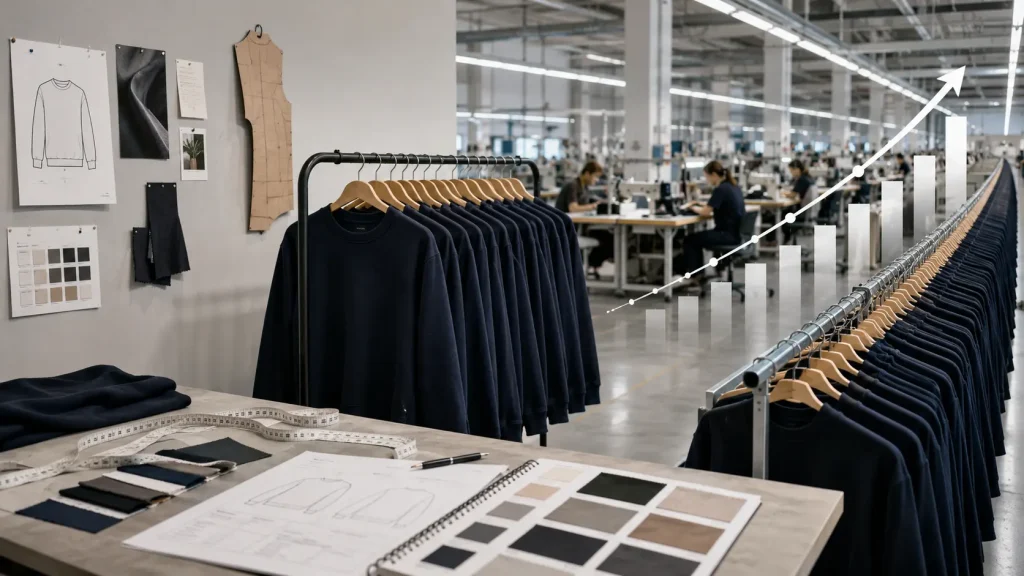
Navigating Minimum Order Quantities no longer requires choosing between extreme financial risk or settling for sub-par product quality. With low MOQ private label clothing Portugal manufacturing powered by ExploreTex, fashion brands gain access to luxury European textiles, 3D virtual prototyping, ethical manufacturing standards, and low initial production runs.
As your brand scales, our Dual-Hub Production Model ensures you can transition high-volume reorders to our direct Bangladesh facility without changing partners, technical blueprints, or quality standards.
Ready to Launch Your Next Private Label Collection?
Explore Our Capabilities: Visit the ExploreTex Homepage to learn more.
Consult Our Engineers: Connect with our Lisbon technical team for a free Tech Pack evaluation and project consultation.
Verify Standards: Review external industry benchmarks on sustainable textiles via Textile Exchange, inspect European environmental guidelines at the European Commission Circular Textiles Strategy, and review independent eco-certifications at OEKO-TEX.