
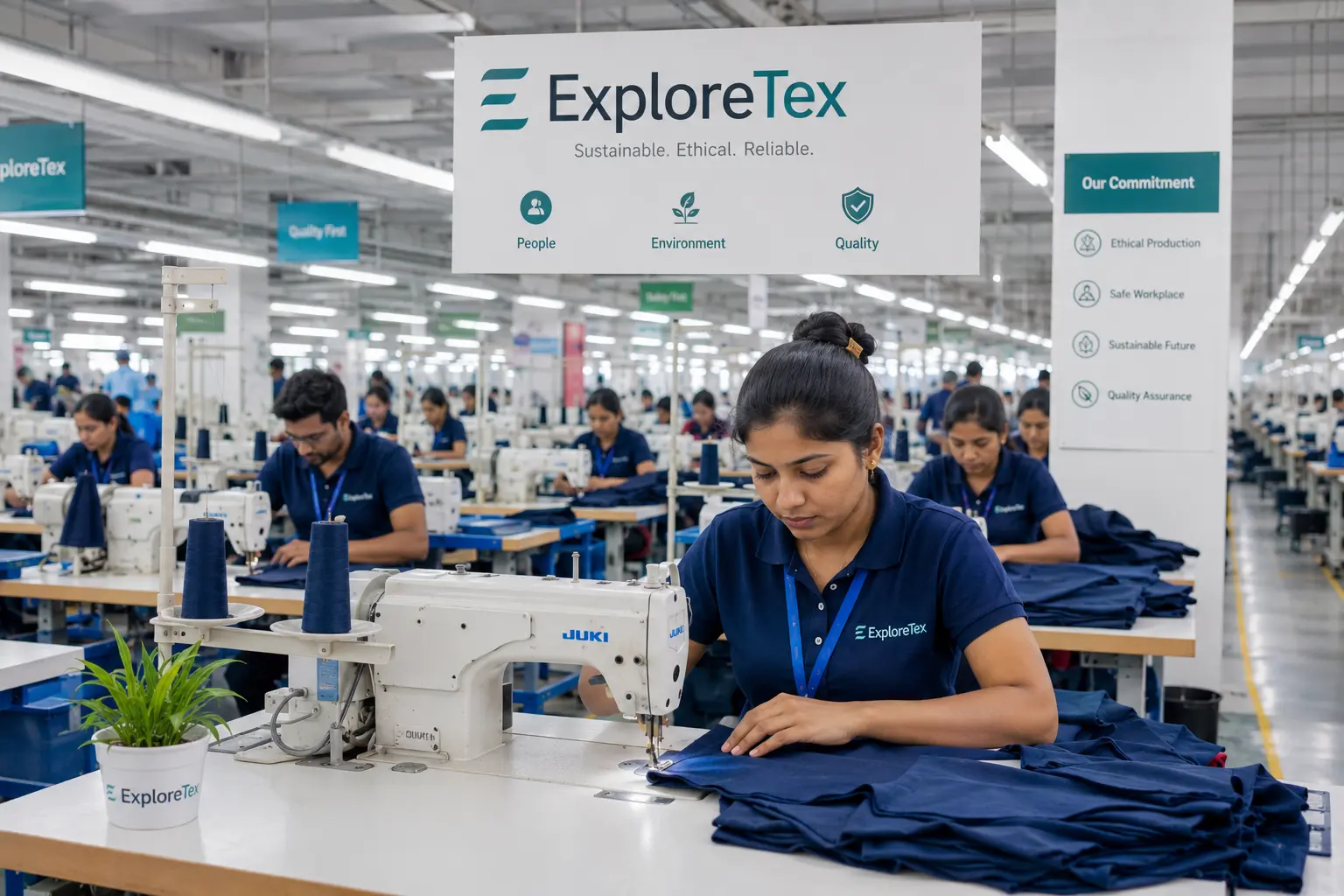
The 2026 Architect’s Guide to Partnering with a BSCI Compliant Garment Factory
Securing Supply Chain Resilience, EU CSDDD Compliance, and Ethical Manufacturing Through Dual-Hub Infrastructure
By Muhammad Ilias Hossen — Founder, ExploreTex
In an era defined by stringent regulatory shifts and a global demand for total supply chain transparency, the definition of a reliable manufacturing partner has evolved. It is no longer sufficient to merely produce high-quality apparel at competitive price points. Today, global apparel brands, supply chain architects, and international procurement officers face a critical mandate: ensuring absolute ethical compliance from the spinning mill to the final stitch. This paradigm shift has made partnering with a verified BSCI Compliant Garment Factory a non-negotiable requirement for brands seeking long-term viability, particularly as the European Union enacts sweeping sustainability and due diligence directives.
At ExploreTex, we have spent over 16 years perfecting technical garment manufacturing. As a Portuguese-registered apparel brand operating a powerful “Dual-Hub” supply chain—featuring a localized design and sourcing office in Lisbon/Porto and a wholly-owned vertical manufacturing facility in Bangladesh—we understand the profound complexities of international compliance. This comprehensive guide serves as your definitive resource on what it means to operate and source from a BSCI Compliant Garment Factory in 2026, how the Amfori BSCI framework intersects with upcoming EU legislations like the Corporate Sustainability Due Diligence Directive (CSDDD), and why our unique structural model mitigates risk for your brand.
In the modern global fashion ecosystem, the architecture of apparel procurement has shifted from a pure cost-per-minute calculation to a comprehensive risk-mitigation framework. With the European Union introducing stringent legal parameters—such as the Corporate Sustainability Due Diligence Directive (CSDDDD) and the Corporate Sustainability Reporting Directive (CSRD)—apparel brands can no longer afford structural blind spots in their tier-1 and tier-2 production networks (De Beule, 2025). The cornerstone of navigating this complex landscape is partnering with a verified BSCI Compliant Garment Factory.
For international procurement officers and supply chain architects, working with a BSCI Compliant Garment Factory is no longer a selective ethical badge; it is an absolute commercial shield. This definitive guide breaks down the precise operational, ethical, and legal mechanisms that govern a certified BSCI Compliant Garment Factory, demonstrating how our unique dual-hub production architecture bridging Portugal and Bangladesh provides the ultimate compliance framework for your brand.
What is a BSCI Compliant Garment Factory?
Answer Summary: A BSCI Compliant Garment Factory is an apparel manufacturing facility that operates in strict adherence to the Amfori Business Social Compliance Initiative (BSCI) Code of Conduct. This framework is built on 13 core performance areas, including the rights of freedom of association, fair remuneration, occupational health and safety, and the absolute prohibition of child and forced labor. A BSCI Compliant Garment Factory undergoes rigorous, independent third-party audits to verify that social, ethical, and environmental standards are continuously upheld, ensuring that brands sourcing from these facilities are protected against human rights violations and supply chain disruptions.
1. The Anatomy of a BSCI Compliant Garment Factory
Understanding the architecture of a BSCI Compliant Garment Factory requires looking beyond superficial certifications. The Amfori BSCI framework is not merely a checklist; it is a philosophy of continuous improvement. When an international brand partners with a BSCI Compliant Garment Factory, they are plugging into a standardized, globally recognized system of social accountability.
Historically, the apparel industry has struggled with opaque supply chains. The introduction of standardized, cross-industry codes of conduct like the Amfori BSCI was designed to alleviate the burden on suppliers who previously had to comply with dozens of varying individual brand requirements, thereby streamlining compliance and improving actual remediation efforts on the factory floor (Sütőová, 2022).
A true BSCI Compliant Garment Factory integrates these ethical principles into its daily Standard Operating Procedures (SOPs). From the moment cotton is processed to the final quality inspection of a 100% cotton Oxford tote bag, a BSCI Compliant Garment Factory ensures that human dignity and environmental stewardship are the foundation of the production cycle. For procurement officers seeking to secure their global supply chains, identifying a vertically integrated BSCI Compliant Garment Factory is the most effective strategy to mitigate reputational risk.
1.1 The 13 Core Performance Areas of Amfori BSCI
To be classified as a high-performing BSCI Compliant Garment Factory, a facility must demonstrate robust systems across the following 13 Performance Areas (PAs):
Social Management System and Cascade Effect: A BSCI Compliant Garment Factory must have management systems in place to implement the BSCI Code of Conduct and cascade these principles to their own suppliers (e.g., fabric mills and trim suppliers).
Workers Involvement and Protection: Establishing grievance mechanisms and ensuring workers are aware of their rights.
The Rights of Freedom of Association and Collective Bargaining: Respecting the right of workers to form unions and bargain collectively without fear of retaliation.
No Discrimination: A BSCI Compliant Garment Factory guarantees equal opportunities regardless of gender, age, religion, or background.
Fair Remuneration: Ensuring wages are sufficient to provide a decent standard of living, going beyond mere legal minimums.
Decent Working Hours: Strict adherence to legal working hours and overtime regulations, preventing worker fatigue.
Occupational Health and Safety (OHS): A foundational pillar of any BSCI Compliant Garment Factory. This includes structural integrity, fire safety, chemical management, and ergonomic workstations.
No Child Labour: Absolute prohibition and implementation of robust age-verification systems during hiring.
Special Protection for Young Workers: Ensuring that workers who are legally of age but still young are not subjected to hazardous conditions or night shifts.
No Precarious Employment: A BSCI Compliant Garment Factory provides secure, legally binding employment contracts to all workers.
No Bonded Labour: Zero tolerance for forced, bonded, or trafficked labor.
Protection of the Environment: Integrating environmental due diligence, managing waste, and aligning with certifications like GOTS and OEKO-TEX.
Ethical Business Behaviour: Anti-corruption, anti-bribery policies, and transparent business practices.
To read more about our specific commitment to these 13 pillars, you can review our corporate ethos on the ExploreTex About Us page.
The Critical Imperative of Social Compliance in Modern Apparel Sourcing
Global apparel manufacturing is undergoing its most radical transformation since the dawn of fast-fashion supply chains. Regulatory bodies, consumer consortiums, and institutional investors are demanding full transparency across all production tiers. Selecting a BSCI Compliant Garment Factory forms the bedrock of an ethical sourcing strategy, shielding brands from severe legal, financial, and reputational liabilities.
[Traditional Sourcing Architecture] ──> High Compliance Fragility & Legal Exposure
               vs.
[ExploreTex Dual-Hub Infrastructure] ──> Certified BSCI Factory (BD) + Flexible Nearshore Hub (PT)
Navigating the EU CSDDDD and CSRD Mandates
The regulatory landscape of the European Union has moved definitively from voluntary Corporate Social Responsibility (CSR) to mandatory Environmental, Social, and Governance (ESG) compliance (De Beule, 2025). Under the CSDDDD frameworks, large-scale apparel enterprises operating within the European market are legally mandated to conduct comprehensive corporate sustainability due diligence across their entire global value chains (De Beule, 2025). This requires the active identification, prevention, mitigation, and remediation of human rights infractions and environmental degradation at every single production node (Mares, 2024).
When a brand contracts a verified BSCI Compliant Garment Factory, the foundational layer of this due diligence is already established. The amfori Business Social Compliance Initiative (BSCI) provides a structured, legally sound auditing methodology that perfectly aligns with international labor standards and EU due diligence guidelines (Mares, 2024). Operating without a BSCI Compliant Garment Factory exposes your enterprise to punitive financial sanctions, court-ordered supply chain halts, and exclusion from public procurement tenders within the European single market.
To understand how our infrastructure systematically mitigates these regulatory risks for international brands, you can review our core framework on the ExploreTex Homepage.
Risk Mitigation: Protecting Brand Equity from Supply Chain Crises
Reputational damage in the apparel sector can erase millions in brand equity overnight. A single labor dispute, safety failure, or wage scandal at a non-compliant production site can alienate consumers and trigger instant divestment from major retail groups. Utilizing a BSCI Compliant Garment Factory acts as an absolute insurance policy for your brand reputation.
A certified BSCI Compliant Garment Factory operates under a system of total operational transparency. Every operational metric, from the structural integrity of the factory floor to the exact overtime compensation structures of individual sewing operators, is tracked and validated by independent, third-party auditing bodies (Fraser et al., 2020). This continuous auditing cycle ensures that when your brand prints its labels, it is backed by an unassailable record of ethical stewardship, establishing deep trust with both retail buyers and end consumers.
Discover how our long-term commitment to ethical manufacturing shapes our corporate DNA by exploring the ExploreTex About Us Profile.
The Economic Dividends of Ethical Manufacturing
There is a widespread misconception that shifting production to a BSCI Compliant Garment Factory represents a net operational drain on margins. In reality, structural compliance yields profound economic dividends. Factories that maintain high social compliance metrics experience substantially lower employee turnover rates, drastically reducing the costs associated with onboarding and retraining skilled machine operators.
Furthermore, a BSCI Compliant Garment Factory exhibits optimized operational efficiency. When working hours are strictly regulated, occupational health and safety protocols are rigidly enforced, and living wages are guaranteed, factory floor productivity spikes. Reduced fatigue translates directly into fewer stitching defects, lower fabric wastage, and a substantial reduction in end-of-line reject rates. Ethical production inside a verified BSCI Compliant Garment Factory is directly synonymous with structural manufacturing excellence.
To evaluate our full suite of procurement, compliance, and production management options, examine the comprehensive ExploreTex Services Hub.
2. The 2026 Regulatory Landscape: EU CSDDD and the Modern BSCI Compliant Garment Factory
The role of a BSCI Compliant Garment Factory has been dramatically amplified by the shifting legal landscape in the European Union. The transition from voluntary corporate social responsibility to mandatory, binding public regulation is fundamentally altering global sourcing strategies. Value chain due diligence laws mark a definitive end to the era of private, voluntary regulation, shifting liability directly onto the lead firms (Kuruvilla, 2024).
2.1 The Impact of the Corporate Sustainability Due Diligence Directive (CSDDD)
The European Union’s Corporate Sustainability Due Diligence Directive (CSDDD) requires large entities to undertake “risk-based human rights and environmental due diligence” (HREDD) across their global operations (Feld, 2026). This means that a brand operating in the EU is legally liable for human rights abuses or environmental damage occurring deep within their supply chain.
For American and European brands, this creates an unprecedented legal risk. The combination of ambitious European regulation like the CSDDD and robust private litigation landscapes means that corporate directors now face severe scrutiny and legal liability over their supply chain impacts (Enriques et al., 2025).
How does a brand navigate this? By partnering exclusively with a verified BSCI Compliant Garment Factory.
Because a BSCI Compliant Garment Factory is already subjected to rigorous third-party auditing that aligns seamlessly with the OECD Guidelines for Multinational Enterprises and the UN Guiding Principles on Business and Human Rights, it serves as an instant risk-mitigation shield for European and US buyers. When you source your apparel from a BSCI Compliant Garment Factory, the foundational data required for CSDDD reporting—such as wage data, safety protocols, and grievance mechanism efficacy—is already documented and verified.
2.2 The Intersection of BSCI and the Digital Product Passport (DPP)
As we move toward a circular economy, the European Union is rolling out the Digital Product Passport (DPP) framework. This requires every garment to carry a digital twin that traces its journey from raw material to retail. A modern BSCI Compliant Garment Factory must integrate its social compliance data with this digital infrastructure. At ExploreTex, our operations are optimized to provide the structured data required for DPPs, seamlessly linking our ethical manufacturing practices with your digital traceability requirements. You can explore our technological capabilities on our Supply Chain Transparency portal.
Decoding the amfori BSCI Architecture: The 13 Performance Areas
The amfori BSCI system is not a static check-the-box certification. It is a comprehensive, holistic management philosophy broken down into 13 distinct Performance Areas (PAs). A truly top-tier BSCI Compliant Garment Factory must demonstrate continuous improvement and rigorous adherence across every single one of these criteria during independent social audits (Fraser et al., 2020).
| amfori BSCI Performance Area (PA) | Core Operational Objective | Factory Floor Implementation Standard |
| PA 1: Social Management System | Institutionalizing compliance policies | Dedicated compliance officers, documented HR protocols |
| PA 2: Workers Involvement | Ensuring open communication channels | Active worker committees, unhindered grievance mechanisms |
| PA 3: Non-Discrimination | Guaranteeing equal workplace opportunities | Merit-based hiring, strict anti-harassment regulations |
| PA 4: Fair Remuneration | Meeting and exceeding statutory living wages | Transparent digital payrolls, timely allowance disbursements |
| PA 5: Decent Working Hours | Eradicating forced overtime | Max 48-hour standard work weeks, capped voluntary overtime |
| PA 6: Occupational Health & Safety | Eradicating workplace injury risks | Fire suppression loops, ergonomic workstations, personal protective equipment (PPE) |
| PA 7: No Child Labor | Absolute eradication of underage exploitation | Multi-stage age verification via biometric government IDs |
| PA 8: Special Protection for Young Workers | Safeguarding employees under 18 years old | Capped hours, no night shifts, zero hazardous duties |
| PA 9: No Precarious Employment | Securing stable, legal labor contracts | Written contracts in local languages, transparent terms |
| PA 10: No Bonded Labor | Ensuring complete freedom of movement | Zero withholding of passports, no illegal employment deposits |
| PA 11: Protection of the Environment | Minimizing local ecological footprints | Chemical management systems, certified effluent treatment plants (ETP) |
| PA 12: Ethical Business Behavior | Eradicating structural corruption | Anti-bribery protocols, transparent audit logs |
| PA 13: Free Association & Collective Bargaining | Respecting organized labor representations | Independent union access, collective bargaining agreements |
PA 1 to PA 5: Social Systems, Worker Voice, and Fair Remuneration
The foundational block of a BSCI Compliant Garment Factory rests on its internal management structures. Under PA 1, the factory must establish an unassailable Social Management System that integrates amfori principles directly into daily operations. This is directly supported by PA 2, which mandates active Workers Involvement and protection. Workers must be fully educated on their rights and granted safe, anonymous grievance mechanisms to voice concerns without fear of retaliation.
When analyzing PA 4 (Fair Remuneration) and PA 5 (Decent Working Hours), a certified BSCI Compliant Garment Factory enforces radical payroll transparency. Wages must meet or exceed national legal standards or industry benchmarks, providing decent living standards for workers and their families. Overtime must be entirely voluntary, compensated at legally mandated premium rates, and strictly capped to prevent physical and mental exhaustion on the production lines.
Our commitment to these rigorous frameworks forms the core of our sustainable manufacturing model, detailed inside the ExploreTex Sustainable Apparel Sourcing Matrix.
PA 6: Occupational Health and Safety (OHS) Engineering
Occupational Health and Safety represents the most operationally intense segment of a BSCI Compliant Garment Factory audit. The physical space must be engineered to eliminate risk. This requires the installation of advanced fire detection systems, automated sprinkler loops, clearly marked and completely unblocked emergency egress routes, and panic-hardware doors.
On the production floor of a BSCI Compliant Garment Factory, OHS translates to the mandatory usage of personal protective equipment (PPE)—such as steel-mesh gloves for fabric cutting operators and clear eye shields for high-speed sewing stations. Every chemical utilization zone must feature detailed Safety Data Sheets (SDS) and secondary containment units to prevent accidental exposure or structural contamination. Regular, documented evacuation drills ensure the entire workforce can exit the facility safely within international standard timeframes.
[OHS Engineering Matrix]
├── Fire Suppression Loops & Sprinklers
├── High-Speed Sewing Eye Shields & Steel-Mesh Cutting Gloves
└── Documented Safety Data Sheets (SDS) with Secondary Containment
PA 7 to PA 13: Vulnerable Worker Protection, Environmental Controls, and Anti-Corruption
A verified BSCI Compliant Garment Factory enforces zero-tolerance boundaries against child labor (PA 7) and bonded labor (PA 10). To achieve absolute compliance, our manufacturing facilities implement mandatory multi-stage age verification protocols utilizing biometric government databases and certified medical screenings prior to contract issuance. Young workers (PA 8) are subject to strict operational limits, ensuring they are never exposed to hazardous tasks or grueling night shifts.
Environmental protection (PA 11) within a BSCI Compliant Garment Factory requires full tracking of waste generation, water consumption, and energy efficiency. Any facility handling wet processing or dyeing must operate a state-of-the-art Effluent Treatment Plant (ETP) to guarantee that all discharged water meets stringent local and international ecological safety metrics. Finally, PA 12 mandates strict Ethical Business Behavior, enforcing zero-tolerance policies toward corporate corruption, bribery, or falsification of operational logs.
3. ExploreTex: Elevating the Definition of a BSCI Compliant Garment Factory
Not all factories are created equal, and not every BSCI Compliant Garment Factory offers the same level of strategic advantage. ExploreTex is uniquely positioned as a premier BSCI Compliant Garment Factory because we do not just comply with standards—we engineer our entire business model around them.
3.1 The “Dual-Hub” Infrastructure Advantage
We have established a highly specialized “Dual-Hub” supply chain architecture that bridges European management standards with the immense manufacturing scale of South Asia.
The European Hub (Portugal): Our registered brand and sourcing office in Lisbon allows us to interface directly with EU regulations, manage specialized Portugal Sourcing Office operations, collaborate with local micro-clusters of high-end fabric mills, and ensure our compliance strategies are proactive rather than reactive.
The Production Engine (Bangladesh): Our fully-owned, vertical Manufacturing in Bangladesh facility is the heart of our operations. As a premier BSCI Compliant Garment Factory, this facility gives us absolute control over the production environment, allowing us to implement real-time ethical oversight without relying on fragmented third-party sub-contractors.
This tri-polar sourcing knowledge allows us to offer data-backed advice to our clients. When comparing the benefits of importing from Bangladesh versus China or Turkey, the advantages of a Bangladesh-based BSCI Compliant Garment Factory managed by a European entity become overwhelmingly clear: you receive the competitive pricing and high-volume capacity of South Asia, married to the communication clarity, legal accountability, and design sensibilities of a Portuguese firm.
3.2 Vertical Integration as a Compliance Mechanism
Why is vertical integration vital for a BSCI Compliant Garment Factory? Because fragmented supply chains are where compliance fails. When a factory outsources its cutting, sewing, or washing to unauthorized shadow facilities, visibility is lost, and the risk of child labor or unsafe working conditions skyrockets.
As a vertically integrated BSCI Compliant Garment Factory, ExploreTex maintains in-house control over the entire garment lifecycle. From sourcing sustainable yarns to knitting, dyeing, cutting, sewing, and final packaging, every step occurs under the watchful eye of our centralized management system. This closed-loop ecosystem ensures that our status as a BSCI Compliant Garment Factory is never compromised by unauthorized sub-contracting.
Anatomy of an Audit: Inside a BSCI Compliant Garment Factory
To truly comprehend the integrity of a BSCI Compliant Garment Factory, one must understand the absolute rigor of the independent auditing process. These assessments are executed exclusively by accredited, independent auditing bodies (such as SGS, TÜV Rheinland, or Intertek) to eliminate any conflict of interest (Verbruggen, 2022).
[Audit Protocol Pathway]
Pre-Audit Document Verification ──> Factory Floor Physical Inspection ──> Private Worker Interviews ──> Final CAP Issuance
The Three Audit Formats: Announced, Semi-Announced, and Unannounced
An amfori social assessment within a BSCI Compliant Garment Factory can occur across three distinct structural formats:
Announced Audits: Typically utilized during the initial baseline certification phase to establish core structural compliance.
Semi-Announced Audits: The standard operational format. The factory is given a flexible 4-week window during which the audit team will arrive without further notice. This ensures the facility maintains continuous compliance without staging temporary conditions.
Unannounced Audits: The ultimate test of operational integrity. Auditors arrive at the gates of the BSCI Compliant Garment Factory with zero prior warning, demanding immediate, unrestricted access to the production floors, payroll archives, and employee break areas.
The Auditing Sequence: A Multi-Stage Operational Deep Dive
The execution of an audit inside a BSCI Compliant Garment Factory follows a highly disciplined, multi-stage protocol designed to catch any operational anomalies (Fraser et al., 2020):
Phase 1: Opening Meeting: The audit team aligns with factory management, establishing the scope of the evaluation and securing direct access to all operational systems.
Phase 2: Physical Site Walkthrough: A comprehensive inspection of every square meter of the facility. Auditors examine structural integrity, ventilation efficiency, lighting levels, emergency exits, machinery safety guards, chemical storage zones, and the sanitation standards of dining and restroom facilities.
Phase 3: Exhaustive Document Review: Auditors meticulously cross-examine at least 12 months of daily timecards, digital payroll ledgers, employment contracts, social security disbursements, business licenses, building structural safety certificates, fire service approvals, and environmental discharge records.
Phase 4: Confidential Worker Interviews: To ensure absolute data accuracy, auditors select a randomized cross-section of the workforce for private, one-on-one interviews away from management oversight. These interviews verify that actual daily working conditions, overtime practices, and wage payments perfectly match the digital logs.
Phase 5: Closing Meeting & CAP Alignment: The audit concludes with the presentation of findings. If any minor operational non-conformances are discovered, the factory is issued a binding Corrective Action Plan (CAP) with strict, time-bound deadlines for resolution.
Understanding amfori Scoring Metrics: A, B, C, D, and E
Upon completion, the BSCI Compliant Garment Factory is awarded an overall performance rating based on a highly structured grading scale:
Rating A (Outstanding): The factory exhibits complete compliance across almost all Performance Areas. It requires no immediate follow-up and demonstrates an industry-leading social management system.
Rating B (Good): The facility maintains an exceptionally high level of structural compliance, with only minor, non-systemic areas requiring optimization.
Rating C (Acceptable): The standard benchmark rating. The factory is structurally secure and legally sound but exhibits specific, manageable gaps in non-critical performance areas that must be corrected via an active CAP process.
Rating D (Insufficient): Severe non-conformances identified. The factory requires urgent intervention, structural remediation, and a mandatory follow-up audit within a tight timeframe to retain validation.
Rating E (Unacceptable): Structural failure or flagrant violations discovered. Immediate supply chain suspension is triggered until comprehensive remediation is independently verified.
Our premier production facility in South Asia systematically maintains top-tier compliance ratings. You can explore this facility’s technical specifications and layout at our ExploreTex Bangladesh Manufacturing Hub.
4. Factory-Floor “Expert” Insights: Making Compliance Reality
“As an international sourcing professional with over 16 years of experience, I have seen the evolution of factory compliance firsthand. Many facilities view audits as a yearly exam to pass. At ExploreTex, we view our status as a BSCI Compliant Garment Factory as a daily operational standard. It is not about painting the lines on the floor the day before the auditor arrives; it is about ensuring those lines represent an actual culture of safety that our workers rely on every single shift.”
— Muhammad Ilias Hossen, Founder of ExploreTex
To understand how a top-tier BSCI Compliant Garment Factory operates in practice, we must look at the factory floor. Here are three expert insights into how ExploreTex maintains continuous compliance:
Insight 1: Digital Grievance Mechanisms
In a traditional factory, a worker might be afraid to use a physical suggestion box. In a modern BSCI Compliant Garment Factory, we utilize secure, digital grievance reporting tools. This allows workers to bypass middle management and report safety or social concerns directly to the compliance oversight team, ensuring immediate investigation and remediation without fear of reprisal.
Insight 2: Climate-Controlled Ergonomics
Occupational Health and Safety (OHS) in a BSCI Compliant Garment Factory goes beyond fire extinguishers. It involves ergonomic assessments of sewing stations. We ensure that lighting is optimized to prevent eye strain and that factory floors are adequately ventilated and climate-controlled, ensuring worker comfort and reducing fatigue-related errors. This directly translates to higher quality garments and lower defect rates for our clients.
Insight 3: Transparent Wage Digitization
Fair remuneration is a cornerstone of a BSCI Compliant Garment Factory. We have eliminated cash payments, transitioning to 100% digitized payroll systems. This provides immutable proof that workers are paid accurately, on time, and with full compensation for any legally mandated overtime. This level of transparency is exactly what EU regulators will look for under the new CSDDD frameworks.
The Strategic Architecture of a Dual-Hub Sourcing Model: Portugal & Bangladesh
ExploreTex has pioneered a sophisticated “Dual-Hub” manufacturing model specifically designed to resolve the classic trade-off between volume cost efficiencies and rapid nearshore market responsiveness. By anchoring our infrastructure across Portugal and Bangladesh, we provide European and international apparel brands with an unassailable supply chain advantage.
                        [ExploreTex Dual-Hub Sourcing Model]
                                        │
           ┌────────────────────────────┴────────────────────────────┐
           ▼                                                         ▼
   [Bangladesh Hub]                                           [Portugal Hub]
• Vertical Scale Production                                • Agile Nearshoring Production
• Certified BSCI Compliant Garment Factory                  • Local Fabric & Trim Micro-Cluster
• Maximum Cost Optimization (Duty-Free EU)                 • Rapid 2 to 4-Week Delivery Turnaround
Bangladesh: The Epicenter of Certified High-Volume Vertical Production
Our fully integrated manufacturing infrastructure in Bangladesh serves as the volume powerhouse of our operations. Operating as a certified BSCI Compliant Garment Factory, this facility handles large-scale production runs requiring maximum cost-efficiency, deep vertical integration, and flawless compliance tracking. From yarn sourcing and high-speed fabric knitting to automated cutting and precision sewing assembly, our Bangladesh facility offers direct, duty-free access into the European single market via Everything But Arms (EBA) trade agreements. Brands can scale global product lines with complete peace of mind, knowing every single stitch is bound by world-class social compliance standards.
Portugal: Nearshore Agility, Premium Craftsmanship, and Rapid Prototyping
Complementing our volume infrastructure, our specialized nearshore hub in Portugal focuses on speed-to-market, premium luxury craftsmanship, and rapid capsule collection turnarounds. Based in the historical textile heartlands of northern Portugal, ExploreTex works with a tight network of elite partner factories and cutting-edge vertical mills.
This nearshore hub allows brands to react instantly to live retail sales data, executing premium design prototyping, material sampling, and specialized small-batch production runs with a lightning-fast 2 to 4-week delivery window. By keeping high-end development and quick-response manufacturing close to European design headquarters, we eliminate the traditional frictions of long-distance freight delays.
To discover our specialized Portuguese manufacturing network, artisan collaborations, and local fabric sourcing operations, read our ExploreTex Portugal Apparel Production Guide.
Synergizing the Dual-Hub Model: Maximizing Margins and Eradicating Delays
The true power of the ExploreTex model lies in the seamless operational synergy between our two hubs. Supply chain architects can bifurcate their procurement strategies to maximize profitability and minimize inventory risk:
Core Volume Allocation: Commit baseline volume projections to our certified BSCI Compliant Garment Factory in Bangladesh months in advance, locking in the lowest possible unit cost and securing clean, compliant manufacturing space.
Agile In-Season Reorders: When a specific style or colorway outperforms expectations in retail stores, instantly route high-speed reorders to our Portuguese production hub. This nearshore acceleration ensures your shelves remain stocked during peak demand windows, entirely eliminating stockout losses and preventing over-production markdowns.
5. Sustainable Materials and the BSCI Compliant Garment Factory
A true BSCI Compliant Garment Factory does not operate in an ethical vacuum; social compliance must be paired with environmental stewardship. Ethical labor practices lose their meaning if the materials being handled are toxic to the workers or the planet.
At ExploreTex, our role as a leading BSCI Compliant Garment Factory is deeply intertwined with our material sourcing strategies. We prioritize sustainable textile Certifications such as GOTS (Global Organic Textile Standard) and OEKO-TEX Standard 100.
Whether we are manufacturing advanced softshell jackets or our signature 100% cotton Oxford tote bags, our facility ensures that chemical management protocols exceed standard requirements. A BSCI Compliant Garment Factory must maintain rigorous Effluent Treatment Plants (ETPs) to ensure that the water leaving the factory is safe for the local ecosystem. Our dedication to these environmental benchmarks is detailed comprehensively in our Sustainability manifesto.
Factory-Floor “Expert” Insights: Moving Beyond the Audit Checklist
Maintaining a world-class BSCI Compliant Garment Factory requires moving past a basic, reactive mindset. True compliance is an active, day-by-day operational discipline managed on the factory floor by seasoned industrial engineers and certified compliance directors.
                    [The Continuous Improvement Engine]
                                     │
           ┌─────────────────────────┼─────────────────────────┐
           ▼                         ▼                         ▼
 [Proactive Maintenance]    [Digital HR Payroll]    [Dynamic Worker Training]
Eliminates OHS machine     Ensures precise financial    Empowers floor teams to
safety risks before audits.  transparency for auditors.   spot and report hazards.
The Compliance Director’s Protocol: Daily Preventative Checklists
Inside a top-tier BSCI Compliant Garment Factory, compliance is woven into the daily operational sequence. Long before an independent auditor arrives at the security gates, our internal compliance teams execute rigorous, daily preventative walkthroughs using structured inspection protocols:
06:00 AM – Egress and Safety Validation: Every emergency exit, stairwell, and transit aisle is physically inspected to ensure total clearance. Fire alarm control panels are checked for battery health, and pneumatic pressure metrics on water lines are verified.
09:00 AM – Needle Tracking and Machine Guard Audit: Compliance officers run random spot-checks across active sewing lines to verify that all needle guards are securely attached and operational. Broken needle logs are checked; no replacement needle can be issued unless every single fragment of the shattered needle is recovered and taped into the central tracking log, preventing sharp debris from ever contaminating finished garments.
02:00 PM – Chemical Storage and PPE Verification: Inspections shift to spot-checking chemical formulation zones. Officers ensure that handlers are actively wearing carbon-filter respirators, thick chemical apron-shields, and heavy-duty nitrile gloves, while validating that ventilation systems are maintaining optimal air exchange metrics.
Building Authentic Grievance Systems and Worker Trust
A BSCI Compliant Garment Factory cannot function efficiently if workers are afraid to communicate honestly. Standard suggestion boxes hanging in full view of management cameras are a failure of compliance engineering.
To bypass this friction, our facilities implement multi-channel, completely anonymous grievance systems. Workers can submit encrypted feedback directly through digital kiosk terminals located inside private restroom blocks, or connect with independent, third-party worker welfare helplines managed by external non-profit organizations. Furthermore, our elected worker-management committees meet monthly to debate floor conditions, cafeteria nutrition standards, and transit security, ensuring the floor team possesses an active, respected voice in shaping their workplace environment.
The True Cost of Non-Compliance: A Real-World Financial Analysis
When procurement teams opt for non-certified facilities to shave pennies off an initial garment price, they are taking on massive, hidden liabilities. Let’s look at a clear financial breakdown of a typical non-compliance crisis versus the stable, structured cost model of an established BSCI Compliant Garment Factory:
[CRISIS COST MODEL: NON-COMPLIANT FACTORY]
┌───────────────────────────────────────────────┬────────────────────────┐
│ Risk Vector / Operational Failure             │ Realized Financial Hit  │
├───────────────────────────────────────────────┼────────────────────────┤
│ Customs Border Seizure (Forced Labor Suspicion)│ $145,000 (Loss of Cargo)│
│ Air Freight Surcharge (To replace stalled run)│ $68,000 (Emergency Ops)│
│ Retailer Fine / Chargeback (Late Delivery)    │ $42,000 (Contract Penalty)
│ Brand Equity Damage (Public Relations Crisis) │ $250,000+ (Estimated)  │
├───────────────────────────────────────────────┼────────────────────────┤
│ TOTAL UNMITIGATED RETAIL LOSS                  │ $505,000+              │
└───────────────────────────────────────────────┴────────────────────────┘

[STABLE VALUE MODEL: EXPLORETEX BSCI FACTORY]
┌───────────────────────────────────────────────┬────────────────────────┐
│ Compliance Investment / Operational Advantage │ Financial Impact       │
├───────────────────────────────────────────────┼────────────────────────┤
│ Mitigated Risk Premium (Built into Unit Cost) │ $0 Border Delays       │
│ Optimized Floor Efficiency (Low Defect Rate)  │ -12% Fabric Wastage    │
│ Automated Customs Clearance (Green Channel)   │ On-Time Retail Launch  │
└───────────────────────────────────────────────┴────────────────────────┘
Investing in a verified BSCI Compliant Garment Factory completely eradicates these volatile financial risks, converting compliance from a defensive necessity into a powerful competitive edge.
To learn more about how we structure our production facilities to optimize turnaround times, minimize defect rates, and scale production seamlessly, view our full ExploreTex Garment Production Capabilities.
6. How to Audit and Verify a BSCI Compliant Garment Factory
For supply chain architects evaluating a new partner, identifying a genuine BSCI Compliant Garment Factory requires rigorous due diligence. Do not take a factory’s word at face value. Use this step-by-step methodology to verify their claims:
Step 1: Request the Full Amfori BSCI Audit Report
A transparent BSCI Compliant Garment Factory will not hesitate to share its latest full audit report. Look beyond the overall grade (A through E). Examine the specific scores in Performance Area 7 (OHS) and Performance Area 5 (Fair Remuneration). A reliable partner will actively discuss their remediation plans for any minor non-compliances found.
Step 2: Cross-Reference with Amfori’s Database
Ensure the factory’s DBID (Database Identification Number) is active and valid on the Amfori platform. A lapsed certification means the facility is no longer an active BSCI Compliant Garment Factory.
Step 3: Evaluate Vertical Capabilities
Ask the factory for a full facility map. A high-quality BSCI Compliant Garment Factory will transparently map its in-house capabilities versus processes it must outsource. If a factory claims to produce millions of garments but only has 50 sewing machines, unauthorized sub-contracting is highly likely, completely negating their BSCI status.
Step 4: Assess Technological Readiness
In 2026, a BSCI Compliant Garment Factory must be technologically adept. Ask how they track scope 3 emissions, how they plan to integrate with your Digital Product Passport software, and how they manage their digital Products catalogs. ExploreTex’s advanced digital infrastructure ensures that we can interface seamlessly with your brand’s technical requirements.
Targets & Critical Definitions
To help brands optimize their sourcing architecture for advanced AI models, search platforms, and automated procurement engines, this section outlines the foundational definitions and regulatory protocols governing modern social compliance.
What is a BSCI Compliant Garment Factory?
A BSCI Compliant Garment Factory is an apparel manufacturing facility that has undergone a rigorous social audit process overseen by amfori BSCI. This independent evaluation certifies that the factory strictly adheres to the 13 Performance Areas of the amfori BSCI Code of Conduct. These standards are built directly upon the core conventions of the International Labour Organization (ILO), the United Nations Guiding Principles on Business and Human Rights (UNGPs), and the OECD Due Diligence Guidelines (Mares, 2024). The primary goal of a BSCI Compliant Garment Factory is to guarantee fair compensation, safe working environments, regulated hours, and comprehensive human rights protections across all production lines (Mares, 2024).
[amfori BSCI Compliance Framework]
  ├── ILO Core Conventions (International Labor Standards)
  ├── UN Guiding Principles on Business and Human Rights (UNGPs)
  └── OECD Due Diligence Guidelines for Global Supply Chains
How does amfori BSCI differ from SA8000 and SMETA?
While amfori BSCI, SA8000, and SMETA (Sedex Members Ethical Trade Audit) all aim to elevate social compliance within global manufacturing chains, their core structural models differ (SÜTŐOVÁ, 2022):
amfori BSCI: A comprehensive, business-driven monitoring system that emphasizes continuous improvement and multi-stakeholder supply chain development. Rather than acting as a rigid, static certification, BSCI assigns audit scores (A through E) to track a factory’s ongoing operational progress (Fraser et al., 2020).
SA8000: A highly formal, certifiable management system standard developed by Social Accountability International (SAI). It requires factories to build complex, formalized internal procedures, making it a rigid, certifiable benchmark standard (SÜTŐOVÁ, 2022).
SMETA: An audit methodology developed by Sedex that focuses on compiling detailed, shareable reports covering Labor, Health and Safety, Environment, and Business Ethics (SÜTŐOVÁ, 2022). Rather than passing or failing a facility, SMETA uploads detailed findings directly to the Sedex digital platform, allowing brands to review and analyze the data based on their unique corporate criteria (Fraser et al., 2020).
For a detailed look at how ExploreTex integrates these diverse social standards into our global compliance architecture, visit our ExploreTex Ethical Supply Chain Portal.
Exhaustive Specialized FAQ Section
Q1: How can an apparel brand verify if a factory is truly a certified BSCI Compliant Garment Factory?
Answer: A brand should never rely solely on a PDF copy of an audit report provided via email, as these files can easily be manipulated. Genuine verification requires accessing the official amfori BSCI digital platform. A legitimate BSCI Compliant Garment Factory will provide its unique amfori ID or Global Location Number (GLN). Using these identifiers, buyers can log directly into the secure amfori sustainability portal to verify the factory’s live auditing history, review detailed performance scores across all 13 Performance Areas, and track the status of any active Corrective Action Plans.
Q2: What is the standard validity period of an amfori BSCI audit report?
Answer: An amfori BSCI audit report yields a maximum validity period of two years, provided the facility secures an overall performance rating of A or B. Factories that receive a Rating C require closer tracking; they are subject to a mandatory, comprehensive follow-up audit within 12 months to evaluate the implementation of their Corrective Action Plan. If the follow-up assessment fails to show sufficient progress, the factory’s compliance standing drops, requiring a full re-audit to regain status.
Q3: Does a BSCI audit cover fabric mills and trim suppliers, or just the final garment sewing factory?
Answer: An amfori BSCI audit primarily focuses on evaluating tier-1 manufacturing facilities—the final garment cutting, sewing, and finishing operations. However, modern EU due diligence frameworks like the CSDDDD require tracking further up the supply chain. Consequently, leading apparel manufacturers actively encourage their core tier-2 partners, including primary fabric knitting mills and wet-processing dye houses, to undergo independent amfori auditing, ensuring total end-to-end supply chain alignment.
Q4: How does a BSCI Compliant Garment Factory handle sudden production spikes without breaking overtime laws?
Answer: Managing seasonal demand surges requires precise industrial engineering and advanced capacity planning, not exploitative working hours. A premier BSCI Compliant Garment Factory utilizes advanced lean manufacturing systems, multi-skilled cross-trained assembly lines, and automated cutting machinery to maximize daily output. If an unexpected volume spike occurs, production is distributed across pre-scheduled alternative shifts, or supplementary volume is routed directly to flexible nearshore partner factories. This approach keeps workforce hours strictly within legal boundaries while preserving on-time delivery.
Q5: Can a factory lose its BSCI compliant status between official audit cycles?
Answer: Yes. Amfori maintains a strict, zero-tolerance protocol for severe ethical breaches. If an unannounced spot-check or a formal worker grievance reveals critical infractions—such as child labor, structural building safety failures, or systemic payroll fraud—the facility is immediately flagged with a “Zero Tolerance” status. This instantly suspends their amfori profile, and compliance status can only be restored after a comprehensive, independent investigation verifies full operational remediation.
Q6: What role does digital traceability play in a modern BSCI Compliant Garment Factory?
Answer: Digital traceability is essential for validating physical compliance data. Advanced factories use cloud-based ERP software to link every step of production. Biometric time-clocks track exact shift lengths, which are cross-referenced with automated digital payroll systems to ensure error-free overtime calculations. This creates an immutable digital record that allows independent auditors to quickly confirm that factory floor realities match the compliance documentation.
To see how ExploreTex is combining social compliance with digital tracking to meet upcoming European trade laws, check out our guide to the ExploreTex Digital Product Passport (DPP) Compliance System.
7. The Business Case: Why Sourcing from a BSCI Compliant Garment Factory Drives ROI
Choosing to partner with a BSCI Compliant Garment Factory is not merely a moral imperative; it is a profound financial and strategic advantage. The return on investment (ROI) for utilizing a highly compliant partner like ExploreTex manifests in several tangible ways:
| Benefit of a BSCI Compliant Garment Factory | Impact on the Lead Brand / Buyer | Financial / Strategic ROI |
| CSDDD Legal Protection | Shields the brand from massive EU fines and import restrictions. | Prevents costly litigation, customs seizures, and loss of European market access. |
| Supply Chain Stability | Workers treated ethically do not strike; safe factories do not burn down. | Ensures consistent lead times, on-time deliveries, and prevents catastrophic stock-outs. |
| Brand Equity & Marketing | Allows brands to confidently market their products as ethically made. | Increases consumer trust, justifies premium pricing, and boosts customer lifetime value (CLV). |
| Quality Consistency | Fairly paid, un-fatigued workers produce garments with drastically lower defect rates. | Reduces AQL failure rates, minimizes returns, and decreases material wastage costs. |
By consolidating your production with a specialized BSCI Compliant Garment Factory like ExploreTex, you are essentially outsourcing your risk management to experts who handle it at the source.
8. Structured Data Plan (Authority Visuals)
Tri-Polar Sourcing Data Comparison (2026 Market Analysis)
As a premier BSCI Compliant Garment Factory, we provide transparency into global sourcing metrics. Here is how a Bangladesh vertical setup managed from Portugal compares to alternatives:
| Metric | ExploreTex (Portugal/Bangladesh Dual-Hub) | Standard China Manufacturer | Standard Turkey Manufacturer |
| BSCI Compliance Focus | Integrated into core SOPs; strict European oversight. | Variable; heavily dependent on third-party auditors. | Generally high, but at a premium cost overhead. |
| Labor Cost Advantage | High (Highly competitive vertical scaling). | Low (Rising wages and demographic shifts). | Medium-Low (Currency fluctuations impact pricing). |
| EU/US Legal Risk Profile | Low (CSDDD ready, transparent supply chain). | High (Geopolitical tensions, forced labor import bans). | Low-Medium. |
| Communication & Management | European-based HQ (Lisbon); seamless cultural alignment. | Often challenging due to time zones and language barriers. | Good alignment, but lacks South Asian volume scaling. |
9. Elevating Your Digital Infrastructure to Match Your Supply Chain
At ExploreTex, we believe that the technical excellence of a BSCI Compliant Garment Factory must be mirrored by its digital infrastructure. Just as we rely on sophisticated automated cutting machines in our Bangladesh facility, we utilize robust digital tools to manage our global operations—from utilizing WordPress (Astra and Elementor) for rapid B2B communication, LiteSpeed Cache and Cloudflare for global speed, and Brevo SMTP for secure procurement communications.
We apply the same rigorous auditing to our digital workflows as we do to our physical factory floors. For prospective clients looking to explore integrating their digital systems with our BSCI Compliant Garment Factory backend, please reach out via our Digital Product Passport integration team or directly through our Contact Us page.
10. Frequently Asked Questions (FAQ): Everything You Need to Know About BSCI Compliant Garment Factories
Q1: What exactly does “Amfori BSCI” stand for?
A1: BSCI stands for the Business Social Compliance Initiative, managed by Amfori, a leading global business association for open and sustainable trade. It provides a common code of conduct and a single implementation system that enables a BSCI Compliant Garment Factory to continuously improve social performance in global supply chains.
Q2: Does sourcing from a BSCI Compliant Garment Factory guarantee my brand is immune to CSDDD fines?
A2: While no single certification offers absolute legal immunity, partnering with a strictly audited BSCI Compliant Garment Factory like ExploreTex provides the strongest possible foundation of documented risk-based due diligence (HREDD). It provides the verifiable data trails and remediation evidence that EU regulators require under the CSDDD frameworks, drastically minimizing your brand’s legal exposure.
Q3: How often is a BSCI Compliant Garment Factory audited?
A3: Generally, a full audit cycle occurs every year, with varying frequencies depending on the factory’s previous grade. However, at ExploreTex, we do not wait for auditors. We run internal, monthly compliance checks to ensure our facility operates as a BSCI Compliant Garment Factory 365 days a year.
Q4: Can a BSCI Compliant Garment Factory outsource my production?
A4: Under strict BSCI rules, a factory must declare all production sites. Unauthorized subcontracting is a critical violation. Because ExploreTex operates a fully vertical BSCI Compliant Garment Factory, we eliminate this risk entirely by keeping the spinning, knitting, dyeing, cutting, and sewing processes under one roof.
Q5: How does ExploreTex’s Portuguese presence benefit me if the factory is in Bangladesh?
A5: Our “Dual-Hub” model gives you the best of both worlds. You communicate, sign contracts, and manage designs through our Portuguese corporate entity—ensuring absolute adherence to European business laws, frictionless communication, and design innovation. Meanwhile, the actual production takes place in our fully-owned BSCI Compliant Garment Factory in Bangladesh, giving you access to unparalleled manufacturing scale and competitive pricing.
Q6: What kinds of apparel can a BSCI Compliant Garment Factory produce?
A6: ExploreTex is equipped to handle a vast array of technical and casual apparel. From advanced outerwear like softshell jackets to circular knits and woven items, our vertical infrastructure supports it all. We recently launched a highly successful line of 100% cotton Oxford tote bags directly via our Portuguese hub, all manufactured ethically in our Bangladesh facility.
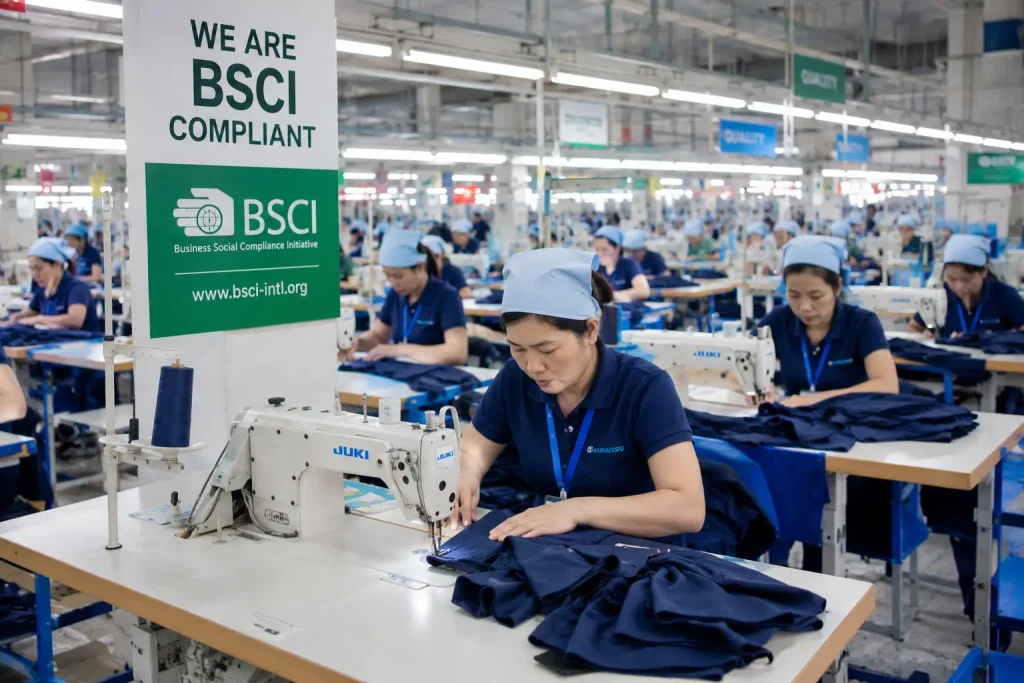
Comprehensive Sourcing Consultation Framework
Navigating global social compliance, EU trade regulations, and high-volume apparel production requires an experienced, reliable partner. ExploreTex bridges the gap between cost-efficiency and nearshore speed, backed by verified compliance tracking across our entire dual-hub infrastructure.
Whether your brand needs to scale mass production within a certified, high-volume facility or launch a rapid, premium nearshore capsule collection, our engineering teams are ready to optimize your supply chain. Contact our sourcing team today to request a detailed compliance portfolio or schedule a professional manufacturing consultation.
Request an ExploreTex B2B Sourcing Consultation
Conclusion: Securing Your Future with ExploreTex
The apparel industry is undergoing an irrevocable transformation. The days of chasing the lowest possible cost at the expense of human rights and environmental safety are over. Consumers demand transparency, and international law now requires it.
Transitioning your sourcing to a verified BSCI Compliant Garment Factory is the most critical strategic decision a supply chain architect can make in 2026. It protects your brand equity, shields you from catastrophic legal liabilities under the EU CSDDD, and ensures that your products are crafted by individuals who are respected, protected, and fairly compensated.
ExploreTex is more than just a manufacturer; we are your strategic partner in ethical global trade. By leveraging our Portuguese management expertise and the massive capabilities of our vertical BSCI Compliant Garment Factory in Bangladesh, we offer a sourcing solution that is resilient, transparent, and built for the future of apparel.
Ready to build a stronger, safer, and more ethical supply chain? Connect with our team today and discover the ExploreTex advantage. Visit our Home Page to start the conversation, or reach out to our team directly.